Attirement of the Bride is an example of Max Ernst’s veristic or illusionistic Surrealism, in which a traditional technique is applied to an incongruous or unsettling subject. The theatrical, evocative scene has roots in late nineteenth-century Symbolist painting, especially that of Gustave Moreau. It also echoes the settings and motifs of sixteenth-century German art. The willowy, swollen-bellied figure types recall those of Lucas Cranach the Elder in particular. The architectural backdrop with its strong contrast of light and shadow and its inconsistent perspective shows the additional influence of Giorgio de Chirico, whose work had overwhelmed Ernst when he first saw it in 1919.
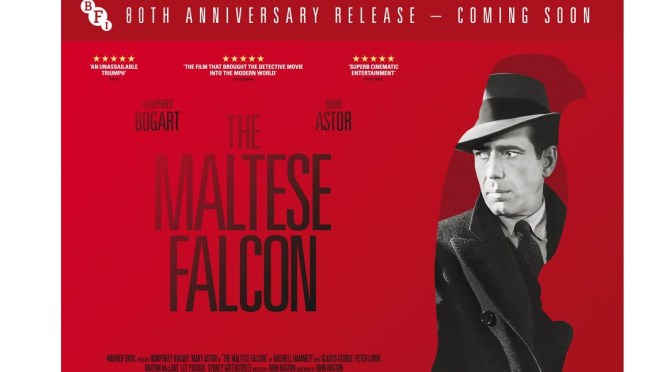
The new trailer for the landmark film noir starring Humphrey Bogart and directed by John Huston – back in cinemas UK-wide from 17 September to celebrate its 80th anniversary.
John Huston’s directorial debut, this year celebrating its 80th anniversary, turned Bogart into a major star. Adapted from Dashiell Hammett’s novel about a San Francisco detective’s investigations into the murder of his business partner, Huston’s snappily witty script retains the plot’s labyrinthine complexity while revelling in colourful characterisations of the villains Sam Spade encounters during his quest. Inspired casting includes Lorre as volatile Joel Cairo, Greenstreet as menacingly amiable Kasper Gutman, and Cook as his gunman. But it’s the fraught, febrile relationship between Bogart’s Spade and Mary Astor’s femme fatale – who persuaded his partner to take on her case – that shapes the deep, dark core of desire, doubt and duplicity pervading the film from beginning to memorable end.
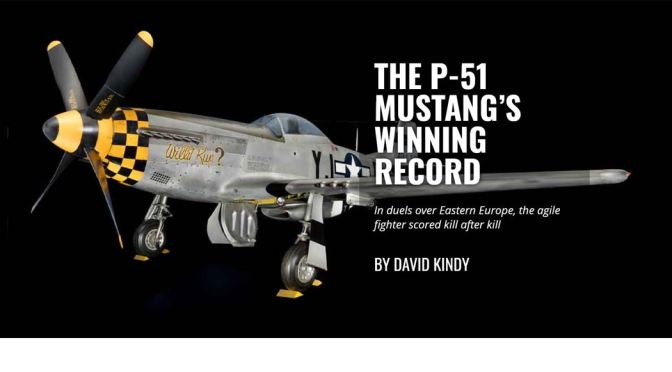
The P-51 was the darling of the Army Air Forces. Aerodynamically agile and acrobatic, the Mustang was fast and furious in its effectiveness in downing enemy aircraft. A latecomer to World War II, it first saw combat over Europe near the end of 1943. The long-range fighter proved to be just what the Allies needed to escort bombers to and from Germany as they hammered enemy targets.
Aug. 2, 2021, 6 a.m.
“In terms of the air war over Europe with the strategic bombing campaign, the P-51 was a war-winning weapon,” says Jeremy Kinney, associate director of research and curatorial affairs at the Smithsonian’s National Air and Space Museum. “As a fighter escort, it enabled the successful bombing of targets deep in Nazi Germany from bases in England and Italy. That was a crucial component in the destruction of strategic sites such as factories and munition plants.”
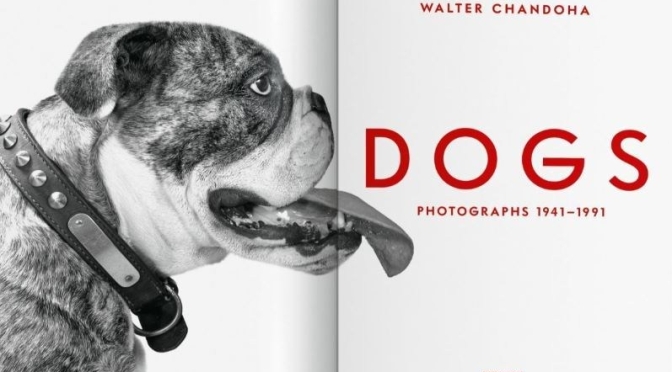
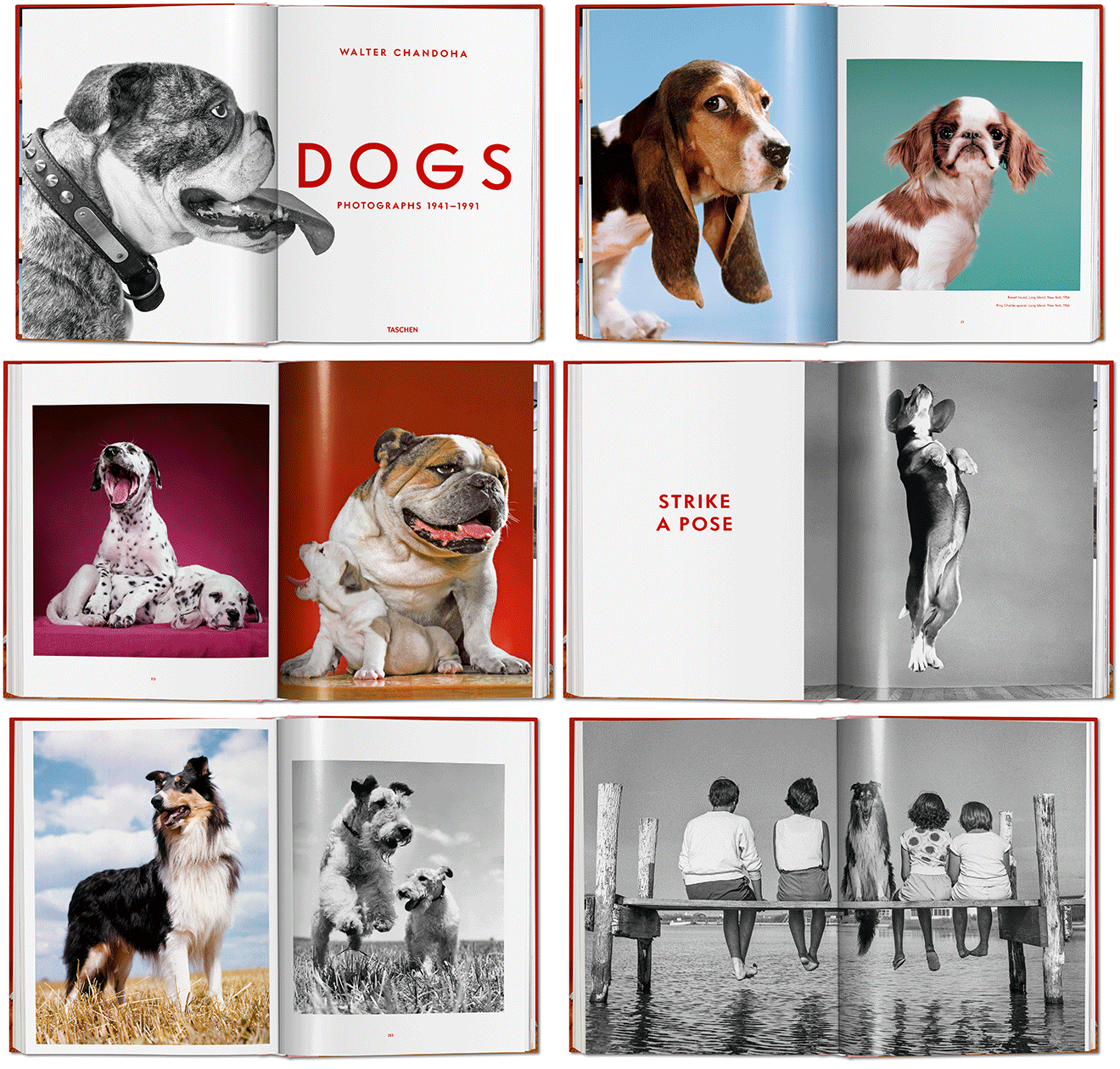
We see terriers, collies, beagles, bloodhounds, poodles, small dogs, big dogs, show dogs, working dogs, and many more, featuring over 60 breeds photographed in both black-and-white and glorious Kodachrome.
The world appears to be divided into cat and dog lovers, but fortunately Walter Chandoha, the 20th century’s greatest pet photographer found himself happily in the middle. He loved these intriguing creatures equally for their unique beauty and individualism, and as subjects to photograph in a career spanning over 70 years. While working on his critically acclaimed TASCHEN book Cats, Chandoha handpicked his favorite dog photos for a potential follow-up title, putting into carefully marked boxes hundreds of contact sheets, prints, and color transparencies, many unseen for at least 50 years, and some totally unseen.
Chandoha sadly passed away in 2019 at the age of 98, but his legacy lives on in this dashing sequel dedicated to man’s best friend. “Walter Chandoha’s photographs of dogs are compelling not just because dogs have an inherent charm, but because the person behind the camera was a master of his craft,” writes the photography critic Jean Dykstra in the book’s introduction.
Spanning a 50-year period, the book is divided into six sections, and each chapter reveals Chandoha’s exceptional combination of technique, versatility, and soul. The opening chapter “In the Studio” focuses on formal portraiture; next it’s “Strike a Pose” where our canine companions ham it up for the camera; in “Out and About” they get to roam and play, often photographed with Chandoha’s own children; next it’s “Best in Show” with Chandoha using his reportage skills to capture vintage dog shows from the Mad Men era; in “Tails from the City,” the dogs are hitting the streets of mid-century New York; and in the closing chapter “Country Dogs,” it’s back to nature, the fields, and the beaches. Dogs is an unleashed photographic tribute to these lovable and loyal creatures.
The photographer
Walter Chandoha(1920–2019) was a combat photographer in the Second World War, before a chance encounter with a cat led him on a path that would shape his professional career. He is regarded as the world’s greatest domestic animal photographer with a career spanning over seven decades and an archive of more than 200,000 photographs. His photographs have appeared on over 300 magazine covers, thousands of advertisements, and were regularly featured in magazines such as Life, Look, and their equivalents around the world.
The editor
Reuel Golden is the former editor of the British Journal of Photography and the Photography editor at TASCHEN. His TASCHEN titles include: Mick Rock: The Rise of David Bowie, both London and New York Portrait of a City books, Andy Warhol. Polaroids, The Rolling Stones, Her Majesty, Football in the 1970s, the National Geographic editions, and The David Bailey SUMO.
On this episode of Art Institute Essentials Tour, take a closer look at Nighthawks, painted by Edward Hopper in 1942. Inspired by “a restaurant on New York’s Greenwich Avenue where two streets meet,” Hopper’s painting, one of the best-known images of 20th-century art, has a timeless, universal quality that transcends locale.
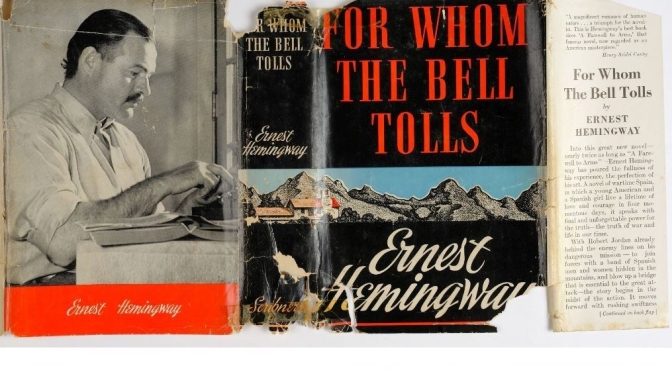
The first three chapters of Ernest Hemingway’s classic novel.
For Whom the Bell Tolls is a novel by Ernest Hemingway published in 1940. It tells the story of Robert Jordan, a young American volunteer attached to a Republican guerrilla unit during the Spanish Civil War. As a dynamiter, he is assigned to blow up a bridge during an attack on the city of Segovia.
It was published just after the end of the Spanish Civil War (1936–1939), whose general lines were well known at the time. It assumes the reader knows that the war was between a democratically elected, pro-working-class and anti-Catholic government, supported by the Soviet Union, which many foreigners like Robert went to Spain to help, and a successful, dictatorial, Catholic, pro-landowner revolt, supported by Nazi Germany and Fascist Italy. It was commonly viewed as the dress rehearsal for the Second World War. In 1940, the year the book was published, the United States had not yet entered the war, which had begun on Sept. 1, 1939, with Nazi Germany’s invasion of Poland.
The novel is regarded as one of Hemingway’s best works, along with The Sun Also Rises, A Farewell to Arms, and The Old Man and the Sea.
Ernest Miller Hemingway (July 21, 1899 – July 2, 1961) was an American journalist, novelist, short-story writer, and sportsman. His economical and understated style—which he termed the iceberg theory—had a strong influence on 20th-century fiction, while his adventurous lifestyle and his public image brought him admiration from later generations. Hemingway produced most of his work between the mid-1920s and the mid-1950s, and he won the Nobel Prize in Literature in 1954. He published seven novels, six short-story collections, and two nonfiction works. Three of his novels, four short-story collections, and three nonfiction works were published posthumously. Many of his works are considered classics of American literature.
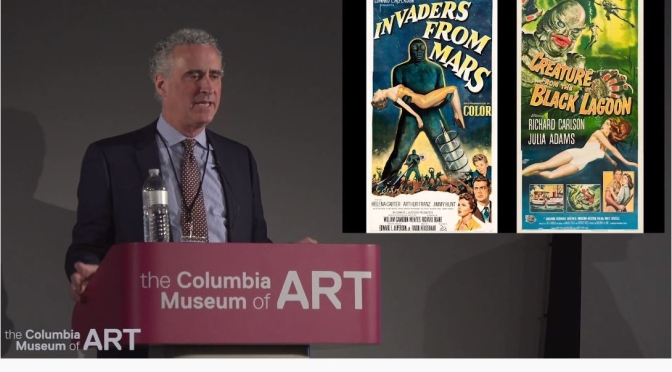
Recorded February 14, 2020 at the Columbia Museum of Art.
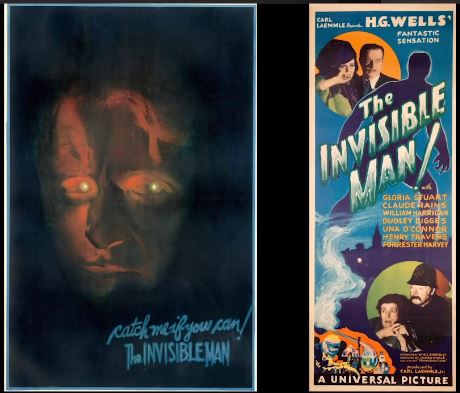
Daniel Finamore, curator of It’s Alive! Classic Horror and Sci-Fi Art from the Kirk Hammett Collection talks about the exhibition and where these posters fit into the canon of art history. Finamore is the curator of Maritime Art and History at the Peabody Essex Museum. Best known as lead guitarist of the famed rock band Metallica, Kirk Hammett is also an obsessive collector of visually arresting horror and sci-fi film art and has dedicated the last three decades to creating one of the world’s most important collections.
It’s Alive! features more than 100 pieces of graphic art, many hailing back to the days of Boris Karloff and Bela Lugosi, that have seeped into the public imagination and reflected society’s deepest fears and anxieties for nearly a century. Not only do these objects explore the power of graphic art in its own right, they have inspired Hammett’s work throughout his own artistic career.
Organized by the Peabody Essex Museum, Salem, Massachusetts.
Packard Super Eight was the name given to the larger of the two eight-cylinder luxury automobiles produced by the Packard Motor Car Company of Detroit, Michigan. It shared frames and some body types with the top model Packard Twelve. Following the discontinuation of the Seventeenth Series Packard Twelve after the 1939 model year, a new Super Eight One-Eighty was derived from the Super Eight as the new top car range. The Super Eight was renamed the Packard Super Eight One-Sixty.
After 1942, Packard concentrated on the new Clipper styling that was developed for an upper-class sedan the previous year. There were Super Clippers and Custom Super Clipper in the One-Sixty and One-Eighty tradition until 1947. After a heavy facelift, the name Clipper was dropped. The most senior Super Eight One-Eighty became the Custom Eight, while its slightly lower-priced sibling, the Super Eight One-Sixty, once again became simply the Super Eight. Clipper Custom Super Eights and Custom Eights were very close relatives to their respective Super models, distinguished outside by the lack of an eggcrate grille and small rear chrome trim moulding under the trunk lid on Supers. In 1949, a new Super Eight Deluxe was added to the line. This car had also the Custom Eight’s eggcrate grille, but not the rear trim.
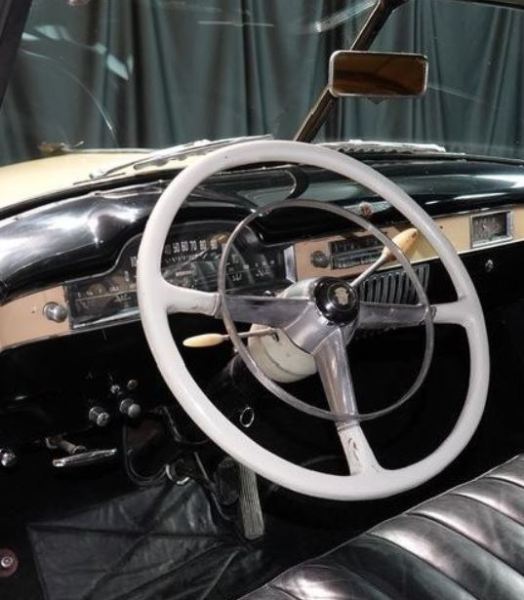
The Cadillac Series 62 is a series of cars which was produced by Cadillac from 1940 through 1964. Originally designed to replace the entry level Series 65, it became the Cadillac Series 6200 in 1959, and remained that until it was renamed to Cadillac Calais for the 1965 model year. The Series 62 was also marketed as the Sixty-Two and the Series Sixty-Two.
The Cadillac Series 62 Coupe de Ville was introduced late in the 1949 model year. Along with the Buick Roadmaster Riviera, and the Oldsmobile 98 Holiday, it was among the first pillarless hardtop coupes ever produced.mAt $3,496 it was only a dollar less than the Series 62 convertible, and like the convertible, it came with power windows standard. It was luxuriously trimmed, with leather upholstery and chrome ‘bows’ in the headliner to simulate the ribs of a convertible top.
55,643 Series 62 Cadillacs were produced in 1949 out of a total volume of 92,554 vehicles.







 of art history. Finamore is the curator of Maritime Art and History at the Peabody Essex Museum. Best known as lead guitarist of the famed rock band Metallica, Kirk Hammett is also an obsessive collector of visually arresting horror and sci-fi film art and has dedicated the last three decades to creating one of the world’s most important collections.
 Packard Super Eight was the name given to the larger of the two eight-cylinder luxury automobiles produced by the Packard Motor Car Company of Detroit, Michigan. It shared frames and some body types with the top model Packard Twelve. Following the discontinuation of the Seventeenth Series Packard Twelve after the 1939 model year, a new Super Eight One-Eighty was derived from the Super Eight as the new top car range. The Super Eight was renamed the Packard Super Eight One-Sixty.
 After 1942, Packard concentrated on the new Clipper styling that was developed for an upper-class sedan the previous year. There were Super Clippers and Custom Super Clipper in the One-Sixty and One-Eighty tradition until 1947. After a heavy facelift, the name Clipper was dropped. The most senior Super Eight One-Eighty became the Custom Eight, while its slightly lower-priced sibling, the Super Eight One-Sixty, once again became simply the Super Eight. Clipper Custom Super Eights and Custom Eights were very close relatives to their respective Super models, distinguished outside by the lack of an eggcrate grille and small rear chrome trim moulding under the trunk lid on Supers. In 1949, a new Super Eight Deluxe was added to the line. This car had also the Custom Eight’s eggcrate grille, but not the rear trim.
 The Cadillac Series 62 is a series of cars which was produced by Cadillac from 1940 through 1964. Originally designed to replace the entry level Series 65, it became the Cadillac Series 6200 in 1959, and remained that until it was renamed to Cadillac Calais for the 1965 model year. The Series 62 was also marketed as the Sixty-Two and the Series Sixty-Two.
 Boomers Daily