The casa grande could be an ancient chalet in the Austrian Tyrol. A steeply gabled roof to slough off the winter snow, dandelion-yellow paintwork, and inside a treasure trove of all an outdoorsman loves. Antlers jostle for space on every wall. There is a tack room thick with the leathery tang of saddles, a bathroom
Colm Tóibín explores the art of short story writing
hen I was 20 and tentatively trying to write, every single person I knew read Ian McEwan’s First Love, Last Rites (1975). It not only gave the short story a good name, but it also gave writing a good name. It was like a punk moment converted into fiction. People used the word “macabre,” but there was a sort of excitement about the characters, the strangeness of the stories, the shortness of some of the stories and just how much contemporary urban life was in them.
It’s a popular phrase on X, usually in response to someone accomplishing something remarkable, taken to mean that there’s nothing stopping you from doing something out of the ordinary. SpaceX might post video of a rocket landing – “you can just do things.” Victor Vescovo might be the living embodiment of the phrase.
My first introduction to Vescovo was an email from him, extending an invitation to be a guest at his table for the Explorers Club Annual Dinner. The name was vaguely familiar to me but didn’t immediately register. Who was this mysterious correspondent?
The US-Israeli war against Iran, far from encouraging a popular uprising, has strengthened the regime’s grip and set back the cause of Iranian freedom indefinitely.
In Everthing Is Now, J. Hoberman chronicles a radical avant-garde’s attempts to jostle New York City out of its postwar complacency and moral retrenchment.
Everything Is Now: The 1960s New York Avant-Garde—Primal Happenings, Underground Movies, Radical Pop by J. Hoberman
Walter Lippmann was the most influential political commentator of his generation, but behind his preternatural confidence was a far more complicated and unsettled character.
Walter Lippmann: An Intellectual Biography by Tom Arnold-Forster
It’s fair to say that the Guardian Weekly does not cover many royal visits, but King Charles III’s US state visit was the most consequential of his reign so far. The king’s ostensible purpose was to celebrate America’s 250 years of independence but last week’s trip was freighted with other agendas, most important of which was to flatter his host, Donald Trump. Washington bureau chief David Smith’s cover story shows how “like a rapier wrapped in ermine, Charles managed to tame Trump while rebuking Trumpism”. Both David and our veteran foreign affairs commentator Simon Tisdall unpick the skill with which Charles spoke truth to this capricious and egotistical president and gave both sides of the heavily divided Congress much to praise. It was a performance of high diplomacy at a time of huge tension in the transatlantic relationship and beyond.
But the charm didn’t wash in New York where, as Adam Gabbatt’s sketch shows, the shadow of Jeffrey Epstein and Andrew Mountbatten-Windsor, Charles’s disgraced brother, lurked while the mayor, Zohran Mamdani, brought up the spectre of colonialism in the shape of the Koh-i-noor diamond, snatched under disputed circumstances.
Spotlight | A small town in Germany Landstuhl, the heart of the largest American military community outside the US, considers its future after Donald Trump’s decision to withdraw 5,000 troops, reports Deborah Cole
Environment | A gift of wings Patrick Barkham takes off for a flight of wonder with The Lost Words duo, who have reunited for a new book on endangered birds
Feature | A balm for tiger mother myths Rebecca Liu explores why a certain image of the tiger mum – strict, cold and demanding – is ubiquitous in popular culture
Opinion | Antiracists need to stand up for us all Another attack on the UK’s Jewish population demands a clear show of solidarity from those who march to protect minorities, argues Jonathan Freedland
Culture | Moose magic on the loose How do cameras capture Sweden’s seasonal TV hit, the Great Moose Migration? Malcolm Jack travels to an uninhabited island in the Ångerman river to ask the show’s makers
Donald Trump’s aversion to admitting fault suggests that we will not likely see events that grapple with the nuanced nature of the nation’s history this July 4th. By Jelani Cobb
Was the Declaration of Independence Better Before the Edits?
Amid contention, criticism, and compromise, a divided nation had to present a unified front. It came at a cost. By Jill Lepore
Barack Obama Considers His Role in the Age of Trump
The former President remains one of the most popular politicians in the country. What are his obligations to it?
“The Consolidation of Collections: New Light on the 18th-Century British Art Market” An in-depth study by the editorial team and guest contributors exploring how major British estates restructured their private galleries during the mid-1700s. The article utilizes newly discovered ledger books to trace the provenance of several key Italian Baroque works.
“Paolo Veneziano and the International Gothic in Venice” Following the research trends seen in the early part of the year, this feature provides a technical analysis of recently restored altarpieces attributed to Veneziano, focusing on the use of ultramarine and gold leaf techniques that defined the Venetian style in the 14th century.
“Nicholas Lanier and the ‘Star’ Drawings: New Discoveries” Building on recent scholarship (featured in related symposiums), this article identifies several previously unrecognized drawings from the collection of Nicholas Lanier (1588–1666). It specifically examines the “star-shaped marks” used by Lanier and his uncle Jerome to catalog their sixteenth-century Italian acquisitions.
Editorial and Shorter Notices Editorial: “The Future of Art History in the Digital Age” Editor Christopher Baker discusses the balance between traditional archival research and the integration of AI and digital imaging in art historical authentication.
Object in Focus: “George Frederic Watts’s Satan (1847)” A specialized notice providing a new interpretation of Watts’s massive canvas. The author argues that the figure’s pose was inspired by the Monte Cavallo Horse Tamers in Rome rather than the Apollo Belvedere, as previously thought.
Exhibition and Book Reviews The Farnese Gallery Drawings (Musée du Louvre, Paris): A critical review by Ketty Gottardo on the exhibition focusing on the Carracci brothers’ preparatory works.
Studio Prints: A History, 1968–2011: A review of the new publication by Paul Holberton Publishing, detailing the impact of the London workshop on 20th-century printmaking.
Modernizing the Catalog: A review of the Patek Philippe exhibition and the intersection of fine horology with decorative arts history.
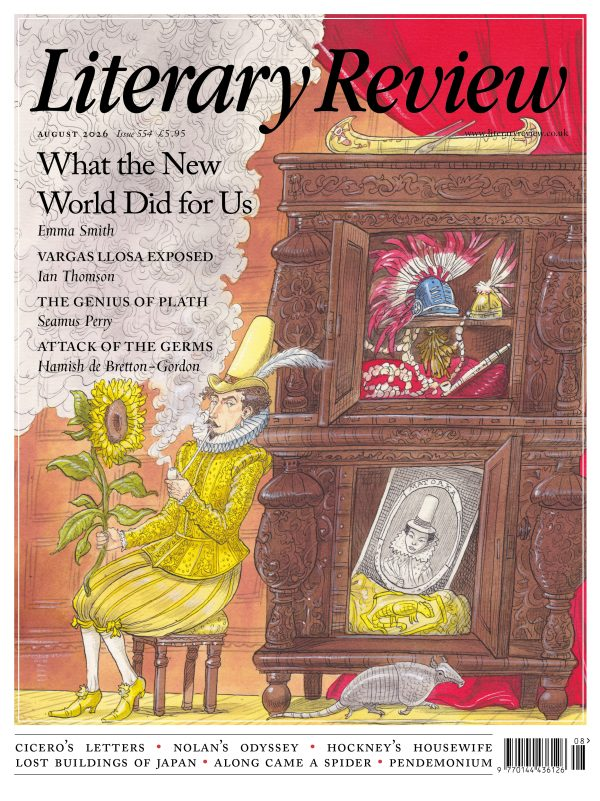
LITERARY REVIEW : The latest issue featuresRitchie Robertson on Weimar * Charles Darwent on Louise Bourgeois * John Guy on the Tudors * Kirsten Tambling on dogs in art * Piers Brendon on Churchill and the crown * Saul David on AI warfare * Simon Nixon on private equity predators * Nigel Andrew on outsider animals * Zoe Guttenplan on Beatrice Warde * Maren Meinhardt on women and music * Lucy Lethbridge on swimming * Diane Purkiss on being published * Anthony Pagden on the West * Michael Reid on Lula * Anthony Teasdale on Tory leaders * Anna Reid on Vera Gedroits * Wendy Holden on Elizabeth II * Harriet Rix on trees * Emma Smith on Shakespeare’s identity * Jane Yager on Herta Müller * Sheena Joughin on Siri Hustvedt * Adam Kucharski on evidence * Keith Miller on Douglas Stuart * Natalie Perman on Jem Calder * and much, much more…
Weimar Germany: Death of a Democracy By Victor Sebestyen
Weimar: Life on the Edge of Catastrophe By Katja Hoyer
The small town of Weimar is overladen with historical associations. Goethe spent more than fifty years there as an employee and friend of Duke (later Grand Duke) Karl August. After the last grand duke abdicated in November 1918, the National Assembly met in Weimar to draw up a new republican constitution for Germany. Other symbolically charged venues considered were Nuremberg (home of Dürer) and Bayreuth (because of Wagner), but it was Weimar that gave its name to the period of German history from …
Having been named for her father, Louis, a mere dealer in antique tapestries, seemed insufficiently romantic to Louise Bourgeois, who was born on Christmas Day in 1911. She preferred the idea that her namesake was Louise Michel, ‘the red virgin of Montmartre’, an anarchist heroine of the Paris Commune. It wasn’t true, of course, but …
A phrase like ‘fortress England’ seems to echo down the centuries, and turns up again in This Little World, Nandini Das’s new study of identity and belonging, cross-border migration, assimilation and estrangement in the period between 1500 and the restoration of Charles II. Das seeks to unmask the period’s most fundamental assumptions about English … read more