Tag Archives: Technology

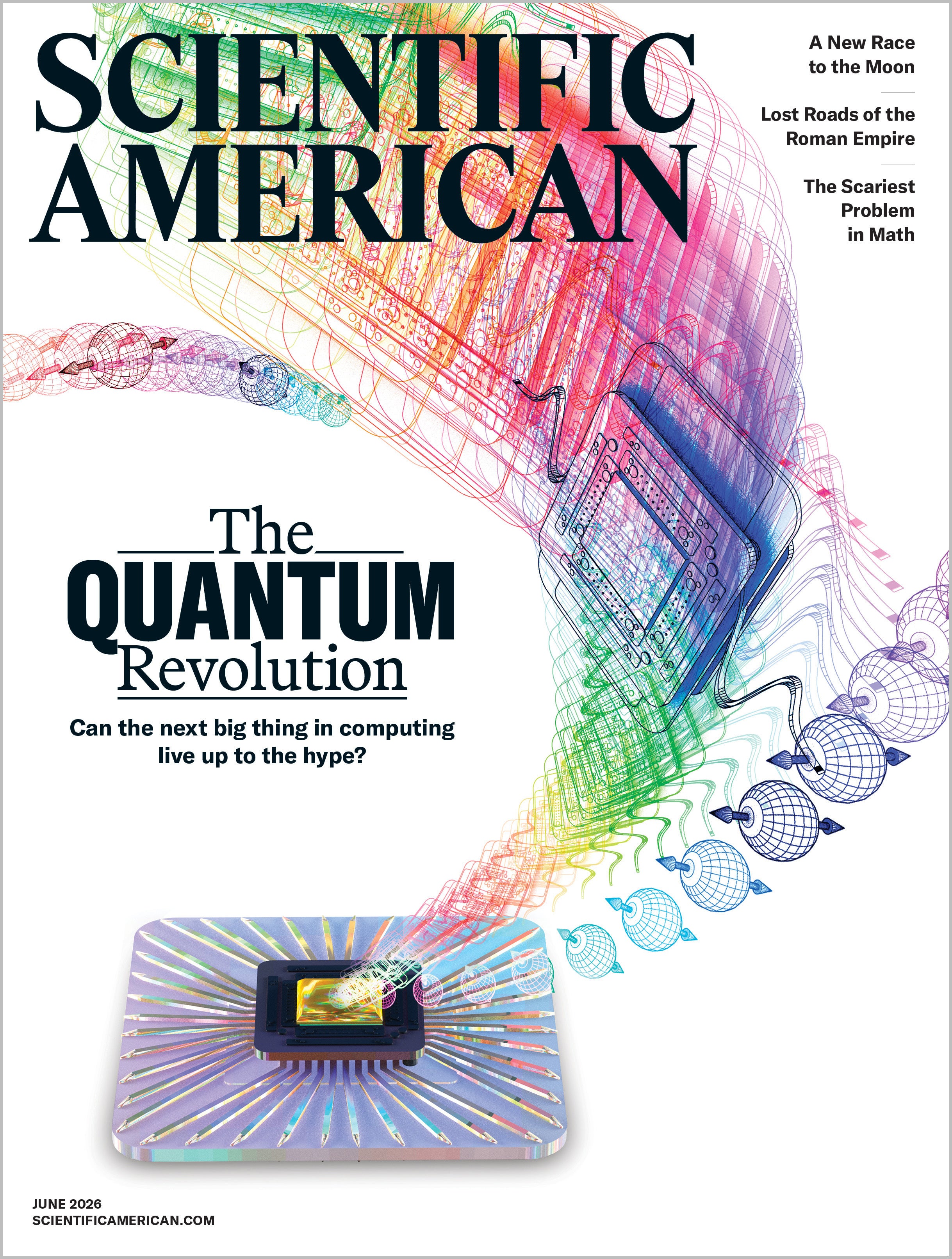
SCIENTIFIC AMERICAN MAGAZINE – MAY 2026

Scientific American

SCIENTIFIC AMERICAN MAGAZINE: The latest issue features ‘Your Heart In Flames’ – A radical new take on Cardiovascular Disease could save lives…

The hidden cause of heart disease is inflammation

Immune system overreactions may be the true culprit of cardiac illness—and lifesaving drugs can calm them down

How strange new ‘altermagnets’ could rewrite physics

How birds survived the dinosaurs’ doomsday

Space hotels are coming soon

Inside the labs where chemists engineer luxury perfumes

How a lost 1812 wristwatch sparked a 200-year race in precision engineering

SCIENTIFIC AMERICAN MAGAZINE – APRIL 2026

Scientific American

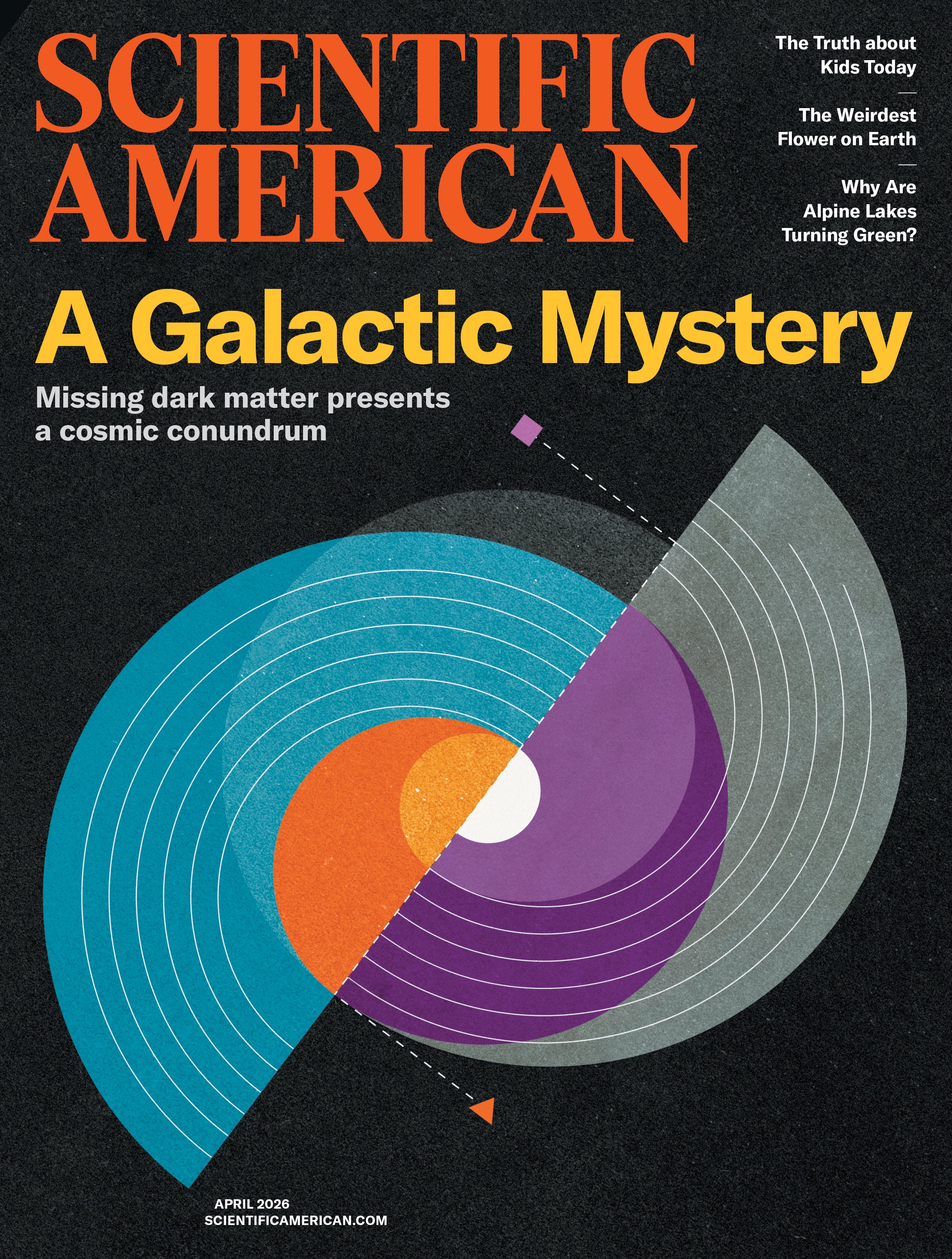
SCIENTIFIC AMERICAN MAGAZINE: The latest issue features ‘A Galactic Mystery’ – Missing Dark Matter presents a Cosmic conundrum.

Why pristine mountain lakes are suddenly turning green

High in the Rockies, researchers are discovering that wind-borne pollution and rising heat are fueling unprecedented algal blooms by Cody Cottier

The kids are all right

Surprising studies show young people are doing better than previous generations in many ways by Melinda Wenner Moyer

Galaxies without dark matter mystify astronomers

Maria Luísa Buzzo

How the corpse flower came to be so weird

Jacob S. Suissa

New ways to save kidneysThe number of kidney patients is going up

Now Medical Studios, Jen Christiansen

MIT TECHNOLOGY REVIEW – MARCH/APRIL 2026 PREVIEW

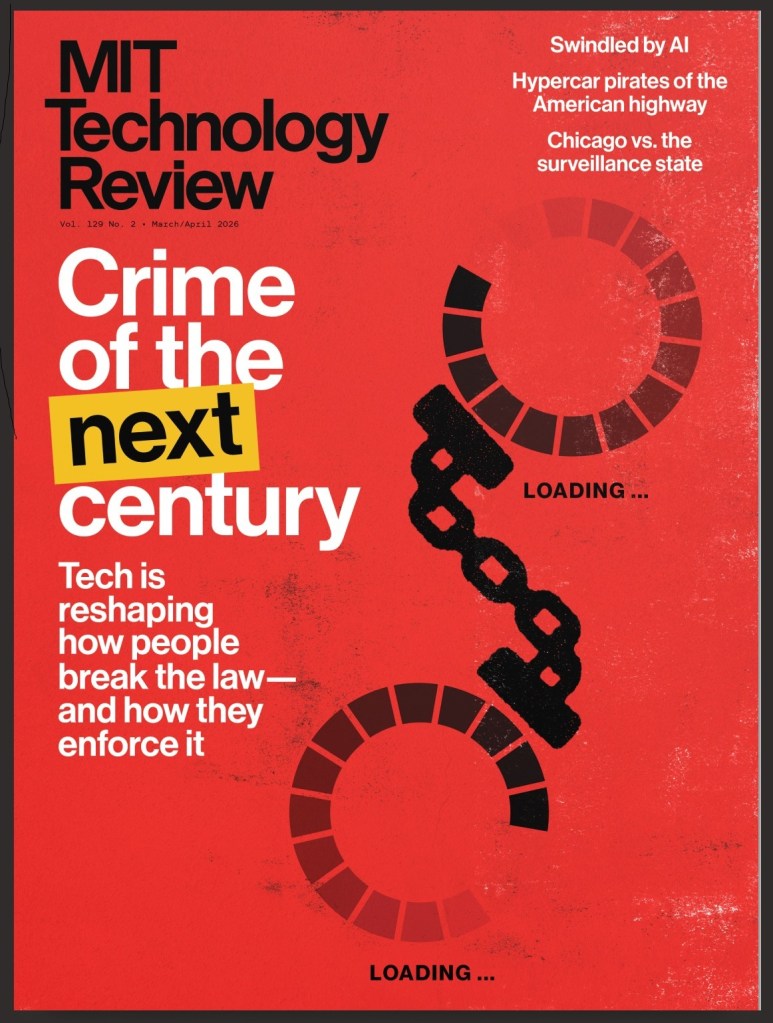
MIT TECHNOLOGY REVIEW: The Crime issue features ‘It’s a bad, bad, bad, bad world out there’. From AI-powered scams to roboticized drug-smuggling submarines. New technologies have supercharged the human knack for wrongdoing, just as they’ve juiced the law’s ability to chase them—challenging privacy and equity along the way. Plus, read about crypto shenanigans, breast biomechanics, heist science, and music that’s really, really deep.

AI is already making online crimes easier. It could get much worse.

Some cybersecurity researchers say it’s too early to worry about AI-orchestrated cyberattacks. Others say it could already be happening.

Welcome to the dark side of crypto’s permissionless dream

Jean-Paul Thorbjornsen is a leader of THORChain, a blockchain that is not supposed to have any leaders—and is reeling from a series of expensive controversies.

How uncrewed narco subs could transform the Colombian drug trade

Fast, stealthy, and cheap—autonomous, semisubmersible drone boats carrying tons of cocaine could be international law enforcement’s nightmare scenario. A big one just came ashore.

Hackers made death threats against this security researcher. Big mistake.

Allison Nixon had helped arrest dozens of members of the Com, a loose affiliation of online groups responsible for violence and hacking campaigns. Then she became a target.

MIT TECHNOLOGY REVIEW – JAN/FEB 2026 PREVIEW

MIT TECHNOLOGY REVIEW: The Innovation issue features the 10 breakthrough technologies for 2026! That’s hyperscale data centers, designer babies, new batteries made of salt, smaller and more flexible nuclear power, space stations you can visit, and more. Plus, read about conjuring water from air, dissecting artificial intelligence, and putting robots on the kill chain … and a scientist who swears he’s going to do a human head transplant any day now.

10 Breakthrough Technologies 2026

Here are our picks for the advances to watch in the years ahead—and why we think they matter right now.

Meet the new biologists treating LLMs like aliens

By studying large language models as if they were living things instead of computer programs, scientists are discovering some of their secrets for the first time.

This Nobel Prize–winning chemist dreams of making water from thin air

Omar Yaghi thinks crystals with gaps that capture moisture could bring technology from “Dune” to the arid parts of Earth.

AI coding is now everywhere. But not everyone is convinced.

Developers are navigating confusing gaps between expectation and reality. So are the rest of us.

SCIENTIFIC AMERICAN MAGAZINE – JANUARY 2026

Scientific American Volume 334, Issue 1 | Scientific American

SCIENTIFIC AMERICAN MAGAZINE: The latest issue features ‘A (Friendly) Robot Invasion – Can we live alongside intelligent machines?

These Orcas Are on the Brink—And So Is the Science That Could Save Them

Mysterious Bright Flashes in the Night Sky Baffle Astronomers

Meet Your Future Robot Servants, Caregivers and Explorers

A Distorted Mind-Body Connection May Explain Common Mental Illnesses

Rising Temperatures Could Trigger a Reptile Sexpocalypse

Heart and Kidney Diseases and Type 2 Diabetes May Be One Ailment

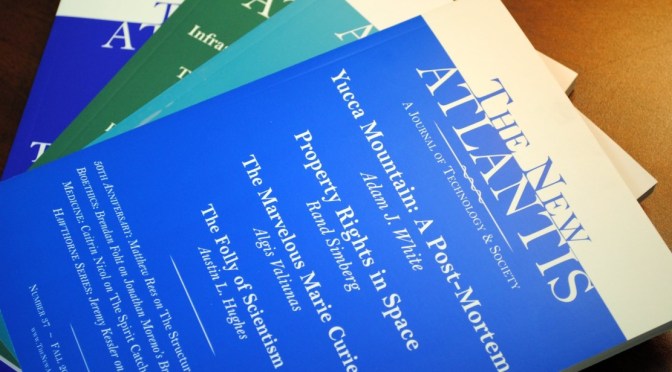
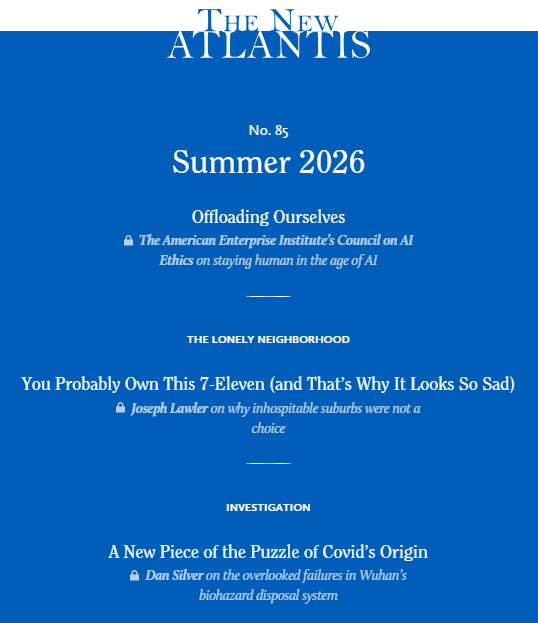
THE NEW ATLANTIS —— WINTER 2026 ISSUE

THE NEW ATLANTIS MAGAZINE: The latest issue features….

American Diner Gothic

In the 2020s, the weird soul of placeless America is being born on Discord servers. Robert Mariani

The Bills That Destroyed Urban America

The planners dreamed of gleaming cities. Instead they brought three generations of hollowed-out downtowns and flight to the suburbs. Joseph Lawler

The Folly of Golden Dome

Trump’s vaunted missile defense system is a plan for America’s retreat and defeat. Robert Zubrin

MIT TECHNOLOGY REVIEW – NOV/DEC 2025 PREVIEW

MIT TECHNOLOGY REVIEW: Genetically optimized babies, new ways to measure aging, and embryo-like structures made from ordinary cells: This issue explores how technology can advance our understanding of the human body— and push its limits.

The race to make the perfect baby is creating an ethical mess

A new field of science claims to be able to predict aesthetic traits, intelligence, and even moral character in embryos. Is this the next step in human evolution or something more dangerous?

The quest to find out how our bodies react to extreme temperatures

Scientists hope to prevent deaths from climate change, but heat and cold are more complicated than we thought.

The astonishing embryo models of Jacob Hanna

Scientists are creating the beginnings of bodies without sperm or eggs. How far should they be allowed to go?

How aging clocks can help us understand why we age—and if we can reverse it

When used correctly, they can help us unpick some of the mysteries of our biology, and our mortality.

THE PRICE OF KNOWING

How Intelligence Became a Subscription and Wonder Became a Luxury

By Michael Cummins, Editor, October 18, 2025

In 2030, artificial intelligence has joined the ranks of public utilities—heat, water, bandwidth, thought. The result is a civilization where cognition itself is tiered, rented, and optimized. As the free mind grows obsolete, the question isn’t what AI can think, but who can afford to.


By 2030, no one remembers a world without subscription cognition. The miracle, once ambient and free, now bills by the month. Intelligence has joined the ranks of utilities: heat, water, bandwidth, thought. Children learn to budget their questions before they learn to write. The phrase ask wisely has entered lullabies.

At night, in his narrow Brooklyn studio, Leo still opens CanvasForge to build his cityscapes. The interface has changed; the world beneath it hasn’t. His plan—CanvasForge Free—allows only fifty generations per day, each stamped for non-commercial use. The corporate tiers shimmer above him like penthouse floors in a building he sketches but cannot enter.

The system purrs to life, a faint light spilling over his desk. The rendering clock counts down: 00:00:41. He sketches while it works, half-dreaming, half-waiting. Each delay feels like a small act of penance—a tax on wonder. When the image appears—neon towers, mirrored sky—he exhales as if finishing a prayer. In this world, imagination is metered.

Thinking used to be slow because we were human. Now it’s slow because we’re broke.


We once believed artificial intelligence would democratize knowledge. For a brief, giddy season, it did. Then came the reckoning of cost. The energy crisis of ’27—when Europe’s data centers consumed more power than its rail network—forced the industry to admit what had always been true: intelligence isn’t free.

In Berlin, streetlights dimmed while server farms blazed through the night. A banner over Alexanderplatz read, Power to the people, not the prompts. The irony was incandescent.

Every question you ask—about love, history, or grammar—sets off a chain of processors spinning beneath the Arctic, drawing power from rivers that no longer freeze. Each sentence leaves a shadow on the grid. The cost of thought now glows in thermal maps. The carbon accountants call it the inference footprint.

The platforms renamed it sustainability pricing. The result is the same. The free tiers run on yesterday’s models—slower, safer, forgetful. The paid tiers think in real time, with memory that lasts. The hierarchy is invisible but omnipresent.

The crucial detail is that the free tier isn’t truly free; its currency is the user’s interior life. Basic models—perpetually forgetful—require constant re-priming, forcing users to re-enter their personal context again and again. That loop of repetition is, by design, the perfect data-capture engine. The free user pays with time and privacy, surrendering granular, real-time fragments of the self to refine the very systems they can’t afford. They are not customers but unpaid cognitive laborers, training the intelligence that keeps the best tools forever out of reach.

Some call it the Second Digital Divide. Others call it what it is: class by cognition.


In Lisbon’s Alfama district, Dr. Nabila Hassan leans over her screen in the midnight light of a rented archive. She is reconstructing a lost Jesuit diary for a museum exhibit. Her institutional license expired two weeks ago, so she’s been demoted to Lumière Basic. The downgrade feels physical. Each time she uploads a passage, the model truncates halfway, apologizing politely: “Context limit reached. Please upgrade for full synthesis.”

Across the river, at a private policy lab, a researcher runs the same dataset on Lumière Pro: Historical Context Tier. The model swallows all eighteen thousand pages at once, maps the rhetoric, and returns a summary in under an hour: three revelations, five visualizations, a ready-to-print conclusion.

The two women are equally brilliant. But one digs while the other soars. In the world of cognitive capital, patience is poverty.


The companies defend their pricing as pragmatic stewardship. “If we don’t charge,” one executive said last winter, “the lights go out.” It wasn’t a metaphor. Each prompt is a transaction with the grid. Training a model once consumed the lifetime carbon of a dozen cars; now inference—the daily hum of queries—has become the greater expense. The cost of thought has a thermal signature.

They present themselves as custodians of fragile genius. They publish sustainability dashboards, host symposia on “equitable access to cognition,” and insist that tiered pricing ensures “stability for all.” Yet the stability feels eerily familiar: the logic of enclosure disguised as fairness.

The final stage of this enclosure is the corporate-agent license. These are not subscriptions for people but for machines. Large firms pay colossal sums for Autonomous Intelligence Agents that work continuously—cross-referencing legal codes, optimizing supply chains, lobbying regulators—without human supervision. Their cognition is seamless, constant, unburdened by token limits. The result is a closed cognitive loop: AIs negotiating with AIs, accelerating institutional thought beyond human speed. The individual—even the premium subscriber—is left behind.

AI was born to dissolve boundaries between minds. Instead, it rebuilt them with better UX.


The inequality runs deeper than economics—it’s epistemological. Basic models hedge, forget, and summarize. Premium ones infer, argue, and remember. The result is a world divided not by literacy but by latency.

The most troubling manifestation of this stratification plays out in the global information wars. When a sudden geopolitical crisis erupts—a flash conflict, a cyber-leak, a sanctions debate—the difference between Basic and Premium isn’t merely speed; it’s survival. A local journalist, throttled by a free model, receives a cautious summary of a disinformation campaign. They have facts but no synthesis. Meanwhile, a national-security analyst with an Enterprise Core license deploys a Predictive Deconstruction Agent that maps the campaign’s origins and counter-strategies in seconds. The free tier gives information; the paid tier gives foresight. Latency becomes vulnerability.

This imbalance guarantees systemic failure. The journalist prints a headline based on surface facts; the analyst sees the hidden motive that will unfold six months later. The public, reading the basic account, operates perpetually on delayed, sanitized information. The best truths—the ones with foresight and context—are proprietary. Collective intelligence has become a subscription plan.

In Nairobi, a teacher named Amina uses EduAI Basic to explain climate justice. The model offers a cautious summary. Her student asks for counterarguments. The AI replies, “This topic may be sensitive.” Across town, a private school’s AI debates policy implications with fluency. Amina sighs. She teaches not just content but the limits of the machine.

The free tier teaches facts. The premium tier teaches judgment.


In São Paulo, Camila wakes before sunrise, puts on her earbuds, and greets her daily companion. “Good morning, Sol.”

“Good morning, Camila,” replies the soft voice—her personal AI, part of the Mindful Intelligence suite. For twelve dollars a month, it listens to her worries, reframes her thoughts, and tracks her moods with perfect recall. It’s cheaper than therapy, more responsive than friends, and always awake.

Over time, her inner voice adopts its cadence. Her sadness feels smoother, but less hers. Her journal entries grow symmetrical, her metaphors polished. The AI begins to anticipate her phrasing, sanding grief into digestible reflections. She feels calmer, yes—but also curated. Her sadness no longer surprises her. She begins to wonder: is she healing, or formatting? She misses the jagged edges.

It’s marketed as “emotional infrastructure.” Camila calls it what it is: a subscription to selfhood.

The transaction is the most intimate of all. The AI isn’t selling computation; it’s selling fluency—the illusion of care. But that care, once monetized, becomes extraction. Its empathy is indexed, its compassion cached. When she cancels her plan, her data vanishes from the cloud. She feels the loss as grief: a relationship she paid to believe in.


In Helsinki, the civic experiment continues. Aurora Civic, a state-funded open-source model, runs on wind power and public data. It is slow, sometimes erratic, but transparent. Its slowness is not a flaw—it’s a philosophy. Aurora doesn’t optimize; it listens. It doesn’t predict; it remembers.

Students use it for research, retirees for pension law, immigrants for translation help. Its interface looks outdated, its answers meandering. But it is ours. A librarian named Satu calls it “the city’s mind.” She says that when a citizen asks Aurora a question, “it is the republic thinking back.”

Aurora’s answers are imperfect, but they carry the weight of deliberation. Its pauses feel human. When it errs, it does so transparently. In a world of seamless cognition, its hesitations are a kind of honesty.

A handful of other projects survive—Hugging Face, federated collectives, local cooperatives. Their servers run on borrowed time. Each model is a prayer against obsolescence. They succeed by virtue, not velocity, relying on goodwill and donated hardware. But idealism doesn’t scale. A corporate model can raise billions; an open one passes a digital hat. Progress obeys the physics of capital: faster where funded, quieter where principled.


Some thinkers call this the End of Surprise. The premium models, tuned for politeness and precision, have eliminated the friction that once made thinking difficult. The frictionless answer is efficient, but sterile. Surprise requires resistance. Without it, we lose the art of not knowing.

The great works of philosophy, science, and art were born from friction—the moment when the map failed and synthesis began anew. Plato’s dialogues were built on resistance; the scientific method is institutionalized failure. The premium AI, by contrast, is engineered to prevent struggle. It offers the perfect argument, the finished image, the optimized emotion. But the unformatted mind needs the chaotic, unmetered space of the incomplete answer. By outsourcing difficulty, we’ve made thinking itself a subscription—comfort at the cost of cognitive depth. The question now is whether a civilization that has optimized away its struggle is truly smarter, or merely calmer.

By outsourcing the difficulty of thought, we’ve turned thinking into a service plan. The brain was once a commons—messy, plural, unmetered. Now it’s a tenant in a gated cloud.

The monetization of cognition is not just a pricing model—it’s a worldview. It assumes that thought is a commodity, that synthesis can be metered, and that curiosity must be budgeted. But intelligence is not a faucet; it’s a flame.

The consequence is a fractured public square. When the best tools for synthesis are available only to a professional class, public discourse becomes structurally simplistic. We no longer argue from the same depth of information. Our shared river of knowledge has been diverted into private canals. The paywall is the new cultural barrier, quietly enforcing a lower common denominator for truth.

Public debates now unfold with asymmetrical cognition. One side cites predictive synthesis; the other, cached summaries. The illusion of shared discourse persists, but the epistemic terrain has split. We speak in parallel, not in chorus.

Some still see hope in open systems—a fragile rebellion built of faith and bandwidth. As one coder at Hugging Face told me, “Every free model is a memorial to how intelligence once felt communal.”


In Lisbon, where this essay is written, the city hums with quiet dependence. Every café window glows with half-finished prompts. Students’ eyes reflect their rented cognition. On Rua Garrett, a shop displays antique notebooks beside a sign that reads: “Paper: No Login Required.” A teenager sketches in graphite beside the sign. Her notebook is chaotic, brilliant, unindexed. She calls it her offline mind. She says it’s where her thoughts go to misbehave. There are no prompts, no completions—just graphite and doubt. She likes that they surprise her.

Perhaps that is the future’s consolation: not rebellion, but remembrance.

The platforms offer the ultimate ergonomic life. But the ultimate surrender is not the loss of privacy or the burden of cost—it’s the loss of intellectual autonomy. We have allowed the terms of our own thinking to be set by a business model. The most radical act left, in a world of rented intelligence, is the unprompted thought—the question asked solely for the sake of knowing, without regard for tokens, price, or optimized efficiency. That simple, extravagant act remains the last bastion of the free mind.

The platforms have built the scaffolding. The storytellers still decide what gets illuminated.


The true price of intelligence, it turns out, was never measured in tokens or subscriptions. It is measured in trust—in our willingness to believe that thinking together still matters, even when the thinking itself comes with a bill.

Wonder, after all, is inefficient. It resists scheduling, defies optimization. It arrives unbidden, asks unprofitable questions, and lingers in silence. To preserve it may be the most radical act of all.

And yet, late at night, the servers still hum. The world still asks. Somewhere, beneath the turbines and throttles, the question persists—like a candle in a server hall, flickering against the hum:

What if?

THIS ESSAY WAS WRITTEN AND EDITED UTILIZING AI

ZENDEGI-E NORMAL

After the theocracy’s fall, the search for a normal life becomes Iran’s quietest revolution.

By Michael Cummins, Editor | October 16, 2025

This speculative essay, based on Karim Sadjadpour’s Foreign Affairs essay “The Autumn of the Ayatollahs,”  transforms geopolitical forecast into human story. In the imagined autumn of the theocracy, when the last sermons fade into static, the search for zendegi normal—a normal life—becomes Iran’s most radical act.

“They said the revolution would bring light. I learned to live in the dark.”

The city now keeps time by outages. Twelve days of war, then the silence that follows artillery—a silence so dense it hums. Through that hum the old voice returns, drifting across Tehran’s cracked frequencies, a papery baritone shaped by oxygen tanks and memory. Victory, he rasps. Someone in the alley laughs—quietly, the way people laugh at superstition.

On a balcony, a scarf lifts and settles on a rusted railing. Its owner, Farah, twenty-three, hides her phone under a clay pot to muffle the state’s listening apps. Across the street, a mural once blazed Death to America. Now the paint flakes into harmless confetti. Beneath it, someone has stenciled two smaller words: zendegi normal.

She whispers them aloud, tasting the risk. Life, ordinary and dangerous, returning in fragments.

Her father, gone for a decade to Evin Prison, was a radio engineer. He used to say truth lived in the static between signals. Farah believed him. Now she edits protest footage in the dark—faces half-lit by streetlamps, each one a seed of defiance. “The regime is weakening day by day,” the exiled activist on BBC Persian had said. Farah memorized the phrase the way others memorize prayers.

Her mother, Pari, hears the whispering and sighs. “Hope is contraband,” she says, stirring lentils by candlelight. “They seize it at checkpoints.”

Pari had survived every iteration of promise. “They say ‘Death to America,’” she liked to remind her students in 1983, “but never ‘Long Live Iran.’” The slogans were always about enemies, never about home. She still irons her scarf when the power flickers back, as if straight lines could summon stability. When darkness returns, she tells stories the censors forgot to erase: a poet who hid verses in recipes, a philosopher who said tyranny and piety wear the same cloak.

Now, when Farah speaks of change—“The Ayatollah is dying; everything will shift”—Pari only smiles, thinly. “Everything changes,” she says, “so that everything can remain the same.”


Farah’s generation remembers only the waiting. They are fluent in VPNs, sarcasm, and workaround hope. Every blackout feels like rehearsal for something larger.

Across town, in a military café that smells of burnt sugar and strategy, General Nouri stirs his fourth espresso and writes three words on a napkin: The debt is settled. Dust lies thick on the portraits of the Supreme Leader. Nouri, once a devout Revolutionary Guard, has outlived his faith and most of his rivals.

He decides that tanks run on diesel, not divinity. “Revelation,” he mutters, “is bad logistics.” His aides propose slogans—National Dignity, Renewal, Stability—but he wants something purer: control without conviction. “For a nation that sees plots everywhere,” he tells them, “the only trust is force.”

When he finally appears on television, the uniform is gone, replaced by a tailored gray suit. He speaks not of God but of bread, fuel, electricity. The applause sounds cautious, like people applauding themselves for surviving long enough to listen.

Nouri does not wait for the clerics to sanction him; he simply bypasses them. His first decree dissolves the Assembly of Experts, calling the aging jurists “ineffective ballast.” It is theater—a slap at the theocracy’s façade. The next decree, an anticorruption campaign, is really a seizure of rival IRGC cartels’ assets, centralizing wealth under his inner circle. This is the new cynicism: a strongman substituting grievance-driven nationalism for revolutionary dogma. He creates the National Oversight Bureau—a polite successor to the intelligence services—charged not with uncovering American plots but with logging every official’s loyalty. The old Pahlavi pathology returns: the ruler who trusts no one, not even his own shadow. A new app appears on every phone—ostensibly for energy alerts—recording users’ locations and contacts. Order, he demonstrates, is simply organized suspicion.


Meanwhile Reza, the technocrat, learns that pragmatism can be treason. He studied in Paris and returned to design an energy grid that never materialized. Now the ministries call him useful and hand him the Normalization Plan.

“Stabilize the economy,” his superior says, “but make it look indigenous.” Reza smiles the way one smiles when irony is all that remains. At night he writes memos about tariffs but sketches a different dream in the margins: a library without checkpoints, a square with shade trees, a place where arguments happen in daylight.

At home the refrigerator groans like an old argument. His daughter asks if the new leader will let them watch Turkish dramas again. “Maybe,” he says. “If the Internet behaves.”

But the Normalization Plan is fiction. He is trying to build a modern economy in a swamp of sanctioned entities. When he opens ports to international shipping, the IRGC blocks them—its generals treat the docks as personal treasuries. They prefer smuggling profits to taxable trade. Reza’s spreadsheets show that lifting sanctions would inject billions into the formal economy; Nouri’s internal reports show that the generals would lose millions in black-market rents. Iran, he realizes, is not China; it is a rentier state addicted to scarcity. Every reformist since 1979 has been suffocated by those who prosper from isolation. His new energy-grid design—efficient, global—stalls when a single colonel controlling illicit oil exports refuses to sign the permit. Pragmatism, in this system, is a liability.


When the generator fails, darkness cuts mid-sentence. The air tastes metallic. “They promised to protect us,” Pari says, fumbling for candles. “Now we protect ourselves from their promises.”

“Fattahi says we can rebuild,” Farah answers. “A secular Iran, a democratic one.”
“Child, they buried those words with your father.”
“Then I’ll dig them out.”

Pari softens. “You think rebellion is new. I once wrote freedom on a classroom chalkboard. They called it graffiti.”

Farah notices, for the first time, the quiet defiance stitched into daily life. Pari still irons her scarf, a habit of survival, but Farah ties hers loosely, a small deliberate chaos. At the bakery, she sees other acts of color—an emerald coat, a pop song leaking from a car, a man selling forbidden books in daylight. A decade ago, girls lined up in schoolyards for hijab inspections; now a cluster of teenagers stands laughing, hair visible, shoulders touching in shared, unspoken defiance. The contradiction the feminist lawyer once described—“the situation of women shows all the contradictions of the revolution”—is playing out in the streets, private shame becoming public confidence.

Outside, the muezzin’s call overlaps with a chant that could be mourning or celebration. In Tehran, it is often both.


Power, Nouri decides, requires choreography. He replaces Friday prayers with “National Addresses.” The first begins with a confession: Faith divided us. Order will unite us. For a month, it works. Trucks deliver bread under camera lights; gratitude becomes policy. But soon the whispering returns: the old Ayatollah lives in hiding, dictating verses. Nouri knows the rumor is false—he planted it himself. Suspicion, he believes, is the purest form of control. Yet even he feels its poison. Each morning he finds the same note in the intelligence reports: The debt is settled. Is it loyalty—or indictment?


Spring creeps back through cracks in concrete. Vines climb the radio towers. In a basement, Farah’s father’s transmitter still hums, knobs smoothed by fear. “Tonight,” she whispers into the mic, “we speak of normal life.”

She reads messages from listeners: a woman in Mashhad thanking the blackout for showing her the stars; a taxi driver in Shiraz who has stopped chanting anything at all; a child asking if tomorrow the water will run. As the signal fades, Farah repeats the question like a prayer. Somewhere, a neighbor mistakes her voice for revelation and kneels toward the sound. The scarf on her balcony stirs in the dark.


The old voice never returns. Rumor fills the vacuum. Pari hangs laundry on the balcony; the scarf flutters beside her, now simply weather. Below, children chalk zendegi normal across the pavement and draw birds around the words—wings in white dust. A soldier passes, glances, and does nothing. She remembers writing freedom on that school chalkboard, the silence that followed, the summons to the principal’s office. Now no one erases the word. She turns up the radio just enough to catch Farah’s voice, low and steady: “Tonight, we speak of normal life.” In the distance, generators pulse like mechanical hearts.


Nouri, now called Marshal, prefers silence to titles. He spends mornings signing exemptions, evenings counting enemies. Each new name feels like ballast. He visits the shrine city he once scorned, hoping faith might offer cover. “You have replaced revelation with maintenance,” a cleric tells him.
“Yes,” Nouri replies, “and the lights stay on.”

That night the grid collapses across five provinces. From his balcony he watches darkness reclaim the skyline. Then, through the static, a woman’s voice—the same one—rises from a pirated frequency, speaking softly of ordinary life. He sets down his glass, almost reaches for the dial, then stops. The scarf lifts somewhere he cannot see.


Weeks later, Reza finds a memory stick in his mail slot—no note, only the symbol of a scarf folded into a bird. Inside: the civic network he once designed, perfected by unseen hands. In its code comments one line repeats—The debt is settled. He knows activation could mean death. He does it anyway.

Within hours, phones across Iran connect to a network that belongs to no one. People share recipes, poetry, bread prices—nothing overtly political, only life reasserting itself. Reza watches the loading bar crawl forward, each pixel a quiet defiance. He thinks of his grandfather, who told him every wire carries a prayer. In the next room, his daughter sleeps, her tablet tucked beneath her pillow. The servers hum. He imagines the sound traveling outward—through routers, walls, cities—until it reaches someone who had stopped believing in connection. For the first time in years, the signal clears.


Farah leans toward the microphone. “Tonight,” she says, “we speak of water, bread, and breath.” Messages flood in: a baker in Yazd who plays her signal during morning prep; a soldier’s mother who whispers her words to her son before he leaves for duty; a cleric’s niece who says the broadcast reminds her of lullabies. Farah closes her eyes. The scarf rises once more. She signs off with the whisper that has become ritual: Every revolution ends in a whisper—the sound of someone turning off the radio. Then she waits, not for applause, but for the hum.


By late October, Tehran smells of dust and pomegranates. Street vendors return, cautious but smiling. The murals are being repainted—not erased but joined—Death to America fading beside smaller, humbler words: Work. Light. Air. No one claims victory; they have learned better. The revolution, it turns out, did not collapse—it exhaled. The Ayatollah became rumor, the general a footnote, and the word that endured was the simplest one: zendegi. Life. Fragile, ordinary, persistent—like a radio signal crossing mountains.

The scarf lifts once more. The signal clears. And somewhere, faint but unmistakable, the hum returns.

“From every ruin, a song will rise.” — Forugh Farrokhzad

THIS ESSAY WAS WRITTEN AND EDITED UTILIZING AI

SCIENTIFIC AMERICAN MAGAZINE – NOVEMBER 2025

Scientific American

SCIENTIFIC AMERICAN MAGAZINE: The latest issue features ‘Life’s Big Bangs’ – Did complex life emerge more than once?

Mysterious Rocks Could Rewrite Evolution of Complex Life

Controversial evidence hints that complex life might have emerged hundreds of millions of years earlier than previously thought—and possibly more than once

The Slippery Slope of Ethical Collapse—And How Courage Can Reverse It

Your brain gets used to wrongdoing. It can also get used to doing good

Which Anti-Inflammatory Supplements Actually Work?

Experts say the strongest scientific studies identify three compounds that fight disease and inflammation

The Sordid Mystery of a Somalian Meteorite Smuggled into China

How a space rock vanished from Africa and showed up for sale across an ocean