When Vladimir Putin sent his tanks over the Ukrainian border to seize Kyiv in February 2022, it’s unlikely he evisaged the mess he finds himself in today. Four-and-a-half years later, Russia remains bogged down in what is no longer simply a ground war but one increasingly being fought in the air by drones.
After years of nightly attacks from Russian ballistic missiles and Iranian-designed Shahed drones, Ukraine has responded by scaling up to become the world’s leading manufacturer of unmanned systems. Its retaliatory campaign targeting Russian energy and retail infrastructure is bringing the war to the doorsteps of Russians in Moscow, Crimea and beyond, making life distinctly uncomfortable for Putin and his regime’s messaging over a “special military operation” that was expected to last days rather than years.
For our big story this week, Luke Harding gained exclusive access to Ukraine’s elite drone strike force, going behind the scenes with senior commanders.
Spotlight | Chaos on the streets of Ceuta People among the more than 70,000 who entered the Spanish enclave in north Africa last week describe the journey and their prospects to Okba MohammadandJavier Jennings Mozo
Technology | What if the streetlights have eyes? The new breed of camera-equipped streetlights has the potential to fight crime and track down missing persons. Or will it just take us one step closer to surveillance states, asks Zoe Williams
Feature | The Clacton klaxon: what Farage’s voters think of Britain The Reform UK leader’s constituency takes in genteel resorts and one of England’s poorest villages. With a snap byelection approaching, Tim Burrows finds out what residents want from him and their views on the country at large
Opinion | The battle of Elon Musk and the media The trillionaire Tesla owner has called the editor of the Economist a “traitor to the west” after a clash-filled interview. The truth must not be the loser, argues Jane Martinson
Culture | Why is the National Theatre shaking up Sophocles? Australian theatre director Benedict Andrews’ bold new London production Electra/Persona, starring Cate Blanchett and Nina Hoss, fuses Sophocles and Ingmar Bergman. Mark Lawson asks what it tells us about how we live today
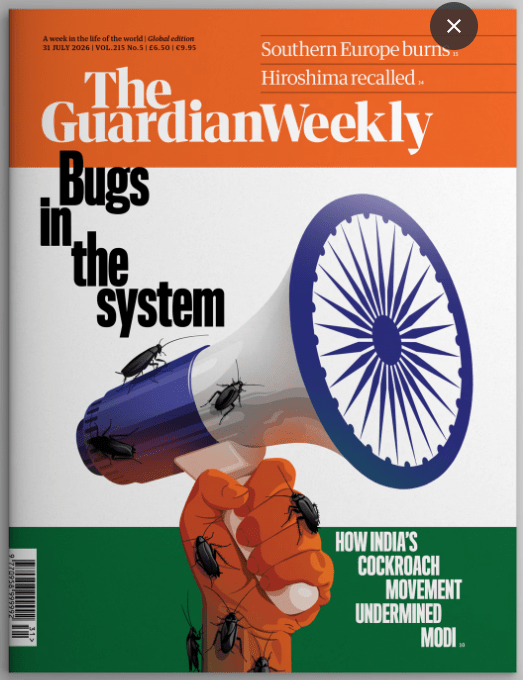
The news agenda has been so dominated for many months by a few big stories about perennial global hotspots and the biggest figures on the international stage, that one could accuse journalists of missing what was happening outside the US, Middle East or Ukraine. But as our south-east Asia correspondent, Hannah Ellis-Petersen, explains for this week’s big story, the rapid rise and sudden explosion on to the streets of India’s Cockroach Janta party took everyone – especially Narendra Modi’s government – by surprise.
What began as a satirical protest when the chief justice of India compared the country’s unemployed youth to cockroaches has damaged prime minister Modi’s image as a “strongman” leader and loosened his grip over the media. But as Hannah explains, it’s not just that the joke has “legs” and strong visuals; young people want a viable future and change.
Spotlight | ‘Smoke covered the sun’ Angelique Chrisafis hears from people evacuated from France’s Gironde region near Bordeaux as southern Europe battles wildfires, the spread and ferocity of which have shocked everyone
Spotlight | Blue horizons for Gaza’s children Sea pools made out of sandbags and rubble are part of Amjed Tantesh’s project to give traumatised children a brief respite from war, reports his niece and our Gaza reporter Seham Tantesh
Feature | A Hiroshima journey from anger to peace Simon Hattenstone meets Koko Kondo, who survived the dropping of the atom bomb on Hiroshima and hears about the publication of her father’s long-forgotten diary written in the aftermath of that horrific day in 1945
Opinion | Andy Burnham’s ticket to major change The UK prime minister’s first policy announcement on cut-price bus fares signals more than a cheap gimmick, says Jonathan Freedland
Culture | John Carpenter interview The uncompromising film director talks to Steve Rose about his shock and horror Hollywood career and his new music album
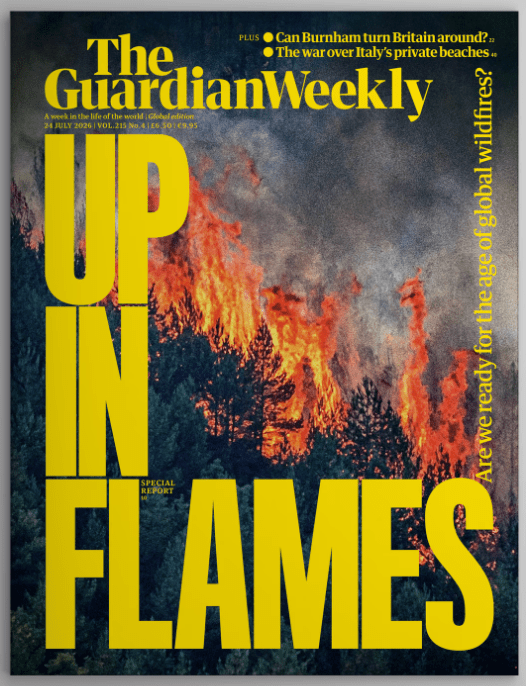
Across the globe, wildfires are on the move. Acrid smoke from huge Ontario fires choked major cities across Canada and the US last week, while in western Europe, France, Portugal and Spain have each been torched by a record-breaking number of blazes for this time of year.
In the UK, parched conditions after a hot dry summer have helped fuel blazes from national parks to cities. Last weekend, firefighters were tackling a blaze on Arthur’s Seat, the volcanic outcrop in the middle of Edinburgh. The week before, dozens of crews were confronted by a wildfire in north-east London.
Because of the climate crisis, fires are burning simultaneously in more places around the world – and they are often hotter, less predictable, and greater in number. For our big story, Ajit Niranjan surveys what seems to be a new normal and considers the impossible decisions specialist fire crews are making when multiple fires are burning in different parts of the world.
In Australia, bushfires have always been part of the country’s landscape. Graham Readfearn talks to some of those who have learned to live with the ever-present danger and asks what they can teach others in this rapidly changing world.
Spotlight | Trump is risking midterm disaster. Why? Less than a month after hailing a ceasefire, Trump resumed strikes on Iran – a move experts warn could prolong the war and hurt Republicans in upcoming elections. Robert Tait asks what is going on
Science | Is the world facing a male reproductive crisis? Reports of falling sperm counts and testosterone levels have fuelled fears over chemicals, pollution and modern lifestyles. Hannah Devlin investigates
Feature | The business of rewilding Intensive farming has all but destroyed England’s ancient woodlands and freshwater wetlands. On a farm in Lincolnshire, a radical aristocrat hopes to show there’s money in protecting nature. Patrick Barkham went to find out
Opinion | What’s left after this World Cup? A kind of messy hope Kazakhs cheering Uzbeks, Bengalis wild for Argentina … This tournament was once a playground for nationalism. Now it shows how flimsy that allegiance is, argues Jonathan Liew
Culture | All shook up: the return of Alabama Shakes With Brittany Howard at the helm, the American three-piece band are back with a new album railing against the state of the US in 2026. Dave Simpson caught up with them
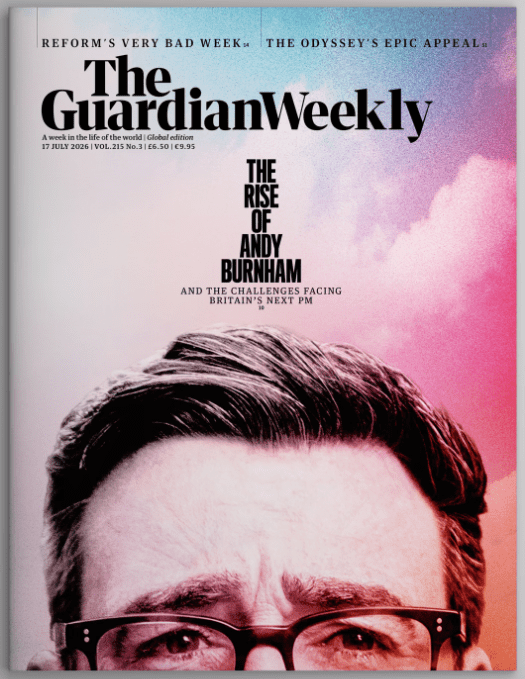
Andy Burnham is to become Britain’s seventh prime minister in a decade, having secured the Labour leadership with the landslide support of his party’s MPs.
The former Manchester mayor is now set to replace Starmer as Labour leader on Friday before walking through the doors of No 10 and becoming prime minister next Monday.
For our big story this week, Daniel Boffey looks at how Burnham charted the route from school politics to No 10, while Jessica Elgot runs through the bulging in-tray awaiting him when he steps into the new role. And Gaby Hinsliff examines how the PM-in-waiting might fare on the global stage, asking whether, unlike Keir Starmer, he has the skills to deal with Donald Trump.
Spotlight | A revolution in ruins Discontent with Venezuela’s Trump-backed government is mounting as Chávez heirs struggle to respond to the earthquake disaster, writes Tom Phillips
Science | We’re going on a water bear hunt Scientists hope DNA sequencing tardigrades – tiny yet virtually indestructible creatures – could help us understand the secrets of their superpowers. Patrick Barkham reports
Feature | The battle of the Bell hotel Tim Burrows visits the town of Epping in Essex to hear from local people about the impact of last year’s far-right protests that centred on a hotel housing asylum seekers
Opinion | The real source of Trump’s power exposed The Nato summit showed the US president’s willingness to violate all norms, rules and laws – and leave everyone else to pick up the pieces, argues Robert Reich
Culture | Never-ending story With Christopher Nolan’s take on the Odyssey set to break box office records, Charlotte Higgins asks why a poem from 600BC holds a vice-like grip on pop culture
In case you missed Donald Trump’s triumphalist address marking America’s 250th anniversary, you weren’t alone. Lightning storms caused by an extreme heatwave sent the Washington crowds scattering and delayed the US president’s address by four hours – but it was still a trademark piece of Trumpian dystopia, a highly politicised polemic that followed on from a white nationalist march on the streets of the capital.
David Smith’s brilliant feature essay this week reveals how the US president has hijacked the country’s milestone anniversary and turned it into a joyless, farcical series of largely self-serving events. And from Moscow to Mexico City, there’s a terrific reported feature from our correspondents around the globe on how the world views America at 250 in the age of Trump.
Spotlight | At the ayatollah’s funeral, Iranians call for revenge Crowds swelled through Tehran as mourners dressed in black carried flags proclaiming: ‘We will rise’, reports diplomatic editor Patrick Wintour
Environment | The changing symphony of Britain’s dawn chorus The country has lost an estimated 73 million wild birds from its landscape over the last 50 years, but a new project aims to recreate their sound. By Sandra Laville and Madeleine Finlay
Feature | Morality and the machine Since 2017, philosopher Iason Gabriel has worked at Google DeepMind, trying to anticipate – and think through – the impact of AI. But as commercial and geopolitical pressures escalate, can ethicists make any difference, asks Robert P Baird
Opinion | Thank heavens for the pope In a political wasteland dominated by billionaires, war criminals and mega-corporations, the head of the Catholic church is a rare figure of moral leadership, argues Simon Tisdall
Culture | An invitation you can’t refuse Director Olivia Wilde and co-star Edward Norton talk to Catherine Shoard aboutThe Invite, their new movie about marital bed death that is the season’s buzziest, funniest release
News, Views and Reviews For The Intellectually Curious









 Boomers Daily