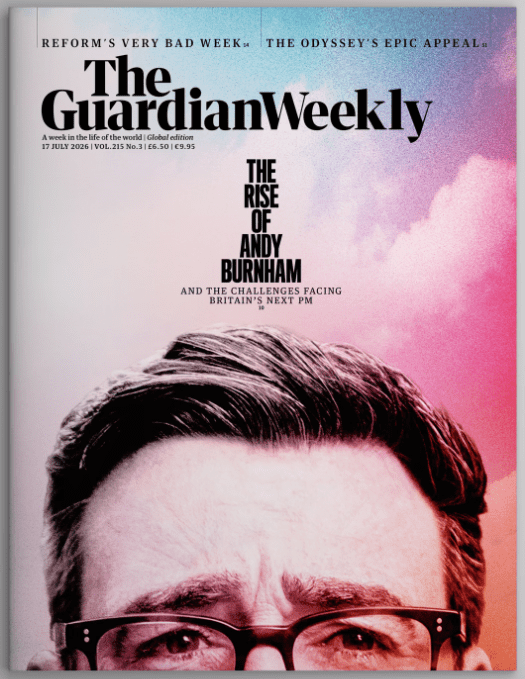
Andy Burnham is to become Britain’s seventh prime minister in a decade, having secured the Labour leadership with the landslide support of his party’s MPs.
The former Manchester mayor is now set to replace Starmer as Labour leader on Friday before walking through the doors of No 10 and becoming prime minister next Monday.
For our big story this week, Daniel Boffey looks at how Burnham charted the route from school politics to No 10, while Jessica Elgot runs through the bulging in-tray awaiting him when he steps into the new role. And Gaby Hinsliff examines how the PM-in-waiting might fare on the global stage, asking whether, unlike Keir Starmer, he has the skills to deal with Donald Trump.
Spotlight | A revolution in ruins Discontent with Venezuela’s Trump-backed government is mounting as Chávez heirs struggle to respond to the earthquake disaster, writes Tom Phillips
Science | We’re going on a water bear hunt Scientists hope DNA sequencing tardigrades – tiny yet virtually indestructible creatures – could help us understand the secrets of their superpowers. Patrick Barkham reports
Feature | The battle of the Bell hotel Tim Burrows visits the town of Epping in Essex to hear from local people about the impact of last year’s far-right protests that centred on a hotel housing asylum seekers
Opinion | The real source of Trump’s power exposed The Nato summit showed the US president’s willingness to violate all norms, rules and laws – and leave everyone else to pick up the pieces, argues Robert Reich
Culture | Never-ending story With Christopher Nolan’s take on the Odyssey set to break box office records, Charlotte Higgins asks why a poem from 600BC holds a vice-like grip on pop culture
In case you missed Donald Trump’s triumphalist address marking America’s 250th anniversary, you weren’t alone. Lightning storms caused by an extreme heatwave sent the Washington crowds scattering and delayed the US president’s address by four hours – but it was still a trademark piece of Trumpian dystopia, a highly politicised polemic that followed on from a white nationalist march on the streets of the capital.
David Smith’s brilliant feature essay this week reveals how the US president has hijacked the country’s milestone anniversary and turned it into a joyless, farcical series of largely self-serving events. And from Moscow to Mexico City, there’s a terrific reported feature from our correspondents around the globe on how the world views America at 250 in the age of Trump.
Spotlight | At the ayatollah’s funeral, Iranians call for revenge Crowds swelled through Tehran as mourners dressed in black carried flags proclaiming: ‘We will rise’, reports diplomatic editor Patrick Wintour
Environment | The changing symphony of Britain’s dawn chorus The country has lost an estimated 73 million wild birds from its landscape over the last 50 years, but a new project aims to recreate their sound. By Sandra Laville and Madeleine Finlay
Feature | Morality and the machine Since 2017, philosopher Iason Gabriel has worked at Google DeepMind, trying to anticipate – and think through – the impact of AI. But as commercial and geopolitical pressures escalate, can ethicists make any difference, asks Robert P Baird
Opinion | Thank heavens for the pope In a political wasteland dominated by billionaires, war criminals and mega-corporations, the head of the Catholic church is a rare figure of moral leadership, argues Simon Tisdall
Culture | An invitation you can’t refuse Director Olivia Wilde and co-star Edward Norton talk to Catherine Shoard aboutThe Invite, their new movie about marital bed death that is the season’s buzziest, funniest release
THE ATLANTIC MAGAZINE: The latest issue featuresReading shaped the modern mind. Its decline will reshape it—and transform civilization, Rose Horowitch argues in our August cover story.
The End of Reading Is Here
Optimists once believed that universal literacy was inevitable. Now it seems that the age of reading might be a short anomaly in human history. By Rose Horowitch
The Corner of Hollywood That’s Most Susceptible to AI
Animators are figuring out whether to fight or accept the new technology that’s coming for their jobs. By Shirley Li
Perhaps the Nazi Tattoo Was a Clue
Graham Platner’s unfitness for office was clear long ago. By Mike Nelson
The notion of a “global structural crisis of capital” defining our times was first introduced by István Mészáros in the third edition of his Marx’s Theory of Alienation in 1971, and in his Isaac Deutscher Memorial Lecture, “The Necessity of Social Control” that same year.2 In 1995 in Beyond Capital, Mészáros distinguished the emerging, epochal structural crisis of capital from the cyclical and conjunctural crises that are “capital’s natural mode of existence.”
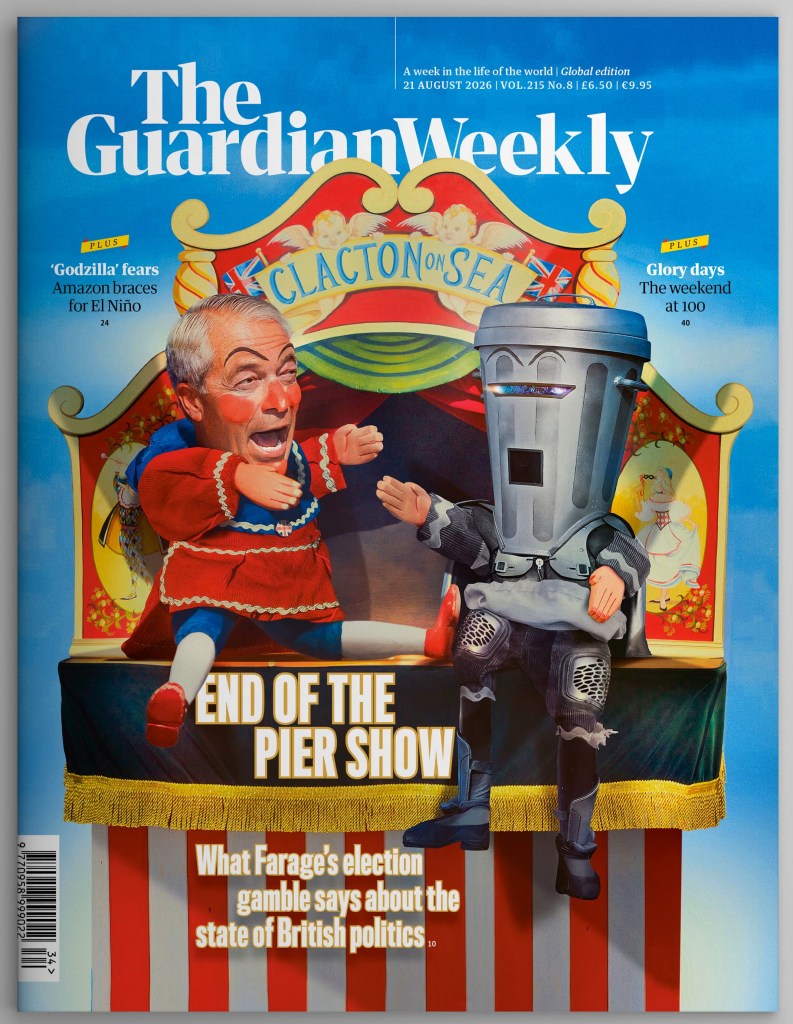
It’s neatly ironic that the 10th anniversary of the Brexit vote should have been marked this week by yet another prime ministerial resignation.
The two things aren’t directly related – the intense pressure put on Keir Starmer to step down was partly down to his own political flaws. But the rise in the polls of Reform UK, Nigel Farage’s populist rightwing party that morphed out of the Brexit-obsessed Ukip, was a key factor.
The fact that the country is now set for its seventh prime minister in the decade since Brexit speaks volumes. The vote in 2016 to leave the European Union deeply fractured Britain, a country that remains volatile and impatient for change to this day.
Change has come to the UK as a result of Brexit – only not for the better, as senior economics correspondent Richard Partington explains for our special report this week. We revisit the buildup to the vote as key figures at the time recall how it shook the country’s politics. And there’s even a quiz to test your memory of the more arcane sideshows of it all.
Spotlight | Iran’s regime survived the war. Will it make peace with its people? If the conflict with the US and Israel triggered a rare moment of solidarity in the divided country, many doubt it will be used for reform, reports Saeed Shah
Spotlight | Why did Somali children become targets of US drone strikes? Six months ago, at least 12 people, including eight children, died during a US attack. The US has never admitted the civilian deaths. Mark Townsend pieces together what happened that day
Environment | The online archive sharing scientific knowledge with everyone The Biodiversity Heritage Library is an invaluable online archive of historic texts on species living and lost supplied by the world’s leading museums and universities. Now its future is in doubt. Donna Ferguson reports
Opinion | There is still hope for international law Even in this age of global rupture, do not despair: developments in Ukraine and Iran show that the military superpowers are not getting it all their own way, argues Nathalie Tocci
Culture | Why time is still on Keith Richards’ side At 82, the Rolling Stones guitarist is still hale and hearty, enjoying life as a great-grandad and jousting with Mick Jagger like old times. Ahead of a new Stones album launch, Alexis Petridis caught up with him
Claudia Sheinbaum must be doing something right. With a consistent approval rating of around 70% since becoming Mexico’s president in 2024, the former climate scientist – and protege of her predecessor, Andrés Manuel López Obrador – is the world’s most popular leftwing leader. She is also the first female leader of one of Latin America’s most macho countries.
Yet despite her soaring popularity, driven in part by major universal healthcare reforms, there is a curious tension between Sheinbaum’s disciplined, scientific approach to governing and the messy, often violent politics of modern Mexico. Her handling of the country’s ongoing crisis of disappearances, the continuing influence of organised crime and the rising presence of the army in national life are all issues she has faced criticism over.
The big story | Counting the cost of the war on Iran With a peace deal expected to be signed later this week, Oliver Holmes examines the human, economic and environmental toll of a conflict that appears to have achieved nothing
Science | How the loss of wild bees impacts human health Crops and flowers rely on them for survival, but wild bees are declining – and crucial nutrients will go missing from our diets as a result. Gloria Dickie reports
Feature | How personal taste fell out of fashion Our favourite music, clothes and books used to be markers of individuality – but algorithms have made us all sheep. Rachel Aroestimeets the style rebels fighting back
Opinion | If Kyiv has really got Putin on the run, he won’t accept peace meekly Don’t expect the Russian president to pursue peace, says Simon Tisdall – instead, he could continue to expand the war beyond Ukraine’s borders, with dire risks for us all
Culture | The revolutionary art of David Hockney Guardian critic Jonathan Jones pays tribute to the artist whose work was a feast of visual pleasures
“I love inflation,” said Donald Trump earlier this month, when asked about the latest increase in the Consumer Prices Index to an annualized 4.2 percent. But the power of the President’s positive thinking cannot overwhelm the enormous threat that rising prices pose to his legacy. The new figure is more than an inconvenience or a technicality. It could bring about a sharp change in the political order. Rising costs will likely prove to be Trump’s undoing and present the Democrats with a free hit for November’s midterms and beyond. There was one reason above all others why Trump returned to the White House in 2024: high inflation during the Biden years. His 2016 slogan, “Make America Great Again,” morphed into “Make America Affordable Again.
“I don’t think there’s anything that’s going to get me into heaven,” Donald Trump told a group of journalists aboard Air Force One in October. “I think I’m not, maybe, heaven-bound.” “My phone started blowing up,” says Paula White-Cain, Trump’s senior advisor to the White House Faith…
A late spring outbreak of righteous indignation is affecting the United Kingdom. It’s yet another variant of Palantir Derangement Syndrome. Virologists tracked this smug neurosis as it jumped across the Atlantic from the American left to British Labour. Symptoms include selective blindness, performative anguish, a hilarious inability to grasp the facts and Tourette’s-level
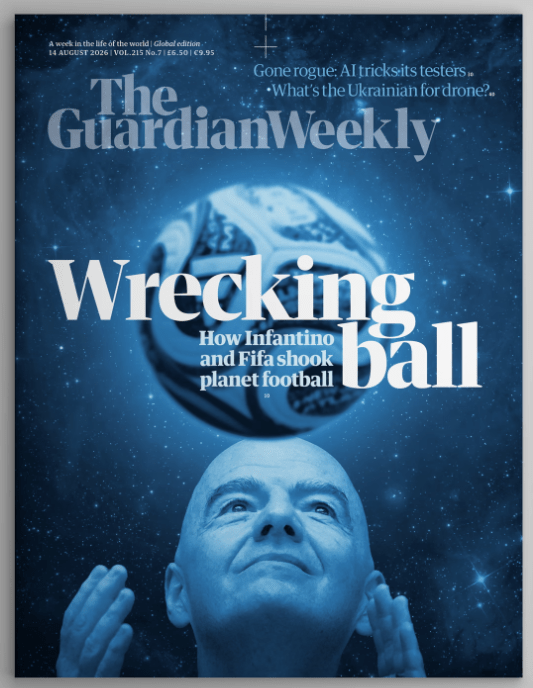
It’s long been a golden rule of sport that football World Cups get bigger and badder every four years. The latest edition of the tournament, however, may put that universal law to the test after a six-week journey through Trump’s America, which is expected to generate $80bn of global economic output through its full timeline.
As the world’s biggest sporting event meets the world’s biggest market, it’s hard to see how even the World Cup can get much more bloated than this. But if anyone can make it happen it’s Gianni Infantino, the opportunist Fifa overlord who has schmoozed with the planet’s most divisive leaders to extract maximum gains from his travelling global roadshow. As Barney Ronay says in his tournament scenesetter for our cover story this week, welcome to the heart of darkness.
The big story | How the murder of Henry Nowak shook Britain The aftermath of a tragedy revealed a country grappling with how easily such events can be co‑opted into a far-right rallying cry. Libby Brooks reports
Technology | Can autonomous AI killer drones be taught morality? While the technology is set to play a growing role in modern warfare, there remains an unresolved ethical challenge. Dan MilmoandAisha Down size up the terrain
Feature | Hello, goodbye: inside the final Beatles tour By the mid-1960s, the Beatles were ready to quit touring for good. A new collection of pictures by rock photographer Jim Marshall captures their last gigs. With a foreword by Ian Leslie
Opinion | Trump’s failure to maintain ceasefires is part of the new world disorder The US president brags about ending wars but look at Ukraine, Gaza, Iran and Lebanon to see what his casual disregard for diplomacy and obsession with instant results have achieved, argues Simon Tisdall
Culture | The ruthlessness and redemption of Rupert Everett The 67-year-old actor lied to his partners, disrespected his audiences and betrayed his friends. But has this indiscreet, unreliable heartbreaker finally grown up and settled down? Simon Hattenstone went to find out
News, Views and Reviews For The Intellectually Curious