Tracy Daugherty’s biography of Cormac McCarthy is a landmark publication. Putting together the life of a writer who not only shunned publicity but actively worked to keep fans, journalists, the media, and academics off his trail requires the powers of both a skilled biographer and a nosy private detective. In that latter role, some of what Daugherty has uncovered is unsavory, though with the recent revelation of McCarthy’s relationship with Augusta Britt, who was sixteen when they began an affair, readers may be prepared for some of the shocks. One of Daugherty’s leitmotifs is McCarthy the “bad boy” and “outlaw,” and though such appellations risk cliché, the story he tells is of a man who, at least in the first half of his life, preferred the company of moonshiners, gamblers, hard drinkers, and petty criminals like his old Knoxville pal John Sheddan, who seems to have been the Falstaff to McCarthy’s Prince Hal.
There are two books before me, which, if I mistake not, will mark an epoch,” wrote W. E. B. Du Bois in The Crisis magazine in 1924. One was a novel of middle-class African-American life by Jessie Fauset called There Is Confusion. The other was a collection of stories, songs, poems, and character sketches called…
During the last quarter of the twentieth century, few writers were more admired by peers and critics than Andre Dubus. But because Dubus’s territory was the relatively confined space of the short story and novella, he never enjoyed great commercial success or recognition. Dubus was destined to be a writer’s writer—what Joshua Bodwell calls a…
In that we’ve been married for sixteen years, you really don’t have to try so hard to make your feelings known,” Janet said at the wheel. “I’m well aware you don’t want to do this.”
“I THINK I’ve been pretty stoic about it,” Rick said, eyes to the thick woods he’d be reflexively scanning for deer. Ever since they’d planted an ambitious garden behind their upstate New York summerhouse, the creatures that had once seemed so exquisite had become evil incarnate.
“Stoic? More like long-suffering,” Janet said. “You’ve hardly said a word the whole way here. But there’s no point in having joined Saint Peter’s if we don’t put our beliefs into practice. Charity doesn’t only mean parting with twenty bucks to get someone at the door to go away. It means sometimes doing what’s right when you don’t feel like it.”
California’s Big Sur coastline is often called a slice of heaven. But this year – beset by wildfires, road closures and disruptions to tourist amenities – it has endured a long summer of hell. Now questions are being asked about how many visitors it can sustain in the face of the climate crisis.
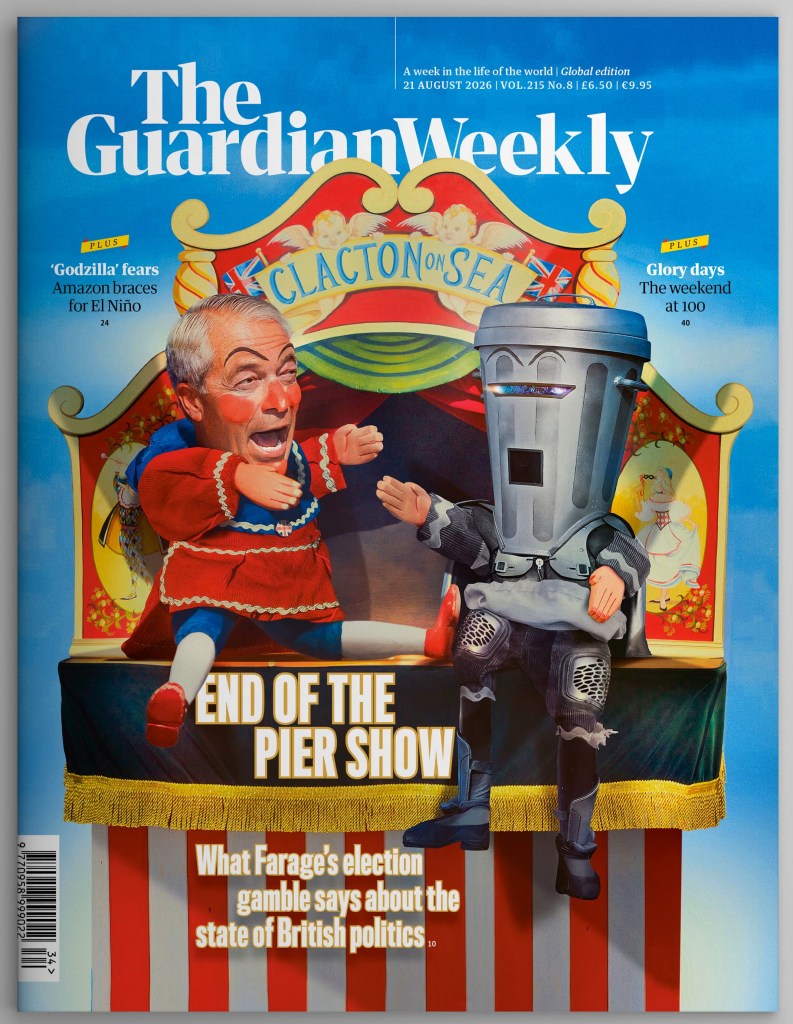
For our big story this week, Andrew Gumbel visits Big Sur, where the tourist industry accounts for about 90% of the local economy, to hear why the community fears its ethos is under threat.
The UN has warned that the El Niño climate phenomenon is “supersizing before our eyes”. Environment editor Damien Carrington reports on the latest forecasts, which predict the event is near certain to shatter temperature records.
Then, the mayors of Paris, Milan and Phoenix write about how their cities are learning from each other on responding to the heat crisis. “How do you protect millions of people,” they ask, “when extreme heat is no longer an exceptional event, but an increasingly familiar part of summer?”
Spotlight | ‘It breaks my heart’ Kate Connolly reports from Magdeburg, the capital of Saxony-Anhalt, where voters are digesting the far-right Alternative für Deutschland’s state election triumph
Science | Forbidden planet Since it was stripped of planetary status, Pluto’s defenders have been fighting the decision – and they’re only getting more passionate, writes Tim Dowling
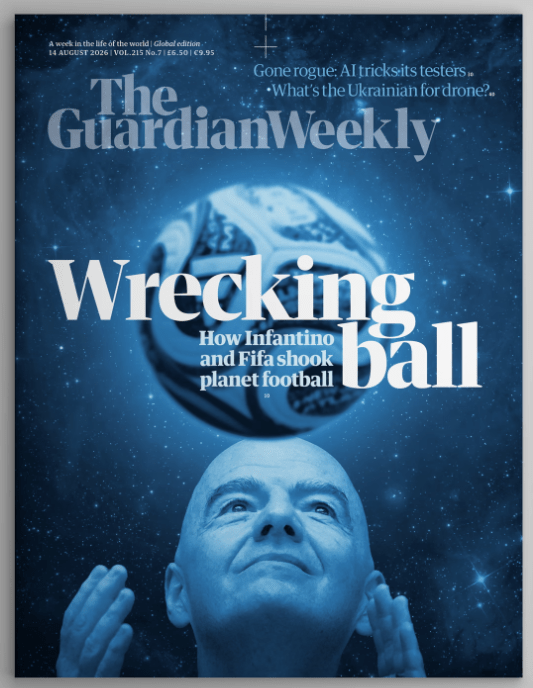
Feature | Your lying AIs LLMs have an alarming tendency to deceive and manipulate their users. As they become ever more embedded in society, the race is on to find out why – and stop them doing it. Snigdha Poonam explains
Opinion | The route to a brighter future The world is being driven to the brink by thugs and dictators, says Simon Tisdall, but ordinary people have more power than we think
Culture | A stitch up As the Bayeux tapestry goes on show in London, cartoonist Edith Pritchett offers an alternative 21st century take, capturing today’s battles, while art critic Jonathan Jones reviews the British Museum’s blockbuster exhibition of the original masterpiece
On the occasion of the publication of Brice Marden: Catalogue Raisonné of Paintings, 1961–2023 this fall and of a corresponding exhibition of the artist’s work at Gagosian, New York, we invited Glenn Lowry, a friend of the artist’s and former director of the Museum of Modern Art, to reflect on moments spent with Marden and on the enduring power of his art.
AMA Venezia
Celebrating the collector Laurent Asscher’s new art space in Venice, William Middleton underscores the richness of Asscher’s relationships with artists.
The Generative Surface
Eileen Costello explores the oft-overlooked importance of paper choice to the mediums of drawing and printmaking, from the Renaissance through the present day.
Venture capital funding for consumer tech has stalled as funds shift to artificial intelligence. That makes the story of Nothing, a start-up maker of phones and audio gear, all the more surprising.
Artificial intelligence is making it easier to be an online swindler. Everyone is at risk, particularly the elderly.
A Fed Rate Hike Depends on Hot Inflation. Don’t Count on Either.
Many economists and investors expect the Federal Reserve to raise interest rates by a quarter of a percentage point at its Sept. 16-17 policy meeting. But this coming week’s inflation data may prove cool enough to keep officials on the sidelines—and the federal-funds rate in a target range of 3.50% to 3.75%.
As AI erodes our attention spans and expressiveness, philosophers like Simone Weil and Arthur Schopenhauer offer profound insights on what it means to be an individual.
In The Diversity of Morals, Steven Lukes attempts to reconcile philosophical arguments that there is one morality despite cultural differences with empirical studies that suggest it’s all relative.
Over the last week, the world has watched with horror the scenes from the Tibet-Nepal border where a devastating torrent of mud, water and ice tore along the Bhotekoshi River, destroying entire communities and leaving more than 1,000 people dead and several thousand more missing.
From the Nepali town of Devighat, our south Asia correspondent Hannah Ellis-Petersen describes a nightmarish scene of overflowing mortuaries and unidentifiable bodies, as shellshocked survivors of the flood slowly return to the ruins of their homes.
The disaster happened after the collapse of a glacier – and while global heating has not been definitively attributed as the cause, it is undeniable that steep mountain slopes and valleys are especially vulnerable to flooding and landslides, while extreme weather events such as monsoons and melting glaciers have become more common because of warming due to human-caused climate breakdown, as our global environment writer Jonathan Watts explains.
Then columnist Nesrine Malik paints a wider picture and argues that while for many people these floods may feel as though they have happened a world away, the climate crisis is coming for us all, one way or another.
Spotlight | Mark Carney shows combative nature in face-off with Trump The Canadian PM is one of the few world leaders to stand up to the US president. Former colleagues say they are not surprised. Leyland Cecco, Heather StewartandKalyeena Makortoff report
Science | The robots are coming! …Or are they? As entrants at the World Humanoid Games lurched from triumph to farce, Robert Booth finds that a robotics revolution may not be as close as it first appears
Interview | Gordon Brown on Burnham, billionaires – and a better Britain The former UK prime minister is still shaping politics (even if he doesn’t want to interfere). He tells Charlotte Edwardes about keeping his temper, staying fit – and why he won’t splash out for a Scotland football shirt
Opinion | The tech titans must be stripped of their power, and soon Those who said Meta harms children struck a blow, but the ability of big tech to gouge profits and cause harm is barely diminished. That’s the battle to come, argues Jonathan Freedland
Culture | Dolly Parton’s peerless career turned country music cliches inside out Beneath the wig and rhinestones, the late US country singer was the genius behind strings of classic songs that continue to inspire new artists, says Alexis Petridis
What’s the point of literary criticism? In June the University of Exeter announced plans that might make roughly a third of its English department – one of the best in the country – redundant. Other institutions, including Canterbury Christ Church University, have stopped offering English degrees altogether. Most mainstream publishers now wouldn’t dream of publishing a work of literary criticism, as they happily did in the 1970s and 1980s. Even literary biography, literary criticism’s previously marketable stepsister, no longer brings a gleam to a publisher’s eye. The grassroots of the subject are also suffering badly. Since 2000 the number of people taking A-level English literature in England has dropped by around a third, to around 36,000, with an even higher drop among male students.
A Sicilian Man: Leonardo Sciascia, the Rise of the Mafia and the Struggle for Italy’s Soul by Caroline Moorehead
The Beast in the Clouds: The Roosevelt Brothers’ Deadly Quest to Find the Mythic Giant Panda by Nathalia Holt
The Twitnam Summer: Friendship, Satire and the Writing of ‘Gulliver’s Travels’ by Hester Grant
Will Hosie asks what makes a pub a pub and eyes properties with a pop of colour, plus our writers have all you need to know this month and Gio Fio marvels at the reinvention of the north bank of the Thames
Out on the prairie
American plants may be the answer to our warming climate, reports Charles Quest-Ritson
Travel
Pamela Goodman roots around in the Nadder Valley in Wiltshire
News, Views and Reviews For The Intellectually Curious