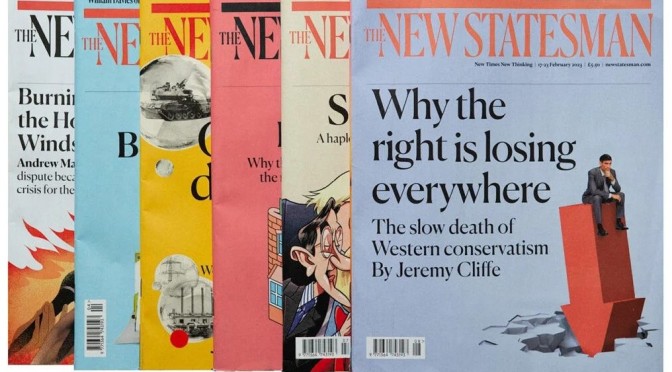
THE NEW CRITERION: The latest issue features….

THE NEW CRITERION: The latest issue features….

LITERARY REVIEW OF CANADA: The latest issue features…
On the connection between books and home Kyle Wyatt
Does healing the world mean abandoning capitalism? Darrell Varga
Where non-sovereign nations dwell George Anderson
Jackie Robinson’s season in Montreal David Marks Shribman

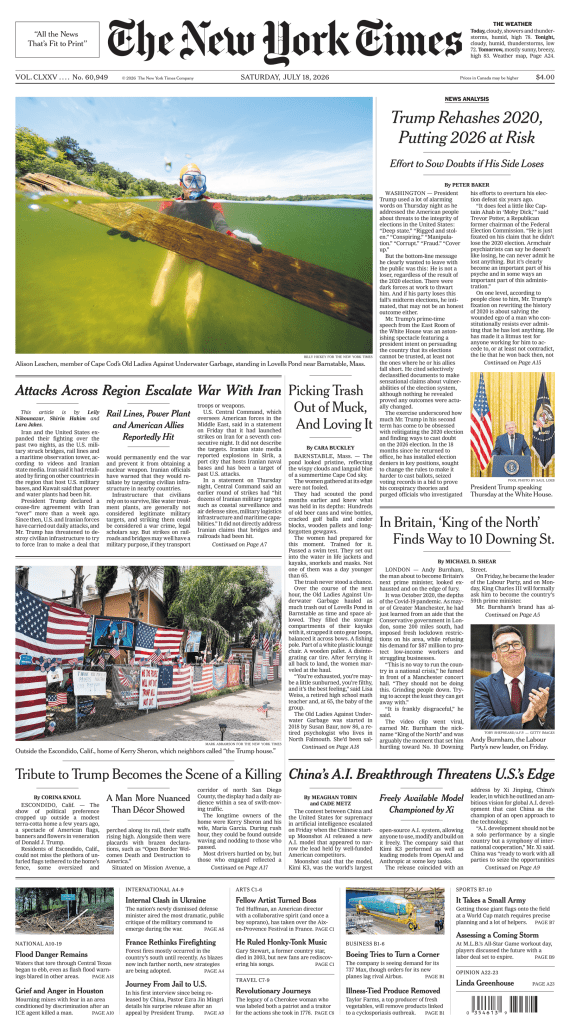
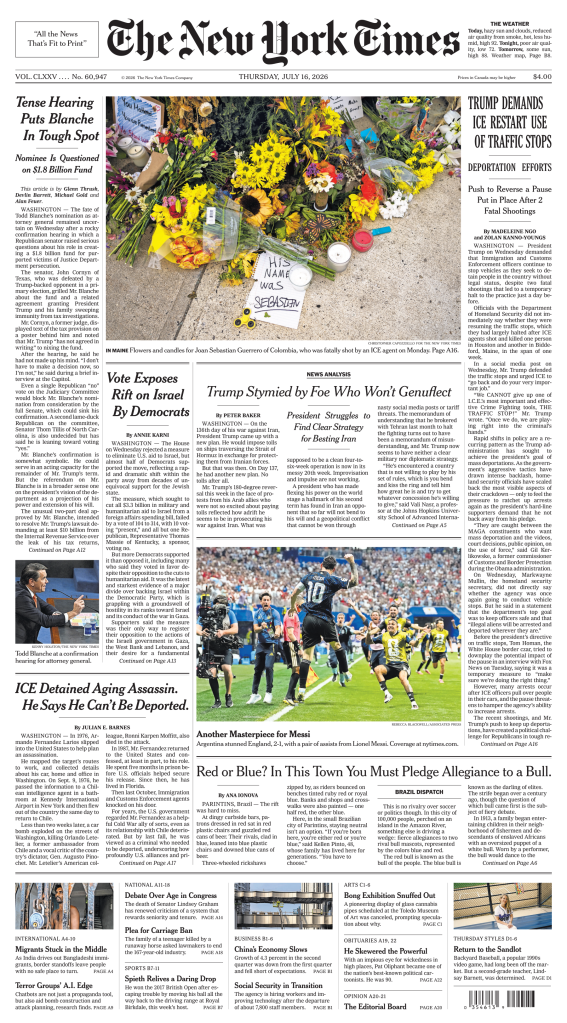
Twenty-five years later, fleeting memories and indelible images still haunt those who lived through the attacks and their aftermath.
Solemn ceremonies will be held at ground zero in New York, and across the U.S. President Trump is scheduled to speak at the Pentagon.
The Iran-backed militia’s ground offensive has reached the Bab al-Mandab, a Red Sea strait that is a choke point for global trade.
The Ukrainian city of Izium still bears the scars of Russian occupation from four years ago. As Moscow’s forces approach, residents are bracing for the worst.
China sees the BRICS group as a vehicle for challenging American power. India wants to keep the group broad enough to avoid choosing sides.

SCIENCE MAGAZINE: The latest issue features ‘Rotavirus Entry’ – Visualizing how nonenveloped viruses cross cell membranes…
Early results from the $1 billion SinoProbe II project hint at how continental fragments assemble and evolve
Trump administration officials argue the change is necessary to reduce wildfire risk in national forests
Study in mice strengthens T cells’ ties to neurodegenerative conditions like Alzheimer’s
Platinum-based drugs cause mutations and liver aging in children treated for cancer

THE ECONOMIST MAGAZINE: The latest issue features The truth and the lies about Islam in Europe…
Islam poses no serious danger. But Islamism and the fear of Islam do
Republicans are proving that party unity is overrated
A stunning success for the AfD in Saxony-Anhalt
The Federal Reserve’s next meeting will be his first big test as chair
Machines are getting brighter. Teens are getting dimmer. Schools must act now
Without it, Javier Milei’s remarkable liberal experiment could end next year

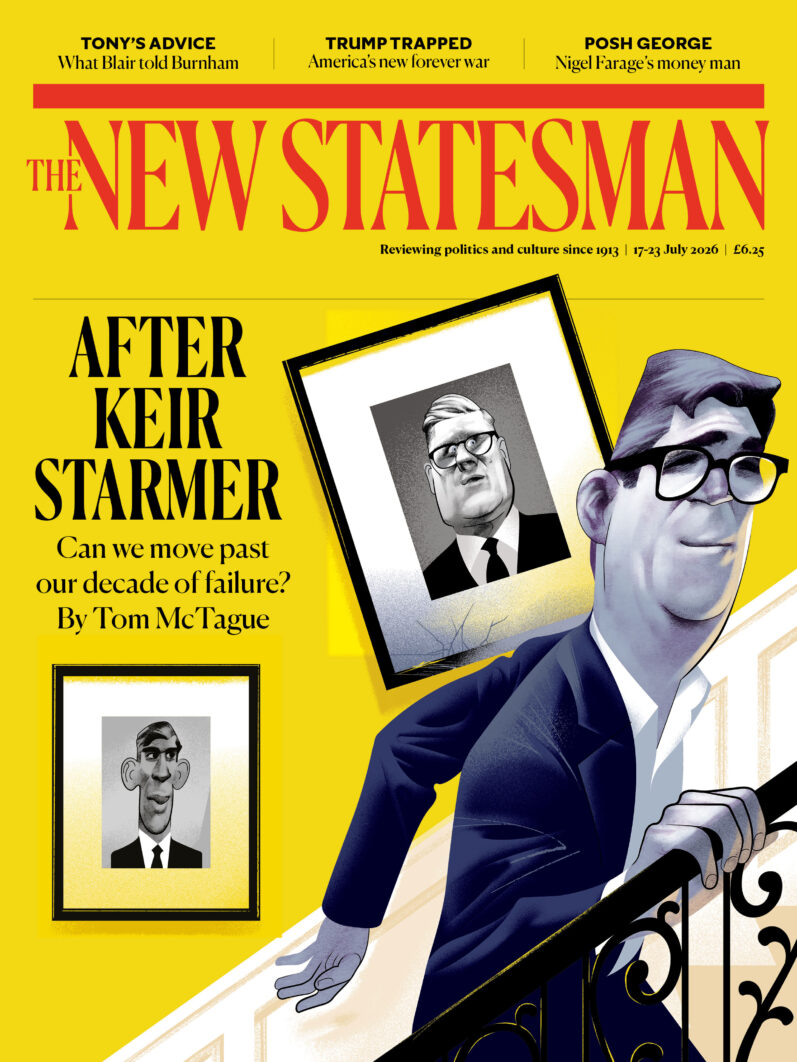
The Foreign Secretary has unveiled the biggest reset in UK relations with Israel for decades By Ailbhe Rea
Its legacy has been twisted out of recognition By Freddie Hayward
The young are too often the greatest casualties of war By Gordon Brown
How Britain lost its mind to online shopping addiction By Kate Mossman

PORTICO LITERARY QUARTERLY: The latest issue features….
By Michael Crews
Tracy Daugherty’s biography of Cormac McCarthy is a landmark publication. Putting together the life of a writer who not only shunned publicity but actively worked to keep fans, journalists, the media, and academics off his trail requires the powers of both a skilled biographer and a nosy private detective. In that latter role, some of what Daugherty has uncovered is unsavory, though with the recent revelation of McCarthy’s relationship with Augusta Britt, who was sixteen when they began an affair, readers may be prepared for some of the shocks. One of Daugherty’s leitmotifs is McCarthy the “bad boy” and “outlaw,” and though such appellations risk cliché, the story he tells is of a man who, at least in the first half of his life, preferred the company of moonshiners, gamblers, hard drinkers, and petty criminals like his old Knoxville pal John Sheddan, who seems to have been the Falstaff to McCarthy’s Prince Hal.
Helen Andrews
There are two books before me, which, if I mistake not, will mark an epoch,” wrote W. E. B. Du Bois in The Crisis magazine in 1924. One was a novel of middle-class African-American life by Jessie Fauset called There Is Confusion. The other was a collection of stories, songs, poems, and character sketches called…
Christopher J. Scalia
During the last quarter of the twentieth century, few writers were more admired by peers and critics than Andre Dubus. But because Dubus’s territory was the relatively confined space of the short story and novella, he never enjoyed great commercial success or recognition. Dubus was destined to be a writer’s writer—what Joshua Bodwell calls a…
By Lionel Shriver
In that we’ve been married for sixteen years, you really don’t have to try so hard to make your feelings known,” Janet said at the wheel. “I’m well aware you don’t want to do this.”
“I THINK I’ve been pretty stoic about it,” Rick said, eyes to the thick woods he’d be reflexively scanning for deer. Ever since they’d planted an ambitious garden behind their upstate New York summerhouse, the creatures that had once seemed so exquisite had become evil incarnate.
“Stoic? More like long-suffering,” Janet said. “You’ve hardly said a word the whole way here. But there’s no point in having joined Saint Peter’s if we don’t put our beliefs into practice. Charity doesn’t only mean parting with twenty bucks to get someone at the door to go away. It means sometimes doing what’s right when you don’t feel like it.”

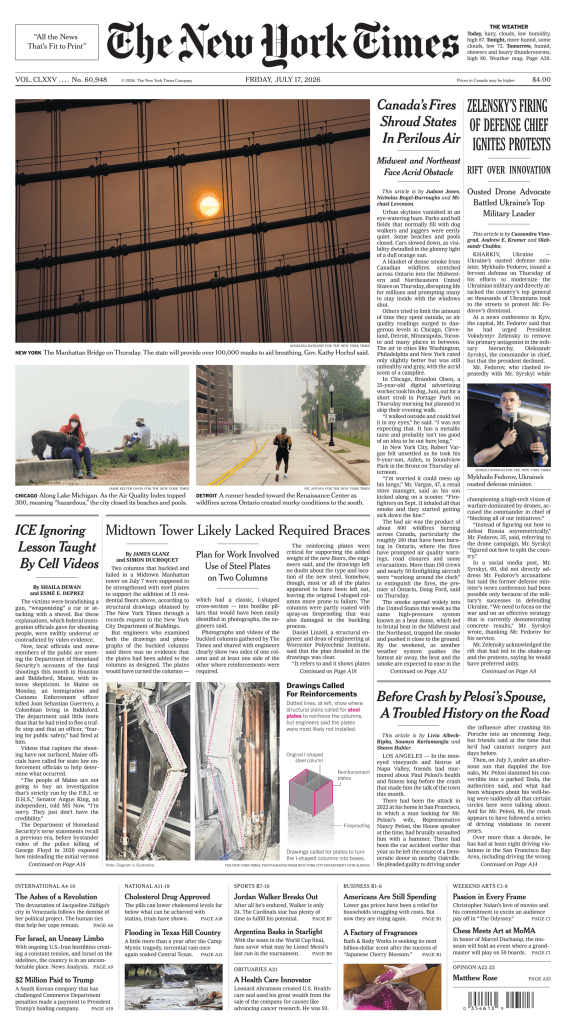
President Trump mostly offered retreads and self-congratulation at the gathering. Then, he offered to pay Americans $5,000 apiece if Republicans kept power.
At the unusual midterm convention, the president and his allies painted Democrats as dangerously un-American.
The Taliban claim that Afghanistan is no longer a sanctuary for terrorist groups, but Al Qaeda and others are still present, reviving old fears.
The Iran-backed militia routed Yemeni government forces in Mokha, putting the group in a stronger position to attack ships in a crucial waterway for global trade.
Embracing positions extolled by the Kremlin, the Alternative for Germany party may govern for the first time in a German state.

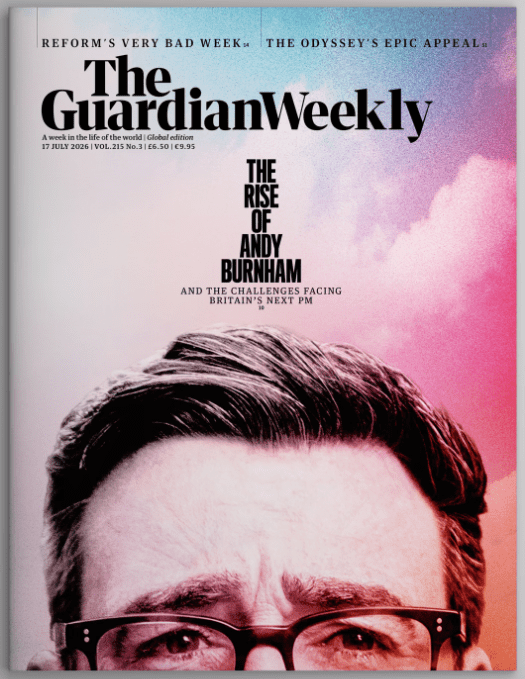
THE GUARDIAN WEEKLY: The latest issue features ‘A Season In Hell’ – Tourism on a heating planet.
California’s Big Sur coastline is often called a slice of heaven. But this year – beset by wildfires, road closures and disruptions to tourist amenities – it has endured a long summer of hell. Now questions are being asked about how many visitors it can sustain in the face of the climate crisis.
For our big story this week, Andrew Gumbel visits Big Sur, where the tourist industry accounts for about 90% of the local economy, to hear why the community fears its ethos is under threat.
The UN has warned that the El Niño climate phenomenon is “supersizing before our eyes”. Environment editor Damien Carrington reports on the latest forecasts, which predict the event is near certain to shatter temperature records.
Then, the mayors of Paris, Milan and Phoenix write about how their cities are learning from each other on responding to the heat crisis. “How do you protect millions of people,” they ask, “when extreme heat is no longer an exceptional event, but an increasingly familiar part of summer?”
Spotlight | ‘It breaks my heart’
Kate Connolly reports from Magdeburg, the capital of Saxony-Anhalt, where voters are digesting the far-right Alternative für Deutschland’s state election triumph
Science | Forbidden planet
Since it was stripped of planetary status, Pluto’s defenders have been fighting the decision – and they’re only getting more passionate, writes Tim Dowling
Feature | Your lying AIs
LLMs have an alarming tendency to deceive and manipulate their users. As they become ever more embedded in society, the race is on to find out why – and stop them doing it. Snigdha Poonam explains
Opinion | The route to a brighter future
The world is being driven to the brink by thugs and dictators, says Simon Tisdall, but ordinary people have more power than we think
Culture | A stitch up
As the Bayeux tapestry goes on show in London, cartoonist Edith Pritchett offers an alternative 21st century take, capturing today’s battles, while art critic Jonathan Jones reviews the British Museum’s blockbuster exhibition of the original masterpiece

THE PARIS REVIEW : The latest features Interviews, Prose, Poetry and Art….
Svetlana Alexievich on the Art of Oral History: “If you cut straight to the part you need, which is what journalists do, it won’t be interesting, and it won’t be the truth, either. Not the whole truth.”
Donald Antrim on the Art of Fiction: “I deplored the idea that writing involves suffering, that it had to be a bloodletting. Later I found out that it would be, and maybe should be.”
Prose by Eka Kurniawan, Angie Sijun Lou, Brian Ma, Scott McClanahan, Sam McKinniss, Tomoka Shibasaki, and Woo Dayoung.
Poetry by Asha Futterman, Zakaria Mohammed, Geoffrey G. O’Brien, Vasko Popa, Diane Seuss, and Natalie Shapero.
Art by Gertrude Abercrombie, Silke Otto-Knapp, and Laura Owens; cover by Elizabeth Glaessner.