“Studies with financial links to the indoor tanning industry were much more likely to discuss perceived benefits of indoor tanning and to downplay the harms,” said Eleni Linos, MD, DrPH, professor of dermatology, who sees patients at Stanford Health Care’s dermatology clinic at the Hoover Pavilion. “The association is quite striking. We need scientific data to be independent of industry influence. I am concerned that funding sources may influence the conclusions of these papers.”
In 2012, Eleni Linos, professor of dermatology at Stanford university, published a systematic review and meta-analysis of the link between non-melanoma cancer and sun-beds. That bit of pretty standard research, and a particular rapid response to it, has kicked of years of work – and in this podcast I talk to Eleni and her colleagues Stanton…
Filmed and Directed by: Jim Pattiz and Will Pattiz
Produced by: More Than Just Forests
Music by: The Lady & I (“Sky’s The Limit”)
Sponsored by: Visit Utah
.
From the creators of More Than Just Parks, More Than Just Forests proudly presents More Than Just Forests | Uinta-Wasatch-Cache! Join us as we take you on a visual journey through one of the most stunning and unique regions in the country. Explore mountains, valleys, forests, canyons, and meadows that are home to some of north america’s most treasured animals and landscapes. This is the Uinta-Wasatch-Cache National Forest.
Mercedes-Benz and the upcoming “Avatar” films – what at first seemed to be an unexpected global partnership, turned into a unique interdisciplinary experience.
Inspired by the world of “Avatar”, the two partners created the astonishing VISION AVTR. In this exclusive behind-the-scenes feature, key team members from both parties share their thoughts on the cooperation process and provide fascinating insights into the concept vehicle itself.
Excerpts from a New York Times Style Magazine online article (February 10, 2020)
Marc Jacobs
“People want newness, and they want it from a new person. I understand that I’m not the 25-year-old who was given this incredible job at Perry Ellis, or who created the grunge collection, or who was the bad boy of the 1990s,” he said. “I am a 56-year-old man who still has the privilege of doing a collection.” But his voice was calm as he said this, full of acceptance and experience.
“THE DRIVING FORCE in my life is fear,” Marc Jacobs said.
IT WAS A bright December afternoon, a week or so before Christmas, when Jacobs and I met for the last time. I waited in the reception area of his atelier next to a sculpture of Neville, Jacobs’s bull terrier, whom I had recently begun following on Instagram (he has over 200,000 followers). I thought I could finally understand why Jacobs commands such devotion from those around him. He exudes a precariousness that is deeply affecting to anyone even dimly aware of the mysterious connection between creativity and tragedy. If he attracts protectors, it is because one cannot speak at any length to him without feeling that, as Oscar Wilde wrote about his titular character in “The Picture of Dorian Gray,” “a note of doom runs like a purple thread” through “the gold cloth” of his talent.
The Chevrolet Impala is a full-size car built by Chevrolet for model years 1958 to 1985, 1994 to 1996, and 2000 onward. The Impala is Chevrolet’s popular flagship passenger car and is generally among the better selling American made automobiles in the United States.
The 1959 Chevrolet Impala was redesigned. Sharing bodyshells with lower-end Buicks and Oldsmobiles as well as with Pontiac, part of a GM economy move, the Chevrolet’s wheelbase was 1-1/2 inches longer. Using a new X-frame chassis, the roof line was three inches lower, bodies were two inches wider, and curb weight increased. Its tailfins protruded outward, rather than upward. The taillights were a large “teardrop” design at each side, and two slim-wide nonfunctional front air intake scoops were added just above the grille,
The Impala became a separate series, adding a four-door hardtop and four-door sedan, to the two-door Sport Coupe and convertible. Sport Coupes featured a shortened roof line and wrap-over back window. The standard engine was an I6, while the base V8 was the carryover 283 cu in (4.6 L), at 185 hp (138 kW). Optional were a 283 cu in with 290 hp (220 kW) and 348 cu in (5.7 L) V8 up to 335 hp (250 kW). Standard were front and rear armrests, an electric clock, dual sliding sun visors, and crank-operated front vent windows. A contoured hooded instrument panel held deep-set gauges. A six-way power seat was a new option, as was “Speedminder”, for the driver to set a needle at a specific speed and a buzzer would sound if the pre-set was exceeded.
Andalućia is a non-narrative, short, architectural film, showcasing amazing autonomous community in southern Spain.
Andalusia is a unique region with a fantastic blend of architectural marvels. The whole region is filled with a mix of fantastic buildings, reminiscence of the turbulent history of that area. From Carthaginians and Romans, Moors and Byzantine empire to Christian civilisation. These unique historical intricacies play a vital role in establishing the one and only rare visual identity of this region.
Shot in 4 major cities of Andalucia – Seville, Cordoba, Granada, Marbella, and also in Ronda, Mijas, Nerja and Setenil de las Bodegas, this short film showing just a mere drop of many marvelous exteriors and interiors that Andalucia has to offer.
The vivid photographs are arranged according to the signs’ imagery, with sections such as Spirit of the West, On the Road, Now That’s Entertainment, and Ladies, Diving Girls & Mermaids. Sixteen of the most iconic landmark signs include brief histories on how that unique sign came to be. A resource section includes a photography index by location and a Neon Museums Visitor’s Guide.
Take to the road to discover the history and artistry of North America’s disappearing neon signs.
Neon Road Trip chronicles the history of the commercial neon sign with a curated collection of photographs capturing the most colorful and iconic neon still surviving today.
John Barnes studied art, graphic design, sculpture and photography, earning a BFA degree in documentary photography from the University of Delaware 1984. He worked as a commercial advertising photographer for over fifteen years both on the east coast and in San Francisco, and has been a fine art photographer for the last 30 years. He recently spent the last two years traveling around the United States and Canada photographing iconic neon signs. John resides in Seattle but spends most of his time traveling taking photographs.
James Taylor has been a household name for a long time now. Taylor was just 20-years-old when he released his self-titled debut in 1968; in the half century since then, he has sold over 100 million albums and cemented his status as one of the most successful American singer-songwriters.
But in Break Shot: My First 21 Years, his audio memoir on Audible, Taylor narrates his life before fame — including details of his struggle with drugs, alcohol addiction and time in psychiatric institutions. Taylor is also looking back with American Standard, a new album that revives the American Songbook tunes of his childhood.
NPR’s Lulu Garcia-Navarro spoke with Taylor about revisiting his fraught early memories, dealing with fame at an early age and his connection to The Beatles. Listen to their conversation in the player above and read on for highlights from the interview — including a few audio excerpts from Break Shot.
On the Mayo Clinic Radio program, Dr. Donald Hensrud, director of the Mayo Clinic Healthy Living Program, discusses the obesity epidemic and talks about popular diet trends, including intermittent fasting.
Paul Kolker is pleased to present his seventy-third solo exhibition, Dialogical Perception… Art as Experiment at his studio, the PAUL KOLKER collection, 511 West 25th Street from February 6 through March 27, 2020.
Paul Kolker (b. 1935) is a New York-based artist with doctorate degrees in medicine and law. He began his career of painting and sculpture in the 1960s, illustrating his peer review medical journal articles and life-casting anatomical models. In the 1970s he treated his art production as a post-minimalist experiment questioning experience and using the viewer as the measuring instrument as well as the interpreter of the experiment’s results. Many of his early works are sculptures, each painted in an elemental color, black or white.
In 1975 Kolker developed a keen and hands on understanding of light optics when he purchased a first generation three tube front end television projector with an alignment grid. That grid became the infrastructure for his works, which involved fractionation of a photographic image and the use of modular panels and canvases to create large scale works. In the 1980s Kolker began making light sculptures using one-way mirror and LED message screens, reflecting ad infinitum. In 2001, when he moved into his studio in Chelsea, he created an algorithm for a process of painting minimal shapes, such as a dot or square, in elemental colors (never mixed with each other, but sometimes mixed with black and/or white to form tints and shades). This process is called ‘fracolor’ in attribution to Benoit Mandelbrot’s fractal geometry, wherein minimal shapes and forms are serially replicated, like branches on a tree, rectangles on a grid, or pixels and dots on a television display screen.
As a result, Kolker’s works have become reminiscent of our pixelated world of digital information transfer, as we see it up close as grids of colored dots on our television, computer and cell phone screens; and how more highly defined that screen becomes when viewed from afar. His works are observational experiments which cry out to us, “Because of biases of color, shapes, parallax and perspective relative to where we stand as the observer, a dot may be a universe; and a universe may be a dot.”


 “Studies with financial links to the indoor tanning industry were much more likely to discuss perceived benefits of indoor tanning and to downplay the harms,” said Eleni Linos, MD, DrPH, professor of dermatology, who sees patients at Stanford Health Care’s dermatology clinic at the Hoover Pavilion. “The association is quite striking. We need scientific data to be independent of industry influence. I am concerned that funding sources may influence the conclusions of these papers.”
 In 2012, Eleni Linos, professor of dermatology at Stanford university, published a systematic review and meta-analysis of the link between non-melanoma cancer and sun-beds. That bit of pretty standard research, and a particular rapid response to it, has kicked of years of work – and in this podcast I talk to Eleni and her colleagues Stanton…




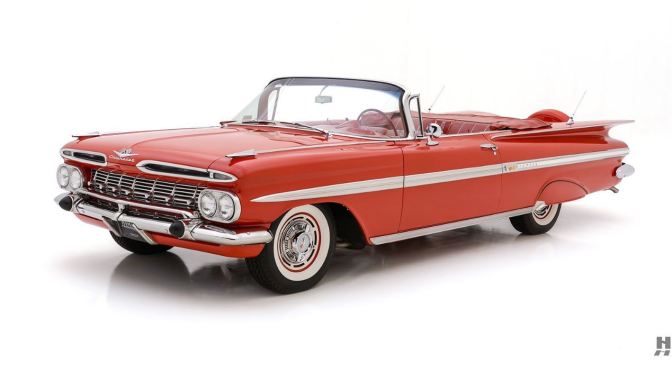
 The Chevrolet Impala is a full-size car built by Chevrolet for model years 1958 to 1985, 1994 to 1996, and 2000 onward. The Impala is Chevrolet’s popular flagship passenger car and is generally among the better selling American made automobiles in the United States.
 The Impala became a separate series, adding a four-door hardtop and four-door sedan, to the two-door Sport Coupe and convertible. Sport Coupes featured a shortened roof line and wrap-over back window. The standard engine was an I6, while the base V8 was the carryover 283 cu in (4.6 L), at 185 hp (138 kW). Optional were a 283 cu in with 290 hp (220 kW) and 348 cu in (5.7 L) V8 up to 335 hp (250 kW). Standard were front and rear armrests, an electric clock, dual sliding sun visors, and crank-operated front vent windows. A contoured hooded instrument panel held deep-set gauges. A six-way power seat was a new option, as was “Speedminder”, for the driver to set a needle at a specific speed and a buzzer would sound if the pre-set was exceeded.

 The vivid photographs are arranged according to the signs’ imagery, with sections such as Spirit of the West, On the Road, Now That’s Entertainment, and Ladies, Diving Girls & Mermaids. Sixteen of the most iconic landmark signs include brief histories on how that unique sign came to be. A resource section includes a photography index by location and a Neon Museums Visitor’s Guide.
 James Taylor has been a household name for a long time now. Taylor was just 20-years-old when he released his self-titled debut in 1968; in the half century since then, he has sold over 100 million albums and cemented his status as one of the most successful American singer-songwriters.

 Boomers Daily