
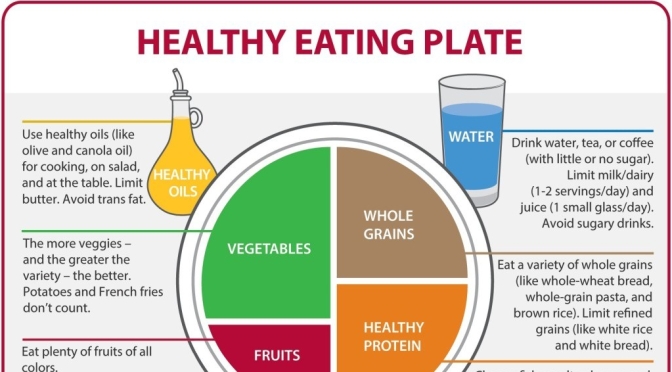
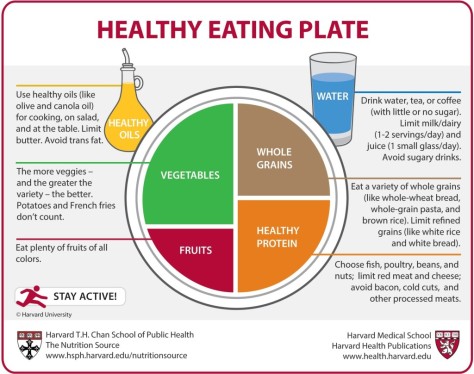
- Make most of your meal vegetables and fruits – ½ of your plate:
Aim for color and variety, and remember that potatoes don’t count as vegetables on the Healthy Eating Plate because of their negative impact on blood sugar.
- Go for whole grains – ¼ of your plate:
Whole and intact grains—whole wheat, barley, wheat berries, quinoa, oats, brown rice, and foods made with them, such as whole wheat pasta—have a milder effect on blood sugar and insulin than white bread, white rice, and other refined grains.
- Protein power – ¼ of your plate:
Fish, poultry, beans, and nuts are all healthy, versatile protein sources—they can be mixed into salads, and pair well with vegetables on a plate. Limit red meat, and avoid processed meats such as bacon and sausage.
- Healthy plant oils – in moderation:
Choose healthy vegetable oils like olive, canola, soy, corn, sunflower, peanut, and others, and avoid partially hydrogenated oils, which contain unhealthy trans fats. Remember that low-fat does not mean “healthy.”
Skip sugary drinks, limit milk and dairy products to one to two servings per day, and limit juice to a small glass per day.
The red figure running across the Healthy Eating Plate’s placemat is a reminder that staying active is also important in weight control.
The main message of the Healthy Eating Plate is to focus on diet quality.
- The type of carbohydrate in the diet is more important than the amount of carbohydrate in the diet, because some sources of carbohydrate—like vegetables (other than potatoes), fruits, whole grains, and beans—are healthier than others.
- The Healthy Eating Plate also advises consumers to avoid sugary beverages, a major source of calories—usually with little nutritional value—in the American diet.
- The Healthy Eating Plate encourages consumers to use healthy oils, and it does not set a maximum on the percentage of calories people should get each day from healthy sources of fat. In this way, the Healthy Eating Plate recommends the opposite of the low-fat message promoted for decades by the USDA.
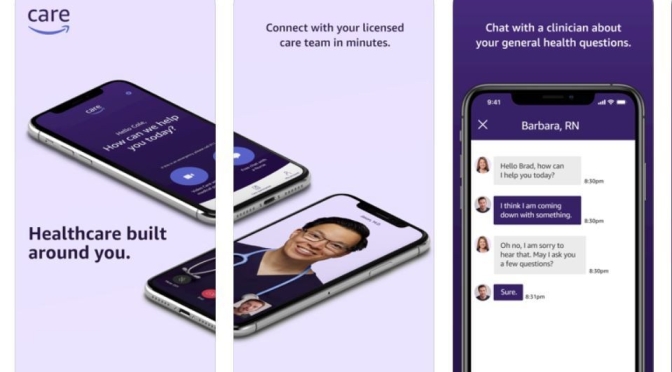
 Amazon’s virtual medical clinic that offers in-person follow-ups is now available to Amazon employees in Seattle.
 3. Medications prescribed via Amazon Care can be delivered to a patient’s home.
 Many Americans are willing to make significant personal tradeoffs to lower their health insurance rates or medical costs, such as agreeing to 24/7 personal monitoring or working with artificial intelligence instead of a human doctor, the Center for the Digital Future at the USC Annenberg School for Communication and Journalism finds.

 Prevention
 Although coronavirus disease 2019 (COVID-19) dominates the news in early 2020, it affects few people in the US. In contrast, at the same time the US is experiencing a severe influenza epidemic, which has caused an estimated 250 000 hospitalizations and 14 000 deaths.
 This small device may change how doctors identify and manage patients with atrial fibrillation, an irregular heart rhythm that increases risk of stroke.
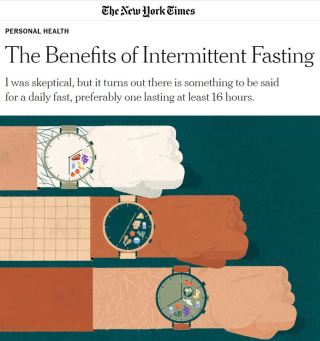 I was skeptical, but it turns out there is something to be said for practicing a rather prolonged diurnal fast, preferably one lasting at least 16 hours. Mark P. Mattson, neuroscientist at the National Institute on Aging and Johns Hopkins University School of Medicine, explained that the liver stores glucose, which the body uses preferentially for energy before it turns to burning body fat.
 Boomers Daily