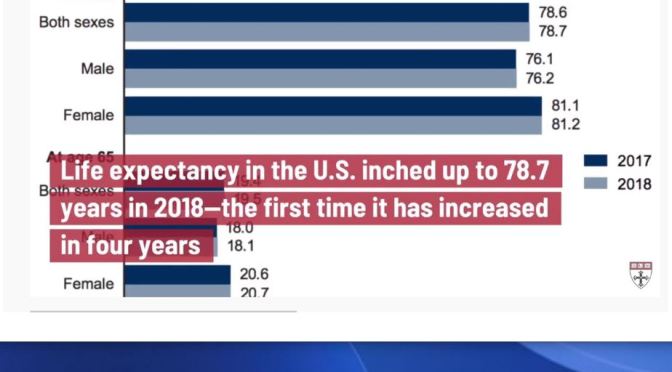
A slight uptick in U.S. life expectancy in the U.S. in 2018 was due partly to a decrease in overdose deaths, but mostly to decreasing cancer deaths.

A slight uptick in U.S. life expectancy in the U.S. in 2018 was due partly to a decrease in overdose deaths, but mostly to decreasing cancer deaths.
Excerpts from a Wall Street Journal online review (Feb 25, 2020):
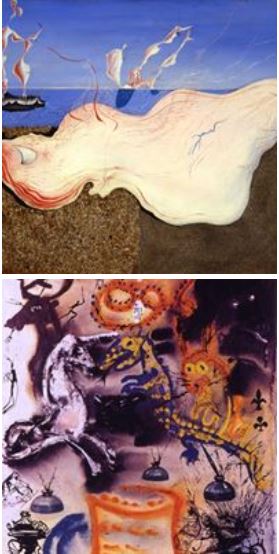 Masson, a founding Surrealist, saw the movement as an immersion “into what the German romantics call the night side of things.” However, “towards 1930,” Masson wrote, “a formidable disaster appeared in its midst: the demagogy of the irrational.” “Midnight in Paris” touches on Surrealism’s highs and lows, its darkness, poetry, beauty and banalities, reminding viewers—at the heart of the Dalí Museum, no less—that the movement is much, much more than melting watches.
In 1920s Paris, Surrealist revolution and transgression were in the air, but not everyone agreed on how to make Surrealist works or what they should look like. “Midnight in Paris: Surrealism at the Crossroads, 1929,” an exhibition of 80 paintings, prints, sculptures, drawings, collages, photographs, films and documents at St. Petersburg’s Dalí Museum, proposes to examine Surrealism’s rich visual fabric, conflicts and rivalries during the movement’s heyday in the City of Light. Organized by Didier Ottinger, deputy director of the Musée national d’art moderne at the Centre Pompidou, and William Jeffett, chief curator of special exhibitions at the Dalí, it focuses on the moment just before Surrealism burst onto and began to dominate the world stage.
Excerpts from a WSJ. Magazine interview (Feb 24, 2020):
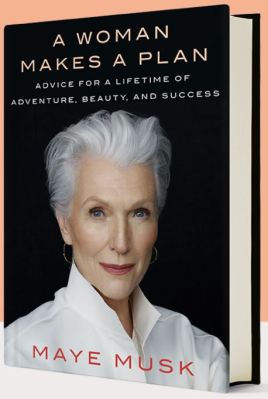 Well, when you get older, you are more fabulous, actually. You go through a lot of hard times in your life… and then, at this stage you get out of those bad situations quicker and they are less painful. You figure them out, and you move on. And I’m having the best time ever. I’m 71 now, it’s the best time ever, and I think at 81 it will be great. My mom [had] her best times when she was in her 90s. So I look forward to that.
A model since age 15, Maye Musk was in her 60s when her life took a turn for the fabulous. In her seventh decade, the former dietitian appeared in a Beyoncé music video, signed a contract with top modeling agency IMG and became a CoverGirl spokesperson, setting a record as their oldest yet. At the end of last year, Musk, now 71, added memoirist to her resume. Her book, A Woman Makes a Plan: Advice for a Lifetime of Adventure, Beauty and Success, chronicles her career and experience raising her children—SpaceX and Tesla founder Elon, restaurateur and philanthropist Kimbal and filmmaker Tosca—as a single mother who fled a turbulent marriage.
Born in Canada, raised in South Africa and now residing in L.A., Musk spoke to WSJ. about what she eats for breakfast, how she stays on top of emails and why she doesn’t miss hustling all the time.
 The Alfa Romeo GTA is a coupé automobile manufactured by the Italian manufacturer Alfa Romeo from 1965 to 1971. It was made for racing (Corsa) and road use (Stradale).
In 1962, the successor for the very popular Giulietta series was introduced. This car was the Alfa Romeo Giulia, internally called the “Series 105”. The coupé of the 105 series, used the shortened floorpan from the Giulia Berlina and was designed by Bertone. The name of the car evolved from Giulia Sprint GT to Giulia Sprint and to GTJ (Junior) and GTV (Veloce) in the late 1960s.
From Wikipedia
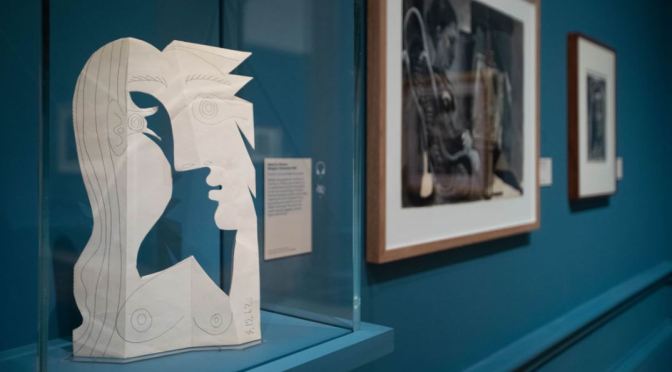
Join Curator Ann Dumas for a view inside the ‘Picasso and Paper’ exhibition, which features works spanning the artist’s entire career. Can you guess which work the artist made when he was just nine years old?
 As we head into South Carolina’s primary and gear up for Super Tuesday, the 2020 candidates are looking to stand out to voters. But perhaps no policy proposal has marked this election more than Sen. Bernie Sanders’s push for Medicare for All.
While the Democratic candidates agree on expanding health coverage, they’re divided on how to insure everyone, whether to insure everyone, and, of course, how to pay for it all.
So how are they similar? How are they different? And how does that compare to President Trump?
Rachana Pradhan, correspondent for Kaiser Health News; Noam Levey, national healthcare reporter for The LA Times; and Dan Diamond, health reporter for Politico and host of the “Pulse Check” podcast helped us break down where each candidate stood on health care.
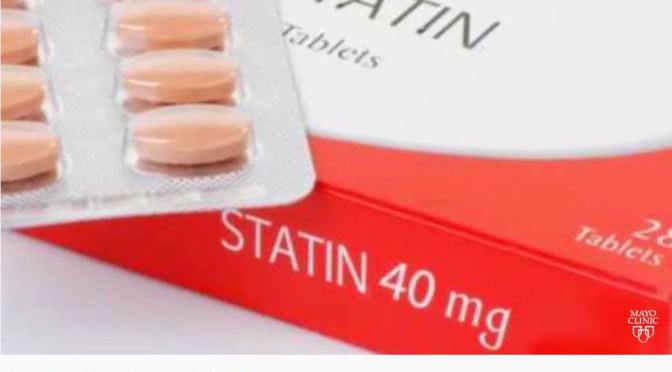
Taking a statin helps keep your cholesterol levels in check. How can that be?
 Dr. Stephen Kopecky explains that some people ask to be put on a statin. That’s because statins, while important and effective, are just one part of the whole heart-healthy picture. When you combine a statin with regular exercise, maintaining a healthy weight, controlling stress, not smoking and eating foods based on the Mediterranean diet, you can improve your heart health.
Dr. Kopecky says if you work in lifestyle changes slowly over time, you’ll be on your way to better heart health.
Statins are drugs that can lower your cholesterol. They work by blocking a substance your body needs to make cholesterol. Statins may also help your body reabsorb cholesterol that has built up in plaques on your artery walls, preventing further blockage in your blood vessels and heart attacks.
Several statins are available for use in the United States. They include:
Sometimes, a statin is combined with another heart health medication. Examples are atorvastatin/amlodipine (Caduet) and simvastatin/ezetimibe (Vytorin).
Increasing evidence suggests that statins do more than just lower bad cholesterol. Research has found that the medicines can safely prevent heart disease in certain adults ages 40 to 75. But the benefits aren’t entirely clear for the elderly. And doctors still want to know more about the side effects of statins.
On the Mayo Clinic Radio program, Dr. Derek Lomas, a Mayo Clinic urologist, discusses prostate cancer, including a new biopsy method.
This interview originally aired Feb. 22, 2020. Prostate cancer is the second most common cancer — second to skin cancer — among men in the U.S. One in 9 men will be diagnosed with prostate cancer in his lifetime, according to the American Cancer Society. Screening is important because early detection greatly improves the chances of survival. While some types of prostate cancer grow slowly, and may need minimal or even no treatment, other types are aggressive and can spread quickly. If prostate cancer is suspected, a biopsy can confirm the diagnosis.
Learn more about prostate cancer: https://www.mayoclinic.org/diseases-c…
“Sunday Morning” looks to an iconic image of World War II, taken 75 years ago today.
Raising the Flag on Iwo Jima is an iconic photograph of six United States Marines raising the U.S. flag atop Mount Suribachi during the Battle of Iwo Jima in the final stages of the Pacific War. The photograph, taken by Joe Rosenthal of the Associated Press on February 23, 1945, was first published in Sunday newspapers two days later and reprinted in thousands of publications. It was the only photograph to win the Pulitzer Prize for Photography in the same year as its publication, and was later used for the construction of the Marine Corps War Memorial in 1954, which was dedicated to honor all Marines who died for their country since 1775. The memorial, sculpted by Felix de Weldon, is located in Arlington Ridge Park, near the Ord-Weitzel Gate to Arlington National Cemetery and the Netherlands Carillon. The photograph has come to be regarded in the United States as one of the most significant and recognizable images of World War II.

The flag raising occurred in the early afternoon, after the mountaintop was captured and a smaller flag was raised on top that morning. Three of the six Marines in the photograph – Sergeant Michael Strank, Corporal Harlon Block, and Private First Class Franklin Sousley – were killed in action during the battle. The other three Marines in the photograph were Corporals (then Private First Class) Ira Hayes, Harold Schultz, and Harold Keller; Block was identified as Sergeant Hank Hansen (helped raise the first flag and was present at the second flag raising) until January 1947, Schultz (was at both flag raisings) was identified as Sousley who was identified as PhM2c. John Bradley (was at both flag raisings) until June 2016, and Keller was identified as Rene Gagnon (carried the second flag up Mount Suribachi) until October 2019. All of the men served in the 5th Marine Division on Iwo Jima.
The Associated Press has relinquished its copyright to the photograph, placing it in the public domain.
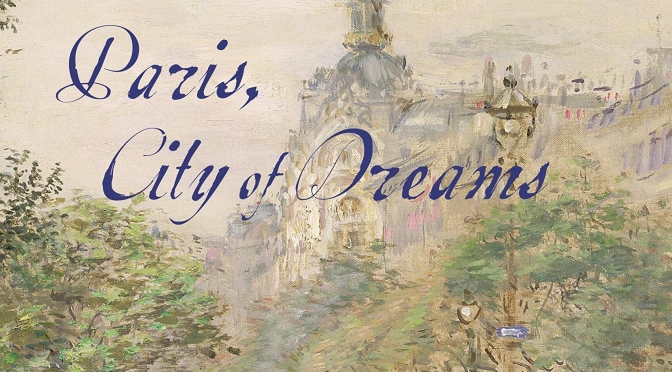
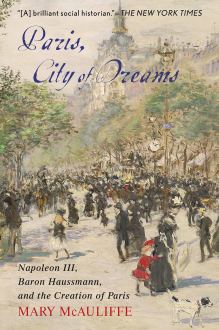 Paris, City of Dreams traces the transformation of the City of Light during Napoleon III’s Second Empire into the beloved city of today. Together, Napoleon III and his right-hand man, Georges Haussmann, completely rebuilt Paris in less than two decades—a breathtaking achievement made possible not only by the emperor’s vision and Haussmann’s determination but by the regime’s unrelenting authoritarianism, augmented by the booming economy that Napoleon fostered.
Acclaimed historian Mary McAuliffe vividly recaptures the Paris of Napoleon III, Claude Monet, and Victor Hugo as Georges Haussmann tore down and rebuilt Paris into the beautiful City of Light we know today.

McAuliffe follows the lives of artists such as Edouard Manet, Berthe Morisot, and Claude Monet, as well as writers such as Emile Zola, Gustave Flaubert, and the poet Charles Baudelaire, while from exile, Victor Hugo continued to fire literary broadsides at the emperor he detested.
McAuliffe brings to life a pivotal era encompassing not only the physical restructuring of Paris but also the innovative forms of banking and money-lending that financed industrialization as well as the city’s transformation. This in turn created new wealth and lavish excess, even while producing extreme poverty. More deeply, change was occurring in the way people looked at and understood the world around them, given the new ease of transportation and communication, the popularization of photography, and the emergence of what would soon be known as Impressionism in art and Naturalism and Realism in literature—artistic yearnings that would flower in the Belle Epoque.
Napoleon III, whose reign abruptly ended after he led France into a devastating war against Germany, has been forgotten. But the Paris that he created has endured, brought to vivid life through McAuliffe’s rich illustrations and evocative narrative.
Mary McAuliffe holds a PhD in history from the University of Maryland, has taught at several universities, and has lectured at the Smithsonian Institution, the Barnes Foundation, and the Frick Pittsburgh. She has traveled extensively in France, and for many years she was a regular contributor to Paris Notes. Her books include Clash of Crowns, Dawn of the Belle Epoque, Twilight of the Belle Epoque, When Paris Sizzled, and Paris on the Brink. She lives in New York City with her husband.






 Boomers Daily