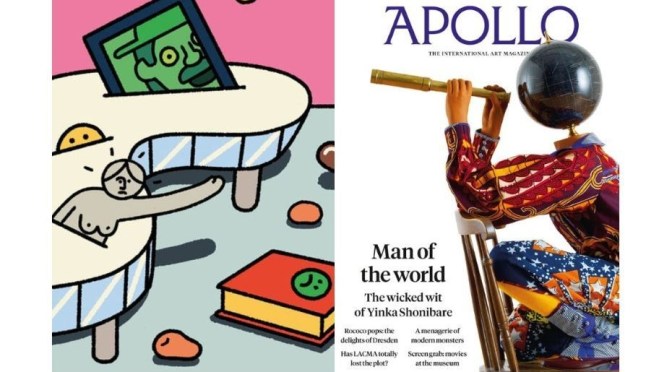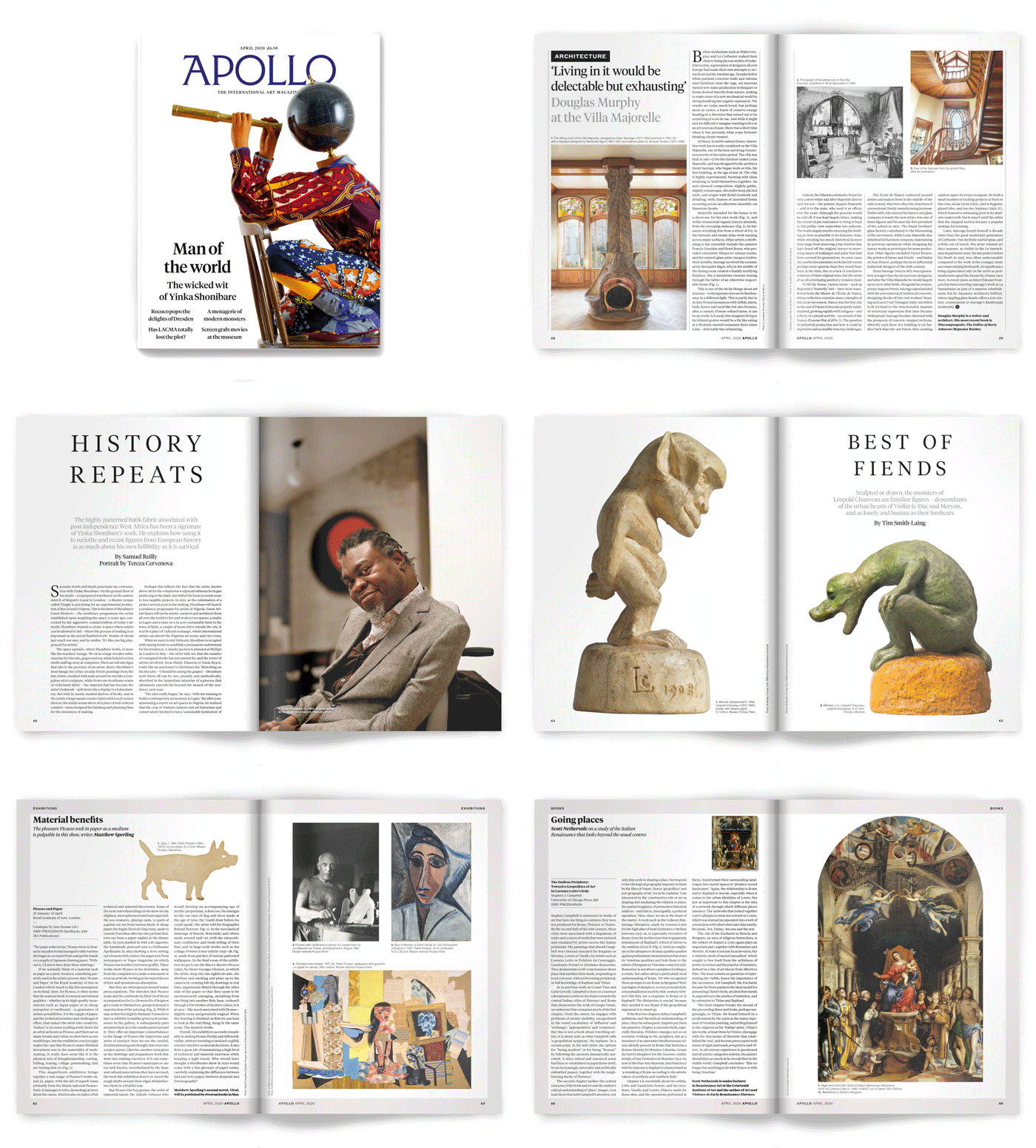
FEATURES | Michael Prodger visits the newly resplendent Gemäldegalerie Alte Meister in Dresden; Yinka Shonibare talks to Samuel Reilly; Seamus Perry considers the visual qualities of Wordsworth’s poems; Tim Smith-Laing on the modern monsters of Léopold Chauveau; Emilie Bickerton looks at how museums tackle the subject of cinema; Christopher Turner talks to Grażyna Kulczyk, founder of the Muzeum Susch
REVIEWS | Matthew Sperling on Picasso’s works on paper at the Royal Academy; Nicholas Hatfull on Edward Hopper at the Fondation Beyeler; Scott Nethersole on Renaissance art in the regions of Italy; Alan Powers on the life of Humphrey Stone; Max Norman on a new study of Poussin; Peter Parker on John Minton’s illustrations for Elizabeth David’s cookery books
MARKET | Tim Maxwell and Tamara Bell on cybersecurity; and the latest art market columns from Susan Moore and Emma Crichton-Miller
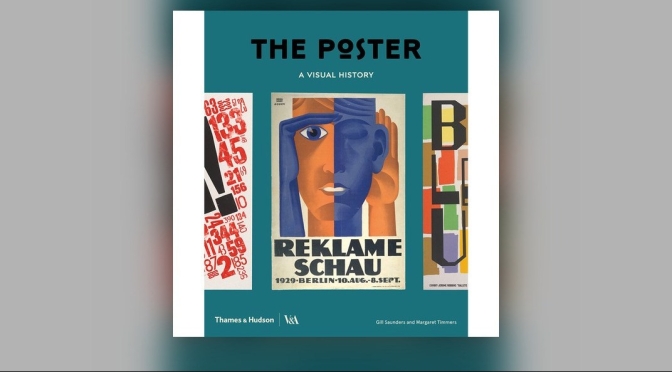
Monocle 24 speaks with Gill Saunders and Margaret Timmers about their upcoming book ‘The Poster’ from Thames & Hudson in partnership with the V&A.
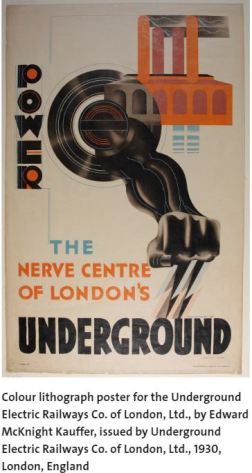
Featuring posters from the world-class collection of the Victoria and Albert Museum, this book is the perfect resource for all those who appreciate one of the most popular art forms.
Even in the digital age, the printed poster has continued to be one of the most influential and well-loved ways of informing and entertaining audiences. A powerful means of mass communication, posters are an invaluable resource for understanding the time periods in which they were produced and distributed and have often played key roles in shaping society.
Organized into seven thematic chapters, The Poster brings together more than 300 examples that offer a comprehensive history of the poster as a medium that has been used to share, sell, or incite political and social change. The text traces the poster through innovations in design, illustration, typography, and printing, as well as movements in art, including Art Nouveau, modernism, Art Deco, psychedelia, and punk.
Featuring works by A. M. Cassandre, Henri de Toulouse-Lautrec, Alphonse Mucha, Milton Glaser, Paula Scher, and Peter Gee, and many more, this book is an essential resource for graphic designers, illustrators, and anyone interested in social and political history.
From a Yatzer.com online article (March 14, 2020):
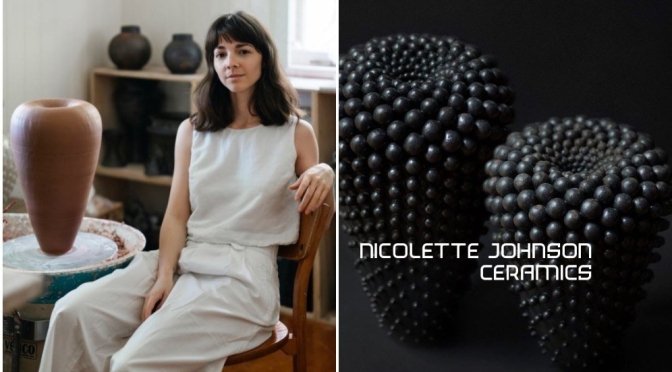
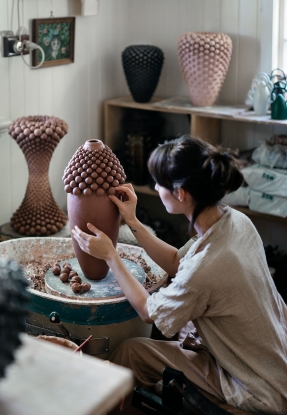
Hand-crafted through a laborious, almost ritualistic process, which sometimes has Nicolette individually sculpting and applying hundreds of protrusions to one vessel for days, her work transcends the dichotomy between artefact and artwork.
Whether it’s a reaction to the intangible aspect of our digital age, or a consequence of the trend-setting power of Instagram, there’s been a resurgence of ceramics in the last few years, both as an art form and a hobby. Perhaps it’s quite telling then that London-born, Australia-based ceramic artist Nicolette Johnson recreationally begun taking pottery classes just a few years ago as a counterbalance to her day job as a photographer.
Fast forward five years and Nicolette has distinguished herself as an acclaimed ceramist artist through the enchanting sophistication and painstaking craftsmanship of her work that channels ancient forms with contemporary precision.
Nicolette Johnson is a ceramic artist whose work explores symmetry, motifs, and the importance of the artefact.
Nicolette was born in London, England in 1990, grew up in Texas, USA, and today is based in Brisbane, Australia. Working in stoneware and employing wheel-throwing, coiling, and sculpting techniques, Nicolette applies a modern aesthetic to re-imagined ancient forms. Her work is included in the permanent collections of The National Gallery of Victoria and the Museum of Brisbane.
With a background in photographic art and social documentary, Nicolette began studying ceramics in 2015 and is continuing her practice-led exploration into functional and sculptural ceramic vessels, hand-making and firing each of her works in her Brisbane home studio.
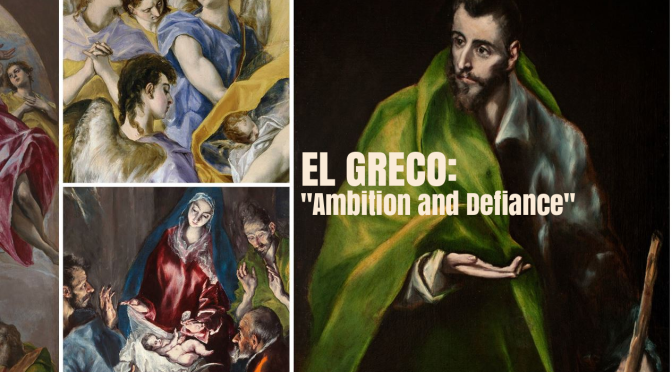
Explore the exhibition “El Greco: Ambition and Defiance” with curator Rebecca Long and research associate Jena Carvana. Follow along as they lead you through the galleries and share some of the reasons El Greco and his work continue to fascinate us.
“I draw literally and figuratively from the natural world. My drawing and mark making refer to and derive from botanical and biological anatomies, including marine life, as well as, the structures of both macro and micro cosmologies and writing systems, such as logograms.”
Sigrid Burton is an American painter, long based in New York City, whose semi-abstract work is known for its use of expressive, atmospheric color fields and enigmatic allusions to natural and cultural realms. Burton has had solo exhibitions in New York City, Los Angeles, San Francisco, Chicago and Osaka, including at Artists Space and the Michael C. Rockefeller Arts Center, and been included in shows at A.I.R. Gallery, the John and Mable Ringling Museum of Art, and the Carnegie Art Museum, Oxnard. Her work belongs to the public collections of the Metropolitan Museum of Art, Rockefeller Foundation, and Palm Springs Desert Museum, and has been reviewed in Arts Magazine, Arts & Antiques, Jung Journal, Chicago Tribune and LA Weekly.
Writers most frequently observe that Burton’s atmospheric works recall artists such as J.M.W. Turner, Odilon Redon, Pierre Bonnard and Mark Rothko, as well as the light of her native California.Art & Antiques described her approach as “chromatic expressionism” in which color is “her undisputed protagonist”. Peter Frank observed, “The dialectic between color and form has always inflected, even impelled” Burton’s painting, with color the more omnipresent element, and form the more persistent. Art historian William C. Agee wrote, “The domains she explores […] meet, intersect, fuse, and then disappear, like apparitions, in liquid pools of mist and color. Her pictorial odyssey refers simultaneously to both a higher order, a timeless cosmic vastness, as well as to a private, interior world, abounding in personal histories and memories.” Burton has lived and worked in Pasadena, California since 2013.
“The grasses up north are as blue as jade, Our mulberries here curve green-threaded branches; And at last, you think of returning home” Li Bai
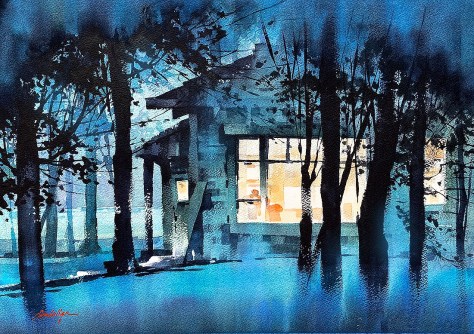
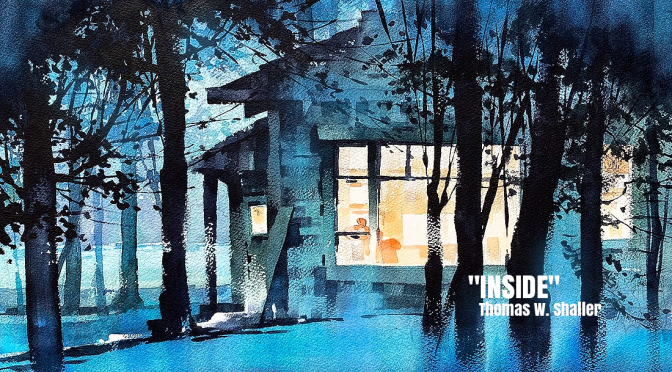
“Inside” – Thomas W. Shaller (March, 2020)
“A feat, this heart’s control Moment to moment To scale all love down To a cupped hand’s size”
Edith Tiempo, Bonsai
“Bonzai” – Thomas W. Shaller (March 2020)
Thomas W. Schaller is an award-winning artist, architect, and author based in Los Angeles. As a renowned architectural artist, he received a Graham Foundation Grant and was a two-time recipient of the Hugh Ferris Memorial Prize. He has authored three books; the best-selling, and AIA award winner, Architecture in Watercolor (VNR – McGraw Hill) The Art of Architectural Drawing (J.Wiley and Sons), and Thomas W. Schaller, Architect of Light : Watercolor Paintings by a Master – a retrospective of his recent artwork released by North Light Books / F+W Media and now Penguin / Random House, NYC in 2018.
“My work is a study in contrasts: light and dark, vertical and horizontal, warm and cool tones, the real and the imagined, as well as the past, present, and future. These elements and others are designed to collide and sometimes find resolution on the surface of the paper. And by so doing, I invite you to take part in my artistic process – not to determine the stories I am telling – but hopefully, to inspire you to tell stories of your own.”
To celebrate our forthcoming book about Japan, we are presenting a new film series that dives into the intriguing ecosystem that has preserved Japanese traditional skills over centuries. Meet the people who are future-proofing the age-old know-how.
My paintings on clay panels begin with thin veils of paint that drip, pool and congeal, and like nature, move out of my control, beautifully mysterious. I work intuitively within these initial drips and pools, searching for structure. Each successive stroke of paint or pencil mark continues to build a dreamlike otherworldly place. The mood is one of nature untamed, enchanting and rife with hidden secrets.
My paintings are my connection to the Earth, its nature and beautiful mysteries. There is a sadness as I witness the loss of our last wild places. My paintings are an attempt to keep alive those places and offer my audience a sanctuary in which to reflect.
Riitta Klint is from Helsinki, Finland and currently lives in Fort Worth, Texas and maintains a studio in nearby Aledo. Between these two places is a lifetime spent traveling the world thanks to her father’s career with IBM. Living in her native Finland, as well as in Iran, Portugal, Indonesia, Germany, Mexico, and the United States, together with extensive travel in Asia and Europe has shaped her unique vision and palette. Her work offers the viewer a front seat to that journey, and a threshold to cross over into their own imagination.
Klint works primarily in acrylic and pencil on Claybord™, smooth kaolin clay covered panels that offer the ideal surface for her manipulation of color and medium.