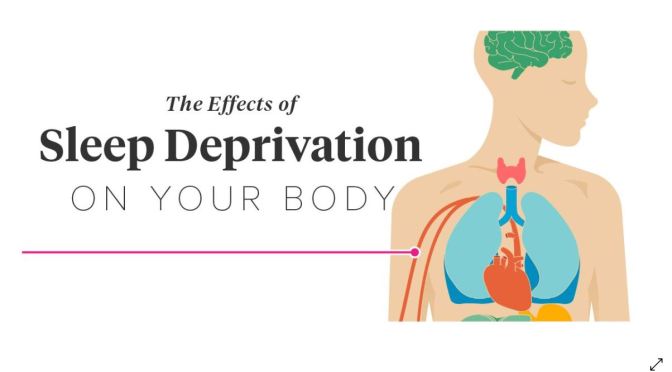
Studies: Chronic Sleep Deprivation Causes Toxic Changes In Gut Health, Increased Early Mortality

From Harvard Medical School (June 4, 2020):

“We took an unbiased approach and searched throughout the body for indicators of damage from sleep deprivation. We were surprised to find it was the gut that plays a key role in causing death,” said senior study author Dragana Rogulja, assistant professor of neurobiology in the Blavatnik Institute at HMS.

Harvard Medical SchoolThe first signs of insufficient sleep are universally familiar. There’s tiredness and fatigue, difficulty concentrating, perhaps irritability or even tired giggles. Far fewer people have experienced the effects of prolonged sleep deprivation, including disorientation, paranoia, and hallucinations.

Total, prolonged sleep deprivation, however, can be fatal. While it has been reported in humans only anecdotally, a widely cited study in rats conducted by Chicago-based researchers in 1989 showed that a total lack of sleep inevitably leads to death. Yet, despite decades of study, a central question has remained unsolved: Why do animals die when they don’t sleep?

Now, Harvard Medical School (HMS) neuroscientists have identified an unexpected, causal link between sleep deprivation and premature death.
Read full article

Infographics: “The New Normal” Post Covid-19

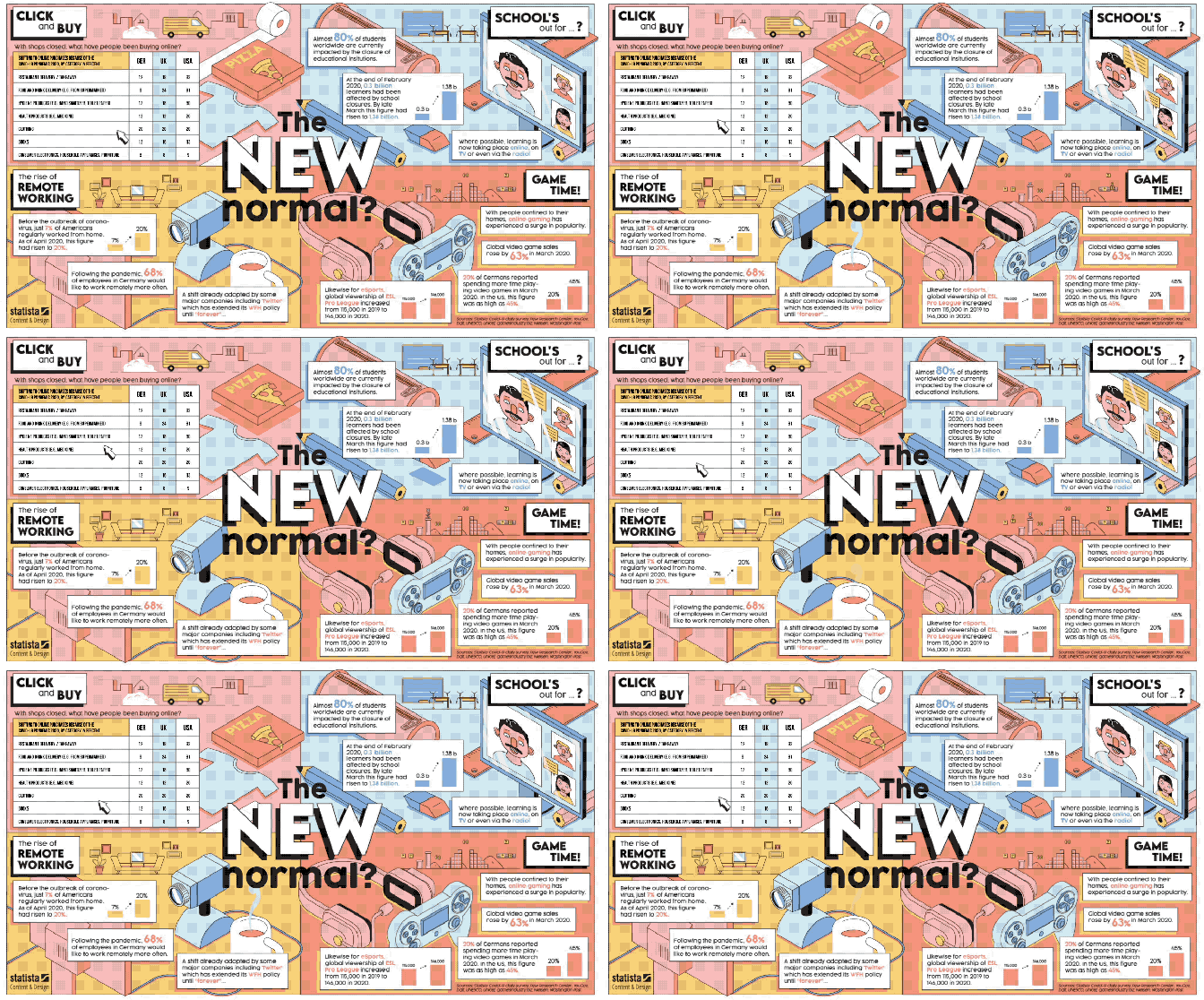
The new normal?


Statista LogoIt is impossible to ignore the ongoing impact the Covid-19 pandemic is having on our lives. This month our infographic shows how some aspects of daily life have changed as a result. The widespread closure of schools, for example, is thought to have affected up to 1.38 billion learners as of late March. Meanwhile, the sudden shift to remote working is one such change expected to have long-lasting effects. Following the pandemic, 68% of Germans have stated they would like to work remotely more often.


Our designer Raphael Hammer has created an isometric-style illustration, with each topic area allocated its own quarter of the infographic. Each topic is then afforded its own principle colour and corresponding design details. The almost monochrome effect of the illustrations allows them to perfectly complement the data presented. Especially effective, are the subtle movements which bring the entire graphic to life.

Website

Technologies: New Plant-Based Plastics & Waste Plastic Into Hydrogen

Plastic has become a malevolent symbol of our wasteful society. It’s also one of the most successful materials ever invented: it’s cheap, durable, flexible, waterproof, versatile, lightweight, protective and hygienic.

During the coronavirus pandemic, plastic visors, goggles, gloves and aprons have been fundamental for protecting healthcare workers from the virus. But what about the effects on the environment of throwing away huge numbers of single-use medical protection equipment? How are we to balance our need for plastic with protecting the environment?

Delayed as a result of the pandemic, the film is being released now because it considers how society might ‘reset the clock’ when it comes to living better with a vital material.

We hear how Cambridge University’s Cambridge Creative Circular Plastics Centre (CirPlas) aims to eliminate plastic waste by combining blue-sky thinking with practical measures – from turning waste plastic into hydrogen fuel, to manufacturing more sustainable materials, to driving innovations in plastic recycling in a circular economy.

“As a chemist I look at plastic and I see an extremely useful material that is rich in chemicals and energy – a material that shouldn’t end up in landfills and pollute the environment,” says Professor Erwin Reisner, who leads CirPlas, funded by UK Research and Innovation.

“Plastic is an example of how we must find ways to use resources without irreversibly changing the planet for future generations.”

Explore more: CirPlas: https://www.energy.cam.ac.uk/Plastic_…


Top New Science Podcasts: Higher Covid-19 Severity In Men, Bacteria Tracking

science-magazine-podcastsFirst up this week, Staff Writer Meredith Wadman talks with host Sarah Crespi about how male sex hormones may play a role in higher levels of severe coronavirus infections in men. New support for this idea comes from a study showing high levels of male pattern baldness in hospitalized COVID-19 patients.
Next, Jason Qian, a Ph.D. student in the systems biology department at Harvard Medical School, joins Sarah to talk about an object-tracking system that uses bacterial spores engineered with unique DNA barcodes. The inactivated spores can be sprayed on anything from lettuce, to wood, to sand and later be scraped off and read out using a CRISPR-based detection system. Spraying these DNA-based identifiers on such things as vegetables could help trace foodborne illnesses back to their source. Read a related commentary piece.

Art History Videos: Italian Early Renaissance Painter Sandro Botticelli (15th C.)

An extract from the Christie’s Education online course, The Great Masters of European Art 1350–1850. Florence in the 1400s, a city of wealthy guilds and merchants, in particular the Medici family, who commissioned astonishing works of art to show off their success and cultivation.

Here we are introduced to one of the great artists the Medicis favoured: Sandro Botticelli, and his most famous works: ‘Primavera’ and ‘The Birth of Venus’.

Alessandro di Mariano di Vanni Filipepi (c. 1445 – May 17, 1510), known as Sandro Botticelli, was an Italian painter of the Early Renaissance. He belonged to the Florentine School under the patronage of Lorenzo de’ Medici, a movement that Giorgio Vasari would characterize less than a hundred years later in his Vita of Botticelli as a “golden age”. Botticelli’s posthumous reputation suffered until the late 19th century; since then, his work has been seen to represent the linear grace of Early Renaissance painting.

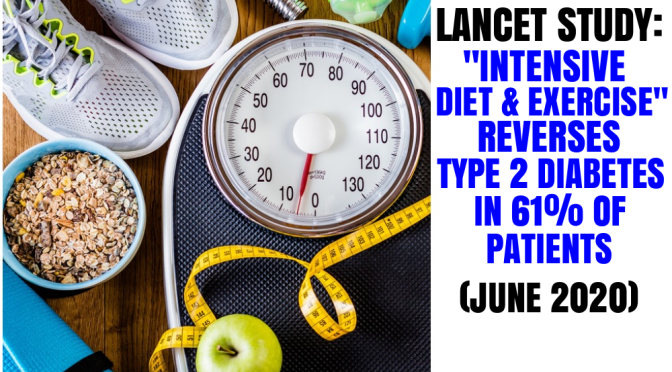
Study: “Intensive Diet And Exercise” Reverses Type 2 Diabetes In 61% Of Patients

From The Lancet Diabetes & Endocrinology (June 2020):

Our findings show that the intensive lifestyle intervention led to significant weight loss at 12 months, and was associated with diabetes remission in over 60% of participants and normoglycaemia in over 30% of participants. The provision of this lifestyle intervention could allow a large proportion of young individuals with early diabetes to achieve improvements in key cardiometabolic outcomes, with potential long-term benefits for health and wellbeing.

The Lancet Diabetes & Endocrinology

Type 2 diabetes is affecting people at an increasingly younger age, particularly in the Middle East and in north Africa. We aimed to assess whether an intensive lifestyle intervention would lead to significant weight loss and improved glycaemia in young individuals with early diabetes.
.
Between July 16, 2017, and Sept 30, 2018, we enrolled and randomly assigned 158 participants (n=79 in each group) to the study. 147 participants (70 in the intervention group and 77 in the control group) were included in the final intention-to-treat analysis population. Between baseline and 12 months, the mean bodyweight of participants in the intervention group reduced by 11·98 kg (95% CI 9·72 to 14·23) compared with 3·98 kg (2·78 to 5·18) in the control group (adjusted mean difference −6·08 kg [95% CI −8·37 to −3·79], p<0·0001). In the intervention group, 21% of participants achieved more than 15% weight loss between baseline and 12 months compared with 1% of participants in the control group (p<0·0001). Diabetes remission occurred in 61% of participants in the intervention group compared with 12% of those in the control group (odds ratio [OR] 12·03 [95% CI 5·17 to 28·03], p<0·0001). 33% of participants in the intervention group had normoglycaemia compared with 4% of participants in the control group (OR 12·07 [3·43 to 42·45], p<0·0001).
.

Podcast Interviews: 56-Year Old British Writer Julia Hobsbawm – “The Simplicity Principle”

JMonocle 24 Meet The Writersulia Hobsbawm is a writer, speaker, social entrepreneur and strategist whose work focuses on finding solutions for humans in an ever-changing world. She speaks to Georgina Godwin about her latest book, ‘The Simplicity Principle: Six Steps Towards Clarity in a Complex World’.

Podcasts Interviews: The Diagnosis And Early Treatment Of Covid-19

In this audio interview conducted on June 3, 2020, the editors discuss two new studies: one comparing test swabs collected by health care workers with swabs collected by the patients themselves and one assessing hydroxychloroquine treatment in people who had been exposed to Covid-19 but weren’t yet ill.

The continuing spread of SARS-CoV-2 remains a Public Health Emergency of International Concern. What physicians need to know about transmission, diagnosis, and treatment of Covid-19 is the subject of ongoing updates from infectious disease experts at the Journal.

Eric Rubin is the Editor-in-Chief of the Journal. Lindsey Baden is a Deputy Editor of the Journal. Stephen Morrissey, the interviewer, is the Executive Managing Editor of the Journal.

News, Views and Reviews For The Intellectually Curious