Category Archives: Art

Travel & Architecture: 14th Century Florence Baptistery Restoration

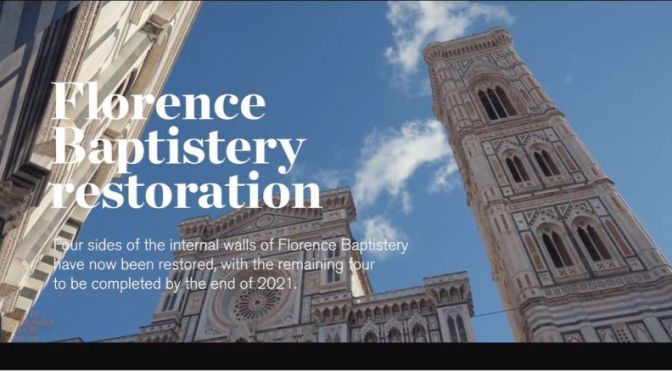
Four sides of the internal walls of Florence Baptistery have been restored, with the remaining four to go by the end of 2021. “Here come all those who wish to see admirable things” is the English translation of the words set in the marble inlay of the floor of Florence’s baptistery, as visitors enter through the Gates of Paradise.

These worthy items include the fourteenth-century mosaics depicting prophets, bishops and cherubs, which are enjoying renewed vigour after the restoration of four of the eight sides of Florence’s oldest monument. The internal walls of the baptistery began to be restored towards the end of 2017 following a restoration campaign on the external walls and roof.

Many discoveries emerged from the diagnostics, the first of their kind to be conducted on the monument, including the original technique used in the parietal mosaics; the presence of a pigmented wax on the green Prato marble, used to cover the white limestone that had formed due to water coming in through the roof, now removed to reveal the stone’s natural hue; and traces of gold leaf on one of the capitals of the matroneum, which could form evidence that the capitals were all originally covered in gold leaf.

In the first couple of decades of the fourteenth century, having completed the colossal feat of the mosaics inside the baptistery’s dome, the decision was made to extend the technique to the parietal sides, something that wasn’t part of the original plans.

It was a solution that allowed the mosaics to be superimposed over the marble covering and solve the issue of the monument’s static nature. Made-to-measure hollow terracotta tiles were used, cut and fixed to the marble on the baptistery’s walls with central iron linchpins driven back and welded in a straight line.

“A hurried sinopia was then conducted on the tiles and later the mosaic with a direct method and over days, which can still be identified and interpreted today,” explained Beatrice Agostini, planner and head of the restoration campaign of Opera di Santa Maria del Fiore. “Even the mixture used to apply the mosaic tiles is absolutely unique. Ordinary mortar wasn’t used. Instead it was more of a glue, and it’s the decline of this compound that has caused the most problems in this restoration.”

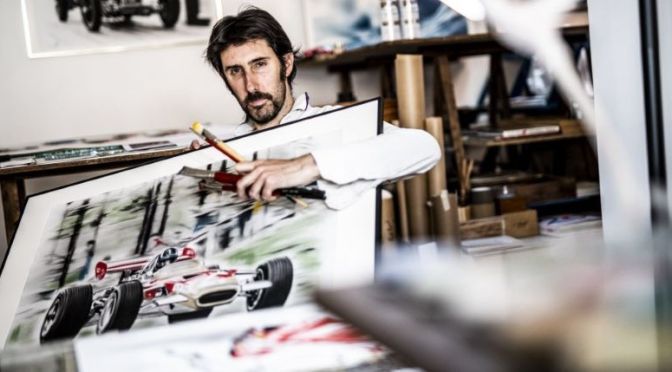
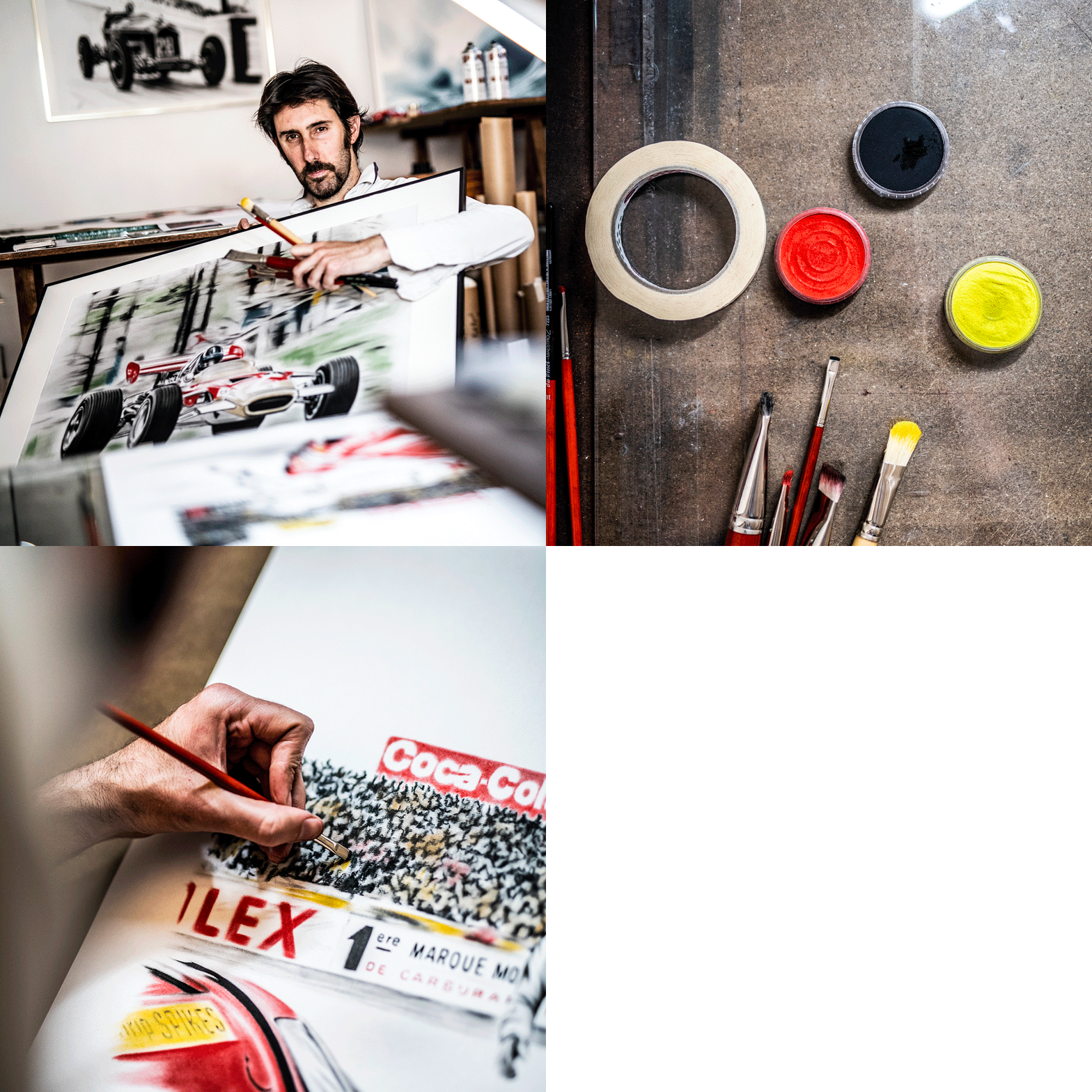
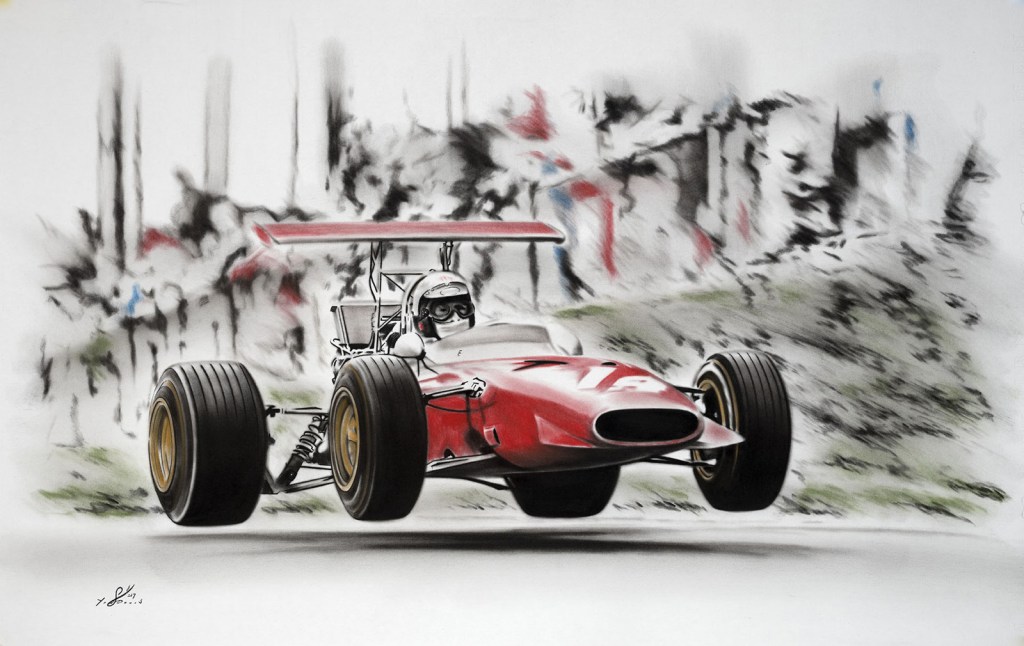
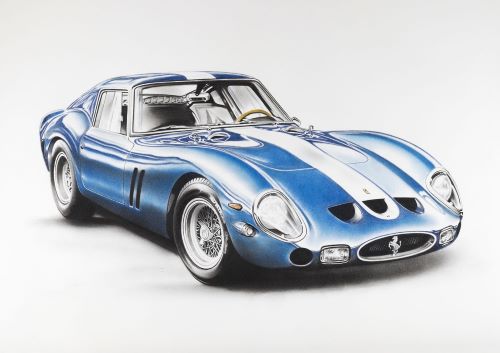
Art & Auto Racing: French Artist Yan Denes’ “Blur & Movement Of The 1960’s”

“My primary era is clearly the ’60s,” he says. “For these scenes, I use period photos with the agreement of their photographer and allow myself some freedom on the framing, for example. I like racing cars, and if they have flaws or imperfections, I represent them faithfully, of course.”

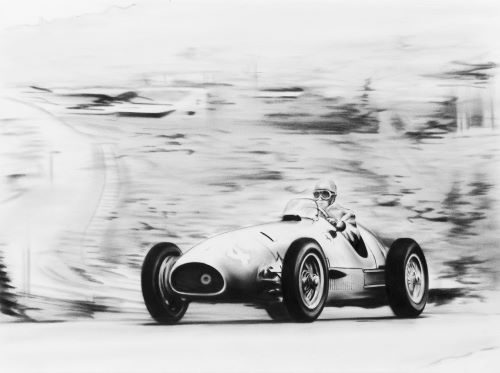
“My master is Leonardo da Vinci, who is the ultimate reference in drawing because of his mastery of blur and movement,” he says. “There’s an indeterminate aspect to these drawings that’s essential. It reminds me of Picasso’s famous phrase ‘finishing a drawing, what a horror’ – that’s exactly it, I always leave an area of blur and a part of emptiness. The viewer fills that space with their experience, their story. In this way, a drawing is simply an exchange – an encounter between two people.”

Few artists, like Yan Denes, understand how to make the thrill of speed tangible for the observer with pen and paper. Not only did he design Scuderia Ferrari’s anniversary helmets in Formula 1, but he is also inspired by historic motorsport.

While the vast majority of Denes’ commissions come from owners of modern Ferrari race cars such as the 360 Challenge, 430 GT2, 488 GT3 and FXX, Yan is actually better known for his passion for historic racing scenes.

It has to be said that Denes is a virtuoso when it comes to transcribing speed and movement.

Read more at Classic Driver

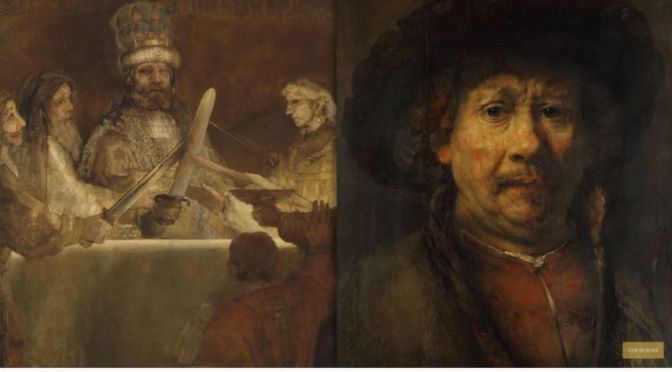
Art: ‘Rembrandt – Master Of The Dutch Golden Age’

Arguably the greatest master of the Dutch Golden Age, Rembrandt is famed for several types of works: his monumental history paintings, his self-portraits and, as beautifully exemplified by the transcendent Abraham and the Angels, his intimate biblical scenes.

Rembrandt Harmenszoon van Rijn was a Dutch draughtsman, painter, and printmaker. An innovative and prolific master in three media, he is generally considered one of the greatest visual artists in the history of art and the most important in Dutch art history.

The Dutch Golden Age was a period in the history of the Netherlands, roughly spanning the era from 1581 to 1672, in which Dutch trade, science, and art and the Dutch military were among the most acclaimed in the world. The first section is characterized by the Eighty Years’ War, which ended in 1648.

Cocktails With A Curator: Boucher’s “Four Seasons”

In this week’s episode of “Cocktails with a Curator,” take a closer look at the extraordinary flickers of paint in the colorful canvases of François Boucher’s Four Seasons series with Deputy Director and Peter Jay Sharp Chief Curator Xavier F. Salomon. Acquired by Henry Clay Frick late in life, the four paintings were commissioned by Boucher’s great patron Madame de Pompadour—the longtime mistress of King Louis XV—to be placed over doors, hence their unusual shape. The complementary cocktail this week is the Time Regained.

To view these paintings in detail, please visit our website: https://www.frick.org/fourseasons

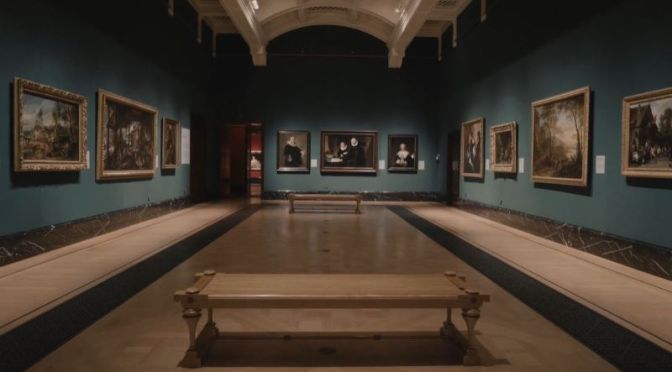
Art: ‘Masterpieces From Buckingham Palace – A Curator’s Tour’ (Video)

Join exhibition curators Desmond Shawe-Taylor and Isabella Manning as they tour the highlights of the exhibition ‘Masterpieces from Buckingham Palace’. With an introduction from Director of the Royal Collection Tim Knox.

The exhibition brings together some of the most important paintings in the Royal Collection from the Picture Gallery at Buckingham Palace. Usually on public view during the annual Summer Opening of the Palace, the paintings will be shown in The Queen’s Gallery while Reservicing works are carried out to protect the historic building for future generations. The Picture Gallery was originally designed by the architect John Nash for George IV to display his collection of Dutch, Flemish and Italian Old Master paintings. Artists represented in the exhibition include Titian, Guercino, Guido Reni, Vermeer, Rembrandt, van Dyck, Rubens, Jan Steen, Claude and Canaletto.

For more information

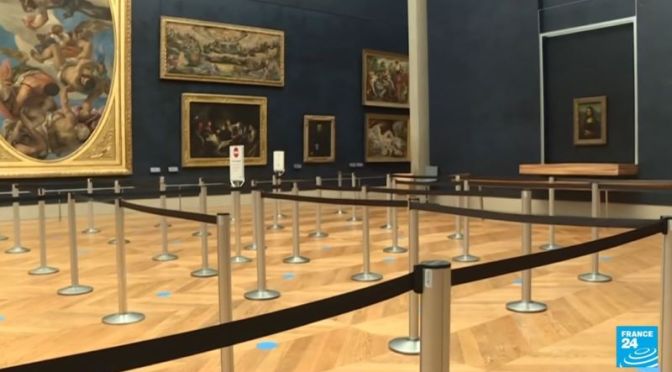
The Arts: ‘Louvre Museum’ In Paris Revives As Visitors Drop 72% In 2020 (Video)

After six months of cumulative closure since the beginning of the health crisis and only a reopening for a few short months between two confinements this summer, the #Louvre​ lost 72% of attendance by 2020. But despite the absence of visitors, the heart of the museum has not completely stopped beating. The Louvre is even taking advantage of this period to carry out #renovations​.

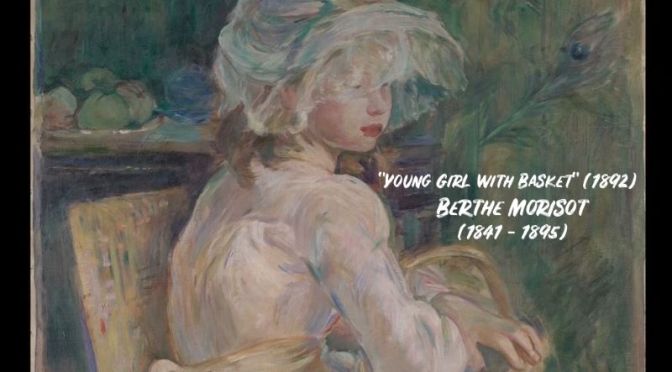
Art: French Impressionist Berthe Morisot’s ‘Young Girl With A Basket’ (Video)

Berthe Marie Pauline Morisot was a French painter and a member of the circle of painters in Paris who became known as the Impressionists. In 1864, Morisot exhibited for the first time in the highly esteemed Salon de Paris.

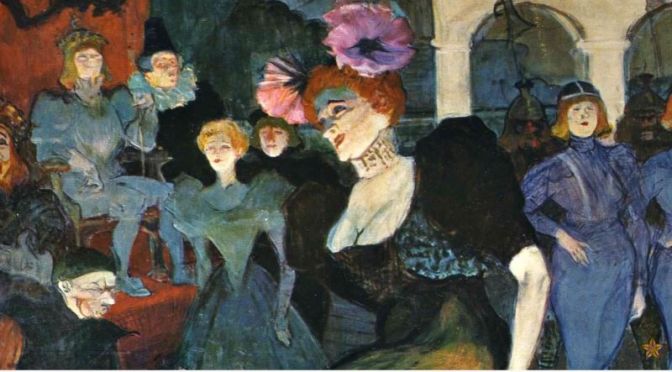
Art Views: French Painter & Illustrator Henri de Toulouse-Lautrec (Video)

Henri Marie Raymond de ToulouseLautrec-Monfa (24 November 1864 – 9 September 1901) was a French painter, printmaker, draughtsman, caricaturist and illustrator whose immersion in the colorful and theatrical life of Paris in the late 19th century allowed him to produce a collection of enticing, elegant, and provocative …

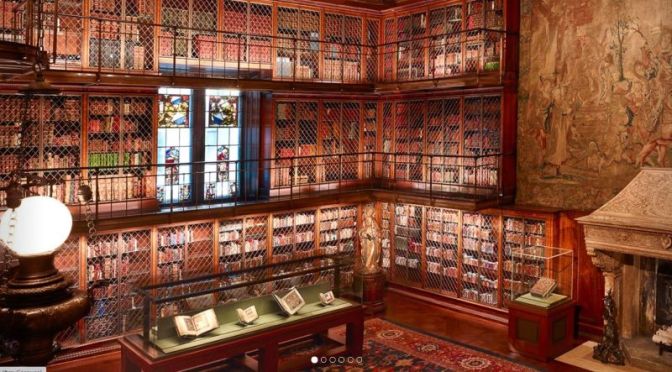
Arts & Literature: ‘The Morgan Library & Museum’

The Morgan Library & Museum, formerly the Pierpont Morgan Library, is a museum and research library in the Murray Hill neighborhood of Manhattan, New York City. It is situated at 225 Madison Avenue, between 36th Street to the south and 37th Street to the north. 

A complex of buildings in the heart of New York City, The Morgan Library & Museum began as the private library of financier Pierpont Morgan (1837–1913), one of the preeminent collectors and cultural benefactors in the United States. As early as 1890 Morgan had begun to assemble a collection of illuminated, literary, and historical manuscripts, early printed books, and old master drawings and prints.

Mr. Morgan’s library, as it was known in his lifetime, was built between 1902 and 1906 adjacent to his New York residence at Madison Avenue and 36th Street. Designed by Charles McKim of the architectural firm McKim, Mead & White, the library was intended as something more than a repository of rare materials. Majestic in appearance yet intimate in scale, the structure was to reflect the nature and stature of its holdings. The result was an Italian Renaissance-style palazzo with three magnificent rooms epitomizing America’s Age of Elegance. Completed three years before McKim’s death, it is considered by many to be his masterpiece. In 1924, eleven years after Pierpont Morgan’s death, his son, J. P. Morgan, Jr. (1867–1943), known as Jack, realized that the library had become too important to remain in private hands. In what constituted one of the most momentous cultural gifts in U.S. history, he fulfilled his father’s dream of making the library and its treasures available to scholars and the public alike by transforming it into a public institution.

Over the years—through purchases and generous gifts—The Morgan Library & Museum has continued to acquire rare materials as well as important music manuscripts, early children’s books, Americana, and materials from the twentieth century. Without losing its decidedly domestic feeling, the Morgan also has expanded its physical space considerably.

In 1928, the Annex building was erected on the corner of Madison Avenue and 36th Street, replacing Pierpont Morgan’s residence. The Annex connected to the original McKim library by means of a gallery. In 1988, Jack Morgan’s former residence—a mid-nineteenth century brownstone on Madison Avenue and 37th Street—also was added to the complex. The 1991 garden court was constructed as a means to unite the various elements of the Morgan campus.

The largest expansion in the Morgan’s history, adding 75,000 square feet to the campus, was completed in 2006. Designed by Pritzker Prize–winning architect Renzo Piano, the project increases exhibition space by more than fifty percent and adds important visitor amenities, including a new performance hall, a welcoming entrance on Madison Avenue, a new café and a new restaurant, a shop, a new reading room, and collections storage. Piano’s design integrates the Morgan’s three historical buildings with three new modestly scaled steel-and-glass pavilions. A soaring central court connects the buildings and serves as a gathering place for visitors in the spirit of an Italian piazza.

Cocktails With A Curator: Meissen “Swan Service”

This week’s episode of “Cocktails with a Curator” is a story of creation and destruction. Join Deputy Director and Peter Jay Sharp Chief Curator Xavier F. Salomon as he examines two pieces of the legendary Meissen “Swan Service,” which was all but destroyed during World War II when Russian soldiers ransacked a palace in the Polish village of Brody. This opulent set of dishes was given by Augustus III, King of Poland, to the statesman Heinrich von Brühl, who helped engineer Augustus’s ascent to the throne in 1734. Originally comprised of 2,200 intricately designed pieces, only about 100 pieces survive. This week’s complementary cocktail is a spiked hot chocolate.

Meissen porcelain or Meissen china was the first European hard-paste porcelain. Early experiments were done in 1708 by Ehrenfried Walther von Tschirnhaus.

To view these objects in detail, please visit our website: https://www.frick.org/swanmeissen