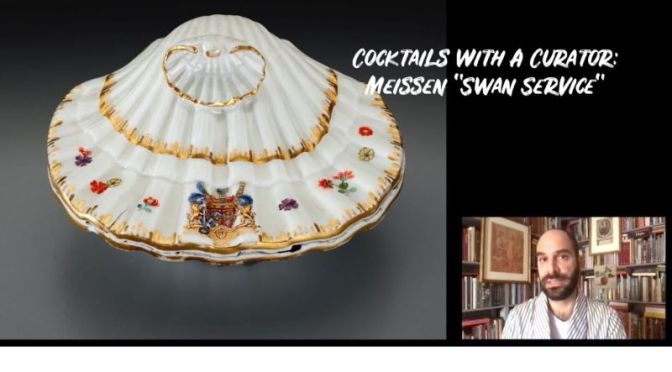
This week’s episode of “Cocktails with a Curator” is a story of creation and destruction. Join Deputy Director and Peter Jay Sharp Chief Curator Xavier F. Salomon as he examines two pieces of the legendary Meissen “Swan Service,” which was all but destroyed during World War II when Russian soldiers ransacked a palace in the Polish village of Brody. This opulent set of dishes was given by Augustus III, King of Poland, to the statesman Heinrich von Brühl, who helped engineer Augustus’s ascent to the throne in 1734. Originally comprised of 2,200 intricately designed pieces, only about 100 pieces survive. This week’s complementary cocktail is a spiked hot chocolate.
Meissen porcelain or Meissen china was the first European hard-paste porcelain. Early experiments were done in 1708 by Ehrenfried Walther von Tschirnhaus.
Ordering plants by post mostly from Italy, Germany, North Africa, and even the Cape of Good Hope, the Nuremberg merchant Volkamer was a devotee of the fragrant and exotic citrus at a time when such fruits were still largely unknown north of the Alps.
Famous First Edition: First printing of 5,000 numbered copies
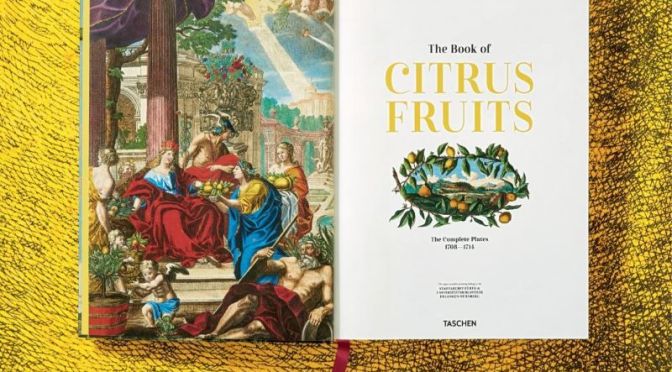
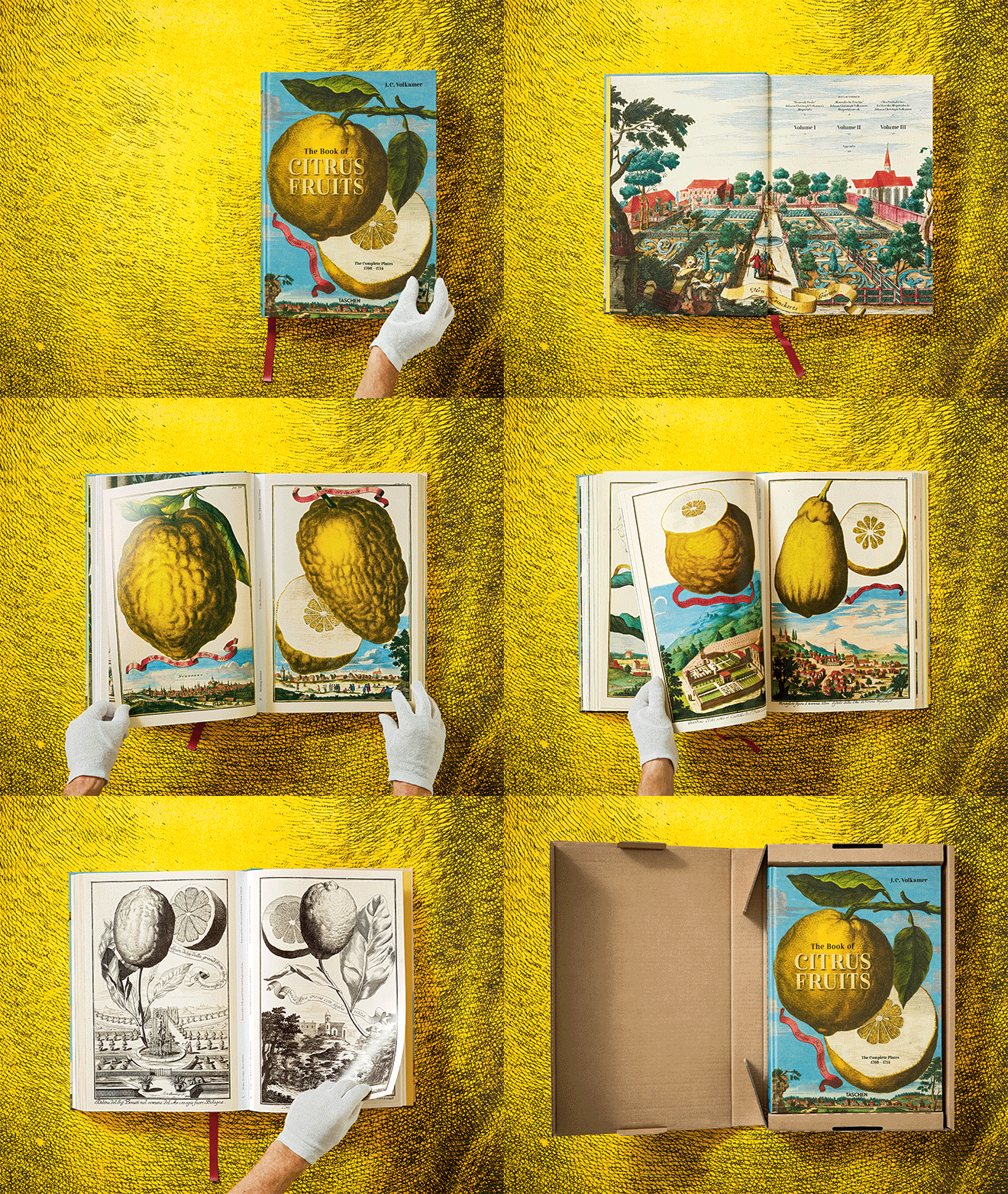
Have you ever thought of citrus fruits as celestial bodies, angelically suspended in the sky? Perhaps not, but J. C. Volkamer (1644–1720) did—commissioning an extravagant and breathtaking series of large-sized copperplates representing citrons, lemons, and bitter oranges in surreal scenes of majesty and wonder.
His garden came to contain a wide variety of specimens, and he became so obsessed with the fruits that he commissioned a team of copperplate engravers to create 256 plates of 170 varieties of citrus fruits, many depicted life size, published in a two-volume work.
In both volumes, Volkamer draws on years of hands-on experience to present a far-reaching account of citrus fruits and how to tend them—from a meticulous walk-through of how to construct temporary orangeries, glasshouses, and hothouses for growing pineapples to commentary on each fruit variety, including its size, shape, color, scent, tree or shrub, leaves, and country of origin.
In each plate, Volkamer pays tribute to the verdant landscapes of Northern Italy, his native Nuremberg, and other sites that captured his imagination. From Genovese sea views to the Schönbrunn Palace, each locale is depicted in the same exceptionaldetail as the fruit that overhangs it. We witness branches heavy with grapefruits arching across a sun-bathed yard in Bologna and marvel at a huge pineapple plant sprouting from a South American town. The result is at once a fantastical line-up of botanical beauty and a highly poetic tour through the lush gardens and places where these fruits grew.
Few colored sets of Volkamer’s work are still in existence today. This publication draws on the two recently discovered hand-colored volumes in the city of Fürth’s municipal archive in Schloss Burgfarrnbach. The reprint also includes 56 newly discovered illustrations that Volkamer intended to present in a third volume.
The author
Iris Lauterbachstudied art history and romance languages and literature in Mainz, Pavia and Paris and obtained her doctorate in 1985. Since 1991 she has been a member of the research department of the Central Institute for Art History in Munich and teaches the history of garden architecture at the Technical University in Munich. Her main areas of research include France during the 18th century and the history of European garden art from the 16th to the 20th century, while she has also carried out extensive research about the restitution of artworks that were looted during the Second World War.
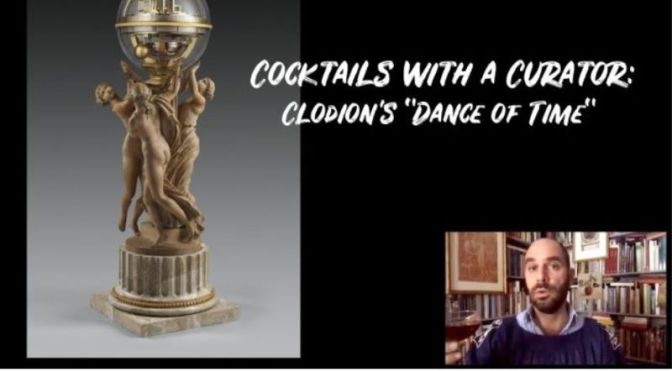
In this week’s episode of “Cocktails with a Curator,” toast the new year with Deputy Director and Peter Jay Sharp Chief Curator Xavier F. Salomon as he examines a masterpiece of both sculpture and clockmaking: “The Dance of Time,” by Clodion (Claude Michel) and Jean-Baptiste Lepaute. In this 18th-century timepiece, three terracotta nymphs or Hours dance in a circle around an exquisite mechanism enclosed in a glass globe. The Frick has one of the country’s most important collections of clocks, many of which came to the museum through a gift from Winthrop Kellogg Edey. Welcome 2021 by raising a Metropolitan cocktail—Happy New Year!
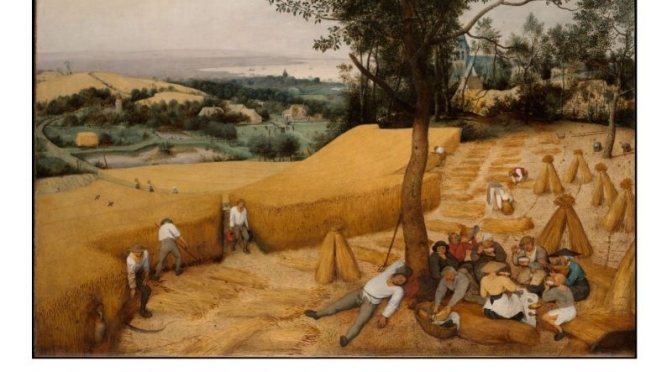
Artist: Pieter Bruegel the Elder (Netherlandish, Breda ca. 1525–1569 Brussels) Title: The Harvesters
The Harvesters is an oil painting on wood completed by Pieter Bruegel the Elder in 1565. It depicts the harvest time, in the months of July and August or late summer. Nicolaes Jonghelinck, a merchant banker and art collector from Antwerp, commissioned this painting.
Pieter Bruegel the Elder was the most significant artist of Dutch and Flemish Renaissance painting, a painter and printmaker, known for his landscapes and peasant scenes; he was a pioneer in making both types of subject the focus in large paintings.
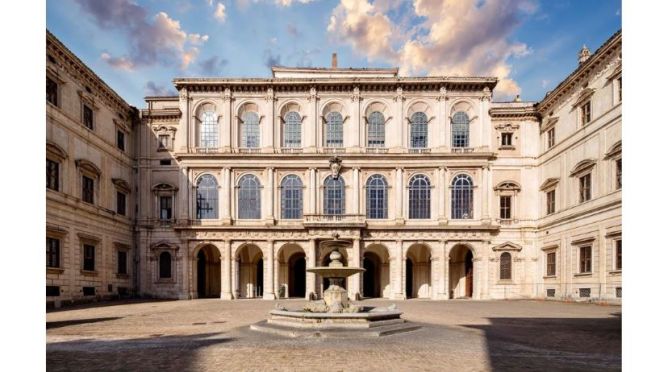
Palazzo Barberini is an imposing Baroque building that houses the Galleria Nazionale d’Arte Antica, the National Gallery of Ancient Art. Commissioned by Pope Urban VIII, the mansion was the most elegant and luxurious villa of the period.
In 1623, Maffeo Barberini, once made Pope (Pope Urban VIII), ordered the construction of the estate to Italian architect Carlo Maderno, who is responsible for the design of St Peter’s Basilica’s façade. The construction started in 1625 and was finished in 1633 by Bernini, after Maderno’s death.
In 1949, the Italian State bought the palazzo to house the Galleria Nazionale d’Arte Antica, which was created from the donations of pieces of art by several noble Italian families.
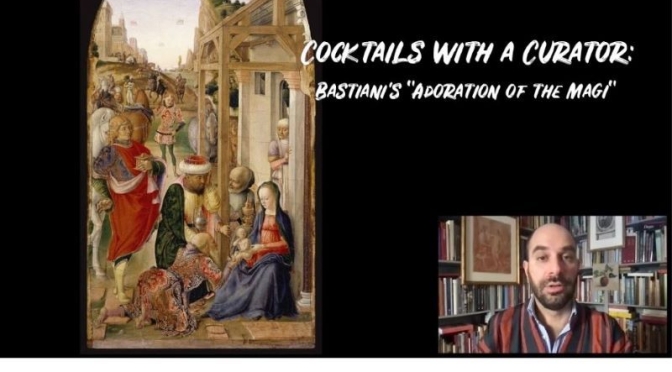
In this week’s episode of “Cocktails with a Curator,” celebrate the Yuletide with Deputy Director and Peter Jay Sharp Chief Curator Xavier F. Salomon as he takes a closer look at Lazzaro Bastiani’s “Adoration of the Magi.” Acquired from Pierpont Morgan’s heirs in 1935—the year The Frick Collection opened to the public—this fascinating picture shows the gift-toting kings on different stages of their journey from Jerusalem to Bethlehem. A contemporary of Giovanni Bellini, Bastiani was considered the artist’s equal at the time and commanded similar prices for his pictures. Explore the work of this magnificent but under-appreciated artist while enjoying a festive Cranberry Bourbon cocktail—Merry Christmas!
Lazzaro Bastiani was an Italian painter of the Renaissance, active mainly in Venice. He was born in Padua. He is first recorded as a painter in Venice by 1460 in a payment for an altarpiece of San Samuele, for the Procuratori di San Marco. In 1462 he was paid at the same rate as Giovanni Bellini.
Spinario (Boy with Thorn), c. 1st century B.C.E., bronze, 73 cm high (Capitoline Museums, Rome), a conversation with Dr. Steven Zucker and Dr. Beth Harris
Sir Cedric Lockwood Morris, 9th Baronet was a British artist, art teacher and plantsman. He was born in Swansea in South Wales, but worked mainly in East Anglia. As an artist he is best known for his portraits, flower paintings and landscapes
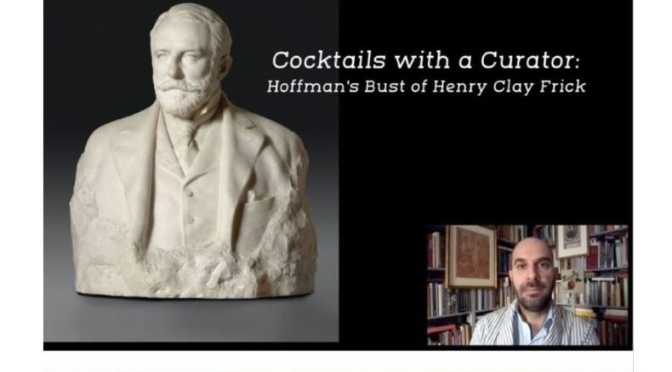
In this week’s episode of “Cocktails with a Curator,” Deputy Director and Peter Jay Sharp Chief Curator Xavier F. Salomon takes a closer look at Malvina Cornell Hoffman’s marble bust of Henry Clay Frick, the museum’s founder, and considers the complicated legacy of the Pennsylvania-born industrialist. This month marks several important milestones for the Frick, including the eighty-fifth anniversary of the opening of a museum for, in Frick’s words, “all persons whomsoever.” This oft-overlooked bust was commissioned by his daughter, Helen Clay Frick, and for many years welcomed guests in the Entrance Hall at 1 East 70th Street. This week’s complementary cocktail is the Old Fashioned, a nod to Frick’s first job as an accountant for the family whiskey distillery.
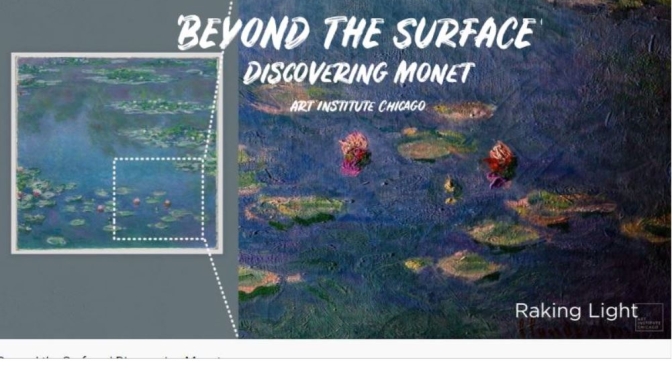
This video takes an in-depth look at Monet’s approach to painting in series, an approach that consumed his later years. From stacks of wheat in the French countryside to sites of foggy London to water lilies at his home garden in Giverny, Monet painted beloved subjects again and again, depicting changing light and atmospheric conditions in works that captivate us still today. New scientific discoveries, however, reveal that Monet’s genius goes well beyond what we see on the surface.



 Boomers Daily