
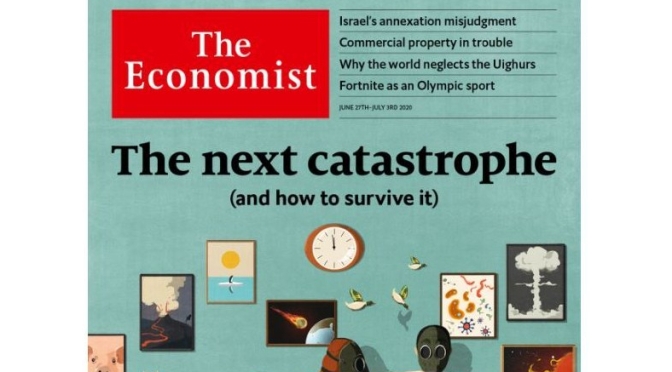
 A selection of three essential articles read aloud from the latest issue of The Economist. This week, the next catastrophe and how to survive it; (9:40) the risks of annexation for Israel; (21:50) and the Wirecard scandal.
Monthly Archives: June 2020

Top New Travel Videos: “Timelapse Showreel 4K” By Martien Janssen (2020)
Filmed and Edited by: Martien Janssen
A 60 second compilation of some of my favourite timelapse footage shot during my travels in Philippines, Indonesia, and Myanmar. Visit my Travel Imagez website for all related blogposts, travel guides, free ebooks, photos & videos.
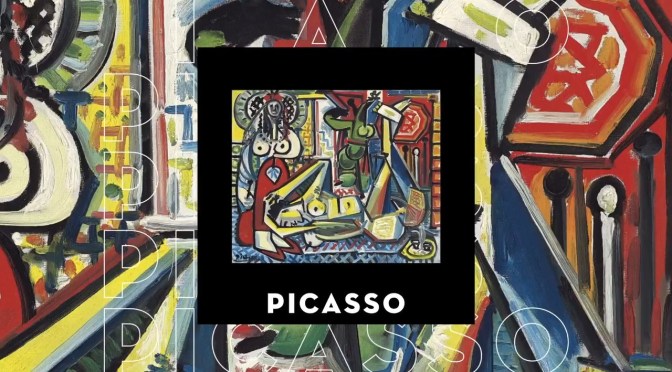
Art History Videos: Pablo Picasso’s “Les Femmes d’Alger – 1955” (Christie’s)
 Between 13 December 1954 and 14 February 1955, Picasso painted a series of fifteen canvases based on Eugène Delacroix’s masterwork Les femmes d’Alger, each of which he assigned an identifying letter from A to O. Together, these paintings constitute Picasso’s single greatest achievement in the decades following the end of the Second World War. They represent his first comprehensive appropriation and thoroughgoing exploration of an important painting by an earlier artist, as well as the most focused analysis he had done since the war years of the female figure set within a specific spatial environment.
Picasso painted the present Femmes d’Alger, Version F on 17 January 1955, around the halfway point in the cycle. It is the culminating, most fully resolved canvas from the first phase of the series, when Picasso favored medium-sized formats for his protean explorations.

Future Homes: “Modular Water Dwellings” By Grimshaw Architects
The Water Dwellings use minimal energy, with well-insulated and shaded lower pontoons and upper stories, and energy provided by solar roof panels and heat exchangers built into base boxes below the waterline. By developing a communal energy supply, the Water Dwellings’ environmental efficiency has the potential to achieve near zero energy use.

Global design practice Grimshaw and Dutch manufacturing specialists Concrete Valley have developed an innovative design for Modular Water Dwellings, in response to the growing risks of climate change and the challenges of increasing urbanisation.

 The Modular Water Dwellings incorporate standardised components that provide efficiency in manufacturing, while still allowing a variety of internal layouts for occupants’ individual requirements. The Dwellings can be orientated and spaced in different ways, responding to varying site contexts, local conditions, light sources and primary views. They also maximise the use of durable and non-corroding materials, such as concrete and glass, ensuring a long design life that anticipates multiple occupants.
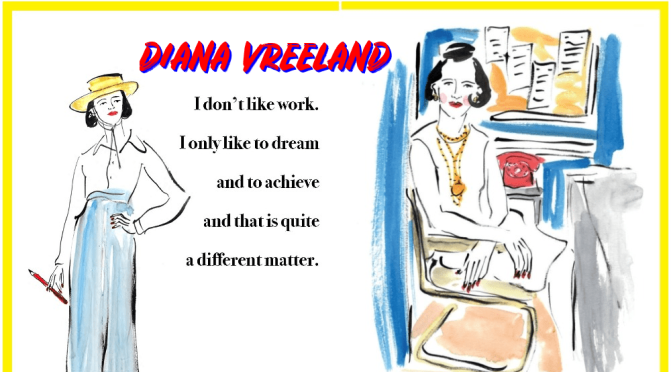
Podcast Interviews: Alexander Vreeland On His Fashion Journalist Grandmother “Diana”
 Alexander Vreeland, grandson of fashion journalist Diana Vreeland, tells us about his new book, ‘Bon Mots: Words of Wisdom from the Empress of Fashion’.
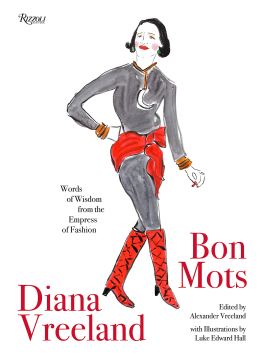 Diana Vreeland’s insightful edicts and evocative aphorisms remain her strongest legacy. She looked at life as a romantic and lived through dreams and imagination. Showing leadership, vision, and timeless wit, this book celebrates her visionary words that not only transformed the world of fashion, but also gave us sage advice to live by.
Sourced and edited by her grandson Alexander, Diana Vreeland: Bon Mots covers Vreeland’s incisive views of subjects such as allure, fashion, and style (“I mean, a new dress doesn’t get you anywhere; it’s the life you’re living in the dress”); beauty (“The neck is the beginning and end of looking like anybody”); age (“The quickest way to show your age is to try to look young”); color (“Black is the hardest color to get right–except for gray”); and her powerfully creative way of thinking (“I’m looking for the suggestion of something I’ve never seen”) Brought to life by illustrator Luke Edward Hall, Bon Mots vividly displays Mrs. Vreeland’s original thought and speech, which is equally as inspiring and relevant now as it was then.
About the Author
Diana Vreeland (1903-1989) joined Harper’s Bazaar as fashion editor in 1936; was the editor in chief of Vogue from 1962 to 1971; and later oversaw the Costume Institute at the Metropolitan Museum of Art. Alexander Vreeland has had an extensive career in fashion and beauty and is the president of the Diana Vreeland Estate and the author of Diana Vreeland Memos (Rizzoli, 2013) and Diana Vreeland: The Modern Woman (Rizzoli, 2015). Luke Edward Hall is a London-based artist and designer.

Art Profiles: 99-Year Old American Painter Wayne Thiebaud’s “Classic Pop”
From Christie’s (June 27, 2020):
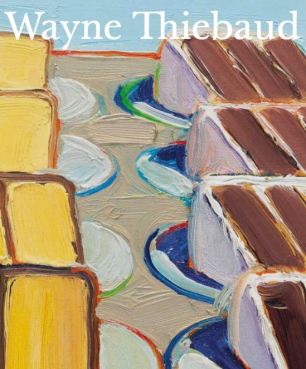 One of the largest canvases from Thiebaud’s groundbreaking early period, it depicts a row of arcade machines, decorated in a vibrant mix of oranges and yellows…With their foreshortened bodies, the machines press towards the picture plane like the cakes and hot dogs in Thiebaud’s other works, inviting the viewer to reach in and taste.
It’s a classic of Pop art, a masterful reflection of the post-war boom in consumerism.
In November 2020, Wayne Thiebaud — the American artist best-known for his still lifes of pies, pastries and other tempting treats — turns 100.
Thiebaud also had a lot of fun with the backglasses: instead of cartoons and flashing lights, he decorated them with the ghostly, geometric forms of Frank Stella’s Concentric Squares, Jasper Johns’ Targets and Ellsworth Kelly’s Colors for a Large Wall.
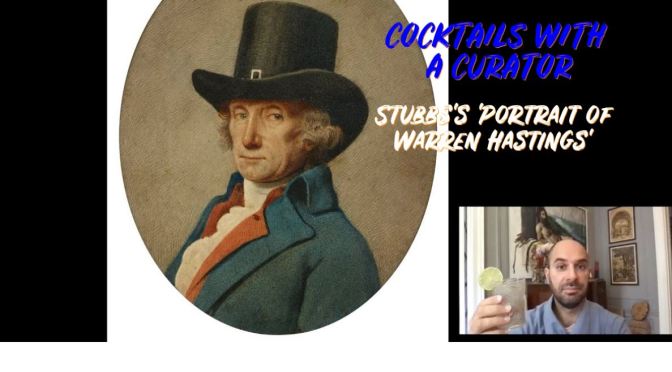
Cocktails With A Curator: “Stubb’s ‘Portrait Of Warren Hastings’ (Frick)
In this week’s episode of “Cocktails with a Curator,” join Deputy Director and Peter Jay Sharp Chief Curator Xavier F. Salomon as he considers the life of statesman Warren Hastings, who is depicted in a small watercolor from about 1791 by the prominent British artist George Stubbs. Explore the tumultuous career of Hastings, from his tenure as governor-general of India to a decade-long trial in Westminster Hall upon his return to England. This week’s complementary cocktail is a gin and tonic garnished with a slice of lime.
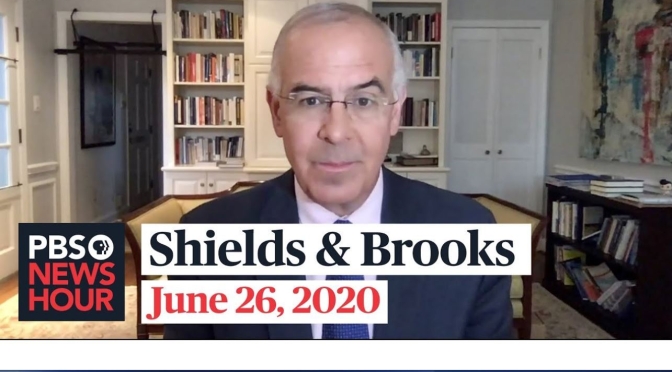
Political News: “Shields & Brooks” On The 2020 Presidential Race (PBS)
Syndicated columnist Mark Shields and New York Times columnist David Brooks join Judy Woodruff to discuss the week in politics, including new polls on the 2020 presidential race and President Trump’s job performance, the federal response to a surging coronavirus pandemic, the administration’s effort to strike down the Affordable Care Act, congressional divergence on police reform and whether Washington, D.C., will become a state.

Interviews: Richard Haass – “The World – A Brief Introduction” (Podcast)
 “The whole lesson of this pandemic, and the whole lesson of 9/11, is we can’t ignore the world, or if we do ignore the world, it’s at our peril,” Haass says. “These oceans that surround us are not moats. We’ve got to pay attention to the world and we’ve got to fix things here at home.”
The ambition of Richard Haass’s new book is clear from its title: “The World: A Brief Introduction.” In just 400 pages, Haass, who has been the president of the nonpartisan Council on Foreign Relations since 2003, offers a primer on world affairs. On this week’s podcast, Haass talks about why he wrote it. (Read more)
Richard Nathan Haass is an American diplomat. He has been president of the Council on Foreign Relations since July 2003, prior to which he was Director of Policy Planning for the United States Department of State and a close advisor to Secretary of State Colin Powell.

Coronavirus Update: State Of The Pandemic After Six Months (Nature Podcast)
 We take a look back over the past six months of the pandemic, and discuss how far the world has come. It’s been a period of turmoil and science has faced an unprecedented challenge. What lessons can be learned from the epidemic so far to continue the fight in the months to come?
Also in this episode:
12:55 Unanswered questions
After months of intensive research, much is known about the new coronavirus – but many important questions remain unanswered. We look at the knowledge gaps researchers are trying to fill.
Nature Medicine: Real-time tracking of self-reported symptoms to predict potential COVID-19
20:36 How has lockdown affected fieldwork?
The inability to travel during lockdown has seriously hampered many researchers’ ability to gather fieldwork data. We hear from three whose work has been affected, and what this means for their projects.
 Boomers Daily