
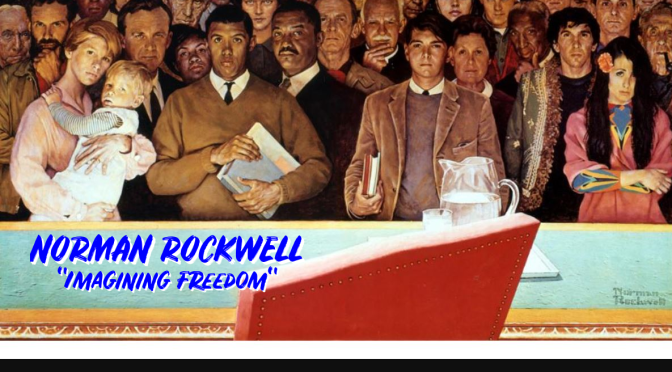
Norman Rockwell: Imagining Freedom explores themes and events in American history that still resonate today. (On View through September 7, 2020)

Four Freedoms
In the 1940s, Franklin D. Roosevelt developed a concept called the Four Freedoms—Freedom of Speech, Freedom of Worship, Freedom from Want, and Freedom from Fear—to persuade Americans to support the war effort. Not immediately embraced by the American public, the administration turned to the arts to help Americans understand and rally behind these enduring ideals. Artists, writers, actors, designers, and musicians were encouraged to take on the challenge of advancing the Four Freedoms as the U.S. prepared to enter World War II, moving away from its policy of neutrality.
Norman Rockwell, a renowned illustrator, was among those who took on the challenge to communicate visually the notions of freedom in support of the war efforts. The results were Rockwell’s popular Four Freedoms illustrations that depicted everyday community and domestic life that helped Americans rally for the defense of public freedom.
Civil Rights
The exhibition also showcases his post-war artworks from the 1960s, which address civil rights, human rights, and equality for all. One of the most powerful artworks on view in this section is the 1961 Golden Rule, which features people of different religions, races, and ethnicities with the inscription “Do Unto Others as You Would Have Them Do Unto You.” One of Rockwell’s most iconic images of the Civil Rights Movement, The Problem We All Live With, is also on display.
Contemporary Artwork
The exhibition concludes with a section of artworks and social commentary by contemporary artists responding to themes of freedom and American identity. The 2015 painting, Freedom from What? (I Can’t Breathe) by artist Maurice “Pops” Peterson will likely prompt discourse due to its relevance today. Peterson’s take on Rockwell’s Freedom from Fear, explores the idea that not all American families enjoy the privilege of safety, and depicts a newspaper headline with the words “I Can’t Breathe,” spoken by Eric Garner, a Black man killed during an interaction with New York police in 2014.

 The motifs of Thöny’s art are informed by the pervasive unease of the interwar years, whose apprehensions he portrayed in the grotesque and nightmarishly somber drawings he created around 1920 for his unpublished Buch der Träume (Book of Dreams). Other works, however, render serene and idyllic landscapes and urban views as well as scenes from social life.

 Nov 15, 2020 — Jun 27, 2021:

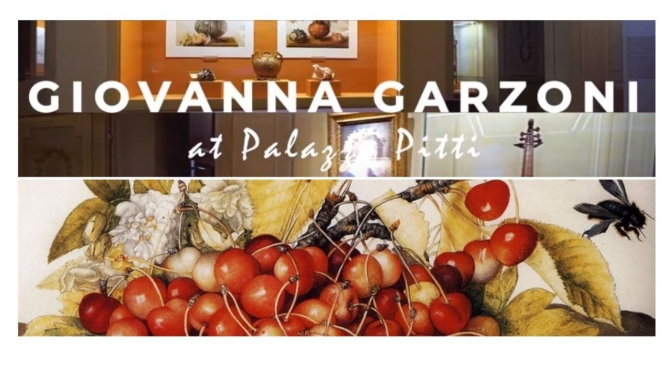
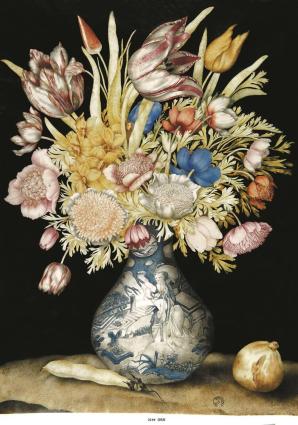 The show has been curated by Sheila Barker of The Medici Archive Project and the Advancing Women Artists foundation is running a challenge to inspire the creation of contemporary art based on Garzoni’s oeuvre. While her role in the evolution of scientific illustration is widely acknowledged, Giovanna Garzoni is less familiar as an illustrator of geographical fantasy in the age of the Baroque.


 Monocle’s Charlie Jermyn talks us through the rich and varied culinary delights on offer in Ireland’s second city.
 Boomers Daily