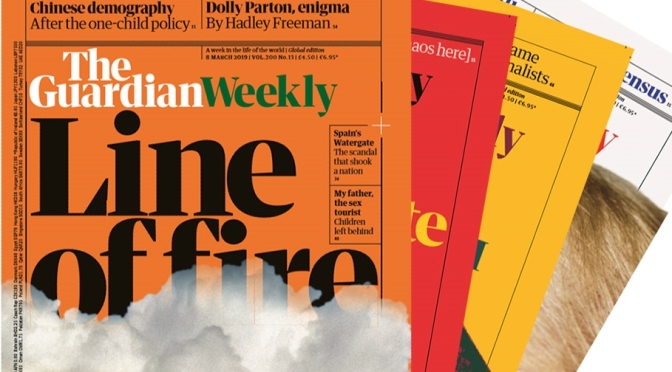
1 Spotlight | 40,000 deaths: another grim milestone for Gaza As faltering ceasefire talks continued this week, Malak A Tantesh and Emma Graham-Harrison report on how the death toll given by Gaza’s health officials fails to tell the full story of Palestinian grief.
2 Technology | Is Threads a new safe haven for those leaving X? Elon Musk’s frequently inflammatory online remarks have left many seeking a less toxic alternative. James Ball explores whether Meta’s Instagram spin-off provides it.
3 Feature | Audrey Tang, the good hacker The activist turned hacker is used to breaking boundaries as the world’s first minister for digital affairs. Now, she tells Simon Hattenstone, she wants the world to learn how to detoxify the internet.
4 Opinion | Caution needed over Kamala Harris’s flying start The Democratic vice-president has enjoyed a spectacular launch to her presidential campaign. But, warns Jonathan Freedland, it is far too early to write off her rival Donald Trump.
5 Culture | Snogs away! The crazy world of UK dating shows There’s much to be gleaned about British culture from analysing its TV dating shows, finds Daisy Jones – and, it stands to reason, about other countries’ via theirs.
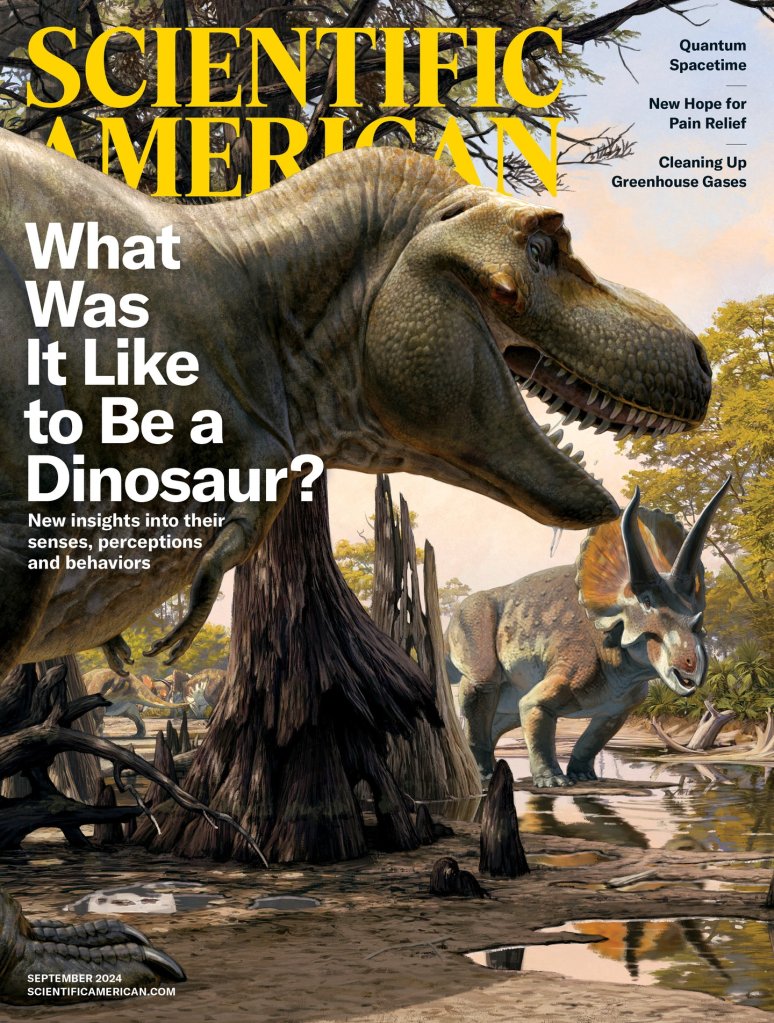
Scientific American (August 21, 2024): The September 2024 issue features ‘What Was It Like To Be A Dinosaur? – New insights into their senses, perceptions and behaviors…
New fossils and analytical tools provide unprecedented insights into dinosaur sensory perception by Amy M. Balanoff, Daniel T. Ksepka
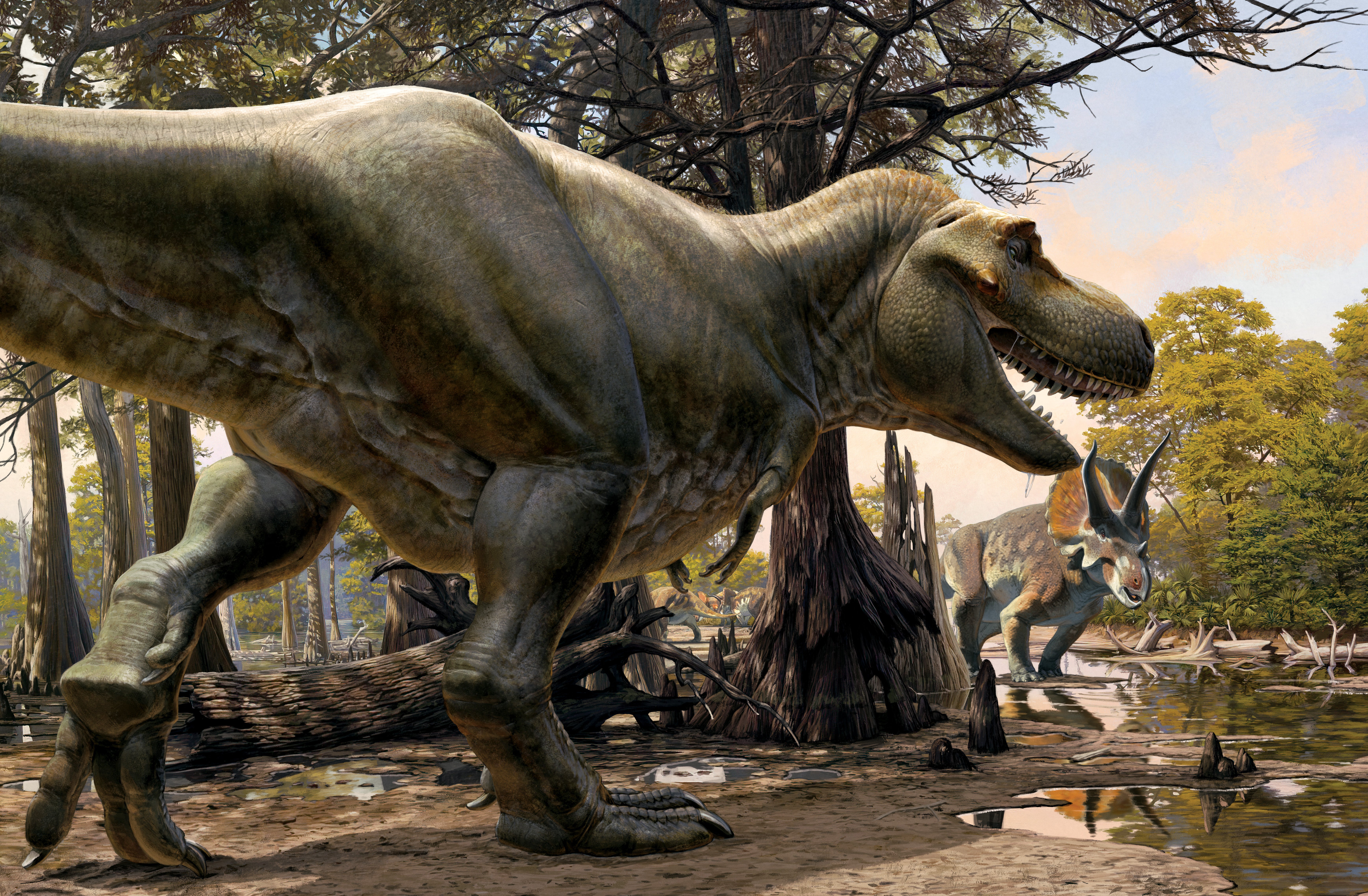
Alone Tyrannosaurus rexsniffs the humid Cretaceous air, scenting a herd of Triceratops grazing beyond the tree line. As the predator scans the floodplain, its vision suddenly snaps into focus. A single Triceratops has broken off from the herd and wandered within striking distance. Standing motionless, the T. rex formulates a plan of attack, anticipating the precise angle at which it must intersect its target before the Triceratops can regain the safety of the herd. The afternoon silence is shattered as the predator crashes though the low branches at the edge of the forest in hot pursuit.
T. rex has hunted Triceratops in so many books, games and movies that the encounter has become a cliché. But did a scene like this one ever unfold in real life? Would T. rex identify its prey by vision or by smell? Would the Triceratops be warned by a loudly cracking branch or remain oblivious because it was unable to locate the source of the sound? Could T. rex plan its attack like a cat, or would it lash out indiscriminately like a shark?
Times Literary Supplement (August 21, 2024): The latest issue features ‘Angels at her table’ – C.K. Stead and Kirsty Gunn on Janet Frame’s singular voice; Pat Barker and Mark Haddon’s modern myths; Rethinking incarceration; How art comes about; Sleep science; Hypochondria and literary reputations….
Country Life Magazine (August 20, 2024): The latest issue features ‘Sensational Scotland’ – Where to buy north of the border; The legend of the Stone of Scone; Up the workers – Chatsworth’s red-sock army; Forests of the future – the trees we should plant now…
Building on history
In the first of two articles, John Goodall charts the central role played by Scone and its former abbey in the history of Scotland.
Barking up the right tree
Britain’s native trees are facing an uncertain future, but we can still act to save our magnificent woodland, argues Sir Harry Studholme
Working their red socks off
A very special band of helpers is behind the smooth staging of Chatsworth Country Fair, as volunteer Simon Reinhold reveals
O Flowers of Scotland
Penny Churchill casts her eye over three Scottish estates, one a ‘pastoral oasis’ making its first appearance on the open market
Tom Byrne’s favourite painting
The actor chooses a work that treads that fine divide between ‘life and death, night and day’.
Dive in with both feet
There’s nothing more diverse than divers. Marianne Taylor dips below the surface to examine these underwater masters
Thistle do nicely
The ‘weediest of weeds’ is loved by insects, loathed by landowners. John Wright tackles the prickly matter of Scotland’s emblem.
The good stuff
Hetty Lintell selects luxuries designed or made in Scotland
Is that a plum in your mouth?
Tom Parker Bowles finds that the best way to savour traditional British varieties is to grow them yourself
Sculpting with plants
Perennials and billowing grasses are a perfect backdrop for the sculpture at Whitburgh House in Midlothian, finds Caroline Donald
Genomics-based newborn screening has the potential to revolutionize healthcare, but new solutions are needed to ensure that the benefits are equitably available.
Dozens of clinical trials are testing new mRNA vaccines, using machine learning to identify antigens, and embracing new technologies such as self-amplifying RNA.
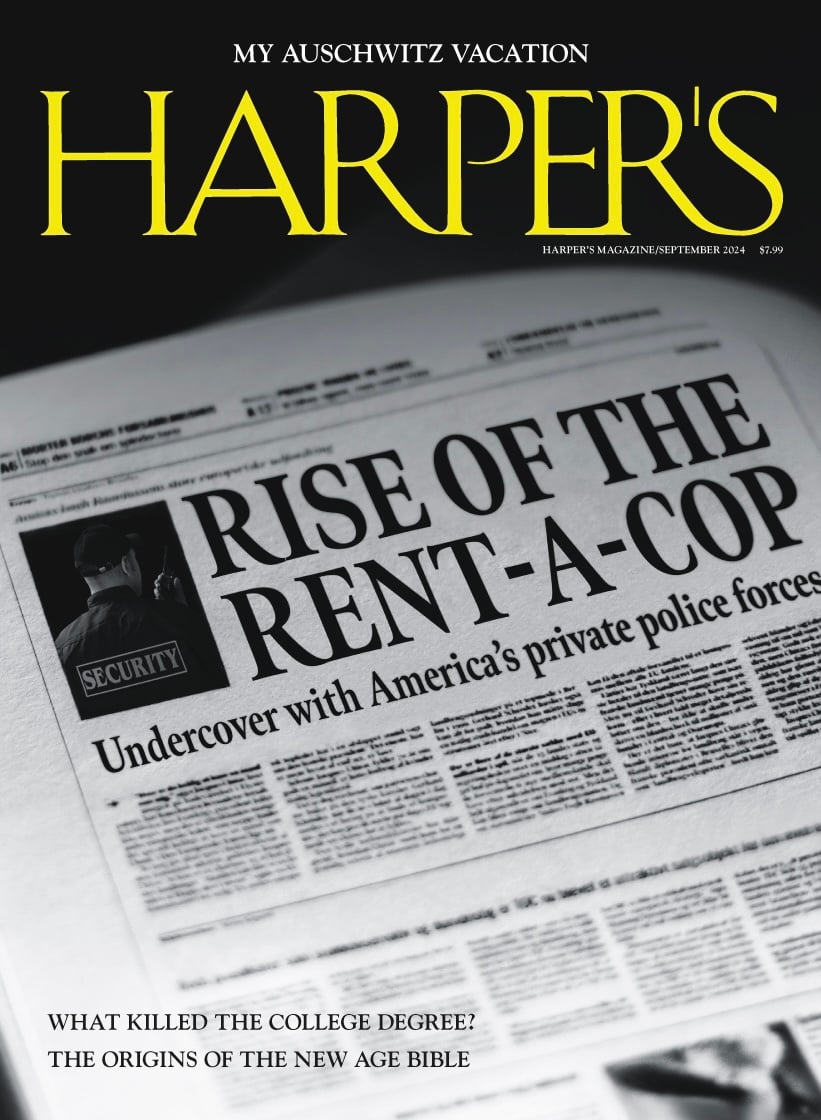
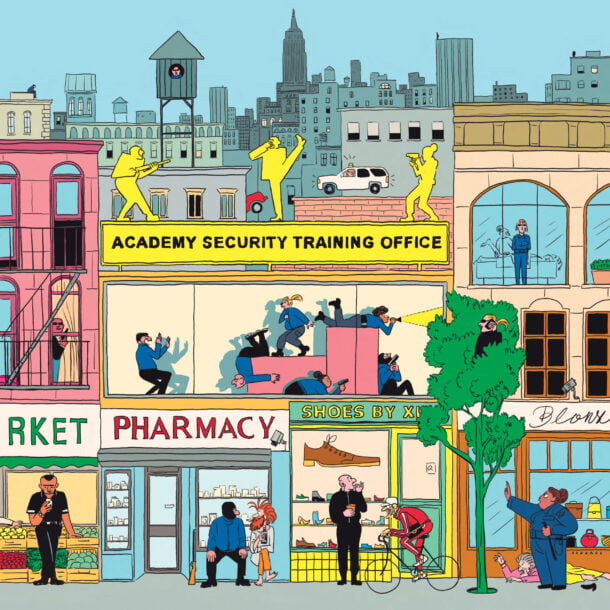
The dubious rise of the private-security industry by Jasper Craven
For millennia, the figure of the guard has inspired as much derision as demand. An early antecedent to the modern security guard can be found in ancient Egypt. Nobles employed “doorkeepers” to protect palaces and tombs. The performance of such duties was accorded a measure of reverence even as guards were often cast as apathetic or incompetent. Some hieroglyphs depict doorkeepers as those “who ward off all evil ones”; others show them as sleepy, drunk, or blind.
Many still believe in this image of guards as feckless agents in spaces not in need of protecting. And yet, in a moment of peculiarly American volatility, certain places that guards patrol—like schools, bars, grocery stores, and retail outlets—are increasingly prone to seeing outbursts of violence. These trends might justify a guard’s usefulness if not for the fact that most guards lack the training or legal authority to do much of anything.
Poison Ivy
From Burdened: Student Debt and the Making of an American Crisis, which will be published this month by Dey Street. by Ryann Liebenthal
The Instant Monet Enters the Studio
From L’instant précis où Monet entre dans l’atelier, which was published in 2022 by Éditions de Minuit. Translated from the French in May by Pauline Cochran. by Jean-Philippe Toussaint
The New Yorker (August 19, 2024): The latest issue featuresBarry Blitt’s “Roller Coaster” – The highs and lows of the campaigns for America’s highest office.
Climate change is putting parasites — the unseen pests running our planet — in peril, but a small band of scientists is fighting to save them from extinction. By Kate Golembiewski
What Goes On Inside the Mind of a Dog?
Help researchers understand the underpinnings of dog personality and behavior with these Citizen Science projects.
News, Views and Reviews For The Intellectually Curious



















 The New Yorker (August 19, 2024):




 Boomers Daily