
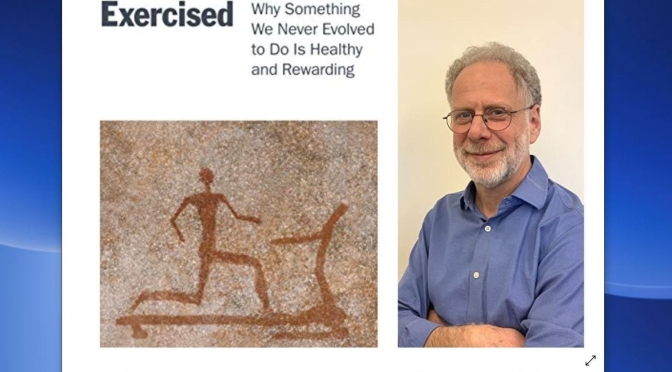

HARVARD MAGAZINE (SEPT – OCT 2020): From the book EXERCISED: Why Something We Never Evolved to Do Is Healthy and Rewarding by Daniel E. Lieberman, to be published on September 8, 2020 by Pantheon Books:
‘….many of the mechanisms that slow aging and extend life are turned on by physical activity, especially as we get older. Human health and longevity are thus extended both by and for physical activity.’

The graph breaks total energy expenditure (TEE) into two parts: active energy expenditure, and resting metabolism. Resting metabolism remains elevated for hours even after exercise ceases, burning additional calories in a phase known as excess post-exercise oxygen consumption (EPOC).
Exercise is like scrubbing the kitchen floor so well after a spill that the whole floor ends up being cleaner. The modest stresses caused by exercise trigger a reparative response yielding a general benefit.
In order to elucidate the links between exercise and aging, I propose a corollary to the Grandmother Hypothesis, which I call the Active Grandparent Hypothesis. According to this idea, human longevity was not only selected for but was also made possible by having to work hard during old age to help as many children, grandchildren, and other younger relatives as possible survive and thrive. That is, while there may have been selection for genes (as yet unidentified) that help humans live past the age of 50, there was also selection for genes that repair and maintain our bodies when we are physically active.
Daniel E. Lieberman is a paleoanthropologist at Harvard University, where he is the Edwin M Lerner II Professor of Biological Sciences, and Professor in the Department of Human Evolutionary Biology. He is best known for his research on the evolution of the human head and the evolution of the human body.

 Contributing correspondent Kai Kupferschmidt talks with host Sarah Crespi about the success of a fast moving megatrial for coronavirus treatments. The United Kingdom’s Recovery (Randomized Evaluation of COVID-19 Therapy) trial has enrolled more than 12,000 hospitalized coronavirus patients since early March and has released important recommendations that were quickly taken up by doctors and scientists around the world.

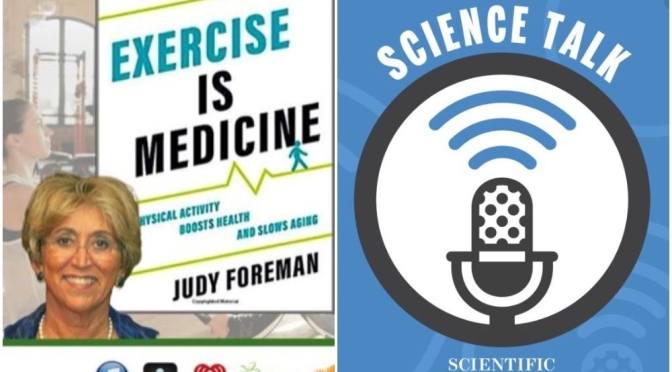
 Health journalist Judy Foreman talks about her new book Exercise Is Medicine: How Physical Activity Boosts Health and Slows Aging
 This is Scientific American’s Science Talk, posted on April 24th, 2020. I’m Steve Mirsky. And under our current, often locked-down situation, it’s still really important to try to get some exercise. Judy Foreman is the author of the new book Exercise is Medicine: How Physical Activity Boosts Health and Slows Aging. She’s a former nationally syndicated health columnist for the Boston Globe, LA times, Baltimore Sun and other places, and an author for the Oxford University Press.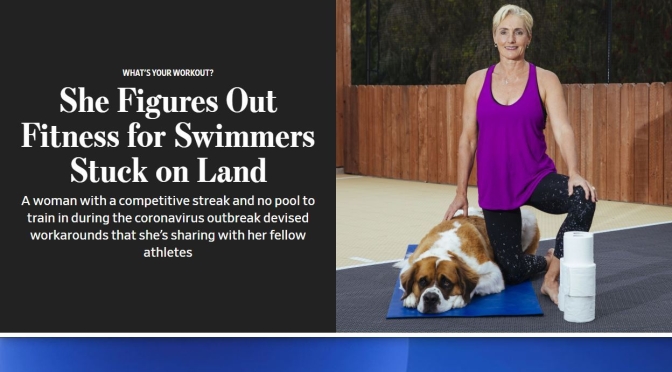
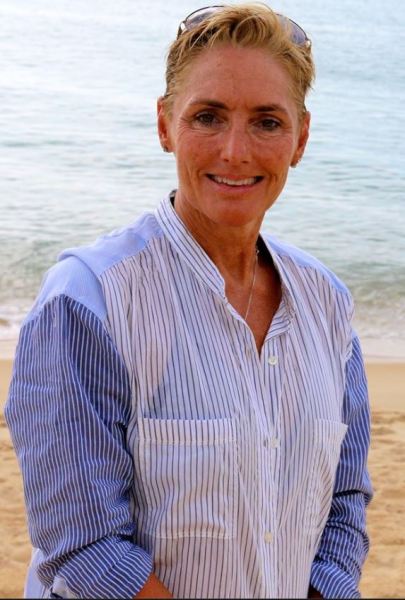 A physical therapist based in Santa Barbara, Calif., Ms. Godges is used to seeing injuries that result when swimmers start training on land. “We are great at cardio, but we aren’t used to pounding our joints. Gravity is not forgiving. We need to give our bodies time to adapt.”
 This week, reassessing the age of the ‘Broken Hill skull’, and unearthing evidence of an ancient forest near the South Pole.
 Boomers Daily