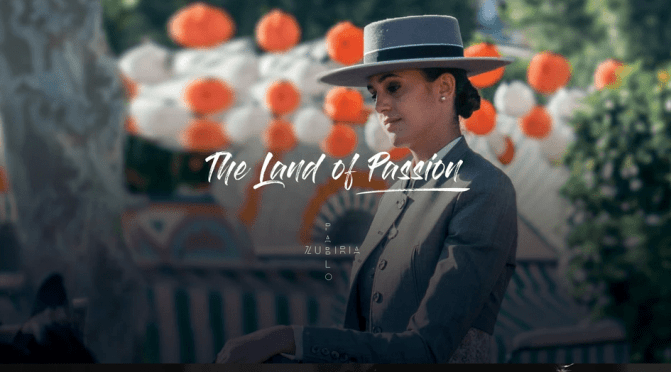
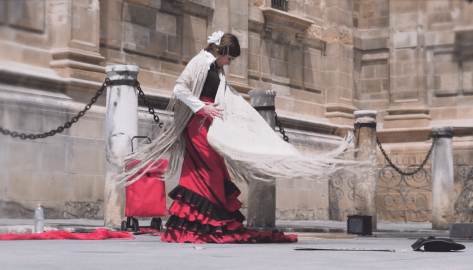
Great art. Great books. Even better wine. Centuries of history. The best tiki taka.
Rhythm and music, everywhere you go. Epic nightlife. Mornings included.
Deep conversations. Big laughs. Unique friendships.
Don’t get me started about the food.
From a Maclean’s Magazine online essay (01/08/20):
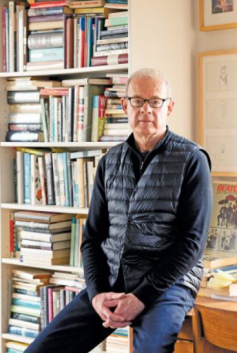
Don Gillmor in his home office (Photograph by May Truong)
Boomers tore down institutions—divorce rates went up, churchgoing went down. We demonized the corporations that previous generations had venerated, though we bought their products in record numbers, our idealism blurring with the search for the perfect pair of jeans. We wanted it all. In place of institutions, we created the cult of the individual, our own particular Frankenstein.
So much of our music comes back to us in unfortunate ways, Dylan’s anthems barely recognizable in sappy orchestral arrangements that fill the hours we spend on hold. And we seem to be permanently on hold these days. We are between 55 and 73 years old now, still defining this as middle age, still a potent economic force because of our numbers, controlling 70 per cent of disposable income, though it feels to many of us that we have already disposed of it. Still, we bought houses when they were vaguely affordable. And politicians still cater to us because we vote en masse. However, we are largely left out of the cultural conversation, as music and social media continues to evolve, always leaving us one app behind the curve.
David Remnick has appeared as the guest of Terry Gross on “Fresh Air” a number of times over the years, talking about Russia, Muhammad Ali, and other subjects. Hosting “Fresh Air” for nearly forty-five years, Gross is a defining voice of NPR, and is perhaps the most celebrated interviewer of our time.
In October, 2019, the tables turned, and Gross joined Remnick as his guest for a live interview at The New Yorker Festival. They spoke about how she first found her way to the microphone, the role of feminism in establishing NPR, the limits of her expertise, and what she has had to give up to prepare for serious conversations day after day.
Hailed as “a towering figure in the world of experimental theater” by the New York Times Waco, Texas-born Robert Wilson has created singular works in the realms of opera, performance, video art, glass, architecture, and furniture design since 1963. Prolific yet exacting in his approach to staging, light, and direction, Wilson has been honored with numerous awards for excellence including a Pulitzer Prize nomination, the Golden Lion of the Venice Biennale, and an Olivier Award. He is also the founding director of The Watermill Center, a laboratory for the arts and humanities in Water Mill, New York.
David Byrne is burning down the house on Broadway. His show “American Utopia” is a smash hit, but that isn’t the only reason the former frontman for the Talking Heads is so happy. Serena Altschul talks with Byrne about his love of performing, his growing affinity for collaboration, and his optimism, apparent in his “Reasons to Be Cheerful,” a platform that spotlights ways in which the world is getting better.
The book follows the journey of a writer in search of wisdom, as he encounters twelve distinguished American men over 80 — including Paul Volcker, the former head of the Federal Reserve, and Denton Cooley, the world’s most famous heart surgeon. In these and other intimate conversations, the book explores and honors the particular way that each man faces four challenges of living a good old age: Am I still a man? Do I still matter? What is the meaning of my life? Am I loved?
We aspire to live in a country where old men are celebrated as vital elders but not demeaned if they become ill and dependent. We aspire to maintain health as well as maintain dignity and fulfillment in frailty. Old Man Country helps readers see and imagine these possibilities for themselves.
Readers will come to see how each man — even the most famous — faces universal challenges. Personal stories about work, love, sexuality, and hope mingle with stories about illness, loss and death. This book will strengthen each of us as we and our loved ones anticipate and navigate our way through the passages of old age.
The volume will be released to coincide with the centenary of Federico Fellini’s birth (January 2020), which will be celebrated in Italy with a traveling exhibition on the director that will start its journey from Milan in December 2019.
This is a new edition of the diary kept by Federico Fellini, in which the great director faithfully recorded his dreams and nightmares.
A highly colorful journey into the boundless territory of a genius’s imagination, this is a work that added a fundamental element to the study of Federico Fellini and his creative experience. From the late 1960s until 1990, the great director used this diary to represent his nocturnal visions in the form of drawings or, as he himself described them, “scribbles, rushed and ungrammatical notes.”
About The Author
Sergio Toffetti, born in Turin in 1951, is president of the Museo Nazionale del Cinema and has published essays on Italian and international cinema, and on the conservation and restoration of film. Felice Laudadio is president of the Fondazione Centro Sperimentale di Cinematografia in Rome. He has overseen numerous cinema events, such as MystFest, EuropaCinema, and RomaFictionFest. Gian Luca Farinelli has been director of the Cineteca of Bologna since 2000. In 1986 he created, together with Nicola Mazzanti, Il Cinema Ritrovato an event dedicated to the history of cinema and the activity of film libraries. Together with Martin Scorsese, Raffaele Donato, Thierry Frémaux, and Alberto Luna he founded the World Cinema Foundation, which brings together about twenty great international directors for the restoration of third-world films.
Psycholinguist Jean Berko Gleason is a professor emerita at Boston University and a pioneer in the field of children’s language. Even as a child, Berko Gleason loved and connected with language. It also made a big impression on her how much her older brother, who suffered from cerebral palsy, struggled to be understood. Berko Gleason shares her Brief But Spectacular take on language.
90 years ago today, Maie Bartlett Heard, curator Allie Walling BraMé along with a small group of friends and volunteers spent Christmas Day making final preparations for the opening of the Heard Museum. The next day, December 26, 1929, the Heard Museum began our now nine decade long and ongoing legacy of advancing American Indian Art.
This short video poem written, recorded and edited by longtime artist and friend of the Heard Museum, Steven J. Yazzie (Diné) is our very sincere thank you to you.
Heard Museum 90th Celebration Poem, December 2019
“Home” By Steven J. Yazzie (Diné)
Voiced by: Jenn Henry
Music: Better Now, Phillip Daniel Zach
Why do we come here to these walls painted shades of off white In search of beauty or memory or place Where the sounds of children can be heard echoing in these vast and intimate spaces And where everyone has just arrived here from a journey What brings us to the feet of stone or textile or dried paint In the galleries of our hearts and truths Our histories are revealed and our humanity ensured This place of my youth and older age This place of beauty stewardship and celebration Is home
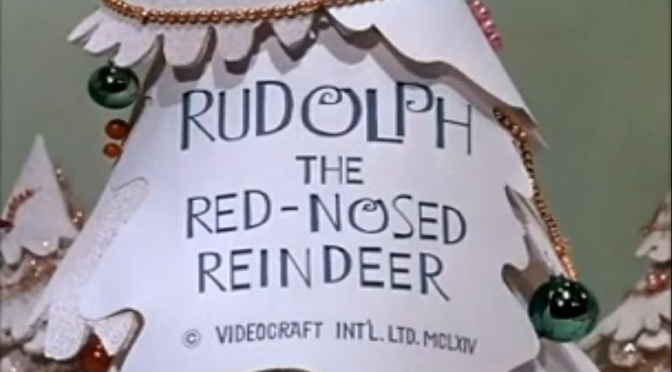
Reindeer and dentists, puppets and LED light bulbs, Gene Autry and General Electric—these odd pairings might not seem to have much in common. But each played an important role in the making of Rudolph the Red-Nosed Reindeer, a classic Christmas special currently celebrating its 55th straight year of annual reruns. Before Rudolph lit up the small screen, a series of tragedies, twists of fortune and lucky coincidences allowed his tale to endure through decades—eventually ensuring a place in holiday tradition.




 David Remnick has appeared as the guest of Terry Gross on “Fresh Air” a number of times over the years, talking about Russia, Muhammad Ali, and other subjects. Hosting “Fresh Air” for nearly forty-five years, Gross is a defining voice of NPR, and is perhaps the most celebrated interviewer of our time.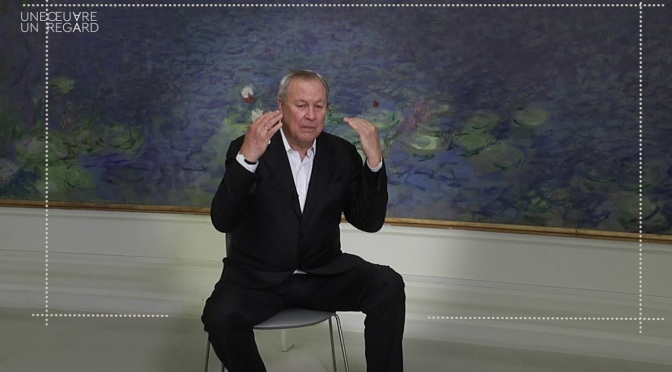
 Hailed as “a towering figure in the world of experimental theater” by the New York Times Waco, Texas-born Robert Wilson has created singular works in the realms of opera, performance, video art, glass, architecture, and furniture design since 1963. Prolific yet exacting in his approach to staging, light, and direction, Wilson has been honored with numerous awards for excellence including a Pulitzer Prize nomination, the Golden Lion of the Venice Biennale, and an Olivier Award. He is also the founding director of The Watermill Center, a laboratory for the arts and humanities in Water Mill, New York.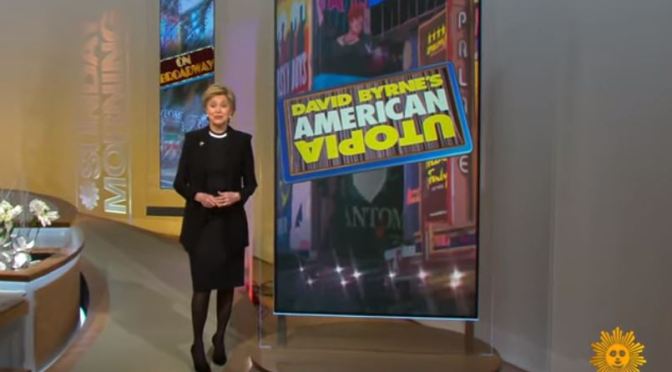
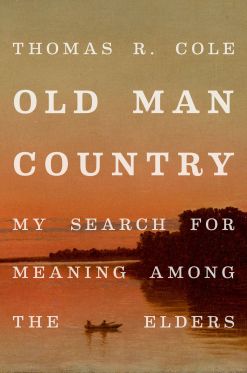 The book follows the journey of a writer in search of wisdom, as he encounters twelve distinguished American men over 80 — including Paul Volcker, the former head of the Federal Reserve, and Denton Cooley, the world’s most famous heart surgeon. In these and other intimate conversations, the book explores and honors the particular way that each man faces four challenges of living a good old age: Am I still a man? Do I still matter? What is the meaning of my life? Am I loved?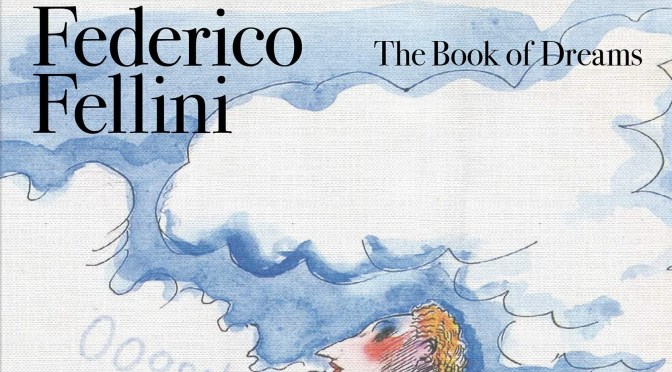
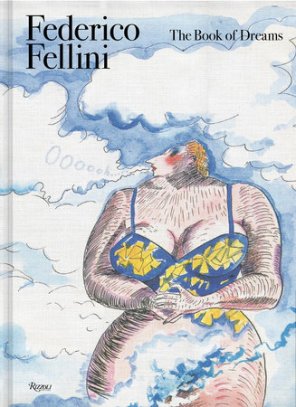 The volume will be released to coincide with the centenary of Federico Fellini’s birth (January 2020), which will be celebrated in Italy with a traveling exhibition on the director that will start its journey from Milan in December 2019.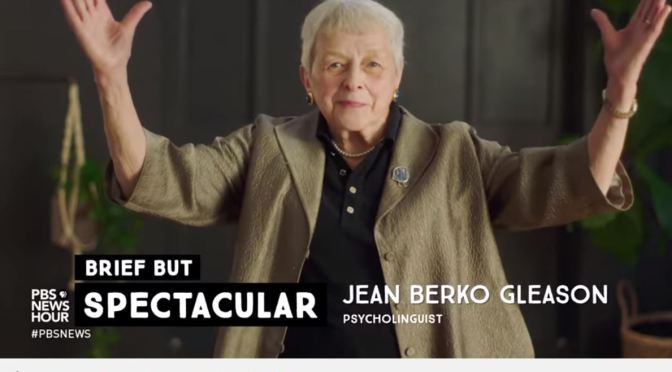
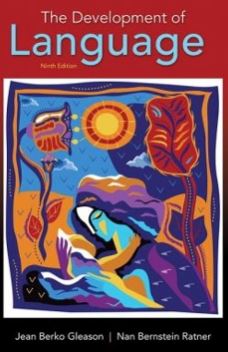 Psycholinguist Jean Berko Gleason is a professor emerita at Boston University and a pioneer in the field of children’s language. Even as a child, Berko Gleason loved and connected with language. It also made a big impression on her how much her older brother, who suffered from cerebral palsy, struggled to be understood. Berko Gleason shares her Brief But Spectacular take on language.

 Boomers Daily