
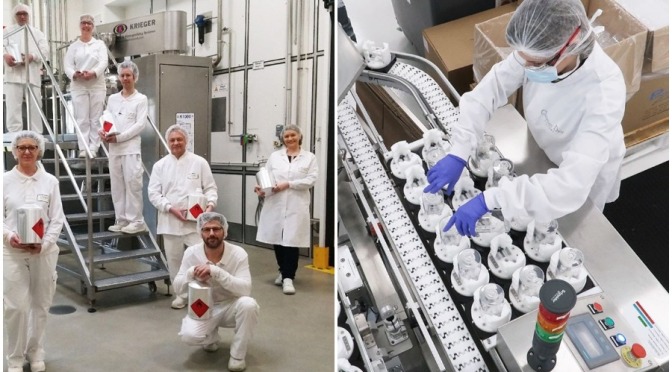
 Jamie Waters explains how the fashion industry emerged as a vital contributor in the fight against the pandemic. Many brands, big and small, have pivoted to make masks and other protective equipment.
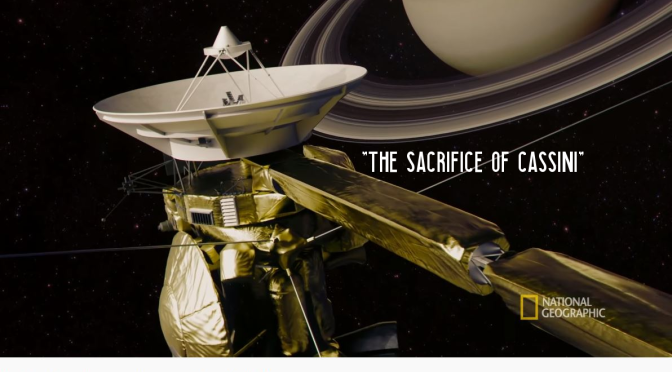
Space Exploration: Saturn – “The Sacrifice Of Cassini” (National Geographic)
Explore the creation of planetary rings with Neil deGrasse Tyson and discover the fate of the Cassini space probe.
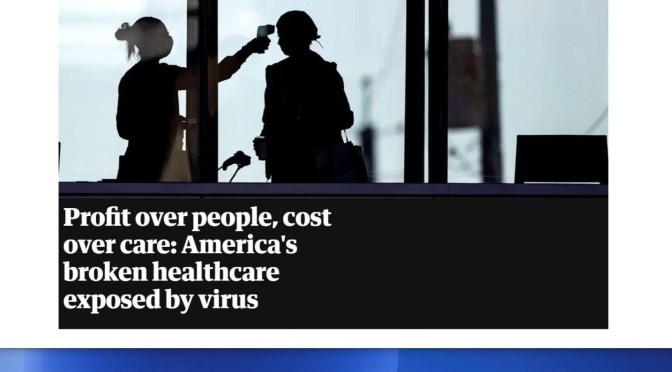
Medical Economics: Virus Exposes America’s “Broken Healthcare System” (2020)
From The Guardian (April 16, 2020):
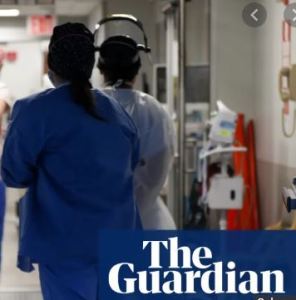 “As this epidemic makes clear, at any moment, any of us could become sick, could become hospitalized, could be on a mechanical ventilator,” said Adam Gaffney, an ICU doctor in Boston. “And that, in the United States, could mean potentially ruinous healthcare costs.”
With over 21,000 people dead and more than a 547,000 infected with the coronavirus in the US the last question on a person’s mind should be how they will pay for life-saving treatment.
There were 27.9 million people without health insurance in 2018, and record-high unemployment will increase that figure by millions
But as the death toll mounted, a patient who was about to be put on a ventilator in one of New York City’s stretched to capacity intensive care units had a final question for his nurse: “Who’s going to pay for it?”
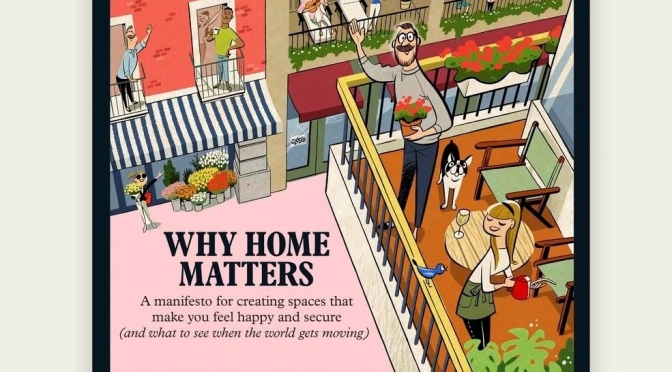
Upcoming Magazines: “Why Home Matters” – (Monocle May 2020)
Monocle’s home-focused May issue goes beyond the dramatic headlines to look at how to create spaces that are apt to linger in.
We launch a manifesto for building better, look at the firms eyeing up the domestic market and profile a few elegant residences. Elsewhere, we examine the importance of keeping manufacturing onshore, decode the US political advertising industry and recommend the best media to hunker down with.
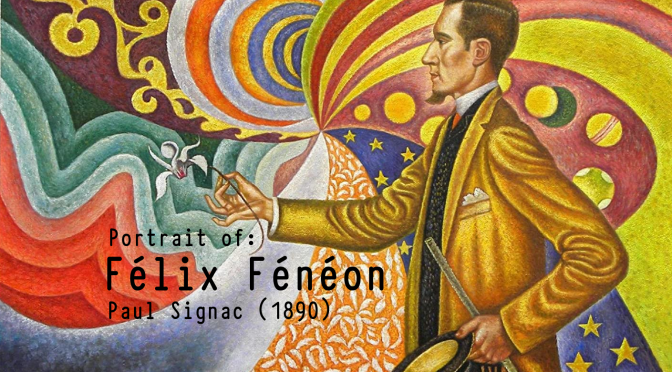
Art History: “Félix Fénéon: The Anarchist And The Avant-Garde” (MoMA)
“It would not be a commonplace portrait at all, but a carefully composed picture, with very carefully arranged colors and lines. A rhythmic and angular pose. A decorative Félix, entering with his hat or a flower in his hand.”
With these words, in 1890, Paul Signac described to Félix Fénéon the extraordinary portrait he was dedicating to him. In it, Signac paid homage to Fénéon’s distinctive appearance, his generous but enigmatic personality, and his innovative approach to modernism.
This painting, a masterpiece in the Museum’s collection, will be the centerpiece of Félix Fénéon, the first exhibition dedicated to Fénéon (1861–1944). An art critic, editor, publisher, dealer, collector, and anarchist, Fénéon had a wide-ranging influence on the development of modernism in the late 19th and early 20th centuries.
In the late 1880s, he played a key role in defining the new movement known as Neo-Impressionism, a term he coined himself, whose artists, including Signac, used tiny dabs of color that would mix in the eye of the viewer. Over the next five decades, he championed the careers of artists from Georges-Pierre Seurat and Signac to Pierre Bonnard, Henri Matisse, and Amedeo Modigliani.
He amassed a renowned collection of paintings by these artists and many others, and he was also a pioneering collector of art from Africa and Oceania. The exhibition will feature some 130 objects, including major works that Fénéon admired, championed, and collected, as well as contemporary photographs, letters, and publications that trace key chapters in his biography. Together these works reveal the profound and lasting legacy of Fénéon’s keen eye and bold, forward-looking vision.
Health: Testing, Approving And Fairly Distributing A New Coronavirus Vaccine
SCIENTISTS ARE working at an unprecedented pace to find a vaccine for SARS-CoV-2, the virus that causes covid-19. The stakes are high. Natasha Loder, The Economist’s health policy editor, explains how an effective vaccine might be developed.
Dr Trevor Drew of the Australian Centre for Disease Preparedness speaks to host Kenneth Cukier about two trials which have reached the animal-testing stage. Plus, once a vaccine is discovered, what can be done to make sure it is distributed fairly? Dr Seth Berkely, chief executive of GAVI, the vaccine alliance, explains the importance of global cooperation. Runtime: 26 min
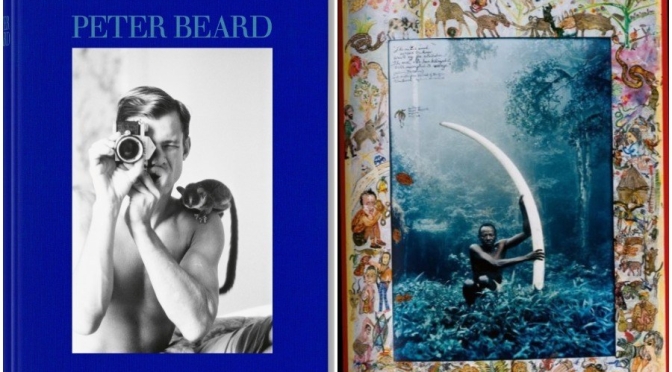
New Photography Books: “Peter Beard” – “Life As Works Of Art” (Taschen)
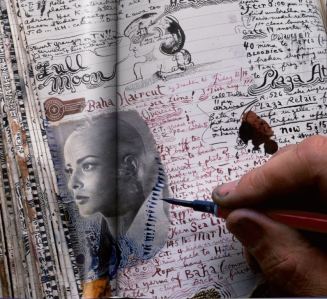 He collaborated with Francis Bacon and Salvador Dalí, he made diaries with Andy Warhol, worked on books with scientists like Dr. Norman Borlaug, Dr. Richard Laws, and Alistair Graham, and toured with Truman Capote, Terry Southern, and the Rolling Stones—all of whom are brought to life, literally and figuratively, in his work. He delved into the world of fashion for its beautiful women, taking Vogue stars like Veruschka to Africa and bringing new ones back to the U.S. with him.
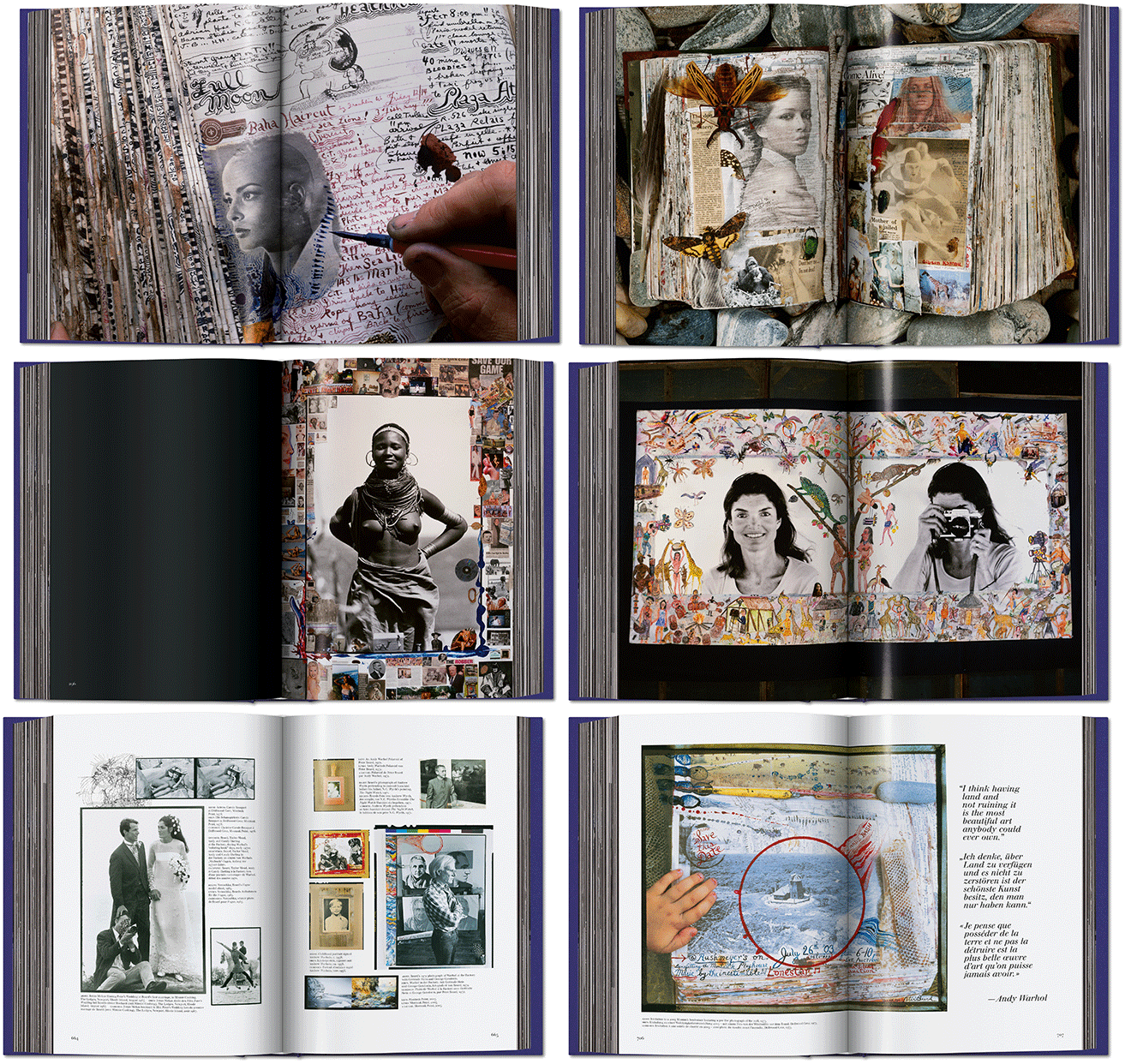
Artist, diarist, collector, and writer Peter Beard has fashioned his life into a work of art; the illustrated diaries he kept from a young age evolved into a serious career as an artist and earned him a central position in the international art world.
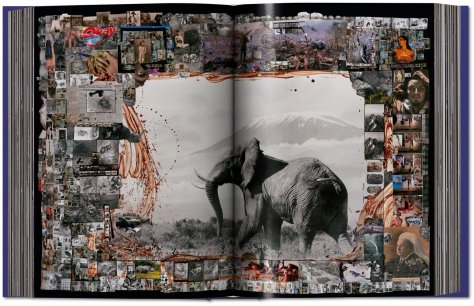
After spending time in Kenya and striking up a friendship with the author Isak Dinesen (Karen Blixen) in the early 1960s, Beard bought 50 acres next to her farm with the stipulation that he would film and write about the land and its flora and fauna. He witnessed the dawn of Kenya’s population explosion, which challenged finite resources and stressed animal populations—including the starving elephants of Tsavo dying by the tens of thousands in a wasteland of eaten trees. So he documented what he saw—with diaries, photographs, and collages. He went against the wind in publishing unique and sometimes shocking books of these works, including The End of the Game. The corpses were laid bare; the facts carefully recorded, sometimes in type and often by hand. Beard uses his photographs as a canvas onto which he superimposes multi-layered contact sheets, ephemera, found objects, newspaper clippings that are elaborately embellished with meticulous handwriting, old-master inspired drawings, and often swaths of animal blood used as paint.
In 2006, TASCHEN first published the book that has come to define his oeuvre, signed by the artist and published in two volumes. It sold out instantly and became a highly sought-after collector’s item. In the decade since, the monograph has been revived in two smaller versions; but sometimes, bigger is better. Now, the book you haven’t been able to get your hands on is available in one large-format volume.

Travel: The “Sweets Hotel” – 28 Bridge House Suites On Canals In Amsterdam
 SWEETS hotel is an initiative and co-creation of the Amsterdam based architecture office Space&Matter (known for De Ceuvel in Amsterdam), project development partner Grayfield and Seven New Things (Suzanne Oxenaar, Otto Nan and Gerrit Groen, founders of Lloyd Hotel & Cultural Embassy (world’s first 1- to 5-star hotel in Amsterdam – sold in 2018), Llove Hotel (pop-up hotel in Tokyo) and Hotel The Exchange (fashion hotel in Amsterdam)).
First initiated in 2012 as an urban space project, SWEETS hotel is now 8 years in the making. 20 bridge houses are currently available for reservations, with more coming soon.
HISTORY
For 100 years Amsterdam’s bridge houses accommodated the city’s many bridge keepers who were responsible for opening these impressive structures for passing boat traffic. However, with the introduction of a centralised bridge control system the bridge houses became redundant.
SWEETS HOTEL PROJECT
In 2012 the initiators of SWEETS hotel presented a plan to the city of Amsterdam to transform the city’s bridge houses into tiny hotel suites. The vision: to introduce travellers to new neighbourhoods and unexpected experiences in the city.
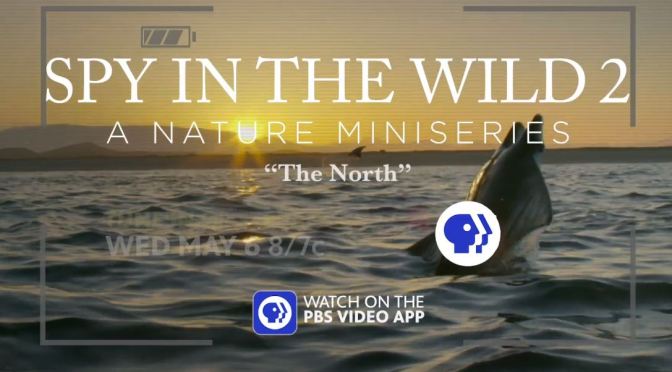
Wildlife Entertainment: “Spy In The Wild 2” Series – “Hilarious” (PBS Nature)
Travel to the Northern Hemisphere, where the spy creatures learn how animals move, feed and fight. “Spy in the Wild 2 – Episode 2: The North“ premieres Wednesday, May 6, at 8/7c.
The spy creatures infiltrate a hippo pod, a gorilla sanctuary and the world of pygmy elephants. “Spy in the Wild 2 – Episode 1: The Tropics“ premieres Wednesday, April 29, at 8/7c.
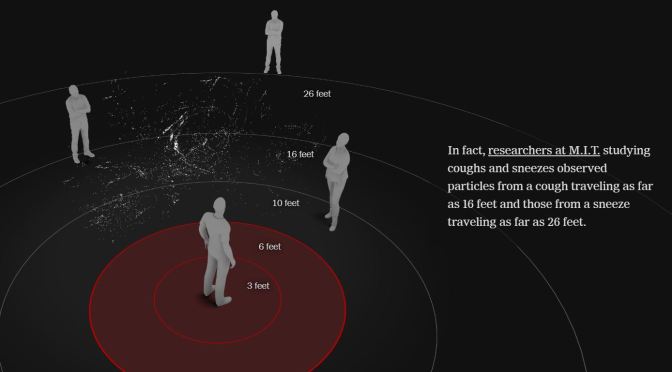
Social Distancing: 3-D Simulation Of How Respiratory Droplets Spread Coronavirus
From The New York Times (April 14, 2020):
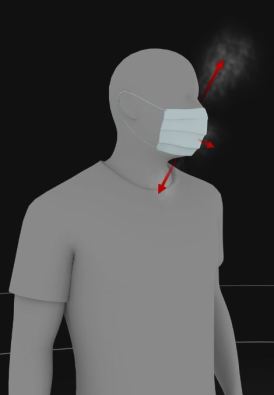
But as this simulation suggests, and scientists have argued, droplets can travel farther than six feet. And small droplets known as aerosols can remain suspended or travel through the air before they eventually settle on surfaces. This is how they could disperse over the next 20 minutes.
The Centers for Disease Control and Prevention encourages people to stay home. If you must venture out, you should stay at least six feet away from others. The World Health Organization recommends a minimum of three feet of separation.
Scientists are learning about the novel coronavirus in real time, and those who study similar respiratory illnesses say that until it is better understood, no guideline is likely to offer perfect safety. Instead, understanding the possible transmission routes for the virus can help us see why keeping our distance is so important.
 Boomers Daily