

 NPR’s Tamara Keith and Amy Walter of the Cook Political Report join Judy Woodruff to discuss the latest political news, including whether open hearings could change Americans’ minds about impeachment, implications for Joe Biden’s presidential campaign, the potential entry of Michael Bloomberg into the Democratic race, Sen. Amy Klobuchar’s comments about standards for female politicians and more.
All posts by She Seeks Serene

Top New Travel Videos: “Iceland – The Prophesy” By Henry Behel (2019)
Filmed, Edited and Directed By: Henry Behel
Voiceover: Júlía Hannam
Music: Sam Plotkin
Percussionists: Amin Malekpour, Sam Archer, Kris Wismer

I filmed this in four days while traveling around Iceland alone. The sun set at midnight and rose at 3am, but it never really got dark. I shot as much of the day as I could, stopping everywhere that caught my eye. I found places off the road and slept on a pad under the stars. I got rained on and blasted with wind, but I felt alive.
I have made a habit of traveling alone in wild places. I feel magic in the howling wind, the ice on my face, the sand in my shoes. My mind can drift back to the beginning of time or out to the stars where the earth is just a dot. I finally feel the connection and peace I so long for, and yet is so elusive in my daily life.
No place has inspired me like this more than Iceland. This film is how it feels to me. Beautiful and serene, but dark and violent as well. Time moves differently here. The land still exists in some ancient forgotten epoch, when earth was still lava rock soup.

Website: http://henrybehel.com/

Top New Animated Videos: “Six Kinetic Characters” By Lucas Zanotto (2019)
Filmed, Animated and Music by: Lucas Zanotto

A series of abstract kinetic characters.

Website: instagram.com/lucas_zanotto

Consumer Surveys: Only 30% Of Baby Boomers Use Online Grocery Services
From a Chain Store Age online release:
 According to a recent survey of 1,000 U.S. consumers from advertising platform Criteo, 48% of millennial and Gen Z respondents use online grocery delivery services, compared to 37% of Gen X respondents and only 30% of baby boomer respondents.
Baby boomers are much less likely than younger consumers to participate in a particular omnichannel grocery activity.
Results for browsing multiple sites to read product reviews are essentially the same across generations. But Gen X consumers are much more likely to browse multiple sites if a product they want is unavailable (37%) than Gen Z/millennial (28%) or baby boomer/silent generation consumers (22%). And more than half (51%) of baby boomer/silent generation consumers will browse multiple sites for none of these reasons, compared to 27% of Gen X and 15% of Gen Z/millennial consumers.
To read more: https://chainstoreage.com/survey-boomers-dont-say-ok-grocery-service

Trends In Transportation: The BST-Hypertek Electric, Carbon Fiber Motorcycle Is “The New Standard”
From a New Atlas online review:
 Well, with this extraordinary electric bike, I think I finally understand what Terblanche has been trying to get at all these years, and I absolutely love it. Designed and built in partnership with South African carbon wheel specialists BST, meet the all-electric Hypertek.
There could be no better name for this thing and its unabashed, triumphant futuristicism. Every component and detail seems stripped back, technical, modular, functional. It’s like a Confederate jumped in a teleportation machine without realizing there was already a Dyson vacuum in there.
The Hypertek is built around the reasonably unglamorous DHX Hawk water-cooled PMS electric motor, presumably chosen for its compact size and high torque output of 120 Nm (88.5 lb-ft). BST claims a peak power of 80 kW (107 hp), but we can’t find any motor on the DHX website capable of such peaks – the company’s largest advertised Hawk motor makes 120 Nm but peaks at 55.3 kW (74 hp) and offers a continuous power of 34.5 kW (46.3 hp). So perhaps it’s a custom build.
To read more: https://newatlas.com/motorcycles/bst-hypertek-crazy-electric-motorcycle/

Studies On Eating: Most Adults Prefer “Snacks” Over Meals On Daily Basis
From a Mondelēz International online release:
 Notably 6 in 10 adults worldwide (59%) say they prefer to eat many small meals throughout the day, as opposed to a few larger ones, with younger consumers especially leaning into snacks over meals as that number rises to 7 in 10 among Millennials (70%).
For consumers around the world, the role food plays in health and wellbeing is increasingly top of mind; people are more commonly considering how smaller bites – snacks – effect their emotional wellbeing, as well as their physical health.
- For more than 8 in 10 people, convenience (87%) and quality (85%) are among the top factors impacting snack choice.
- 80% of consumers are looking for healthy, balanced bites.
- 71% of adults say snacking helps them control their hunger and manage their calories throughout the day.
- Scking is a key way for people around the world to connect to their culture and share their sense of identity with their communities and families.
- 71% say snacking is a way to remind themselves of home.
- 7 in 10 adults make an effort to share their favorite childhood snacks with others (70%).

Top Podcast Interviews: JPMorgan Chase CEO Jamie Dimon On Elizabeth Warren, Income And Economics (60 Minutes)
 From a November 10, 2019 “60 Minutes” program: In an interview with Lesley Stahl, the chairman and CEO of JPMorgan Chase talks about Elizabeth Warren and the state of the global economy.
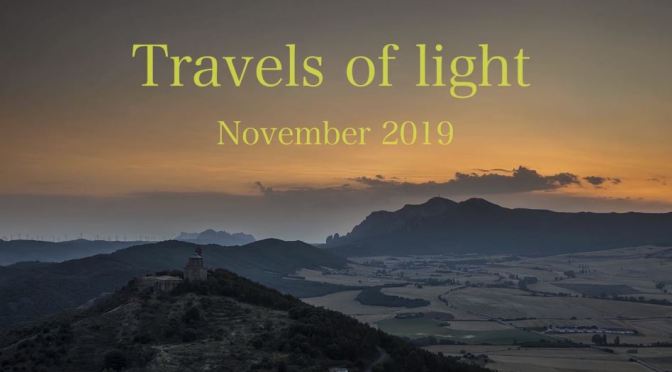
Top New Timelapse Videos: “Travels Of Light” In Spain By Martin Zalba (2019)
Filmed, Edited and Directed by: Martin Zalba
Night and day timelapses that collect different landscapes in Spain


Top Podcasts: 77-Year Old Rock & Roll Legend Graham Nash Talks About His Albums And Music (PBS)
 Two-time Rock and Roll Hall of Fame inductee Graham Nash has hits aplenty spanning his nearly six-decade career. But the 77-year-old singer-songwriter recently chose to perform a special run of shows featuring his lesser-known first two solo albums in their entirety, which together describe a crucial chapter in his personal and artistic life. Tom Casciato recently spoke to Nash to learn more.

Top Museum Exhibitions: “Caravaggio & Bernini” At The Kunst Historisches, Vienna (Thru Jan 19, 2020)
From a Hyperallergic online review:

Caravaggio & Bernini: The Discovery of Emotions features some of the artists’ greatest works, but also charts their influence on others. And that influence proved to be powerful and enduring. Caravaggistas spread across Europe like termites. And so we could call this exhibition a battle of the swaggerers, the pomp of a very eclectic brand of Viennese historicism facing off against the theatrical push and preen of two great Italians.

From almost the beginning, Caravaggio, that man who arrived in Rome in the 1590s, is completely outrageous. Whom did he think were his principal patrons? Churchmen, of course. Did they care that he depicted John the Baptist in an extraordinary painting, circa 1602, as a carefree, lascivious, curly-haired boy with the cheekiest of grins imaginable?
 Boomers Daily