

All posts by She Seeks Serene

Homebuilding: World’s Biggest “3D Printed” Building Completed
 Robotic construction company Apis Cor has used its technology to build the world’s largest 3D-printed building, a two-storey administrative office in Dubai.
Measuring 9.5 metres high with a floor area of 640 square metres, Apis Cor built the record-breaking structure for the Dubai Municipality. Apis Cor developed a gypsum-based material to run through the printer and sourced a local producer. The printing took place out in the open, to prove that the technology could handle a harsh environment without humidity and temperature control.
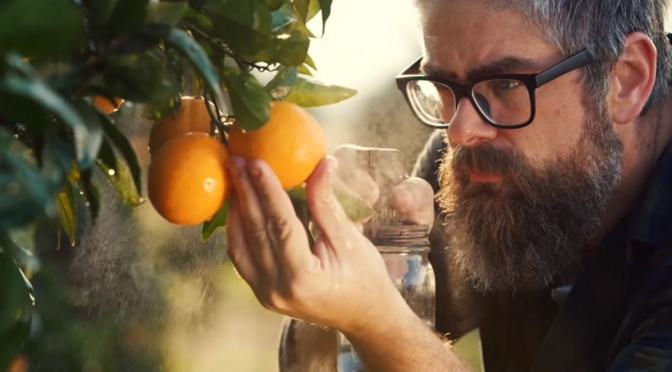
Best TV Ads Of 2019: Ryan Reynolds “Aviation Gin” Parody Ads Are “Brilliant Marketing” (Videos)
From a Marketing Land online article:
Soon after the spot aired, actor and liquor brand owner Ryan Reynolds cashed in on the drama – and marketers everywhere scrambled to pick their jaws up off the floor. The ad spot for Ryan Reynold’s liquor brand, Aviation Gin, cast the same actress from the Peloton ad — in a sequel that tells the story of where the Peloton Woman is now. Spoiler: She’s downing Aviation Gin in a bar with two friends, wallowing in the aftermath of Peloton’s ill-conceived commercial. We’ll toast to that.
It’s the holiday ad that caught fire for all the wrong reasons: A young, seemingly fit woman is gifted a Peloton stationary bike (presumably by her husband) and proceeds to vlog her fitness journey over the course of a year.
The ad, produced by creative agency Mekanism, went viral almost immediately, sparking criticism about Peloton’s unhealthy depictions of body image and marriage – not to mention the “Peloton Woman’s” concerning expressions (which some have quipped resembles a face of fear). Naturally, Twitter users couldn’t contain themselves, dragging the cringe-worthy campaign with labels like sexist, elitist, and entirely unrealistic.

Classic Car Nostalgia: “1965 Ford Thunderbird Convertible”
From Wikipedia:
 The revised model was initially offered as a hardtop, convertible, Sports Roadster with dealer-installed tonneau cover and wire wheels, and Landau with vinyl roof, simulated landau irons, and wood grain interior appointments. Total 1964 sales were excellent: 92,465, up nearly fifty per cent from the previous year, but with only 50 Sports Roadster kits were sold from the factory. The 1964 Thunderbird was the only car of this generation to have the word ‘Thunderbird’ spelled out on the front hood instead of a chrome Thunderbird emblem. The only transmission available was the Cruise-O-Matic MX 3 speed automatic.
 The fourth generation of the Ford Thunderbird is a large personal luxury car produced by Ford for the 1964 to 1966 model years. This generation of the Thunderbird was restyled in favor of a more squared-off, “formal” look. The Thunderbird’s sporty image had by that time become only that: the standard 390-cubic-inch 300 bhp (224 kW) V8 engine needed nearly 11 seconds to push the heavy T-bird to 60 mph (96 km/h). The softly sprung suspension allowed considerable body lean, wallow, and float on curves and bumps. Contemporary testers felt that the Buick Riviera and Pontiac Grand Prix were substantially more roadworthy cars, but the Thunderbird retained its leading market share.
To view more photos: https://www.classicdriver.com/en/car/ford/thunderbird/1965/725139

Politics: Key Moments From 6th Democratic Debate (PBS Video)
At the sixth Democratic debate–hosted by PBS NewsHour and POLITICO — the seven Democrats who are vying for their party’s presidential nomination in 2020, took on the issues of healthcare, immigration, race and impeachment. The debate on Dec. 19 was also the last of 2019. Watch the major moments from the debate between former Vice President Joe Biden, Mayor Pete Buttigieg, Sen. Amy Klobuchar, Sen. Elizabeth Warren, Sen. Bernie Sanders, businessman Tom Steyer and entrepreneur Andrew Yang.
Reading Lists: “The Best Neuroscience Books Of 2019” (TheScientist)

Bury your nose in tales of neurosyphilis, gender identity, the medical mysteries of sleep disorders, and more. JAMES DOLBOW
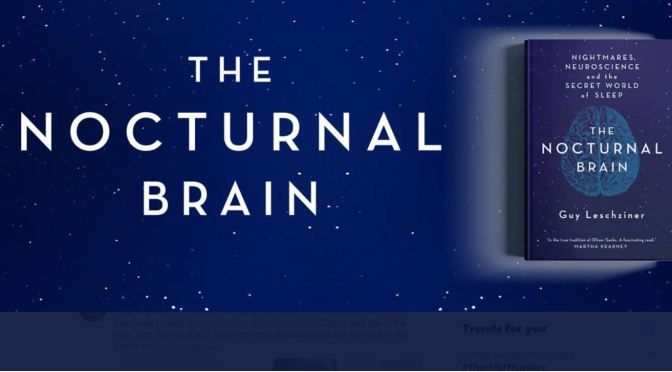
The Nocturnal Brain: Nightmares, Neuroscience and the Secret World of Sleep
Inspired by the legendary book The Man Who Mistook His Wife for a Hat by the late Oliver Sacks, neurologist and sleep scientist Guy Leschziner tells the curious true stories of his patients, their fascinating sleep disorders, and the neuroscience behind each. Also like the works of Sacks, The Nocturnal Brain is written with considerable introspection and wonder about each patient’s case, taking you on a journey from the first patient encounter, to diagnosis, and through treatment. The unusual and often bizarre cases will keep you intrigued and immersed, and make this unique book one you will find yourself looking forward to making time to read.
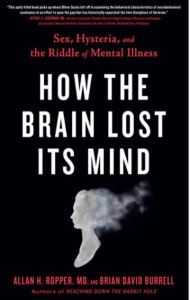 How The Brain Lost Its Mind: Sex, Hysteria, and the Riddle of Mental Health
In this mindful reflection on American and European pasts, authors Allan H. Ropper and Brian Burrell, also the writers of Reaching Down the Rabbit Hole, address our modern concept of mental illness by reviewing the interesting true story of the syphilis epidemic of the 19th century. This little known and fascinating history of neurosyphilis—how it was handled by society and medicine and how it shaped today’s understanding of mental illness—helps address not only why many stigmas exist, but why so many have persisted. This book will take you on an incredible journey through the puzzling diagnosis, eclectic treatments, and lasting social effects of the neurosyphilis epidemic of the 1800s, as well as offer important insight into the difference between diseases of the brain and the mind. This book is perfect for any scientist, psychologist, or historian with even the smallest interest in medical history or mental health theory.
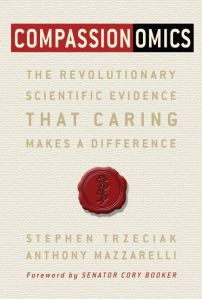 Compassionomics: The Revolutionary Scientific Evidence that Caring Makes a Difference
It is no secret that today’s medical atmosphere scarsely resembles anything similar to that of 50 years ago. Many have argued that this is in large part due to a lack of compassion in the modern medical system. If this is the case, where have we gone wrong, and is there scientific evidence to support that compassion is even beneficial to healthcare, personal relationships, and professional lives? These questions are raised and explored by authors Stephen Trzeciak and Anthony Mazzarelli through the telling of true stories of medical providers and patients that help demonstrate the incredible effect of the human connection. Coupled perfectly with these gripping stories are easily readable summaries of decades of research studying the effects of compassion as well as its implications in our lives. Addressing topics from healthcare cost to provider burnout, from caring for others to caring for ourselves, this evidence-based analysis of the importance of compassion is a must-read for anyone interested in the social science and psychology of the care we give in all settings of our lives.
To read more: https://www.the-scientist.com/news-opinion/opinion–the-best-neuroscience-books-of-2019-66863
Healthiest Adults: Early Risers With 7-8 Hours Of Sleep, No Insomnia Or Daytime Drowsiness
From a European Heart Journal study:
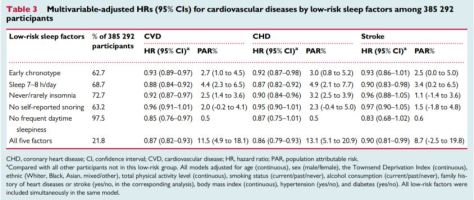
 When the five sleep factors were collapsed into binary categories of low risk vs. high risk (reference group), early chronotype, adequate sleep duration, free of insomnia, and no frequent daytime sleepiness were each independently associated with incident CVD, with a 7%, 12%, 8%, and 15% lower risk, respectively (Table 3). Early chronotype, adequate sleep duration, and free of insomnia were independently associated with a significantly reduced risk of CHD; while only adequate sleep duration was associated with stroke.
 Cardiovascular disease (CVD), including coronary heart disease (CHD) and stroke, is among the leading causes of mortality globally.1 In addition to traditional lifestyle behaviours, emerging evidence has implicated several unhealthy sleep behaviours were important risk factors for CVD.2,3 For example, short or long sleep duration,4–9 late chronotype,10,11 insomnia,12–17 snoring,18,19 and excessive daytime sleepiness20,21 were associated with a 10–40% increased CVD risk.
To read more: https://academic.oup.com/eurheartj/advance-article/doi/10.1093/eurheartj/ehz849/5678714

New Study: Nearly 50% Of Americans Will Have Obesity By 2030, 25% Severely Obese (NEJM)
From a New England Journal of Medicine online study release:
The findings from our approach suggest with high predictive accuracy that by 2030 nearly 1 in 2 adults will have obesity (48.9%; 95% confidence interval [CI], 47.7 to 50.1), and the prevalence will be higher than 50% in 29 states and not below 35% in any state.

Nearly 1 in 4 adults is projected to have severe obesity by 2030 (24.2%; 95% CI, 22.9 to 25.5), and the prevalence will be higher than 25% in 25 states. We predict that, nationally, severe obesity is likely to become the most common BMI category among women (27.6%; 95% CI, 26.1 to 29.2), non-Hispanic black adults (31.7%; 95% CI, 29.9 to 33.4), and low-income adults (31.7%; 95% CI, 30.2 to 33.2).
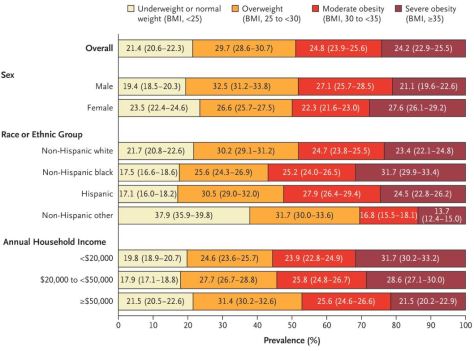
Although severe obesity was once a rare condition, our findings suggest that it will soon be the most common BMI category in the patient populations of many health care providers. Given that health professionals are often poorly prepared to treat obesity,27 this impending burden of severe obesity and associated medical complications has implications for medical practice and education.
In addition to the profound health effects, such as increased rates of chronic disease and negative consequences on life expectancy,25,28 the effect of weight stigma29 may have far-reaching implications for socioeconomic disparities as severe obesity becomes the most common BMI category among low-income adults in nearly every state.
To read more: https://www.nejm.org/doi/full/10.1056/NEJMsa1909301?query=featured_home
Retirement: Colleges Cater To Baby Boomers By Building On-Campus Living Facilities (WSJ)
From a Wall Street Journal online article:

 More schools are building or planning senior-living facilities on or near campus to cater to baby boomers who view college as a stimulating alternative to bingo at an archetypal retirement home. Some savor the pursuit of academic and cultural interests. Others are lured by the promise of interaction with younger students, for whom many hope to act as mentors.
It is the latest way for universities to profit from one of their greatest assets, land. Colleges have already taken advantage of this privilege by developing hotels and high-end student housing. Now, some see sales of upscale senior housing as the next step.
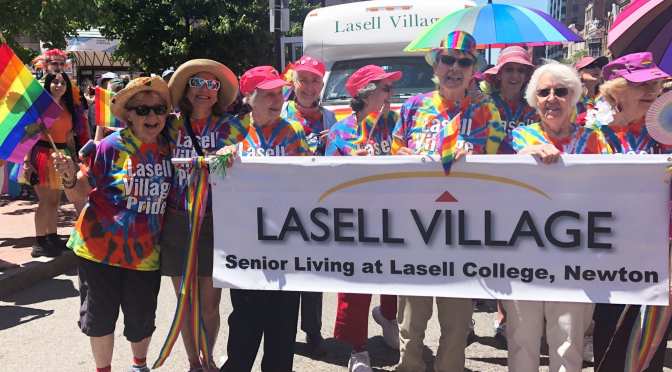
Lasell University, just west of Boston, built one of the first on-campus senior communities two decades ago. It requires members to take 450 hours of coursework or activities each year. Other programs have since sprouted up in places like the University of Michigan and Oberlin College in Ohio. Some communities are on campus; others are situated nearby and may have only a loose affiliation with the school. Many offer assisted living and nursing options.
To read more: https://www.wsj.com/articles/seniors-want-to-go-back-to-class-universities-want-to-sell-them-real-estate-11576751403

Top New Science Videos: “Breakthrough” Of The Year, Top Stories & Books 2019 (ScienceMag)
As the year comes to a close, we review the best science, the best stories, and the best books from 2019. Our end-of-the-year episode kicks off with Host Sarah Crespi and Online News Editor David Grimm talking about the top online stories on things like human self-domestication, the “wood wide web,” and more.
News Editor Tim Appenzeller joins Sarah to discuss Science’s 2019 Breakthrough of the Year, some of the contenders for breakthrough, also known as runners-up, and a breakdown—when science and politics just didn’t seem to mix this year.
Finally, Science books editor Valerie Thompson brings her favorites from the world of science-inflected media. She and Sarah talk about some of the best books reviewed in Science this year, a food extinction book we should have reviewed, a pair of science-centric films, and even an award-winning birding board game.
 Boomers Daily