
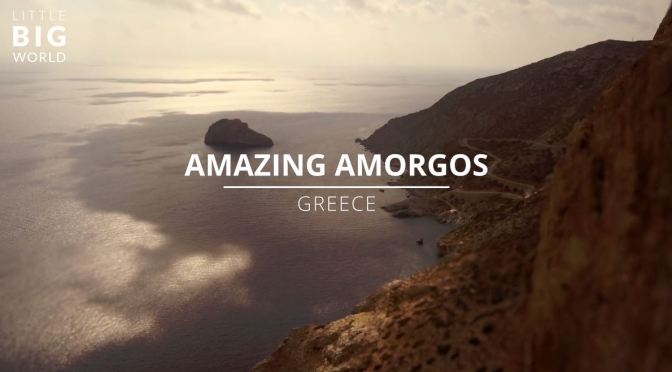
Filmed, Edited and Directed by: Joerg Daiber
I will never understand why so many people go to such an obvious Insta-tourist-trap like Santorini when there are so many amazing alternatives in Greece. Take Amorgos for instance. It’s the easternmost island in Greece’s Cyclades island group. With a land area of just 121 square kilometers, the island has a population of nearly 2000 people. It’s incredibly beautiful and no mass tourism is spoiling the fun so far.

The island was featured in Luc Besson’s film “The Big Blue.” Enjoy this trip around Amorgos and let me know what you think in the comments below. Shot by Joerg Daiber during the Yperia Film Festival in Amorgos.
Website: http://www.spoonfilm.com/



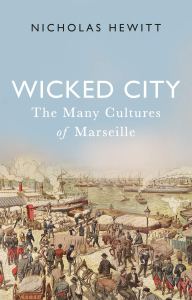 The Toulousain Charles Dantzig wrote, ‘I find the Marseillais tiresome, especially those who, as soon as you speak to them, start to bang on about the uniqueness of being Marseillais, adding with a particular sort of whining machismo that no one likes them and everyone defames them. Their humour is nothing more than pitiable braggadocio.’ Régis Jauffret, who grew up there, is pithier: ‘Marseille is a tragic city. It formed my imagination.’ (It’s an imagination of peerless bleakness.)
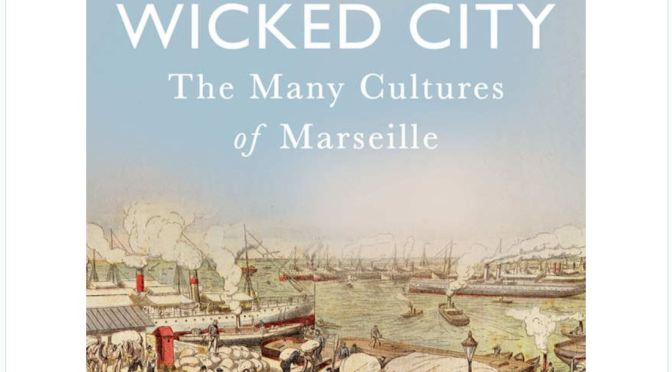
 Nicholas Hewitt died in March, less than a month after completing the text of Wicked City. It’s a fine monument to his curiosity, compendious knowledge, resourcefulness and measured enthusiasm. He calls it ‘a series of snapshots’, which is perhaps too modest. If they are snapshots, they have been photoshopped and retouched to accord with his vision of the city and its well-rehearsed mythology of outsiderdom and exceptionalism, edginess and banditry. And his aspiration to explore Marseille’s hold on the ‘nation’s imagination’ is also too modest. The ‘international imagination’ would be more apt.
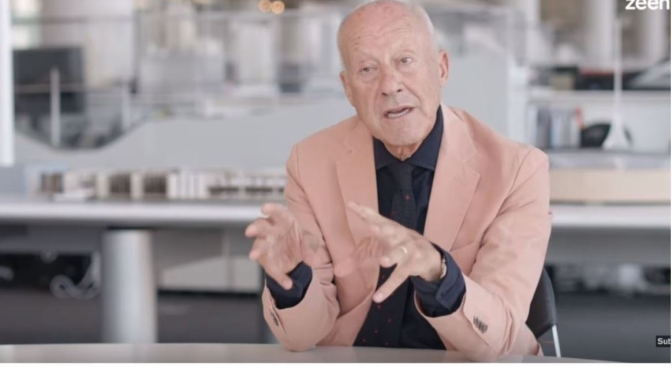
 British architect Norman Foster reflects on his first high-tech building and how it shaped offices to come, in this exclusive video produced by Dezeen. Named after the electronics manufacturer that commissioned the building,
 Melvyn Bragg and guests discuss the history and social impact of coffee. From its origins in Ethiopia, coffea arabica spread through the Ottoman Empire before reaching Western Europe where, in the 17th century, coffee houses were becoming established.

 …primary care providers (general practice, paediatrics, and internal medicine) performed the best, giving a considerably lower percentage of antibiotic prescriptions without a documented indication (12%) than other specialists such as gynaecologists and urologists, who commonly prescribed antibiotics (24%), as well as those in all other specialties (29%).
 Boomers Daily