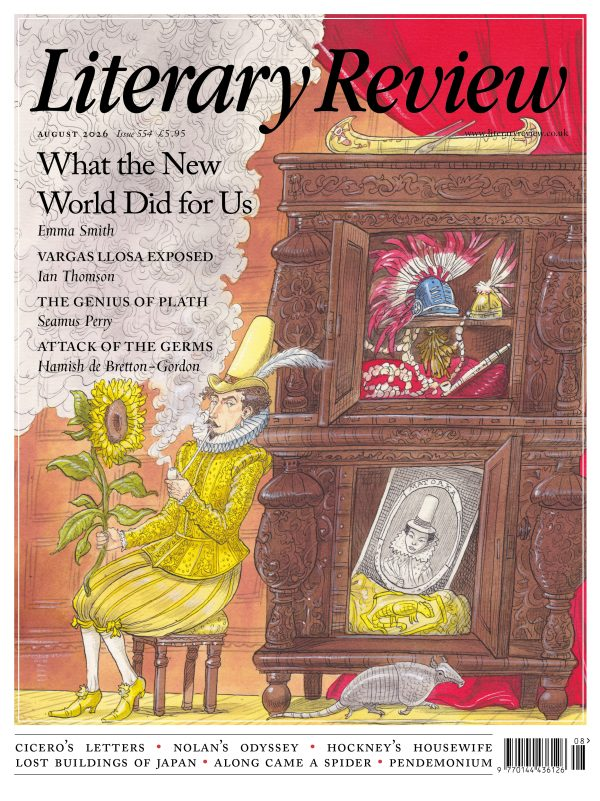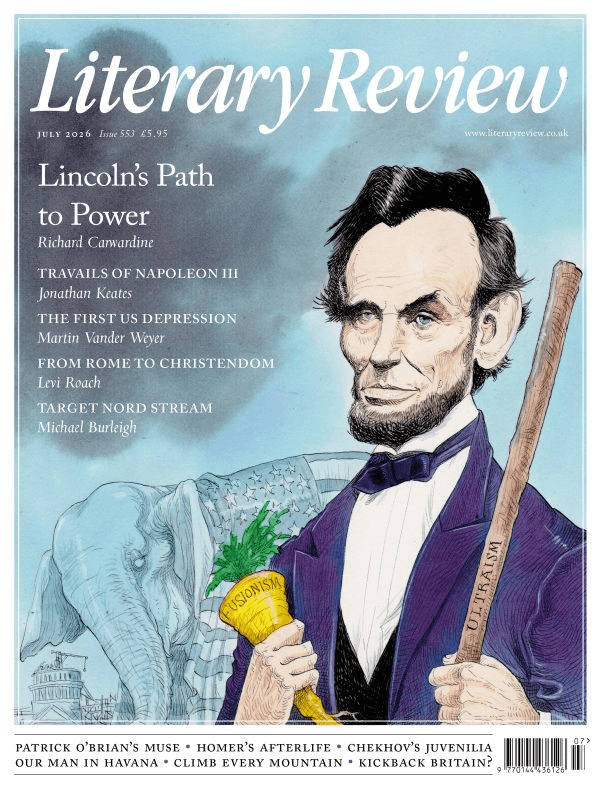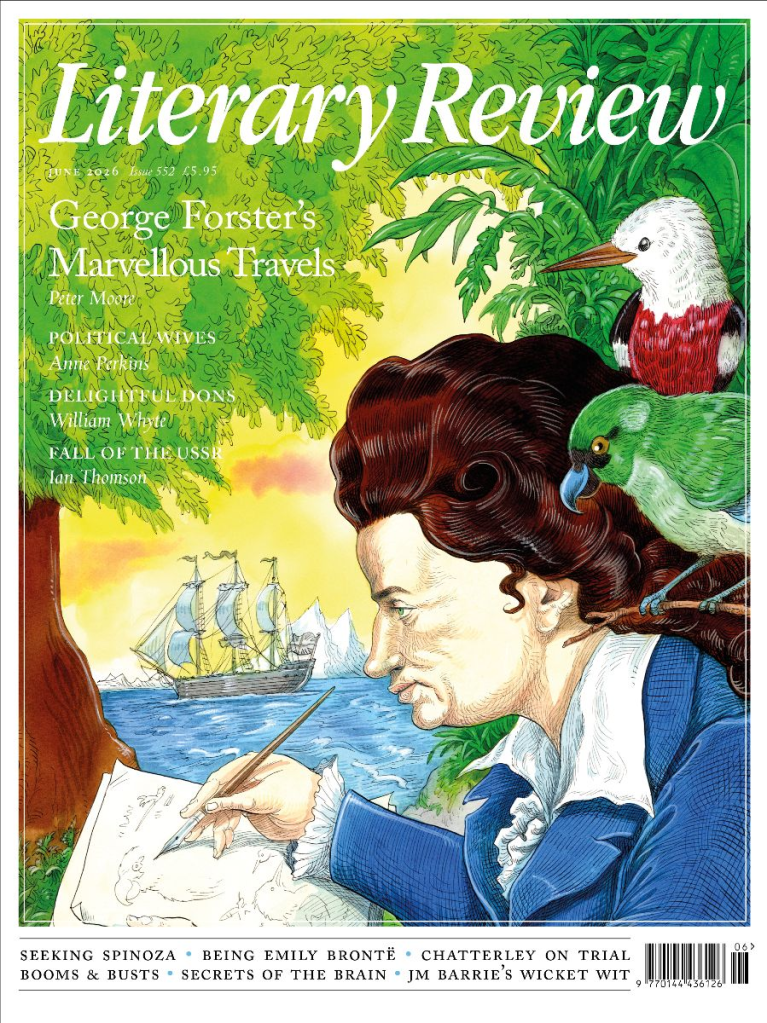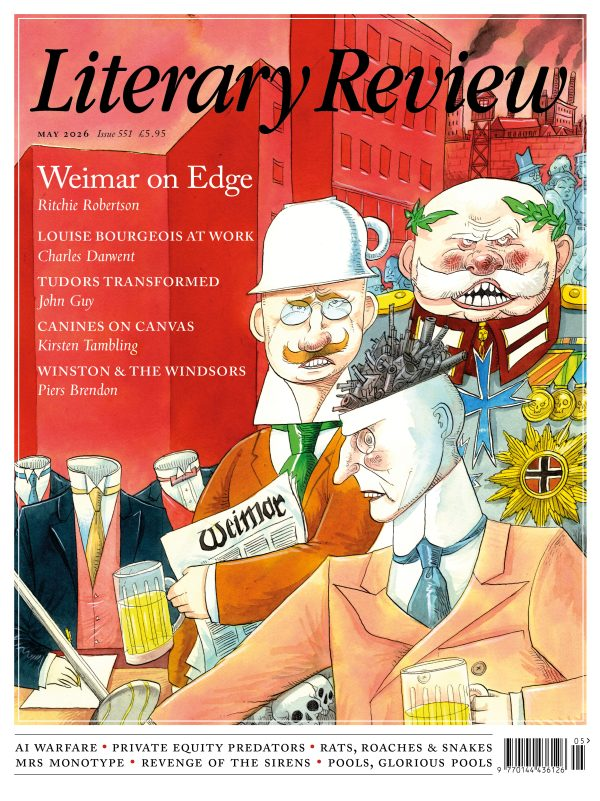

LITERARY REVIEW MAGAZINE – JULY 2026 PREVIEW


By Andrea Wulf
An exemplary tour of the High Enlightenment might go something like this. You’d begin in the streets of 1760s London to feel the pulse of Georgian commerce. You’d then hop aboard one of Captain Cook’s colliers and cruise through the Pacific, having encounters every day. Returning to Europe you might watch Benjamin Franklin in diplomatic action at Passy and dine with Casanova in Vienna, before sailing up the Rhine with Humboldt. Having inspected the Soho Manufactory in Birmingham and admired the picturesque scenery of the Peak District, you’d cross the Channel just in time for the grand and bloody finale in Paris.
By Colin Kidd
Arriving as an undergraduate at Cambridge in 1961, Terry Eagleton was both overawed and underwhelmed by his supervisor, a man he calls Greenway in his memoir. ‘Greenway was the first truly civilised man I had ever encountered,’ Eagleton recalls.
By Deborah Lutz
We know so little about Emily Brontë. There are just a few snapshots, like the vivid recollection of her sister Charlotte’s great friend Ellen Nussey: ‘Her extreme reserve seemed impenetrable, yet she was intensely loveable … one of her rare expressive looks was something to remember through life, there was such a depth of soul and feeling..

The small town of Weimar is overladen with historical associations. Goethe spent more than fifty years there as an employee and friend of Duke (later Grand Duke) Karl August. After the last grand duke abdicated in November 1918, the National Assembly met in Weimar to draw up a new republican constitution for Germany. Other symbolically charged venues considered were Nuremberg (home of Dürer) and Bayreuth (because of Wagner), but it was Weimar that gave its name to the period of German history from …
Having been named for her father, Louis, a mere dealer in antique tapestries, seemed insufficiently romantic to Louise Bourgeois, who was born on Christmas Day in 1911. She preferred the idea that her namesake was Louise Michel, ‘the red virgin of Montmartre’, an anarchist heroine of the Paris Commune. It wasn’t true, of course, but …
A phrase like ‘fortress England’ seems to echo down the centuries, and turns up again in This Little World, Nandini Das’s new study of identity and belonging, cross-border migration, assimilation and estrangement in the period between 1500 and the restoration of Charles II. Das seeks to unmask the period’s most fundamental assumptions about English … read more

The subject of this excellent biography wished to be remembered as Jan ‘Empire’ Morris, author of the great imperial trilogy Pax Britannica, but she correctly predicted that the valedictory headlines would read ‘Sex Change Author Dies’. As James Morris, he had won early fame as the Times reporter who broke the news of the conquest of Everest on Coronation Day, 1953. And Morris’s real distinction, as Sara Wheeler affirms, was as a travel writer. It was a term she loathed. (Wheeler follows Morris’s own lead in using male pronouns for the author’s early life and female ones after 1970, when transition was nearing completion.) But as a young man James had immersed…
It may be thought that the notorious Cambridge spies – the majority of them members of the Apostles, that university’s secretive, elitist society – had been written out. But, as Stalin’s Apostles makes clear, such is not the case. Most of the books on what the KGB later called their ‘Magnificent Five’ – Kim Philby, Guy Burgess, Donald Maclean, Anthony Blunt and John Cairncross – have dwelt …
Not so long ago, stories about powerful computer viruses apparently spreading around the world and threatening to bring modern life to a halt regularly filled the news. These days, cybercrime rarely makes the headlines, and most of us have become inured to warnings that our passwords have been found in a data leak. Yet ..

The historian A J P Taylor was at Oxford during the general strike of 1926. After it, he later recalled, relations between the minority of undergraduates, such as himself, who had gone to help the strikers and those who had signed on as special constables or volunteer strike-breakers were cordial. Only those sensible men who had stuck to their books and essays were disdained. The whole episode seemed funny in a stereotypically English way – like a Punch cartoon brought to life.


It’s an irony to savour: the man who invented the Tudors was a German. If Henry VIII, his wives and courtiers exercise a stronger hold on the public imagination than their Plantagenet precursors or Stuart successors, it is because we can all picture them so clearly. That, in turn, is due to an extraordinary sequence of portraits and drawings produced between the late 1520s and early 1540s by Hans Holbein of Augsburg (c 1497–1543), many of which have become instantly recognisable.
Orwell: 2+2=5 By Raoul Peck (dir)
George Orwell: Life and Legacy By Robert Colls
Nobody under the age of seventy-five has heard George Orwell’s voice. The only extant video footage is in a silent movie of the Eton Wall Game. None of his many wartime recordings for the BBC Eastern Service has survived. By all accounts his voice, damaged by a bullet to the throat during the Spanish Civil War, was thin, flat and weak. In fact, the controller of the BBC Overseas Service complained that putting on ‘so wholly unsuitable a voice’ made the BBC appear ‘ignorant of the essential needs of the microphone and of the audience’.

The Poems of Seamus Heaney By Rosie Lavan, Bernard O’Donoghue and Matthew Hollis (edd.)
A woman stands, oblivious to our gaze, absorbed entirely in her activity – reading, pouring, weighing, holding out her pearls. A window to the left admits a radiance, which falls variously on the common stuff the room contains. The light enters as an absolute blank, but infuses colour as it illuminates the scene.
The rush to tell the story of Katherine Mansfield’s short, fascinating life began as soon as she died. Her husband, John Middleton Murry, a gifted editor, notoriously turned the publication of her writing into an industry.


LITERARY REVIEW : The latest issue features ‘Mysteries of Marlowe’