Tag Archives: Food

Top Restaurant Videos: Gion Mikaku In Kyoto, Japan’s Best Steakhouse

Gion Mikaku, founded 1929: – 2 different cuts of beef: Tajima beef filet mignon and Kobe beef rump steak with just the right amount of marbling (intra-muscular fat) and no extra-muscular fat – 400g in total. Steak cutting behind a window in their kitchen, friendly, dedicated service, pleasant view, extra hot griddle for proper searing, right timing and handling of the steaks: they certainly know what they are doing – This restaurant meal included garlic rice (between steak and dessert).

Gion Mikaku Kyoto Japan Best Kobe Beef Steakhouse Menu

Website

Cookbooks: “Les Dîners de Gala” (1973) By Salvador Dalí Reprinted By Taschen

From an Art Daily online article (March 19, 2020):

“I love eating suits of arms, in fact I love all shell fish… food that only a battle to peel makes it vulnerable to the conquest of our palate.”

Les diners de Gala Salvador Dali rerpint by Taschen 2020This reprint features all 136 recipes over 12 chapters, specially illustrated by Dalí, and organized by meal courses, including aphrodisiacs. The illustrations and recipes are accompanied by Dalí’s extravagant musings on subjects such as dinner conversation: “The jaw is our best tool to grasp philosophical knowledge.”
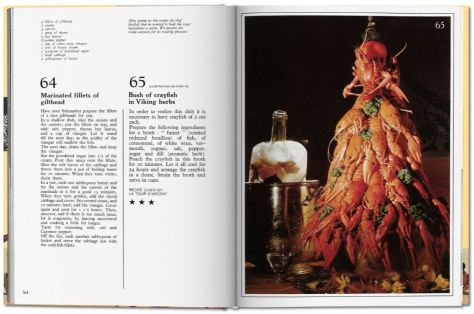
NEW YORK, NY.- “Les diners de Gala is uniquely devoted to the pleasures of taste … If you are a disciple of one of those calorie-counters who turn the joys of eating into a form of punishment, close this book at once; it is too lively, too aggressive, and far too impertinent for you.”—Salvador Dalí

Salvador Dalí Les dîners de Gala cookbook Taschen book

Read fabulous review in Brain Pickings

Food and surrealism make perfect bedfellows: sex and lobsters, collage and cannibalism, the meeting of a swan and a toothbrush on a pastry case. The opulent dinner parties thrown by Salvador Dalí (1904–1989) and his wife and muse, Gala (1894–1982) were the stuff of legend. Luckily for us, Dalí published a cookbook in 1973, Les diners de Gala, which reveals some of the sensual, imaginative, and exotic elements that made up their notorious gatherings.

Purchase book

Read full article

Food Podcasts: The “Rich Delights” Of Cork, Ireland’s Second City

The Menu Monocle 24Monocle’s Charlie Jermyn talks us through the rich and varied culinary delights on offer in Ireland’s second city.

Cork is the second largest city in Ireland. Located in the south-west of Ireland, in the province of Munster, since an extension to the city’s boundary in 2019, its population is c.210,000.

The city centre is an island positioned between two channels of the River Lee which meet downstream at the eastern end of the city centre, where the quays and docks along the river lead outwards towards Lough Mahon and Cork Harbour, one of the largest natural harbours in the world.

Originally a monastic settlement, Cork was expanded by Viking invaders around 915. Its charter was granted by Prince John in 1185. Cork city was once fully walled, and the remnants of the old medieval town centre can be found around South and North Main streets. The third largest city by population on the island of Ireland, the city’s cognomen of “the rebel city” originates in its support for the Yorkist cause in the Wars of the Roses. Corkonians sometimes refer to the city as “the real capital”, a  reference to its opposition to the Anglo-Irish Treaty in the Irish Civil War.

Study: Maintaining Weight Loss Tied To Healthier Eating Routines Formed Over Two-Year Period

From a New York Times online article (March 16, 2020):

New York Times How To Lose Weight and Keep It Off Study March 16 2020“Maintaining weight loss can get easier over time. Over time, less intentional effort, though not no effort, is needed to be successful. After about two years, healthy eating habits become part of the routine. Healthy choices become more automatic the longer people continue to make them. They feel weird when they don’t.”

Among the useful strategies identified in the new study is to keep lower calorie foods like fruits and vegetables more accessible. “We eat what we see,” Dr. Phelan noted. The corollary is equally important: keep high-calorie, less nourishing foods relatively inaccessible and out of sight if not out of the house entirely.

The new study led by Dr. Phelan, professor of kinesiology and public health at California Polytechnic State University, identified habits and strategies that can be keys to success for millions. Yes, like most sensible weight-loss plans, they involve healthful eating and regular physical activity. But they also include important self-monitoring practices and nonpunitive coping measures that can be the crucial to long-term weight management.

Read full article

Studies: “Ultra-Processed Foods” Are 58% Of All Calories In U.S., & Obesity Epidemic’s Major Cause

From a The Guardian online article (Feb 12, 2020):

What characterizes ultra-processed foods is that they are so altered that it can be hard to recognize the underlying ingredients. These are concoctions of concoctions, engineered from ingredients that are already highly refined, such as cheap vegetable oils, flours, whey proteins and sugars, which are then whipped up into something more appetizing with the help of industrial additives such as emulsifiers. 

Read full article

From a MedPage Today online article (March 7, 2020):

The top ultra-processed foods by calorie intake were breads, beverages, cakes, Ultra-Processed Diet and Unprocessed Diet Infographiccookies and pies, salty snacks, frozen and shelf-stable dishes, pizza, and breakfast cereals.

Altogether, ultra-processed foods accounted for 58% of all calories in the U.S. diet and nearly 90% of all added sugars.

They divided foods into four categories:

  • Unprocessed or minimally processed foods: Fresh, dry, or frozen fruits or vegetables, grains, legumes, meat, fish, and milk
  • Processed culinary ingredients: Table sugar, oils, fats, salt, and other substances extracted from foods or from nature and used in kitchens to make culinary preparations
  • Processed foods: Foods manufactured with the addition of salt, sugar, or other substances of culinary use to unprocessed or minimally-processed foods, such as canned food, simple breads, and cheese
  • Ultra-processed foods: Formulations of several ingredients that — besides salt, sugar, oils, and fats — include food substances not used in culinary preparations, in particular, flavors, colors, sweeteners, emulsifiers, and other additives used to imitate sensory qualities of unprocessed or minimally-processed foods and their culinary preparations or to disguise undesirable qualities of the final product

Read full article

Top Upcoming Books: “My Last Supper – One Meal, A Lifetime In The Making” By Jay Rayner (Mar 2020)

Jay Rayner My Last SupperThe plan was simple: he would embark on a journey through his life in food in pursuit of the meal to end all meals. It’s a quest that takes him from necking oysters on the Louisiana shoreline to forking away the finest French pastries in Tokyo, and from his earliest memories of snails in garlic butter, through multiple pig-based banquets, to the unforgettable final meal itself.

This question has long troubled Jay Rayner. As a man more obsessed with his lunch than is strictly necessary, the idea of a showpiece last supper is a tantalizing prospect. But wouldn’t knowledge of your imminent demise ruin your appetite? So, Jay decided to cheat death.

Jay Rayner’s Last Supper is both a hugely entertaining account of a life built around mealtimes and a fascinating global exploration of our relationship with what we eat. It is the story of one hungry man, in eight courses.

Read more or purchase

Video Profiles: 91-Year Old Bob Moore, Founder Of Bob’s Red Mill (CBS)

At 91, Bob Moore is an unexpected celebrity in the natural and organic foods industry, as the face of the company he founded, Bob’s Red Mill. He talks with correspondent Luke Burbank about his recipe for success.

Bob’s Red Mill is a brand of whole-grain foods marketed by employee-owned American[3] company Bob’s Red Mill Natural Foods of Milwaukie, Oregon. The company was established in 1978 by Bob and Charlee Moore.

Bob MooreBob’s Red Mill Natural Foods is a producer of natural, certified organic, and gluten-free milled grain products, billing itself as the “nation’s leading miller of diverse whole-grain foods.” Its products are distributed throughout the United States, Canada, and a number of other locations such as the Caribbean. It produces over 400 products, primarily whole grains that are ground with quartz millstones which come from several 120-year-old mills, as well as baking mixes, beans, seeds, nuts, dried fruits, spices, and herbs. They are sold through seventy natural food and specialty grocery distributors in the United States and Canada, their online store, and the company’s factory store and restaurant.

Website

From Wikipedia

Nutrition Infographic: Harvard Unveils A “Healthy Eating Plate” As Guide For Balanced Meals

Harvard Healthy Eating Plate Infographic February 2020


Aim for color and variety, and remember that potatoes don’t count as vegetables on the Healthy Eating Plate because of their negative impact on blood sugar.

Whole and intact grains—whole wheat, barley, wheat berries, quinoaoatsbrown rice, and foods made with them, such as whole wheat pasta—have a milder effect on blood sugar and insulin than white bread, white rice, and other refined grains.

Fish, poultry, beans, and nuts are all healthy, versatile protein sources—they can be mixed into salads, and pair well with vegetables on a plate. Limit red meat, and avoid processed meats such as bacon and sausage.

Choose healthy vegetable oils like olive, canola, soy, corn, sunflower, peanut, and others, and avoid partially hydrogenated oils, which contain unhealthy trans fats. Remember that low-fat does not mean “healthy.”

Skip sugary drinks, limit milk and dairy products to one to two servings per day, and limit juice to a small glass per day.

The red figure running across the Healthy Eating Plate’s placemat is a reminder that staying active is also important in weight control.

The main message of the Healthy Eating Plate is to focus on diet quality.

  • The type of carbohydrate in the diet is more important than the amount of carbohydrate in the diet, because some sources of carbohydrate—like vegetables (other than potatoes), fruits, whole grains, and beans—are healthier than others.
  • The Healthy Eating Plate also advises consumers to avoid sugary beverages, a major source of calories—usually with little nutritional value—in the American diet.
  • The Healthy Eating Plate encourages consumers to use healthy oils, and it does not set a maximum on the percentage of calories people should get each day from healthy sources of fat. In this way, the Healthy Eating Plate recommends the opposite of the low-fat message promoted for decades by the USDA.

Website

Best New Food Books: “Ana Roš – Sun And Rain” -Essays, Recipes And Stories From The Top Slovenian Chef

Ana Roš - Sun and Rain Food and Cooking Book 2020A personal chef monograph, and the first book, from globally-acclaimed chef Ana Roš of Hiša Franko in Slovenia

Set near the Italian border in Slovenia’s remote Soča valley, in the foothills of mountains and beside a turquoise river full of trout, Ana Roš tells the story of her life. Through essays, recollections, recipes, and photos, she shares the idyllic landscape that inspires her, the abundant seasonal ingredients from local foragers, the tales of fishing and exploring, and the evolution of her inventive and sophisticated food at Hiša Franko – where she has elevated Slovenian food and become influential in the global culinary landscape.

Ana Roš Sun and Rain Monograph book kitchen

Read more or purchase

Food Trends: “Third Culture Bakery” & “Mochi Muffins” Expand From California To Colorado

From a 303Magazine.com online article (Feb 7, 2020):

Third Culture’s largest sit-down café serves butter-mochi style doughnuts with flavors ranging from jasmine milk teastrawberry cream, yuzu lemon and mango passion fruit to black sesamedark chocolateube coconut and strawberry guava.

Third Culture Bakery in Aurora Colorado

Reigning from the Bay Area, Third Culture Bakery has opened its first café in Aurora on East Colfax Avenue. Owners and life partners, Sam Butarbutar and Wenter Shyu have put a twist on traditional bakery desserts by creating mochi muffins, doughnuts and waffles.

While mochi has become trendy to use in various desserts, these ingredients are what Butarbutar and Shyu grew up eating. From the very beginning, the masterminds behind baked mochi muffins have put their heart and soul into their brand.

Website

Read more