
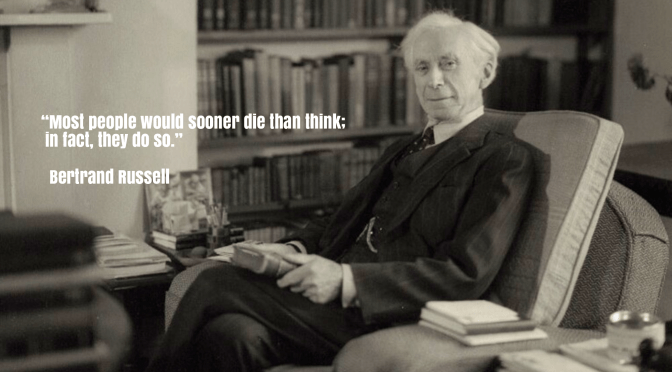
 Bertrand Arthur William Russell, 3rd Earl Russell (18 May 1872 – 2 February 1970) was a British philosopher, logician, mathematician, historian, writer, essayist, social critic, political activist, and Nobel laureate. At various points in his life, Russell considered himself a liberal, a socialist and a pacifist, although he also confessed that his sceptical nature had led him to feel that he had “never been any of these things, in any profound sense.” Russell was born in Monmouthshire into one of the most prominent aristocratic families in the United Kingdom.
In the early 20th century, Russell led the British “revolt against idealism”. He is considered one of the founders of analytic philosophy along with his predecessor Gottlob Frege, colleague G. E. Moore and protégé Ludwig Wittgenstein. He is widely held to be one of the 20th century’s premier logicians. With A. N. Whitehead he wrote Principia Mathematica, an attempt to create a logical basis for mathematics, the quintessential work of classical logic. His philosophical essay “On Denoting” has been considered a “paradigm of philosophy”. His work has had a considerable influence on mathematics, logic, set theory, linguistics, artificial intelligence, cognitive science, computer science (see type theory and type system) and philosophy, especially the philosophy of language, epistemology and metaphysics.
Russell was a prominent anti-war activist and he championed anti-imperialism. Occasionally, he advocated preventive nuclear war, before the opportunity provided by the atomic monopoly had passed and he decided he would “welcome with enthusiasm” world government. He went to prison for his pacifism during World War I.[75] Later, Russell concluded that war against Adolf Hitler’s Nazi Germany was a necessary “lesser of two evils” and criticised Stalinist totalitarianism, attacked the involvement of the United States in the Vietnam War and was an outspoken proponent of nuclear disarmament. In 1950, Russell was awarded the Nobel Prize in Literature “in recognition of his varied and significant writings in which he champions humanitarian ideals and freedom of thought”.
From Wikipedia



 Rosa Park is founding editor of Cereal, which is dedicated to thoughtful travel and lifestyle stories and known for its pared-back aesthetic. Here she reveals her love of Bath’s sandstone buildings, the unique style of her family home – and why you’d better not call her a minimalist.

 well-known capital city, his most recent book,
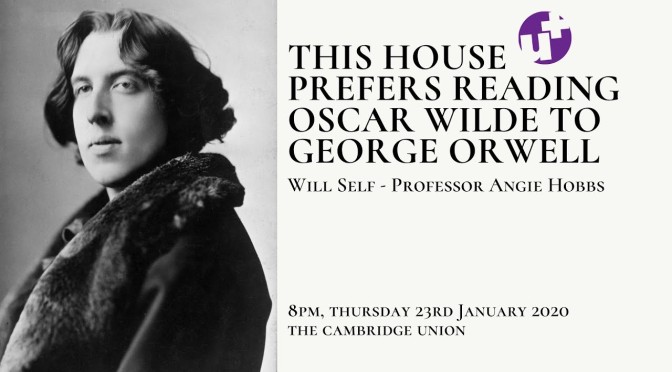
 ABOUT THE MOTION: This House Prefers Reading Oscar Wilde to George Orwell Do we prefer satire or comedy? Do we take refuge in the serious or the frivolous? Do we understand the importance of being earnest or would we rather be in room 101? These two authors demonstrate well two powerful traditions in British literature, the comic and the satirical. They both of course share in each other’s art. Some would argue that during our present global crises we should look to Orwell more than ever, others would reach for the escapism of Oscar Wilde. In a new enterprise for the Cambridge Union, we are beginning our cultural debates – and this is our first. At least for a while.
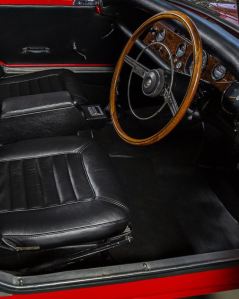 The Sunbeam Tiger is a high-performance V8 version of the British Rootes Group’s Sunbeam Alpine roadster, designed in part by American car designer and racing driver Carroll Shelby and produced from 1964 until 1967. Shelby had carried out a similar V8 conversion on the AC Cobra, and hoped to be offered the contract to produce the Tiger at his facility in the United States. Rootes decided instead to contract the assembly work to Jensen at West Bromwich in England, and pay Shelby a royalty on every car produced.
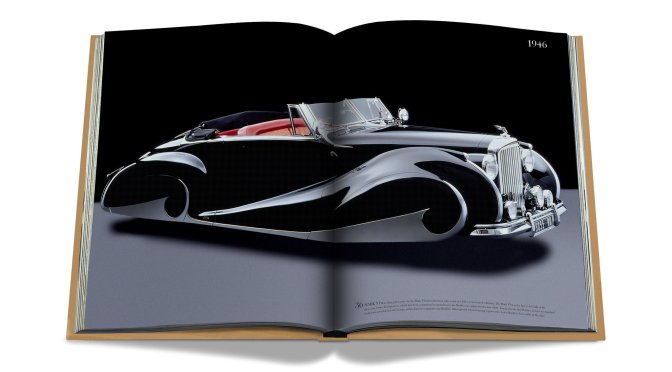
 Assouline presents yet another fascinating volume dedicated to the preeminent British car brand—Bentley: 100. Housed in a hand-stitched leather bound, limited edition case, this all-inclusive work presents an exhaustive list of the one hundred single most important and groundbreaking Bentley models, with detailed critiques and explanations relating to each automobile’s unique engineering excellence and the various creative avenues Bentley may have taken during the manufacturing process.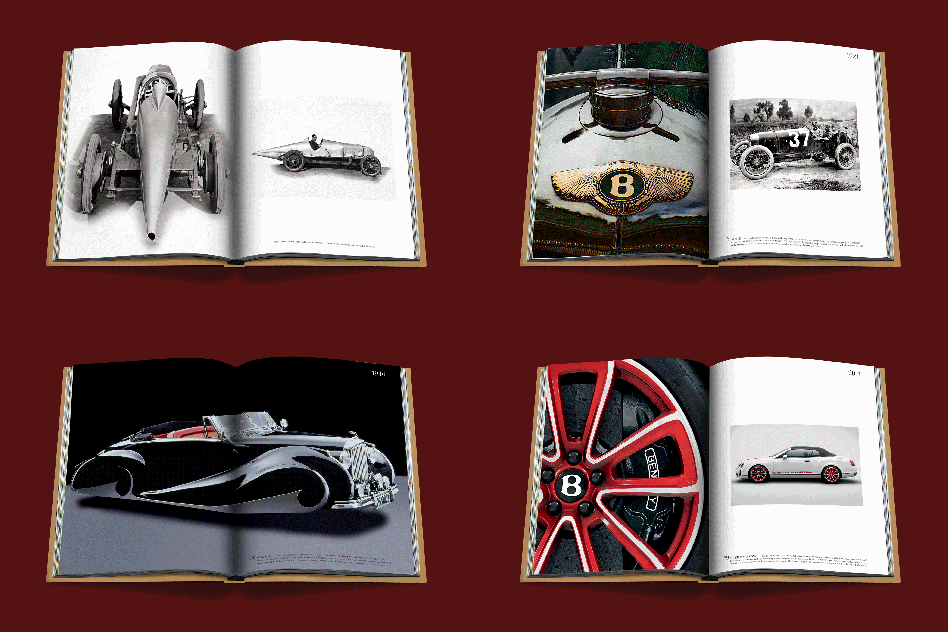





 Boomers Daily