


Category Archives: Reviews
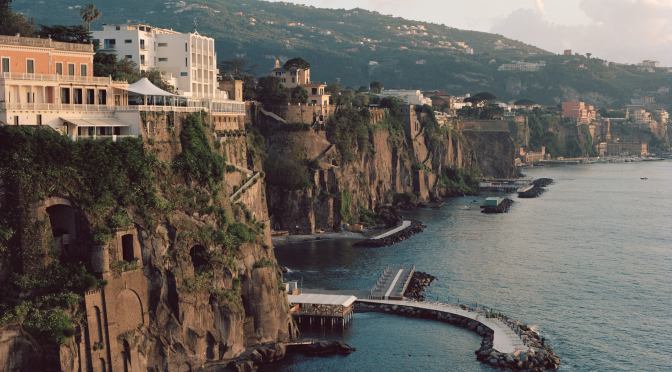
Destination Hotels: Parco Dei Principi In Sorrento, Italy – 1960’s “Infinite Blue”
From a Cereal Magazine online article (March 2, 2020):
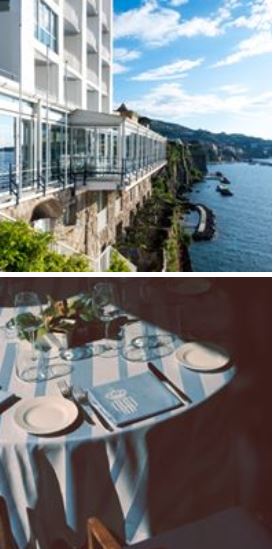 Of all Gio Ponti’s 100-odd buildings, Sorrento is the only hotel where you can still stay, fully immersed in his art — for as well as the building itself he designed every last detail. He was not just an architect, but a designer — of interiors, furniture, industry, cars — an artist and a ceramicist, a writer and a teacher; and at Parco dei Principi his passion for so many disciplines converged in one triumphant paean to modernity.
The concept of infinite blue was architect Gio Ponti’s driving inspiration when he built Parco dei Principi, his slice of 1960s modernism on a coast of faded antiquity. When it opened in 1962, the hotel was something new for ancient Sorrento: a clean-lined, contemporary edifice on the tufa-stone cliff. Inside, the bright, wide-open spaces were pared down and decorated entirely in white and blue.

Future Of Housing: Off-The-Grid “CABN” Tiny Homes In Australia (Video)
CABN was established to provide people with a means of disconnecting from the mayhem we have brought upon ourselves. CABN is designed to be completely off-grid, sustainable and eco-friendly relocatable; transforming some of Australia’s most stunning and stimulating landscapes and offer an ideal escape.
This CABN is named Jude, after CABN founder’s mother. Jude is warm, caring and inviting and has always welcomed everyone into her home and life. It’s those same feelings that you can expect when you stay. Adventurous, warm and welcoming – the perfect tiny escape.
New Architecture Books: “The Gardens Of Eden” By Gestalten (April 2020)
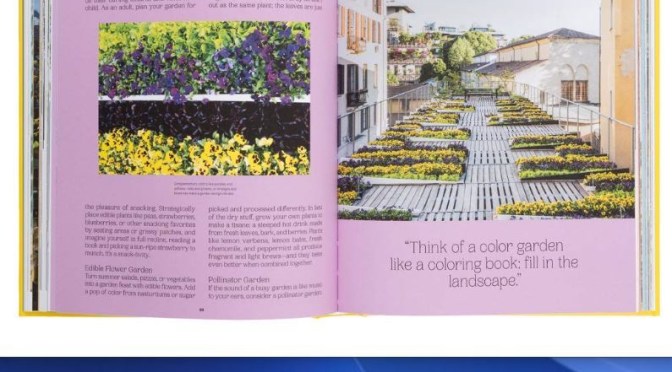
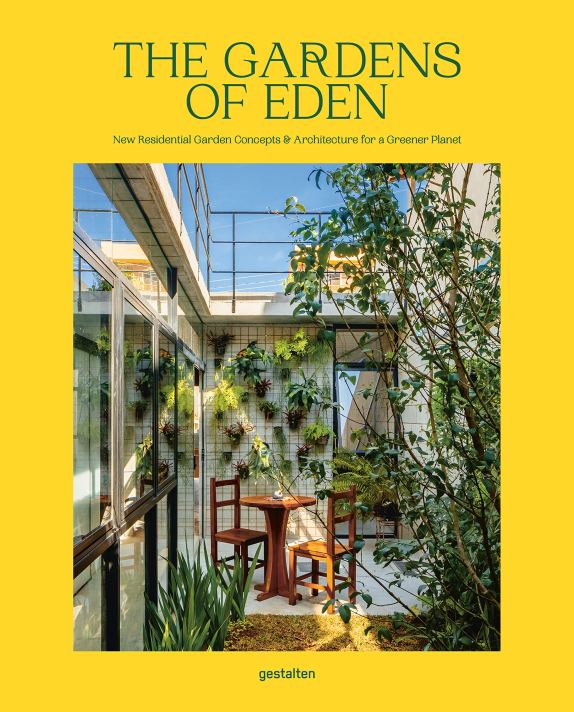 Step into innovative little gardens of Eden created on small terraces and city rooftops, as well as out in the suburbs and countryside.
As our lifestyles become more sustainable, so does the way we interact with the outdoors. Today’s gardeners aim not only to create decorative outside spaces but also to give something back. No matter what size your patch is, it’s easy to create diverse and rich environments for plants and insects, or grow your own vegetables or fruits. This book presents spaces that are more imaginative, diverse, and sustainable. Learn how to grow food in the city, get creative with native plants, and design  greener corners within urban areas. The Gardens of Eden looks at fascinating examples around the world, teaching what you can do for nature while revealing what a garden can do for you.
Abbye Churchill was the editorial director of Wilder Quarterly, and her first book, A Wilder Life, was featured in The New York Times Book Review. Her writing has also appeared in The New York Times, Vogue, Food & Wine, and W. She lives in Brooklyn, New York City.
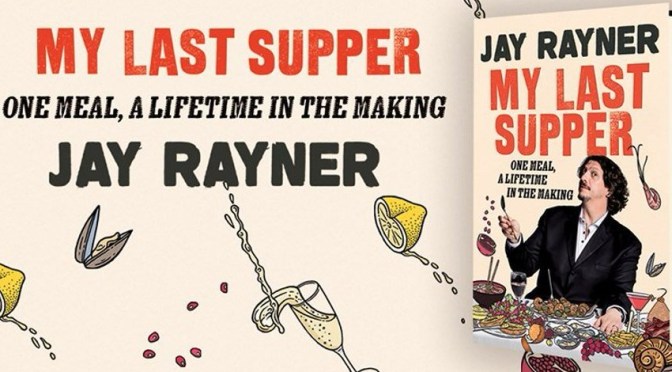
Top Upcoming Books: “My Last Supper – One Meal, A Lifetime In The Making” By Jay Rayner (Mar 2020)
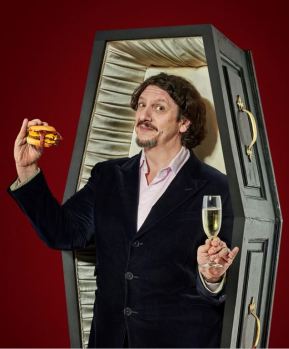 The plan was simple: he would embark on a journey through his life in food in pursuit of the meal to end all meals. It’s a quest that takes him from necking oysters on the Louisiana shoreline to forking away the finest French pastries in Tokyo, and from his earliest memories of snails in garlic butter, through multiple pig-based banquets, to the unforgettable final meal itself.
This question has long troubled Jay Rayner. As a man more obsessed with his lunch than is strictly necessary, the idea of a showpiece last supper is a tantalizing prospect. But wouldn’t knowledge of your imminent demise ruin your appetite? So, Jay decided to cheat death.
Jay Rayner’s Last Supper is both a hugely entertaining account of a life built around mealtimes and a fascinating global exploration of our relationship with what we eat. It is the story of one hungry man, in eight courses.
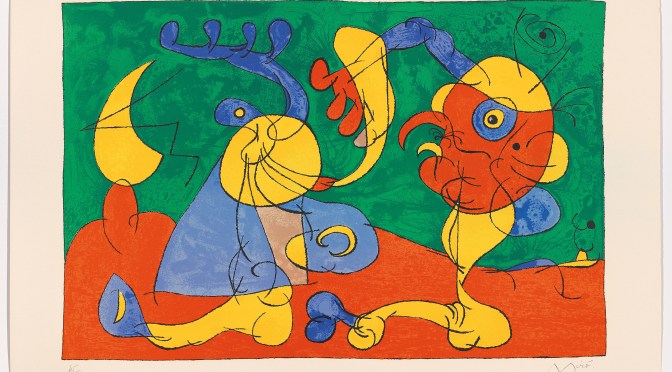
Artists: Spanish Painter Joan Miró’s “Endlessly Creative” Printmaking
Excerpts from a Christie’s online article (Feb 28, 2020):
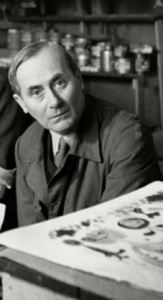
Like Pablo Picasso, his compatriot and peer, Miró had an unwavering commitment to printmaking. Also like Picasso, he created more than 2,000 works in the medium. It’s often said that Miró’s fondness for calligraphic lines — such a distinctive feature of his paintings — lent itself naturally to graphic work.
‘In terms of both the quality and quantity of his output, Joan Miró was one of the most important printmakers of the 20th century,’ says Murray Macaulay, Head of Prints at Christie’s in London.
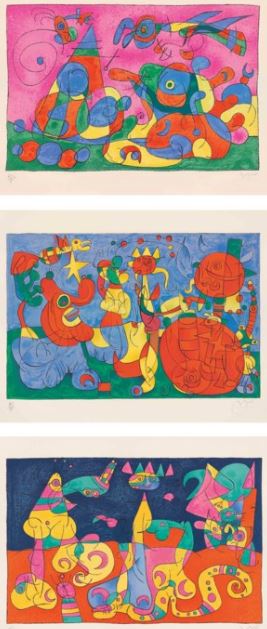 The son of a watchmaker, Joan Miró was born in Barcelona in 1893. He moved to Paris in the early 1920s and soon joined the Surrealist movement. He also befriended a host of avant-garde writers, such as Max Jacob, Tristan Tzara, Antonin Artaud, André Breton and Paul Eluard.
The first prints Miró ever made were illustrations for Tzara’s 1930 book of poems, L’arbre des Voyageurs. Literary sources would prove to be a constant inspiration for him, with notable examples including Alfred Jarry’s play, Ubu Roi; Stephen Spender’s poem, Fraternity; and the mystic, medieval text, Canticle of the Sun, by St Francis of Assisi.
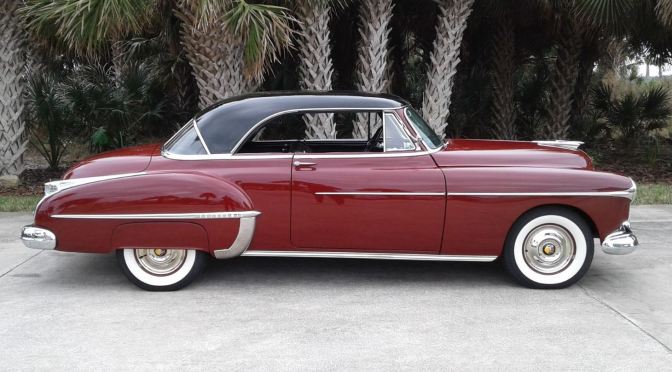
Classics: “1950 Oldsmobile 88 Holiday Coupe”
 The Oldsmobile 88 (marketed from 1989 on as the Eighty Eight) is a full-size car that was sold and produced by Oldsmobile from 1949 until 1999. From 1950 to 1974 the 88 was the division’s top-selling line, particularly the entry-level models such as the 88 and Dynamic 88. The 88 series was also an image leader for Oldsmobile, particularly in the early years (1949–51) when it was one of the best performing automobiles thanks to its relatively small size, light weight and advanced overhead-valve high-compression V8 engine. This engine, originally designed for the larger C-bodied and more luxurious 98 series, also replaced the straight-8 on the smaller B-bodied 78. With the large, high performance V8, the Oldsmobile 88 is widely considered to be the first muscle car, although this title is disputed.
In 1950, Oldsmobile offered a modified Cadillac manual gearbox for V8 models. The 88 now outsold the six-cylinder 76 lineup, which was dropped entirely after the 1950 model year. It had a 40 ft. turning circle. The 1950 model won the 1950 Carrera
 A large number of variations in nomenclature were seen over this long model run — Futuramic, Super, Golden Rocket, Dynamic, Jetstar, Delta, Delmont, Starfire, Holiday, L/S, LSS, Celebrity, and Royale were used at various times with the 88 badge, and Fiesta appeared on some station wagons in the 1950s and 1960s. The name was more commonly shown as numbers in the earlier years (“Delta 88”, for example) and was changed to spell out “Eighty Eight” starting in 1989.
From Wikipedia
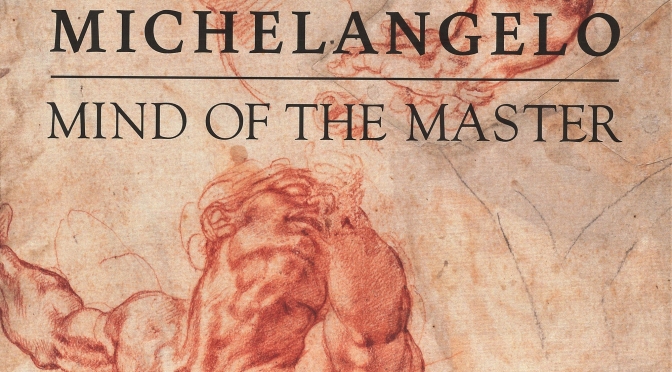
Exhibitions: Press Preview Of “Michelangelo – Mind Of The Master” (The Getty)
A film by Eric Minh Swenson.
Michelangelo was one of the most creative and influential artists in the history of Western art. This exhibition explores the full range of his work as a painter, sculptor, and architect through more than two dozen of his extraordinary drawings, including designs for celebrated projects such as the Sistine Chapel ceiling, the Medici Chapel tombs, and The Last Judgment. These studies and sketches enable us to witness Michelangelo at work, and to experience firsthand his boundless creativity and his pioneering representation of the human form.
This exhibition has been organized by the Teylers Museum, Haarlem in collaboration with the J. Paul Getty Museum and The Cleveland Museum of Art. It is supported by an indemnity from the Federal Council on the Arts and the Humanities.
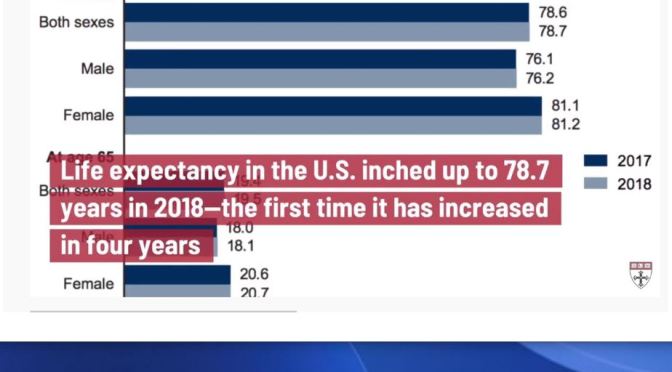
Health: Why U.S. Life Expectancy Stopped Declining In 2018
A slight uptick in U.S. life expectancy in the U.S. in 2018 was due partly to a decrease in overdose deaths, but mostly to decreasing cancer deaths.
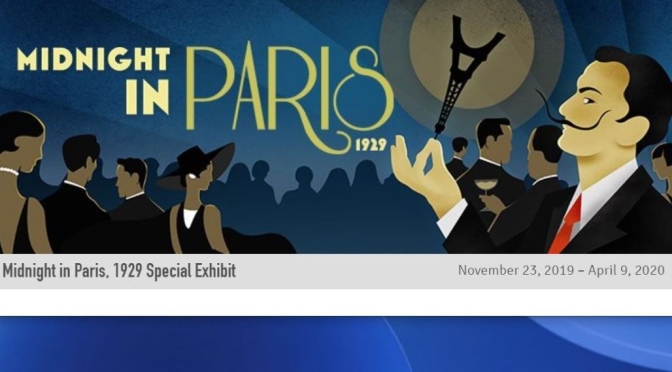
Surrealism: “Midnight In Paris, 1929″(Dalí Museum)
Excerpts from a Wall Street Journal online review (Feb 25, 2020):
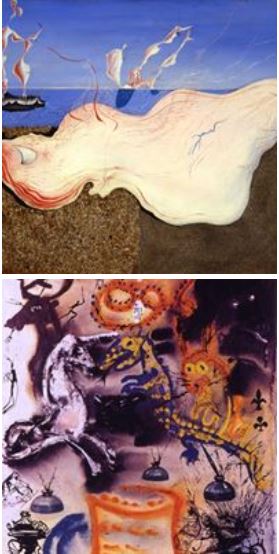 Masson, a founding Surrealist, saw the movement as an immersion “into what the German romantics call the night side of things.” However, “towards 1930,” Masson wrote, “a formidable disaster appeared in its midst: the demagogy of the irrational.” “Midnight in Paris” touches on Surrealism’s highs and lows, its darkness, poetry, beauty and banalities, reminding viewers—at the heart of the Dalí Museum, no less—that the movement is much, much more than melting watches.
In 1920s Paris, Surrealist revolution and transgression were in the air, but not everyone agreed on how to make Surrealist works or what they should look like. “Midnight in Paris: Surrealism at the Crossroads, 1929,” an exhibition of 80 paintings, prints, sculptures, drawings, collages, photographs, films and documents at St. Petersburg’s Dalí Museum, proposes to examine Surrealism’s rich visual fabric, conflicts and rivalries during the movement’s heyday in the City of Light. Organized by Didier Ottinger, deputy director of the Musée national d’art moderne at the Centre Pompidou, and William Jeffett, chief curator of special exhibitions at the Dalí, it focuses on the moment just before Surrealism burst onto and began to dominate the world stage.
 Boomers Daily