
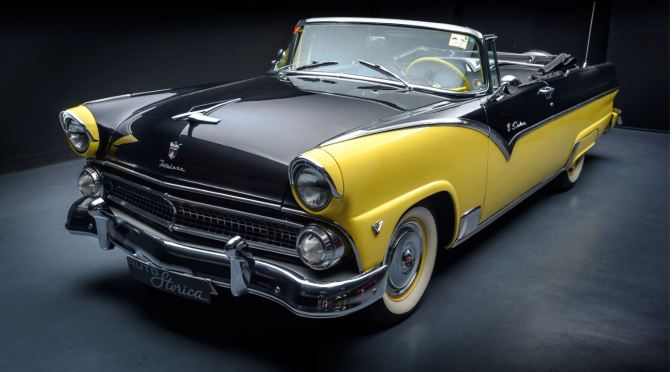
The Ford Fairlane is an automobile model that was sold between 1955 and 1970 by Ford in North America. The name is derived from Henry Ford’s estate, Fair Lane, near Dearborn, Michigan.
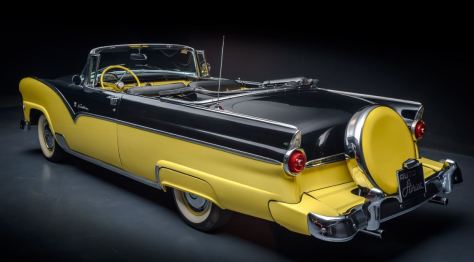
For the 1955 model year the Fairlane name replaced the Crestline as Ford’s premier full-sized offering. Six different body styles were offered, including the Crown Victoria Skyliner with a tinted, transparent plastic roof, the regular Crown Victoria coupe with lots of stainless steel trim, a convertible Sunliner, the Victoria hardtop coupe, and traditional sedans. All featured the trademark stainless-steel “Fairlane stripe” on the side. Power options were a 223 cu in (3.7 L) straight-6 engine and a 272 cu in (4.5 L) V8. The 292 cu in (4.8 L) Y-block was offered as an option and was called the Thunderbird V-8.
More photos at Classic Driver
From Wikipedia

 Wines by Massimo Ferragamo: How Salvatore Ferragamo’s youngest son is succeeding in the wine industry.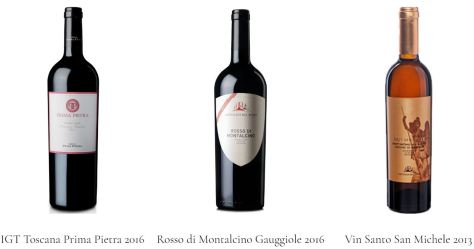

 ABOUT THE MOTION: This House Prefers Reading Oscar Wilde to George Orwell Do we prefer satire or comedy? Do we take refuge in the serious or the frivolous? Do we understand the importance of being earnest or would we rather be in room 101? These two authors demonstrate well two powerful traditions in British literature, the comic and the satirical. They both of course share in each other’s art. Some would argue that during our present global crises we should look to Orwell more than ever, others would reach for the escapism of Oscar Wilde. In a new enterprise for the Cambridge Union, we are beginning our cultural debates – and this is our first. At least for a while.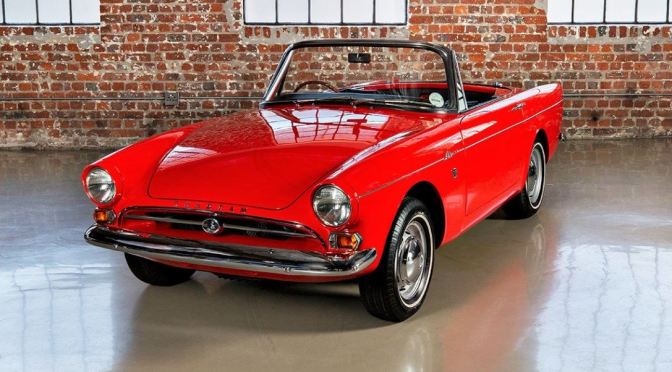
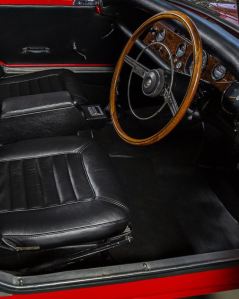 The Sunbeam Tiger is a high-performance V8 version of the British Rootes Group’s Sunbeam Alpine roadster, designed in part by American car designer and racing driver Carroll Shelby and produced from 1964 until 1967. Shelby had carried out a similar V8 conversion on the AC Cobra, and hoped to be offered the contract to produce the Tiger at his facility in the United States. Rootes decided instead to contract the assembly work to Jensen at West Bromwich in England, and pay Shelby a royalty on every car produced.






 Boomers Daily