Category Archives: Reviews

Fiction: “Hercule Poirot” Created 100 Years Ago In 1920 By Agatha Christie

From Open Magazine (May 29, 2020):

Hercule Poirot
Hercule Poirot

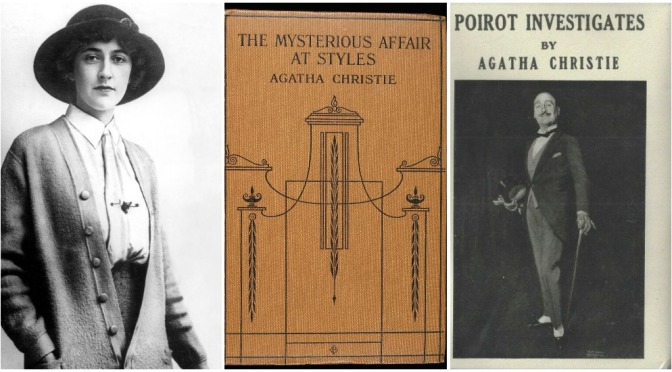
And with The Mysterious Affair at Styles (published a 100 years ago, in 1920) Christie would introduce readers to Monsieur Hercule Poirot, an old Belgian detective who resembled Holmes superficially (‘eccentric detective, stooge assistant’, as the author would admit in her autobiography later) but whose psychological insights and near-mystical idiosyncrasies would make him arguably the most successful and beloved literary sleuth of all time.

IN 1916, THE 26-year-old Agatha Christie finished writing her first detective novel at Dartmoor, a quiet upland in Devon, UK, known for its beautiful granite hilltops. Sir Arthur Conan Doyle had published The Hound of the Baskervilles, in 1902, which would become one of the most widely read Sherlock Holmes adventures—and the story was set in this same corner of the world, Dartmoor.

Books like Murder on the Orient Express (1934), The Murder of Roger Ackroyd (1926)  and Death on the Nile (1937) remain some of the bestselling murder mysteries in the world today, over eight decades after their original publication (Christie’s net sales for all of her books combined are over two billion now).


Read full article

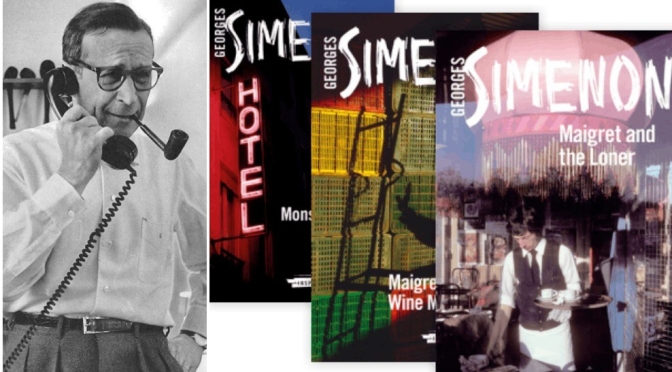
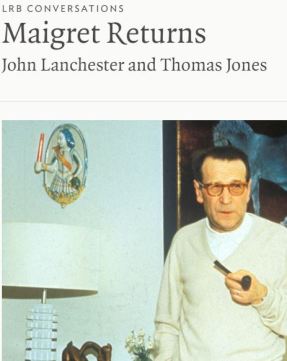
Podcast Profiles: Author Georges Simenon, Creator Of Inspector Maigret (LRB)

London Review of Books’ John Lanchester talks to Thomas Jones about Georges Simenon, whose output was so prodigious that even he didn’t know how many books he wrote.

Georges Simenon - Maigret ReturnsTRANSCRIPT

Thomas Jones: Hello, and welcome to the London Review of Books podcast. My name is Thomas Jones, and today I’m talking to John Lanchester, who’s written a piece in the current issue of the LRB about Georges Simenon and his 75 Maigret novels, which Penguin have just finished reissuing in new translations. Hello, John.

John Lanchester: Hi Tom. Thanks for having me.

TJ: Thank you for joining me. And I thought we could begin where you begin your piece with Simenon’s ‘colossal output’, as you put it, and that nobody knows how many books he actually wrote, though it was probably more than four hundred, which is fewer than Barbara Cartland, but still puts the rest of us to shame.

JL: He didn’t half crack on, that’s true. Yes, he started as a young man in Liège, his home town in Belgium. And he got a job as a reporter on the local paper. I think he was not quite 16, which is properly strange. It’s like something out of a high concept kid’s TV show, you know, Georges Simenon – Boy Reporter, and very early on latched onto the idea of making money through writing.He began writing when he was 18, his first book came out when he was 19. He started writing every sort of potboiler, thrillers, romances, sort of semi-porn westerns, things like that, at an absolutely astounding rate of productivity. And his target was eighty pages a day, typewritten, and even on the assumption that the pages … I mean, a short page would be 150 words and it could well have been more, but it was 10,000 words a day, and he did that every single day. And then he’d write eighty pages, and then he’d go and be sick. Just from the physical and mental exertion and the strain. That was in the morning. And then he’d recover and do a bit of light reading and pottering about. And then the next day he did the same again, over and over and over for about seven years. And in that period, as you’ve mentioned, we don’t know exactly how many, because he forgot, and he had multiple pseudonyms. The main one being Georges Sim, which was how he was known when he began writing the Simenon novels. People thought that Simenon was a pseudonym because George Sim was so well known, but he seems to have written about 150 or more books in this seven-year burst. It  makes you feel peculiar even to think about what that must have been like.

Read full transcript

Food & Travel: “Bangkok’s Fresh Food Markets” (NYT)

From the New York Times (June 1, 2020):

Finding Euphoria in Bangkok's Food Scene - New York Times June 1 2020The aromas here are rich and pungent — smoked, cured, dried and fresh seafood, along with many forms of meat, both raw and cooked. The awnings over the stalls create a shadowy atmosphere that’s punctuated by thin streaks of dancing light.


Finding Euphoria in Bangkok's Food Scene - New York Photographs and Text by Louise PalmbergTimes June 1 2020
Photographs and Text by Louise Palmberg

Early this year, in search of inspiration beyond the food scene in New York (and not yet locked down by the spread of Covid-19), I spent two weeks visiting and documenting life among the fresh markets and street vendors in and around Bangkok.

It made for an unlikely itinerary since tourists in Thailand often spend only a day or two in the capital before heading south toward the country’s many islands.

Read full article

Tiny Home Design: “Base Cabin” By Studio Edwards – “Efficient Micro Living”

Studio-Edwards-Base-Cabin-mobile-tiny-home InteriorThe design is inspired by the A-Frame cabin & iconic airstream trailer.  The A-frame structurally efficient & using less material than conventional portal framed buildings. Mute in its appearance & clad in black rubber to blend into its surrounds.



Designed by Studio Edwards for Base Cabin . A mobile retreat providing a fresh design approach to the ‘micro-home’ typology. Designed to be transported on a trailer & wheeled into its desired location.  Providing an intimate connection to nature & the great outdoors.

Base Cabine - Studio Edwards - Micro Home exterior

A cosy sleeping space sits below the A-frame roof with triangular window framing views outwards . Complete with central bathroom shower bathed in light from the roof-light above. A kitchenette to the rear of the cabin provides kitchen functionality with a window seat & fold out table adjacent to a large operable glazed facade.

Website

Top New Books: “The Idea Of The Brain” By Matthew Cobb – “A Supercomputer”

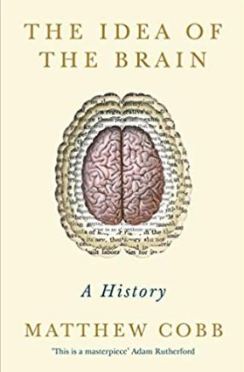
The Idea of the Brain - Matthew Cobb - April 2020Although it might seem to be a story of ever-increasing knowledge of biology, Cobb shows how our ideas about the brain have been shaped by each era’s most significant technologies. Today we might think the brain is like a supercomputer. In the past, it has been compared to a telegraph, a telephone exchange, or some kind of hydraulic system. What will we think the brain is like tomorrow, when new technology arises?


For thousands of years, thinkers and scientists have tried to understand what the brain does. Yet, despite the astonishing discoveries of science, we still have only the vaguest idea of how the brain works. In The Idea of the Brain, scientist and historian Matthew Cobb traces how our conception of the brain has evolved over the centuries.

READ EXCERPT OF FIRST 30 PAGES

The result is an essential read for anyone interested in the complex processes that drive science and the forces that have shaped our marvelous brains.

Matthew Cobb is Professor of Zoology at the University of Manchester. His previous books include Life’s Greatest Secret:The Race to Discover the Genetic Code, which was shortlisted for the the Royal Society Winton Book Prize, and the acclaimed histories The Resistance and Eleven Days in August. He is also the award-winning translator of books on the history of molecular biology, on Darwin’s ideas and on the nature of life.

Read more or purchase

Future Of Living Spaces: “Lumipod” By French Firm Lumicene – “Curved Glass”

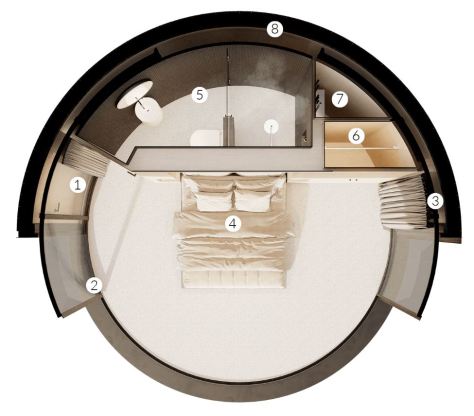
LUMIPOD is built around a LUMICENE® window. This new concept uses curved glass in aluminium frames sliding between two rails, allowing the interior space to be occasionally transformed into an outdoor space.

Lumipod Layout

.

  • 1. Curved entry door
  • 2. Lumicene curved reversible window
  • 3. Curtains
  • 4. 14m²  bedroom with panoramic view!
  • 5. Bathroom and toilets
  • 6. Wardrobe
  • 7. Technical room
  • 8. Curved wood-frame walls


Closed, LUMIPOD is a comfortable cocoon but fully immersed in Nature.

In a single gesture, LUMIPOD eliminates the boundary between interior and exterior for an unforgetable experience.

Website

Auto History: Three “Solid Stainless Steel” Ford Cars Auctioned (1936 – 1967)

Of the six stainless steel cars that rolled off the Ford assembly line in Detroit in 1936, four exist today, including this example that was retained by Allegheny Ludlum – now known as Allegheny Technologies – itself. The company donated the 1936 Ford Deluxe Sedan with a brushed stainless steel body to the Heinz History Center in Pittsburgh, where it is on display as part of the permanent collection.

Solid Stainless Steel Fords

In 1935, executives at the Ford Motor Company and Pittsburgh-based Allegheny Ludlum Steel joined forces on the production of a solid stainless-steel car, a 1936 Deluxe Sedan. That car became the focal point of a campaign to showcase the extreme durability and aesthetic appeal of the new metal. Only six of the 1936 Fords were built in total and all were far from being simply promotional trailer-queens; each was to log over 200,000 miles in the hands of Allegheny Ludlum executives until their “retirement” in 1946, outlasting most of their non-stainless body parts and multiple engines is testament to the superiority of the dynamic metal.

Allegheny Ludlum and Ford would later collaborate on two more stainless models, the 1960 Thunderbird and 1967 Lincoln Continental Convertible. Just two Thunderbirds rolled off the assembly line in 1960, with bodywork formed from T302 stainless. Both retain their original exhaust systems today, after 60 years and more than 100,000 miles each. The 1967 Lincoln Convertible was the last of the stainless steel cars produced. Except for the vehicle’s body, all other parts and equipment on the car are standard for the 1967 Lincoln Convertible. Only three were made, once again proving that stainless steel’s enduring beauty is matched by its toughness.

Website

Travel & Culture: Greek Island Of Hydra In 1960’s – “A Theatre For Dreamers” By Novelist Polly Samson

From The Guardian (May 23, 2020):

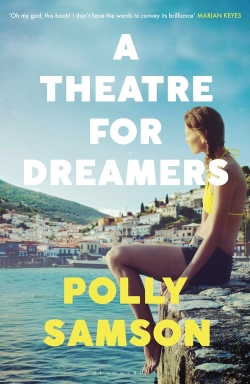
A Theatre For Dreamers - Polly Samson - April 2020I first went to Hydra six years ago, when it was simply a beautiful Greek island and not a place I went to commune with its ghosts. I don’t think I was even aware that it was the island Leonard Cohen had lived on, and knew nothing of Charmian Clift, George Johnston and the bohemian community they fostered.

Bloomsbury Publishers: 1960. The world is dancing on the edge of revolution, and nowhere more so than on the Greek island of Hydra, where a circle of poets, painters and musicians live tangled lives, ruled by the writers Charmian Clift and George Johnston, troubled king and queen of bohemia. Forming within this circle is a triangle: its points the magnetic, destructive writer Axel Jensen, his dazzling wife Marianne Ihlen, and a young Canadian poet named Leonard Cohen.

Into their midst arrives teenage Erica, with little more than a bundle of blank notebooks and her grief for her mother. Settling on the periphery of this circle, she watches, entranced and disquieted, as a paradise unravels.

Burning with the heat and light of Greece, A Theatre for Dreamers is a spellbinding novel about utopian dreams and innocence lost – and the wars waged between men and women on the battlegrounds of genius.

Polly Samson is an English novelist, lyricist and journalist. She is married to musician David Gilmour, and has written the lyrics to many of Gilmour’s works, both as a solo artist and with the group Pink Floyd.