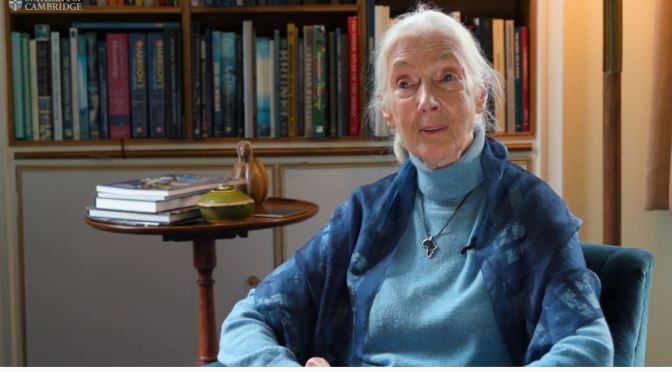
In a new film released as part of Cambridge University’s focus on Sustainable Earth, Dr Jane Goodall DBE talks about the environmental crisis and her reasons for hope. “Every single day that we live, we make some impact on the planet. We have a choice as to what kind of impact that is.”
At the age of 26, Jane Goodall travelled from England to what is now Tanzania, Africa, and ventured into the little-known world of wild chimpanzees. Among her many discoveries, perhaps the greatest was that chimpanzees make and use tools. She completed a PhD at Newnham College in Cambridge in 1966, and subsequently founded the Jane Goodall Institute in 1977 to continue her conservation work and the youth service programme Roots & Shoots in 1991.
She now travels the world as a UN Messenger of Peace. “The human spirit is indomitable. Throughout my life, I’ve met so many incredible people – men and women who tackle what seems impossible and won’t give up until they succeed. With our intellect and our determined spirit, and with the tools that we have now, we can find a way to a better future.”
Cambridge University’s focus on Sustainable Earth looks at how we transition to a carbon zero future, protect the planet’s resources, reduce waste and build resilience.
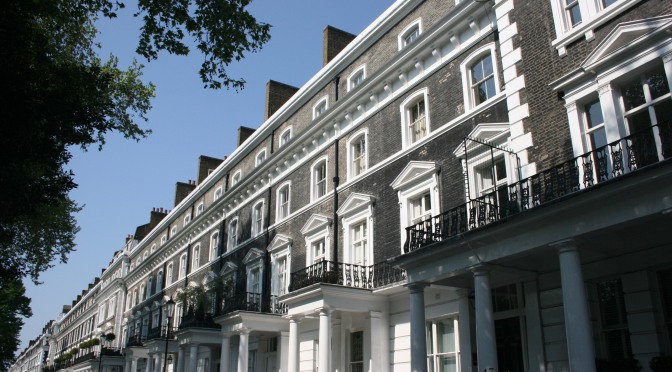
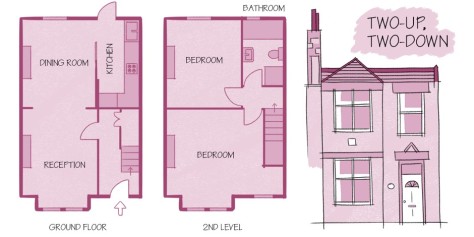
From the outside, London’s row houses have an eclectic variety of ornament, and they range in scale from palatial to boxy. But inside, they are pretty much all configured the same way. That’s because from the late 17th century up until the First World War, most residential buildings here cleaved very close to a model found across English cities: the terraced house, known in its most condensed, emblematic form as the “two-up, two-down.”
For a city that’s long been the repository of vast commercial, imperial, and industrial wealth, this might seem a very modest template. However, it is one that can be easily scaled up, points out Edward Denison, associate professor at the Bartlett School of Architecture and author of The Life of the British Home: An Architectural History.
“What’s extraordinary, in London in particular, is that you can find very grand houses in places such as Carlton House Terrace, with vast rooms and very high ceilings, that are still essentially two-up, two-downs with extra floors added,” says Denison. “Then you go to working-class terraced housing in places like Greenwich, and find a very different scale and quality of fittings, but essentially the same configuration.
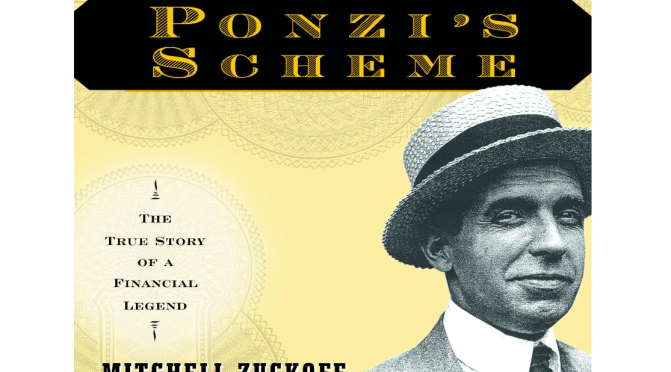
Nearly 100 years ago, Charles Ponzi stumbled across a loophole in the international postal system and turned it into one of the most infamous scams of all time. This time on Sidedoor, we follow Ponzi from his early days until his epic downfall, and hear from a postal investigator trained to catch swindlers like Ponzi who continue to use the U.S. mail for nefarious purposes.
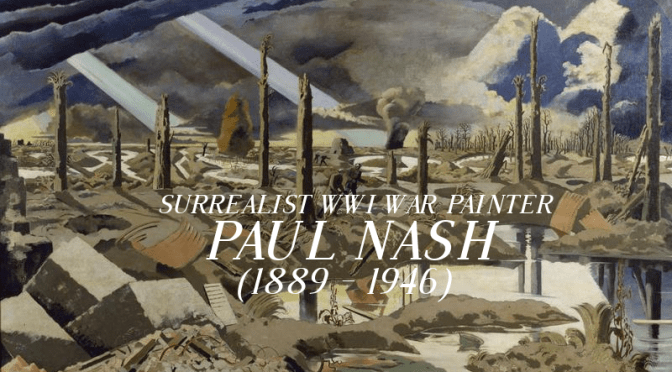
Paul Nash (11 May 1889 – 11 July 1946) was a British Surrealist painter and war artist, as well as a photographer, writer and designer of applied art. Nash was among the most important landscape artists of the first half of the twentieth century. He played a key role in the development of Modernism in English art.
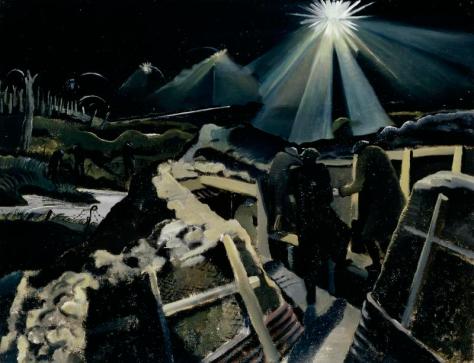
Paul Nash: The Ypres Salient at Night, 1918.PAUL NASH in a woodcut self-portrait (1923)
Born in London, Nash grew up in Buckinghamshire where he developed a love of the landscape. He entered the Slade School of Art but was poor at figure drawing and concentrated on landscape painting. Nash found much inspiration in landscapes with elements of ancient history, such as burial mounds, Iron Age hill forts such as Wittenham Clumps and the standing stones at Avebury in Wiltshire. The artworks he produced during World War I are among the most iconic images of the conflict. After the war Nash continued to focus on landscape painting, originally in a formalized, decorative style but, throughout the 1930s, in an increasingly abstract and surreal manner. In his paintings he often placed everyday objects into a landscape to give them a new identity and symbolism.
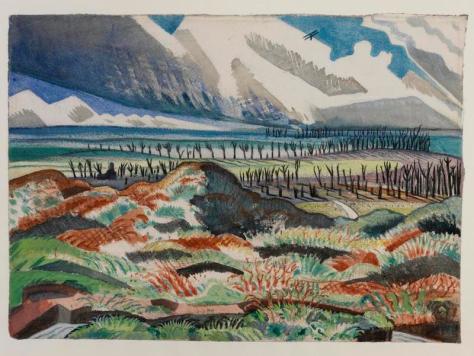
Paul Nash: Ruined Country – Old Battlefield, Vimy, near La Folie Wood, 1918.
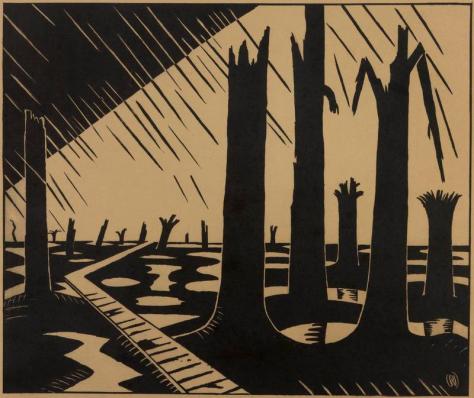
Official World War I Artist – In November 1917 Nash returned to the Ypres Salient as a uniformed observer with a batman and chauffeur. At this point the Third Battle of Ypres was three months old and Nash himself frequently came under shellfire after arriving in Flanders. The winter landscape he found was very different from the one he had last seen in spring. The system of ditches, small canals and dykes which usually drained the Ypres landscape had been all but destroyed by the constant shellfire. Months of incessant rain had led to widespread flooding and mile upon mile of deep mud. Nash was outraged at this desecration of nature. He believed the landscape was no longer capable of supporting life nor could it recover when spring came. Nash quickly grew angry and disillusioned with the war and made this clear in letters written to his wife. One such written, after a pointless meeting at Brigade HQ, on 16 November 1917 stands out,
I have just returned, last night from a visit to Brigade Headquarters up the line and I shall not forget it as long as I live. I have seen the most frightful nightmere of a country more conceived by Dante or Poe than by nature, unspeakable, utterly indescribable. In the fifteen drawings I have made I may give you some idea of its horror, but only being in it and of it can ever make you sensible of its dreadful nature and of what our men in France have to face. We all have a vague notion of the terrors of a battle, and can conjure up with the aid of some of the more inspired war correspondents and the pictures in the Daily Mirror some vision of battlefield; but no pen or drawing can convey this country—the normal setting of the battles taking place day and night, month after month. Evil and the incarnate fiend alone can be master of this war, and no glimmer of God’s hand is seen anywhere. Sunset and sunrise are blasphemous, they are mockeries to man, only the black rain out of the bruised and swollen clouds all though the bitter black night is fit atmosphere in such a land. The rain drives on, the stinking mud becomes more evilly yellow, the shell holes fill up with green-white water, the roads and tracks are covered in inches of slime, the black dying trees ooze and sweat and the shells never cease. They alone plunge overhead, tearing away the rotting tree stumps, breaking the plank roads, striking down horses and mules, annihilating, maiming, maddening, they plunge into the grave, and cast up on it the poor dead. It is unspeakable, godless, hopeless. I am no longer an artist interested and curious, I am a messenger who will bring back word from the men who are fighting to those who want the war to go on for ever. Feeble, inarticulate, will be my message, but it will have a bitter truth, and may it burn their lousy souls.”
Paul Nash: Void of War, 1918.
Nash’s anger was a great creative stimulus which led him to produce up to a dozen drawings a day. He worked in a frenzy of activity and took great risks to get as close as possible to the frontline trenches. Despite the dangers and hardship, when the opportunity came to extend his visit by a week and work for the Canadians in the Vimy sector, Nash jumped at the chance. He eventually returned to England on 7 December 1917.
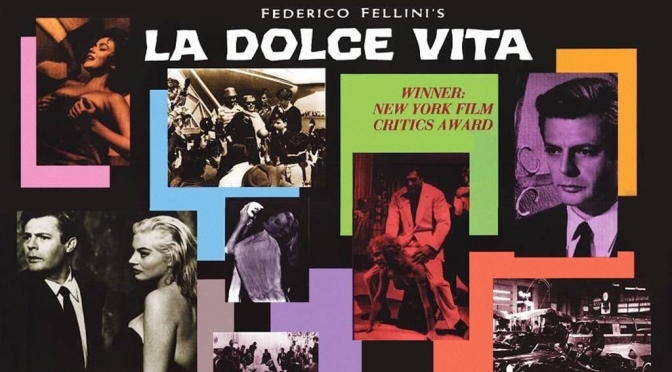
La Dolce Vita (“the sweet life” or “the good life”) is a 1960 comedy-drama film directed and co-written by Federico Fellini. The film follows Marcello Rubini (Marcello Mastroianni), a journalist writing for gossip magazines, over seven days and nights on his journey through the “sweet life” of Rome in a fruitless search for love and happiness. La Dolce Vita won the Palme d’Or (Golden Palm) at the 1960 Cannes Film Festival[ nd the Oscar for Best Costumes. The film was a worldwide box-office success.
111 Years of Waldhaus Sils ranges across the hotel’s life and history. Founders Josef and Amalie Giger and their descendants, by now in the fifth generation, have guided the “house in the woods” with skill and fortitude through good times and bad through the twentieth century and into the present. The owners and their exceptionally diverse guests—lively families side-by-side with intellectuals and artists of world renown—have created a unique blend of luxury and modesty, historic grandeur and playful fun, smooth professionalism and unexpected idiosyncrasies.
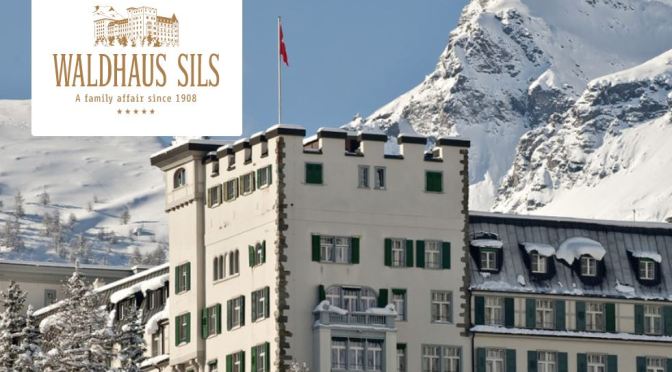
Those in the know are aware that Wes Anderson’s Grand Budapest Hotel has a real-life counterpart in the Swiss Alps: The Waldhaus Sils, which has pleased and puzzled visitors for 111 years and become an icon of Swiss hospitality. Located above the small village of Sils Maria near St. Moritz, it overlooks a striking landscape of forests, lakes and mountains and offers a combination of Belle Epoque flair and modern comfort. Its distinctive charm comes from the fact that the Waldhaus has been family-owned and operated since its grand opening on June 15, 1908.
The act of dive bombing during World War II was a death defying trial of skill and nerve. You aimed your plane down, four miles above the ocean, and plummeted at speeds of up to 275 miles per hour.
Moncocle.com spoke with Tom Geismar, founding partner of Chermayeff & Geismar, one of the top graphic design agencies in the world and the man responsible for the marketing of Pan Am in the 1950’s, 60’s and 70’s.
From the Chermayeff & Geismar website:
The most important aspect of the identity design for Pan Am was to suggest that the name of the airline be changed to “Pan Am” from the long and cumbersome “Pan American World Airways.” The Pan Am logotype in capitals and lower-case letters was also adopted with an accompanying world symbol.
In addition to the corporate identity, our firm designed comprehensive graphics for the airline, including a poster campaign and the menus for the inaugural flight of the Boeing 747.




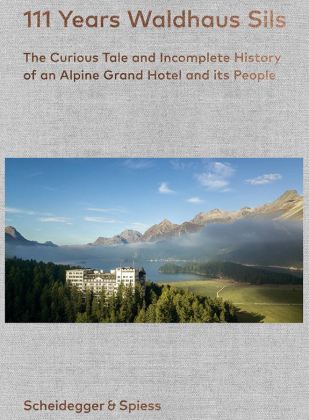 111 Years of Waldhaus Sils ranges across the hotel’s life and history. Founders Josef and Amalie Giger and their descendants, by now in the fifth generation, have guided the “house in the woods” with skill and fortitude through good times and bad through the twentieth century and into the present. The owners and their exceptionally diverse guests—lively families side-by-side with intellectuals and artists of world renown—have created a unique blend of luxury and modesty, historic grandeur and playful fun, smooth professionalism and unexpected idiosyncrasies.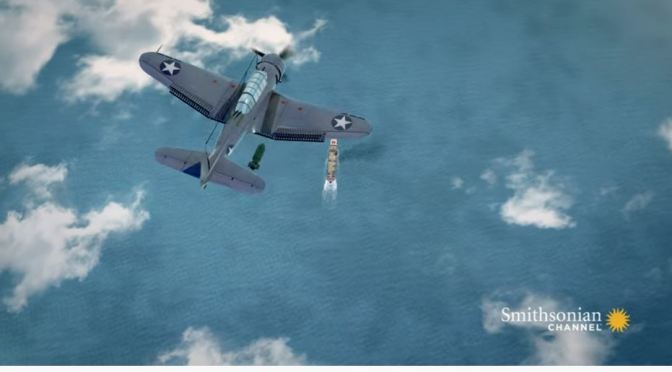

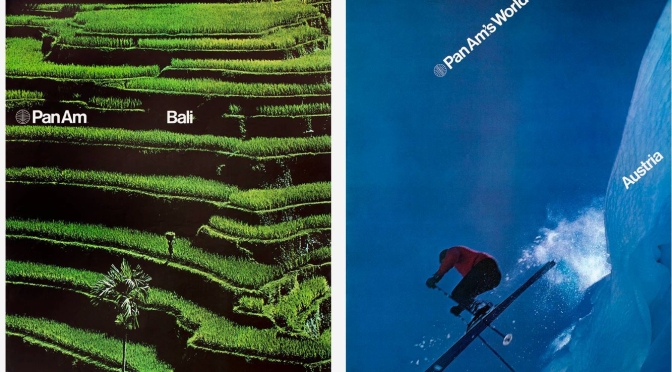
 Moncocle.com spoke with Tom Geismar, founding partner of Chermayeff & Geismar, one of the top graphic design agencies in the world and the man responsible for the marketing of Pan Am in the 1950’s, 60’s and 70’s.
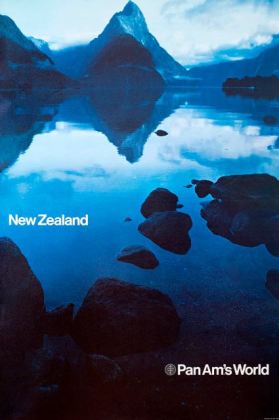 The most important aspect of the identity design for Pan Am was to suggest that the name of the airline be changed to “Pan Am” from the long and cumbersome “Pan American World Airways.” The Pan Am logotype in capitals and lower-case letters was also adopted with an accompanying world symbol.
 Boomers Daily