

Outdoor reel showcasing some of my favorite moments in motion from the last few years including timelapse photography, aerial cinematography, wildlife videography and more.
Monthly Archives: March 2020

Unique Tiny Homes: “Amp House” In Fayetteville, Arkansas (AD Video)
Today we visit Fayetteville, Arkansas to tour a tiny house capable of booming sound. When Asha Mevlana isn’t on tour with the Trans-Siberian Orchestra, she hosts neighborhood concerts from her compact custom home. Situated between her living quarters and the trailer devoted to her instruments, Asha’s porch has enough room for performers to fill the street with music, courtesy of the built-in, wall-sized outdoor amplifier. The innovations don’t end there, though, as living in a tiny house presents plenty of design challenges to overcome. Watch and learn about the ins and outs of this peculiar property on today’s episode of Unique Spaces.

Health Podcast: “Aging And The Immune System” (Mayo Clinic Radio)
On the Mayo Clinic Q&A podcast, Dr. Jessica Lancaster, a Mayo Clinic immunologist, discusses aging and the immune system. Some people are at higher risk of getting very sick from COVID-19 because of their age or underlying health conditions, according to the Centers for Disease Control and Prevention (CDC).
Adults 60 and older and those with an underlying health condition or a compromised immune system appear to develop serious illness more often than others. This interview was recorded March 19, 2020.
Learn more about immune system research at Mayo Clinic: https://www.mayo.edu/research/centers…

Top New Nature Videos: “Siouxon Creek” & Falls In Washington State (2020)
Filmed and Edited by: Henry Jackson
Simply capturing the ambiance and feeling of a beautiful location in the Pacific Northwest tucked in the southern forests of Washington. Turquoise rivers and amazing waterfalls housed within one of the most peaceful forests you’ll ever encounter. A location deserving of visual documentation.
Although this gently rolling creekside ramble is one continuous trail, an adventure in three parts awaits. The first few miles are a quiet walk through a classic fern-dotted, mossy forest. In the second section, hikers find Siouxon Creek and fellow waterfall seekers, and the final miles offer more solitude and small narrow canyons with more waterfalls to enjoy.
The trail to Siouxon Falls, Chinook Falls, and at least three other waterfalls along the way, starts from a subtle trail sign three miles before reaching the main Siouxon Trailhead on FR 5071. Look for a plain trail marker on the left side just after a pull-out on the right after a hairpin right turn. Once you step into the trees, you’ll see the Siouxon Trail No. 130 sign pointing the way to Huffman Peak turnoff (1 mile away) and the main Siouxon trailhead in 3 miles.

Artist Profiles: 69-Year Old American Painter Sigrid Burton (Video)
“I draw literally and figuratively from the natural world. My drawing and mark making refer to and derive from botanical and biological anatomies, including marine life, as well as, the structures of both macro and micro cosmologies and writing systems, such as logograms.”
Sigrid Burton is an American painter, long based in New York City, whose semi-abstract work is known for its use of expressive, atmospheric color fields and enigmatic allusions to natural and cultural realms. Burton has had solo exhibitions in New York City, Los Angeles, San Francisco, Chicago and Osaka, including at Artists Space and the Michael C. Rockefeller Arts Center, and been included in shows at A.I.R. Gallery, the John and Mable Ringling Museum of Art, and the Carnegie Art Museum, Oxnard. Her work belongs to the public collections of the Metropolitan Museum of Art, Rockefeller Foundation, and Palm Springs Desert Museum, and has been reviewed in Arts Magazine, Arts & Antiques, Jung Journal, Chicago Tribune and LA Weekly.
Writers most frequently observe that Burton’s atmospheric works recall artists such as J.M.W. Turner, Odilon Redon, Pierre Bonnard and Mark Rothko, as well as the light of her native California. Art & Antiques described her approach as “chromatic expressionism” in which color is “her undisputed protagonist”. Peter Frank observed, “The dialectic between color and form has always inflected, even impelled” Burton’s painting, with color the more omnipresent element, and form the more persistent. Art historian William C. Agee wrote, “The domains she explores […] meet, intersect, fuse, and then disappear, like apparitions, in liquid pools of mist and color. Her pictorial odyssey refers simultaneously to both a higher order, a timeless cosmic vastness, as well as to a private, interior world, abounding in personal histories and memories.” Burton has lived and worked in Pasadena, California since 2013.
From Wikipedia
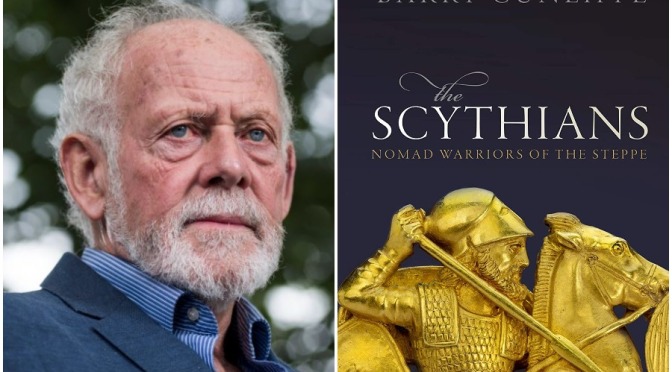
Archaeology Lectures: “The Scythians – Nomad Warriors Of The Steppe” Author Barry Cunliffe
Brilliant horsemen and great fighters, the Scythians were nomadic horsemen who ranged wide across the grasslands of the Asian steppe from the Altai mountains in the east to the Great Hungarian Plain in the first millennium BC.
Their steppe homeland bordered on a number of sedentary states to the south – the Chinese, the Persians and the Greeks – and there were, inevitably, numerous interactions between the nomads and their neighbours. The Scythians fought the Persians on a number of occasions, in one battle killing their king and on another occasion driving the invading army of Darius the Great from the steppe.
Barry Cunliffe, Emeritus Professor of European Archaeology, University of Oxford.
Barry Cunliffe taught archaeology at the Universities of Bristol and Southampton and was Professor of European Archaeology at the University of Oxford from 1972 to 2008, thereafter becoming Emeritus Professor. He has excavated widely in Britain (Fishbourne, Bath, Danebury, Hengistbury Head, Brading) and in the Channel Islands, Brittany, and Spain, and has been President of the Council for British Archaeology and of the Society of Antiquaries, Governor of the Museum of London, a Commissioner of English Heritage, and a Trustee of the British Museum.
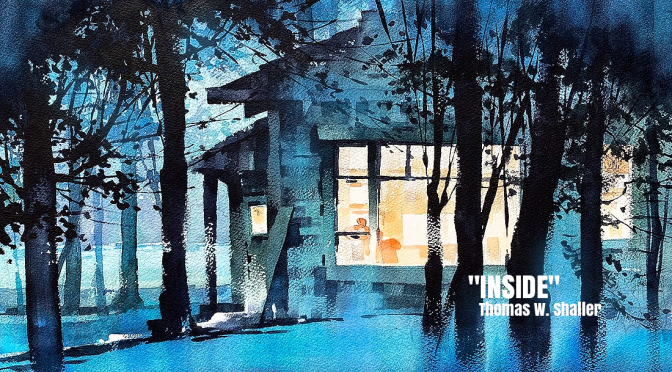
“Watercolor In March”: Artist Thomas W. Shaller Releases New Works (2020)
“The grasses up north are as blue as jade, Our mulberries here curve green-threaded branches; And at last, you think of returning home” Li Bai
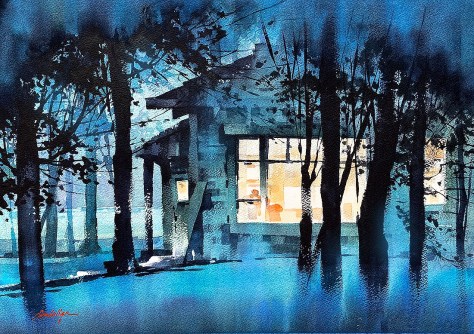
“A feat, this heart’s control
Moment to moment
To scale all love down
To a cupped hand’s size”
Edith Tiempo, Bonsai

Thomas W. Schaller is an award-winning artist, architect, and author based in Los Angeles. As a renowned architectural artist, he received a Graham Foundation Grant and was a two-time recipient of the Hugh Ferris Memorial Prize. He has authored three books; the best-selling, and AIA award winner, Architecture in Watercolor (VNR – McGraw Hill) The Art of Architectural Drawing (J.Wiley and Sons), and Thomas W. Schaller, Architect of Light : Watercolor Paintings by a Master – a retrospective of his recent artwork released by North Light Books / F+W Media and now Penguin / Random House, NYC in 2018.
“My work is a study in contrasts: light and dark, vertical and horizontal, warm and cool tones, the real and the imagined, as well as the past, present, and future. These elements and others are designed to collide and sometimes find resolution on the surface of the paper. And by so doing, I invite you to take part in my artistic process – not to determine the stories I am telling – but hopefully, to inspire you to tell stories of your own.”

Museum Tours: View “The Garden Court – Frick Collection” In 5K Video
Enjoy this 360° video view of the Garden Court of The Frick Collection. Available through your phone with Google Cardboard or other viewer as a 360° VR video. Right click or control + click (on a Mac) to select loop and enjoy the soothing sounds of the fountain. Shot during the exhibition, Canova’s George Washington, on view at The Frick Collection from May 23, 2018 to September 23, 2018.

Covid-19: Chloroquine + Azithromycin (Z-Pack) – “First Line” Treatment For Early Symptom Patients

 Chloroquine was shown in 2004 to be active in vitro against SARS coronavirus but is of unproven efficacy and safety in patients infected with SARS-CoV-2. The drug’s potential benefits and risks for COVID-19 patients, without and with azithromycin, is discussed by Dr. David Juurlink, head of the Division of Clinical Pharmacology and Toxicology at Sunnybrook Health Sciences Centre in Toronto.
From Wall Street Journal article:
Our experience suggests that hydroxychloroquine, with or without a Z-Pak, should be a first-line treatment. Unfortunately, there is already a shortage of hydroxychloroquine. The federal government should immediately contract with generic manufacturers to ramp up production. Any stockpiles should be released.
As a matter of clinical practice, hydroxychloroquine should be given early to patients who test positive, and perhaps if Covid-19 is presumed—in the case of ill household contacts, for instance. It may be especially useful to treat mild cases and young patients, which would significantly decrease viral transmission and, as they say, “flatten the curve.”

Top Urban Architecture: “Modern Lantern Studio” By Flavin Architects (2020)
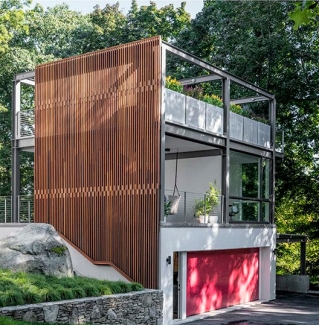 In a leafy Boston suburb, a place to park cars and repair vintage scooters grows into a bucolic sanctuary.
.
To call architect Colin Flavin’s three-story steel-frame structure with mahogany slat screens a “garage” would be misleading. While there’s room for parking and a Vespa workshop behind the double-wide red door on the ground floor, the spaces above feel and function more like a country retreat. “The clients wanted something innovative to complement their traditional Dutch Colonial,” says Flavin, principal of Flavin Architects.
Read more in Dwell.com
 Boomers Daily