More than 60% of cancers in the U.S. occur in people older than 65. As the population grows older, so will the rate of cancer among seniors. The cancer incidence in the elderly is expected to rise 67% from 2010 to 2030, according to a 2017 study in the Journal of Clinical Oncology. Yet many oncologists don’t have geriatric training.
“When the doctor saw how physically active and mentally sharp my father was at 89 years of age, but that he had several chronic, serious medical problems, including end stage kidney disease, she didn’t advise him to have aggressive treatment like the first time around,” says Griggs, who lives in Rochester, N.Y.
Geriatric assessment is an approach that clinicians use to evaluate their elderly patients’ overall health status and to help them choose treatment appropriate to their age and condition. The assessment includes questionnaires and tests to gauge the patients’ physical, mental and functional capacity, taking into account their social lives, daily activities and goals.
From a British Medical Journal (BMJ) online release:
Although he had no pet birds, on closer questioning he had recently acquired a duvet and pillows containing feathers. His symptoms, chest radiograph and lung function tests improved after removal of all feather bedding, and he was also started on oral corticosteroid therapy. Our case reinforces the importance of taking a meticulous exposure history and asking about domestic bedding in patients with unexplained breathlessness. Prompt recognition and cessation of antigen exposure may prevent the development of irreversible lung fibrosis.
A 43-year-old non-smoker was referred with a 3-month history of malaise, fatigue and breathlessness. Blood avian precipitins were strongly positive. Lung function testing confirmed a restrictive pattern with impaired gas transfer. A ‘ground glass’ mosaic pattern was seen on CT imaging, suggestive of hypersensitivity pneumonitis.
Feather duvet lung (FDL), is an immunologically mediated form of hypersensitivity pneumonitis (HP), also sometimes called extrinsic allergic alveolitis. FDL is caused by inhalation of organic dust from duck or goose feathers found in duvets and pillows. Antigen inhalation triggers an immunological cascade, resulting in lung parenchymal inflammation. Repeated exposure may result in irreversible lung fibrosis.
Slovenia is a country defined by water, with more than 60 rivers and streams, 300 artificial and natural lakes, and 7,500 freshwater springs – each of which is packed with minerals and nutrients.
Producers – Nicolas de Rosanbo and Carole Lambert
Scriptwriter – Julien Lilti
Editer – Benjamin Massoubre and Vincent Tricon
Sound designer – Xavier Dreyfuss
Line Producer – Céline Vanlint
Original score by Ali Helnwein
With the voices of :
John Fitch – Nathan Willcocks
Alfred Neubauer – Joe Sheridan
Pierre Levegh – Nicholas Mead
This film was inspired by a 1950s racing car exhibition I visited at the Louvre. I was struck by the beauty of the exhibited sports cars, especially a Jaguar which had competed in 1955 at Le Mans. I began researching the that event and two very contradictory photos appeared next to one another on my screen.
On one side, the image of a tragedy : people in a panic, a blazing inferno behind them. Bodies were sprawled across the stadium. The photo beside it depicted delighted drivers celebrating their victory with champagne.
Currently, 33.9 percent of owner-occupied U.S. homes are owned by residents aged 60 or older, and 55.2 percent by residents aged 50 or older. As these households age and begin vacating housing, that could represent upwards of 20 million homes hitting the market through the mid-2030s.
The massive Baby Boomer generation has already begun aging into retirement, and will begin passing away in large numbers in coming decades – releasing a flood of currently owner-occupied homes that could hit the market. That could help end the last few years’ inventory drought, as well as a more fundamental shortage of homes in certain places.
This Silver Tsunami of homes coming to market could be a good substitute for new home construction, which has been in short supply for the past decade in large part because of difficult-to-overcome challenges faced by builders.
Rodin first exhibited a bronze and a plaster version of The Age of Bronze at the Cercle Artistique in Brussels in January 1877. A few months later, he exhibited the plaster at the Paris Salon, where it caused a scandal. ‘The vitality and naturalism of the sculpture was so extreme, the sense of modelling so observed, that he was accused of having cast the sculpture from the model himself,’ says the specialist.
Tudor Davies, Head of Impressionist & Modern Art in Paris, reveals why Rodin’s Salon ‘scandal’ marked a pivotal turning point in the artist’s career.
The Age of Bronze was originally conceived in 1877, and is widely considered Rodin’s first great work, ranking alongside his later masterpieces, including LaPorte de l’Enfer, Le Penseur and Le Baiser. Its conception marked a decisive turning point in the sculptor’s career.
It started with a phone call. In a week, a scammer would take Nina Belis’s life savings. WSJ’s Sarah Krouse explains why robocalls persist: Because sometimes they work.
Retrofuturism is the curious eye of the past upon us. This era’s rosy predictions about the future seem laughable from the perspective of the present; however, it seems that they got some things exceptionally right. Their ideas ranged from child-like and pridefully ambitious and inspired a movement upon the artists, designers, musicians, and filmmakers who channeled the technological fantasies of a lost age.
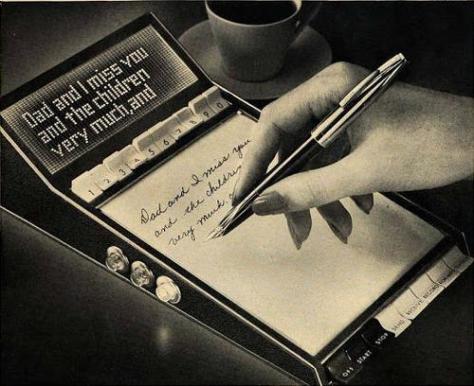
Instant Messaging (1964 Prediction)
This technology has actually become a reality. Many smartphones have this feature, or at least something similar to it. It doesn’t look like this of course, but the main idea is still there: you write it with your smartpen and the device makes your illegible handwriting into a text that is actually readable! However, it is not widely used; nobody could predict that typing would be superior to actual handwriting.
Personal Transportation (1950s Vision)
It is unclear why people in the 1950s thought this was a practical way to travel; not only it looks like it is impossible to breathe in there, who would want to stand upright while driving? It would definitely ease the traffic; however, probably no one would want to use it.
The Smart-Cities of Future
Towering transmitters in the city and private-jet traffic in the sky… This is a prediction that was made probably too early and it is definitely not so far from reality. Today, we paint a similar future for smart-cities and sci-fi movies depict the future cities in the same manner. It seems that older generations and we have a similar vision of the future look of the world.
Syndicated columnist Mark Shields and New York Times columnist David Brooks join Judy Woodruff to discuss the week in politics, including the biggest revelations and most compelling characters from impeachment hearings, whether they will change voters’ minds about impeachment, how 2020 Democrats performed in their fifth debate and President Trump’s moves on military justice.
The mahout (elephant keeper), the turbaned Ottoman warriors, and the crowning crescent all allude to the Eastern origins of the elephant. Within the Kunstkammer the elephant represented rulership. This automaton clock, which strikes at both the quarter hour and the hour, is driven by a movement connected to a wheel mounted on the walkway of the howdah (saddle). On the hour, the four Muslim warriors revolve around the brickwork tower. The mahout thumps his arm up and down, as though he were leading the animal, and his counterweighted eyes move back and forth as the machine travels.
Presented to Empress Maria Theresa in Vienna in 1760, this automaton was made at the height of the “century of writing.” Written communication connected scientists, dignitaries, scholars, and artists across long distances, and the act of writing was celebrated in every form. This piece is the last in a series of increasingly complicated ones that Friedrich von Knaus produced during his tenure as Austrian court machinist; he presented other examples to dignitaries such as the French king Louis XV and Duke Charles Alexander of Lorraine.
The machine writes through the hand of the small statuette seated at its top, one of the first mechanical writing figures in human form. This video shows the mechanisms inside the sphere that produce its precise movements. Up to 107 words can be preprogrammed by the arrangement of pegs on a barrel. The figure can also be set via a hand-worked control to appear to write from dictation; this technology that presaged the first typewriter.
Duke Charles Alexander of Lorraine, who bought this automaton clock in 1777, collected luxury objects made in his realm that demonstrated local technical advances. The self-moving components of this timepiece represent the height of Flemish invention in a fashionable Neoclassical style. Mechanically complex and visually impressive, this sparkling clock was a worthy addition to the duke’s collection of timepieces and scientific instruments.
This video shows the movement of the dials for hours, minutes, and seconds; days of the month; and phases of the moon, as well as that of the seven dynamic design elements. The cross-of-Lorraine pendulum swings steadily over the main dial, underneath a dancing letter M. Above the calendar dial turns a Catherine wheel, while the four dragons supporting the obelisk flap their wings and spit pearls. Another Catherine wheel spins above the moon-phase dial, and the entire obelisk is topped by a rotating planetarium. The fourth dial shows the maker’s signature.


 More than 60% of cancers in the U.S. occur in people older than 65. As the population grows older, so will the rate of cancer among seniors. The cancer incidence in the elderly is expected to rise 67% from 2010 to 2030, according to a 2017 study in the Journal of Clinical Oncology. Yet many oncologists don’t have geriatric training.
 Although he had no pet birds, on closer questioning he had recently acquired a duvet and pillows containing feathers. His symptoms, chest radiograph and lung function tests improved after removal of all feather bedding, and he was also started on oral corticosteroid therapy. Our case reinforces the importance of taking a meticulous exposure history and asking about domestic bedding in patients with unexplained breathlessness. Prompt recognition and cessation of antigen exposure may prevent the development of irreversible lung fibrosis.






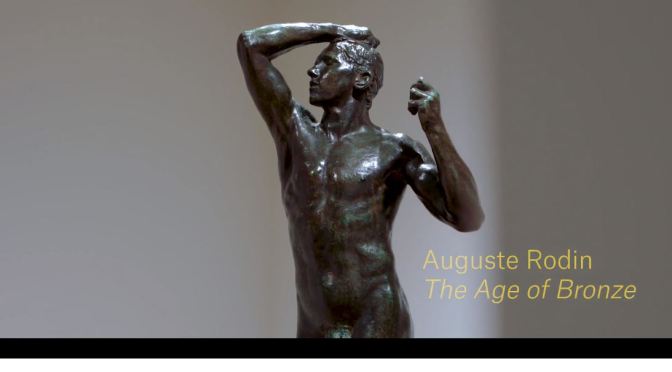
 Rodin first exhibited a bronze and a plaster version of

 It started with a phone call. In a week, a scammer would take Nina Belis’s life savings. WSJ’s Sarah Krouse explains why robocalls persist: Because sometimes they work.
 It is unclear why people in the 1950s thought this was a practical way to travel; not only it looks like it is impossible to breathe in there, who would want to stand upright while driving? It would definitely ease the traffic; however, probably no one would want to use it.
 Towering transmitters in the city and private-jet traffic in the sky… This is a prediction that was made probably too early and it is definitely not so far from reality. Today, we paint a similar future for smart-cities and sci-fi movies depict the future cities in the same manner. It seems that older generations and we have a similar vision of the future look of the world.
 Syndicated columnist Mark Shields and New York Times columnist David Brooks join Judy Woodruff to discuss the week in politics, including the biggest revelations and most compelling characters from impeachment hearings, whether they will change voters’ minds about impeachment, how 2020 Democrats performed in their fifth debate and President Trump’s moves on military justice.
 Boomers Daily