

From a Wall Street Journal article:
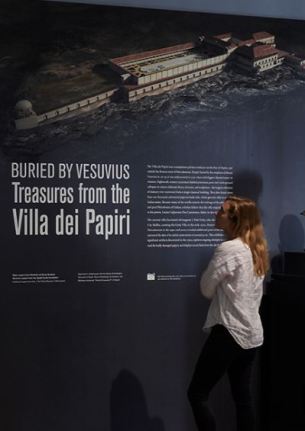 …the Getty Villa, despite some anomalies and insertions, is considered a strong likeness, which makes it a powerful locale for “Buried by Vesuvius: Treasures From the Villa dei Papiri,” the first major exhibition of works discovered in the Roman residence. The show includes Weber’s 1758 architectural map—used to build the Getty Villa—along with some of the approximately 90 sculptures pulled from the site, showing athletes, philosophers, rulers, poets and mythological figures. The exhibition also displays findings from the recent excavations.
The idea was half-mad: building a museum to look like an ancient Roman villa that was buried under 75 feet of debris when Vesuvius erupted in A.D. 79 and had never really been seen since. But J. Paul Getty made his immense fortune by bringing ancient subterranean material (i.e. oil) to the surface, so he must have felt similar excitement in exhuming this villa, in concept if not reality. It opened as the home for his eponymous museum in 1974; now called the Getty Villa, and located in Los Angeles, it holds the institution’s Classical collections.



 I built a frame out of ash wood. Then I hand-formed and welded body panels onto the frame. I re-engineered the brakes, the steering and the clutch system to fit properly, and I hand-formed the grille out of aluminum. The seats I built out of plywood, foam and vinyl that looks like leather. When I started, I had no idea how to do any of this.
 “While we always believed that high levels of uric acid might be bad for kidneys and that patients with gout may have a higher risk of kidney failure, we were quite surprised by the magnitude of the risk imposed by gout in these patients. We were particularly interested in the risk of advanced kidney disease, as these patients in general have a higher risk of kidney failure and death.
 the long and colourful history of haapsalu episcopal castle began when it was built in the 13th century, but since the 17th century the main castle has been in ruins.
 It’s a familiar tune to engineer Ken Smith, director of the mobility division of the Stanford Center on Longevity. He says one of the biggest mistakes designers make is to assume that around the age of 60 people lose interest in aesthetics and design. This can have dire consequences for products meant to help people with their health. No one wants to stick a golf-ball-size hearing aid the color of chewed gum in their ear, any more than they want to wear a T-shirt that reads “SENIOR CITIZEN.”
 “Asking even seasoned chefs and truffle-industry insiders to describe what the fungus tastes or smells like,” Jacobs writes, “is a bit like asking a priest why he believes in God.” Readers not familiar with the pungent, one-of-a-kind flavor will come away even more intrigued. Those of us whose most frequent encounter with the fabled fungus is through truffle oil will also be disappointed. As Jacobs discovers, nearly all truffle butter and truffle oil sold in America is manufactured using chemicals rather than the real thing.

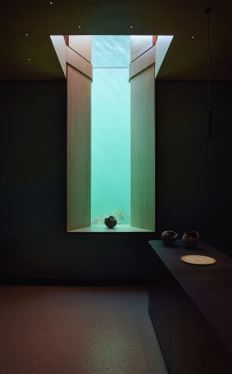 “Under,” which opened in March, is

 Now, researchers have developed a fast-acting skin patch that efficiently delivers medication to attack melanoma cells. The device, tested in mice and human skin samples, is an advance toward developing a vaccine to treat melanoma and has widespread applications for other vaccines.
 A sleek, converted camper van in Brooklyn rents for
  Boomers Daily