
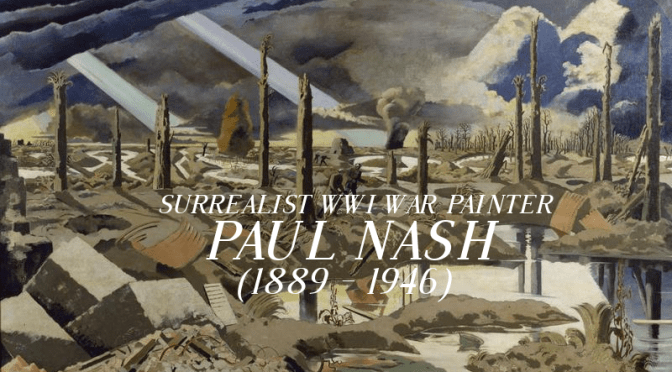
Paul Nash (11 May 1889 – 11 July 1946) was a British Surrealist painter and war artist, as well as a photographer, writer and designer of applied art. Nash was among the most important landscape artists of the first half of the twentieth century. He played a key role in the development of Modernism in English art.
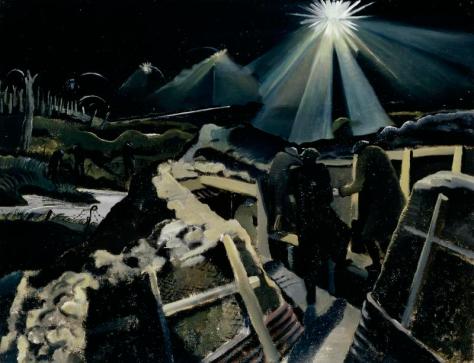

Born in London, Nash grew up in Buckinghamshire where he developed a love of the landscape. He entered the Slade School of Art but was poor at figure drawing and concentrated on landscape painting. Nash found much inspiration in landscapes with elements of ancient history, such as burial mounds, Iron Age hill forts such as Wittenham Clumps and the standing stones at Avebury in Wiltshire. The artworks he produced during World War I are among the most iconic images of the conflict. After the war Nash continued to focus on landscape painting, originally in a formalized, decorative style but, throughout the 1930s, in an increasingly abstract and surreal manner. In his paintings he often placed everyday objects into a landscape to give them a new identity and symbolism.
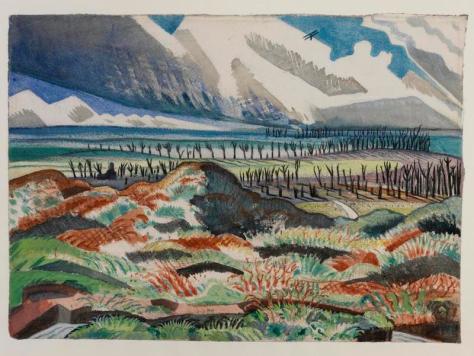
Official World War I Artist – In November 1917 Nash returned to the Ypres Salient as a uniformed observer with a batman and chauffeur. At this point the Third Battle of Ypres was three months old and Nash himself frequently came under shellfire after arriving in Flanders. The winter landscape he found was very different from the one he had last seen in spring. The system of ditches, small canals and dykes which usually drained the Ypres landscape had been all but destroyed by the constant shellfire. Months of incessant rain had led to widespread flooding and mile upon mile of deep mud. Nash was outraged at this desecration of nature. He believed the landscape was no longer capable of supporting life nor could it recover when spring came. Nash quickly grew angry and disillusioned with the war and made this clear in letters written to his wife. One such written, after a pointless meeting at Brigade HQ, on 16 November 1917 stands out,
I have just returned, last night from a visit to Brigade Headquarters up the line and I shall not forget it as long as I live. I have seen the most frightful nightmere of a country more conceived by Dante or Poe than by nature, unspeakable, utterly indescribable. In the fifteen drawings I have made I may give you some idea of its horror, but only being in it and of it can ever make you sensible of its dreadful nature and of what our men in France have to face. We all have a vague notion of the terrors of a battle, and can conjure up with the aid of some of the more inspired war correspondents and the pictures in the Daily Mirror some vision of battlefield; but no pen or drawing can convey this country—the normal setting of the battles taking place day and night, month after month. Evil and the incarnate fiend alone can be master of this war, and no glimmer of God’s hand is seen anywhere. Sunset and sunrise are blasphemous, they are mockeries to man, only the black rain out of the bruised and swollen clouds all though the bitter black night is fit atmosphere in such a land. The rain drives on, the stinking mud becomes more evilly yellow, the shell holes fill up with green-white water, the roads and tracks are covered in inches of slime, the black dying trees ooze and sweat and the shells never cease. They alone plunge overhead, tearing away the rotting tree stumps, breaking the plank roads, striking down horses and mules, annihilating, maiming, maddening, they plunge into the grave, and cast up on it the poor dead. It is unspeakable, godless, hopeless. I am no longer an artist interested and curious, I am a messenger who will bring back word from the men who are fighting to those who want the war to go on for ever. Feeble, inarticulate, will be my message, but it will have a bitter truth, and may it burn their lousy souls.”
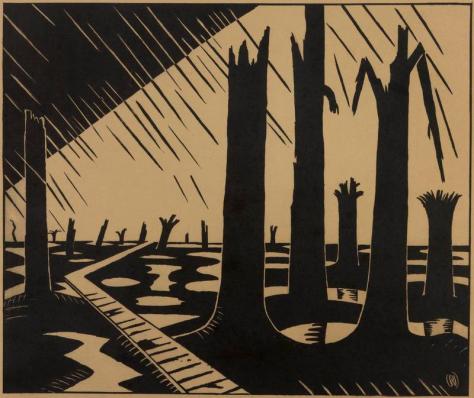
Nash’s anger was a great creative stimulus which led him to produce up to a dozen drawings a day. He worked in a frenzy of activity and took great risks to get as close as possible to the frontline trenches. Despite the dangers and hardship, when the opportunity came to extend his visit by a week and work for the Canadians in the Vimy sector, Nash jumped at the chance. He eventually returned to England on 7 December 1917.
From Wikipedia


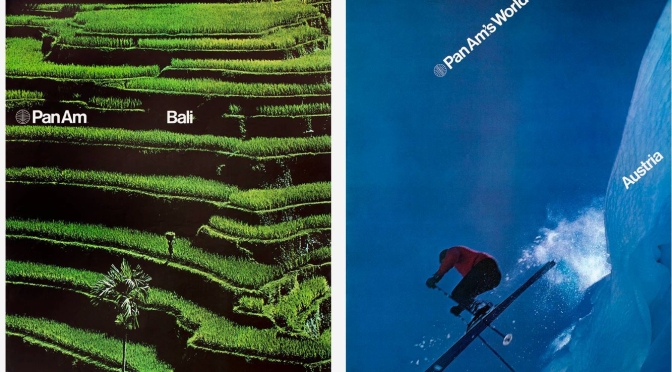
 Moncocle.com spoke with Tom Geismar, founding partner of Chermayeff & Geismar, one of the top graphic design agencies in the world and the man responsible for the marketing of Pan Am in the 1950’s, 60’s and 70’s.
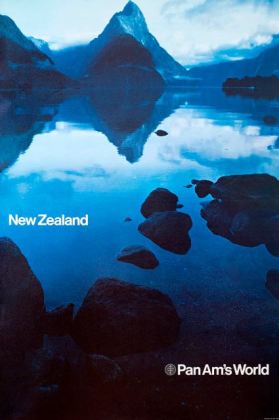 The most important aspect of the identity design for Pan Am was to suggest that the name of the airline be changed to “Pan Am” from the long and cumbersome “Pan American World Airways.” The Pan Am logotype in capitals and lower-case letters was also adopted with an accompanying world symbol.
 The real California, though, the California of immigrant dreams that break and get reborn, of lives as they turn out not as they are planned, is the California of the eucalyptus.
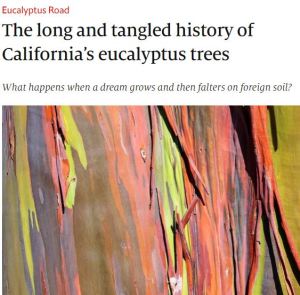 Like his friend John Muir, Lukens believed that California desperately needed more forests. Since the mid-19th century forests, and their loss, had been the principal focus of conservationist thought in America. According to Jared Farmer, who traces the history of the eucalyptus in California in “Trees in Paradise” (2013), Lukens and Muir were particularly keen on growing forests as a way to provide water—always a key to power in the state. Trees brought rain and captured fog and moisture; without forests, the men feared the state’s great cities would dry up.


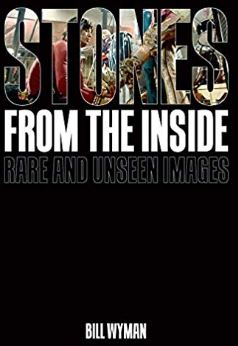 Along with the images of the band at work and play, Wyman includes remarkable images of those along for the ride, from John Lennon, Eric Clapton, David Bowie and Iggy Pop to John Belushi and Dan Aykroyd. To accompany his photographs, Wyman offers up wonderful insights, anecdotes and behind-the-photo stories, giving all us a front-row seat and backstage pass to what it was like to be there, as music history was made as a member of The Rolling Stones.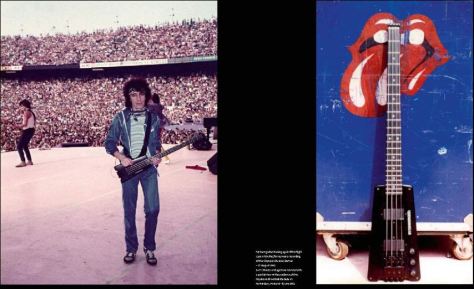
 Boomers Daily