Tag Archives: Design

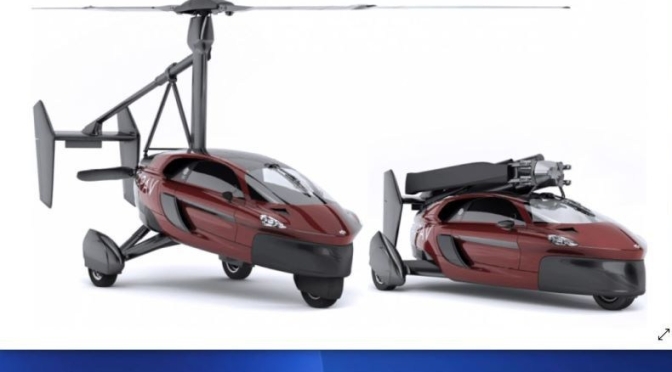
Technology: Dutch ‘PAL-V’ Is World’s First Certified Flying Car (Video)

The world’s first-ever commercial flying car was recently unveiled by Dutch vehicle manufacturer PAL-V. Here’s what that means for our roads (and our skies).

Starting with the undercarriage, which PAL-V credits as their main breakthrough. The company was looking for a three-wheeled design that could still be stable when turning at normal road-going speeds.

In 2005, they discovered the work of another Dutch company, Carver, which made 3-wheeled cars that tilted like motorcycles. A hydraulic tilting system like that could eliminate the need for a 4th wheel and also be useful to raise the whole vehicle up, giving it ground clearance for a rear-facing propeller. Then there was the matter of generating lift.

Fixed wing aircraft need air to move over their wings fast enough to stay aloft, otherwise they’ll stall. A fixed wing flying car has to compromise the size and shape of its wings in the name of practicality, meaning its risk of stalling is higher. So PAL-V chose a rotary wing design instead, but rather than make their flying car a helicopter, they decided it should be an autogyro.

This Flying Car Costs $599K—and It’s Now Street Legal in Holland https://singularityhub.com/2020/10/29…

“In driving mode the Liberty can go up to 99 miles per hour, and in flight mode its max speed is 112 miles per hour. For comparison’s sake, the average helicopter can go up to about 160 miles per hour.”
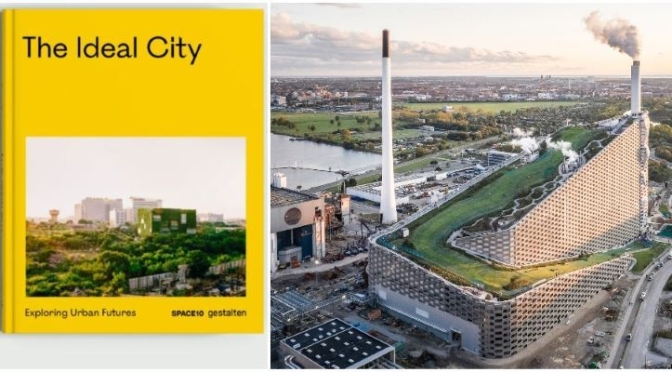
Design Books: ‘The Ideal City – Exploring Urban Futures’ (Gestalten)

Urban life is humankind’s biggest experiment to date, our cities are constantly evolving and adapting to climate and economy. The cities we have today are not necessarily the ones we need, but big and small innovation is rethinking visions of urbanization.

Together with pioneering research and design agency SPACE10, we present future-orientated design which enhances quality of life and makes our urban spaces more vibrant.

As technology and urban life edge ever closer, The Ideal City explores the ambitious actions and initiatives being brought to life across the globe to meet tomorrow’s demand in clever, forwarding-thinking ways. From pedestrian infrastructure to housing, the book uncovers what is being discussed at the forefront of urbanism through expert essays and profiles.

SPACE10 is a Copenhagen-based research and design agency that is on a mission to enable a better everyday life for people and the planet. They specialize in innovation and future-living, often presenting models both for urban spaces or food that could lead to me a more sustainable future.

Read more

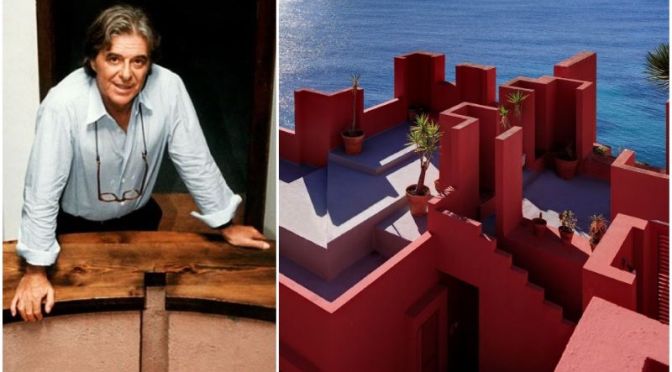
Profile: Spanish Architect & Designer Ricardo Bofill – ‘Dreamer Of Modernity’

December 2, 2020

What Bofill creates with exceptional mastery are spaces or the sense of space. He describes this ability, probably jokingly, as being an escape from the claustrophobia of his childhood in Barcelona, living in bourgeois apartments crammed floor to ceiling with decorative objects.

Postmodernity in the work of Bofill does not have to be the abolishing of rules or the death of history. In his own words, postmodernity “breaks with cultural hegemony to adapt models to different cultures, considering the place and its history.” It is more of a reaction against the uniformity of modern architecture.

Ricardo Bofill was born on December 5, 1939, in Barcelona. The son of a contractor, in the dullest hours of the Franco regime. As he explains himself, the feeling of being, not in the middle of the world but the outskirts, in a periphery—a Catalonia that was not just physically isolated from the cultural capitals but also far from national, political decision-making—sparked dreams of freedom and faraway lands, and was probably what later inspired his nomadic lifestyle. The importance of the vernacular, it’s engagement with classicism, Bofill’s sense of atemporal elegance—all find their roots in this early period.

Read more

Art & Jewelry: A Brief History Of The ‘House Of FABERGÉ’ (Sotheby’s Video)

Family firm Fabergé was the most powerful and largest jewelry company of its era. In this video, find out how the brand captured the attention of Royal families in Russia and across Europe, and discover works with true imperial provenance, including the Balletta Vase, which is offered as part of Sotheby’s upcoming sale Fabergé and Vertu: Property from the Brooklyn Museum (2 December | London). Other highlights include Fabergé special singular commissions, including a nephrite and moonstone study of mistletoe, a nephrite and diamond dandelion, and intricately carved agate models of a dog, a billy goat and a diamond-eyed cat.

The Future Of Driving: Designing ‘The Apple Car’

Every time Californian tech giant Apple puts out a new product, it makes headlines around the world. That was true of its early home computers – the first to use a recognizably modern user interface – and it was even more true of the iPod, which singlehandedly revolutionized the music industry. Not to mention the very smartphone you’re probably watching this video on.

But the world’s biggest and best-loved technology company isn’t done yet. For several years, now Apple engineers have secretly been eyeing up transportation as the next industry ripe for their unique brand of scorched-earth disruption. So today we’re asking the question – when will we see the Apple Car?

Architecture Books: ‘The Conservatory – Gardens Under Glass’ (Princeton)

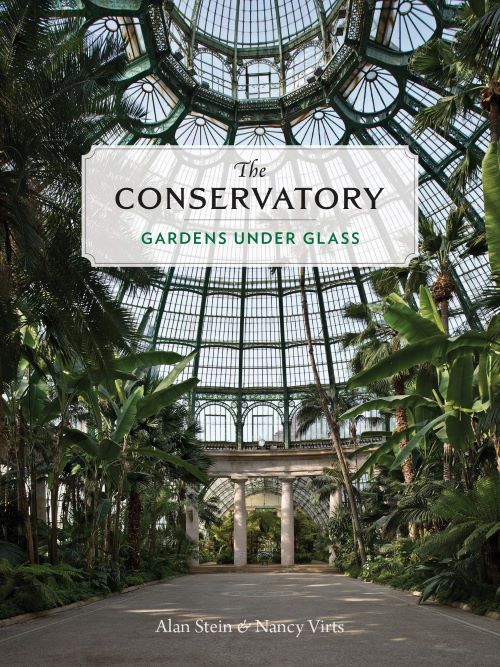
Through evocative archival and contemporary photographs, drawings of landmark structures, and graceful, accessible text, The Conservatory  celebrates the patrons and designers who advanced the technology and architectural majesty of these light-filled structures. The importance of conservatories continues to grow with efforts to conserve phenomenal plants and their environments.

Elegant and magnificent, conservatories reveal fascinating social, cultural, botanical, and engineering advances as they have evolved across history. First appearing in the eighteenth century as simple structures designed to protect fruit trees and other delicate plants from harsh European winters, conservatories became grand glass houses that spread across the European continent, to the Americas, and ultimately around the world.

Alan Stein is President and Director of Architecture at Tanglewood Conservatories, Ltd., founded in 1993 with his wife and business partner, Nancy Virts. The company’s mission is to conceive and build the finest classical and modern glass conservatories. Tanglewood’s work has been published in Architectural Digest, Garden Design Magazine, The New York Times, Town & County and other periodicals around the world. Alan studied design at the California College of Art and graduated from the University of Maryland with a professional degree in architecture. He lives in Maryland.

Nancy Virts is cofounder of Tanglewood Conservatories, Ltd., with her husband and business partner, Alan Stein. The company conceives and builds the finest classical and modern glass conservatories. Tanglewood’s work has been published in Architectural Digest, Garden Design magazine, the New York Times, Town & Country, and other periodicals around the world.

Read more

Design: ‘Jewel Changi Airport’, Singapore By Safdie Architects (Video)

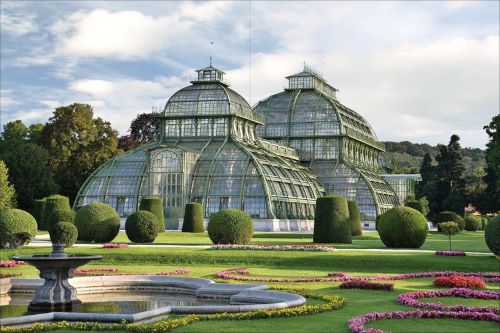
Fulfilling its mission as a connector between the existing terminals, Jewel combines two environments—an intense marketplace and a paradise garden—to create a new community-centric typology as the heart, and soul, of Changi Airport. Jewel re-imagines the center of an airport as a major public realm attraction. Jewel offers a range of facilities for landside airport operations, indoor gardens, leisure attractions, retail offerings and hotel facilities, all under one roof. A distinctive dome-shaped façade made of glass and steel adds to Changi Airport’s appeal as one of the world’s leading air hubs.

Based on the geometry of a torus, the building shape accommodates the programmatic need for multiple connections in the airport setting. At the heart of its glass roof is an oculus that showers water through a primary multistory garden, five stories through to the forest-valley garden at ground level. The core of the program is a 24-hour layered garden attraction that offers many spatial and interactive experiences for visitors. Four cardinal axes—north, south, east, and west—are reinforced by four gateway gardens, which orient visitors and offer visual connections to the internal surroundings and other airport terminals. By night, the glazed facade helps dematerialize the building, revealing the glowing garden within.

Architecture: ‘Lipton Thayer Brick House’ In Evanston, Illinois (Video)

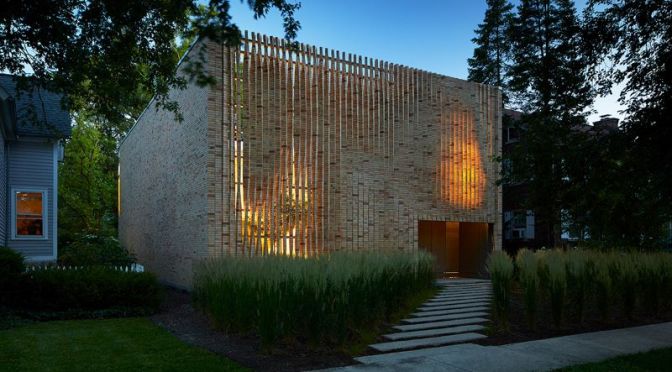
The Lipton Thayer Brick House sits on a leafy street in Evanston, a college town just north of Chicago. Designed for an investment banker, the dwelling occupies a slender, rectangular lot bordered by more traditional houses.

The project was designed by California-based Brooks + Scarpa, with Chicago firm Studio Dwell serving as architect of record. Rectangular in plan, the house consists of airy volumes organized around a gravel courtyard facing the street.