Tag Archives: 1930’s

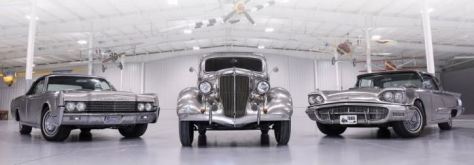
Auto History: Three “Solid Stainless Steel” Ford Cars Auctioned (1936 – 1967)

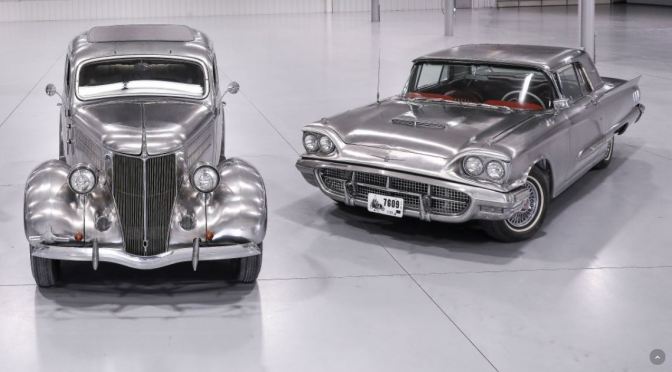
Of the six stainless steel cars that rolled off the Ford assembly line in Detroit in 1936, four exist today, including this example that was retained by Allegheny Ludlum – now known as Allegheny Technologies – itself. The company donated the 1936 Ford Deluxe Sedan with a brushed stainless steel body to the Heinz History Center in Pittsburgh, where it is on display as part of the permanent collection.
Solid Stainless Steel Fords

In 1935, executives at the Ford Motor Company and Pittsburgh-based Allegheny Ludlum Steel joined forces on the production of a solid stainless-steel car, a 1936 Deluxe Sedan. That car became the focal point of a campaign to showcase the extreme durability and aesthetic appeal of the new metal. Only six of the 1936 Fords were built in total and all were far from being simply promotional trailer-queens; each was to log over 200,000 miles in the hands of Allegheny Ludlum executives until their “retirement” in 1946, outlasting most of their non-stainless body parts and multiple engines is testament to the superiority of the dynamic metal.

Allegheny Ludlum and Ford would later collaborate on two more stainless models, the 1960 Thunderbird and 1967 Lincoln Continental Convertible. Just two Thunderbirds rolled off the assembly line in 1960, with bodywork formed from T302 stainless. Both retain their original exhaust systems today, after 60 years and more than 100,000 miles each. The 1967 Lincoln Convertible was the last of the stainless steel cars produced. Except for the vehicle’s body, all other parts and equipment on the car are standard for the 1967 Lincoln Convertible. Only three were made, once again proving that stainless steel’s enduring beauty is matched by its toughness.
Website

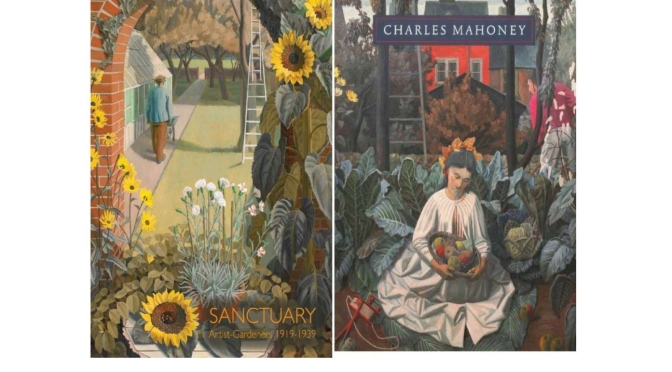
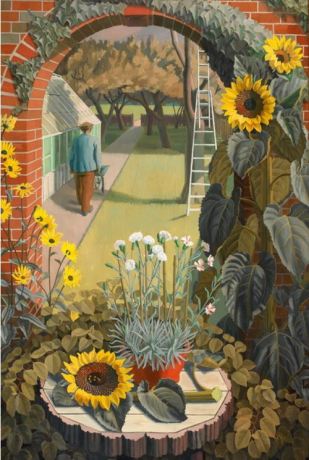
Art Of The Garden: The Brilliant “Sunflowers” Of British Painter Charles Mahoney (1903-1968)

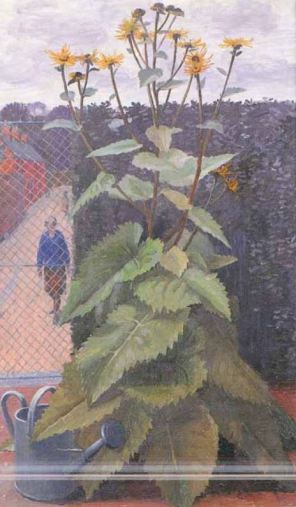
Charles Mahoney (1903-1968) The Garden 1950 LISS LLEWELLYN art website
Charles Mahoney (1903-1968), The Garden 1950

Charles Mahoney,(18 November 1903 – 11 May 1968): Painter, muralist, draughtsman and teacher, born Cyril Mahoney in London – his fellow-student Barnett Freedman re-christened him Charlie at the Royal College of Art, which he attended 1922-6 after a period at Beckenham School of Art under Percy Jowett. Early on, Mahoney established a reputation as a conscientious teacher.

He was at the Royal College 1928-53, from 1948-53 as a painting tutor, and was noted there for his concern for academic discipline.

Charles Mahoney Composite Plant 1954
Charles Mahoney, Composite Plant 1954

His portrait is included in Rodrigo Moynihan’s celebrated Teaching Staff of the Painting School at the Royal College of Art, 1949-50. From 1954 to 1963 he taught at the Byam Shaw School of Drawing and Painting and from 1961 to 1968 at the Royal Academy Schools. He painted murals at Morley College 1928-30 with his colleagues Eric Ravillious and Edward Bawden.

Unfortunately these murals were destroyed during World War II. The work led to further murals: at Brockley School, Kent, with Evelyn Dunbar; and at Campion Hall Lady Chapel, Oxford. His oil paintings are frequently of a religious nature. He was a skilled botanist, and many of his drawings depict his garden at Wrotham, Kent.

He exhibited at NEAC and the RA, being made an RA elect in 1968. He is represented in the Tate Gallery and other public collections. The Ashmolean Museum, Oxford, held a memorial exhibition in 1975. Exhibitions were held in 2000 at the Harris Museum and Art Gallery, Preston, Royal Museum and Art Gallery, Canterbury, and the Fine Art Society plc in association with Liss Fine Art.

Read more about Charles Mahoney

Painters Of The 1920’s & 1930’s: “Moonlight Ballad – The Art Of Martin Lewis”


Born in Victoria, Australia, Martin Lewis was a printmaker who is known for his scenes of urban life in New York during the 1920s and 1930s. As a youth Lewis held a variety of jobs that ranged from working on cattle ranches in the Australian Outback, in logging and mining camps, to being a sailor. In 1898, he moved to Sydney for two years where he received his only formal art training. During this period he may have been introduced to printmaking; a local radical paper, The Bulletin, published two of his drawings.

Lewis left Australia in 1900 and first settled in San Francisco. He eventually worked his way eastward to New York. Little is known about his life during the following decade except that he made a living as a commercial artist and produced his first etching in 1915. Lewis’ skill as an etcher was noticed by Edward Hopper, who became a lifelong friend. In 1920, dissatisfied with his job, Lewis used his entire savings to study art and to sketch in Japan. He returned to New York after a two-year stay and resumed his commercial art career, but also pursued his own work as a painter and printmaker.

During the Depression, Lewis moved to Newtown, Connecticut, but later returned to Manhattan, where he helped establish a school for printmakers. From 1944-1952 Lewis taught a graphics course at the Art Students League in New York.

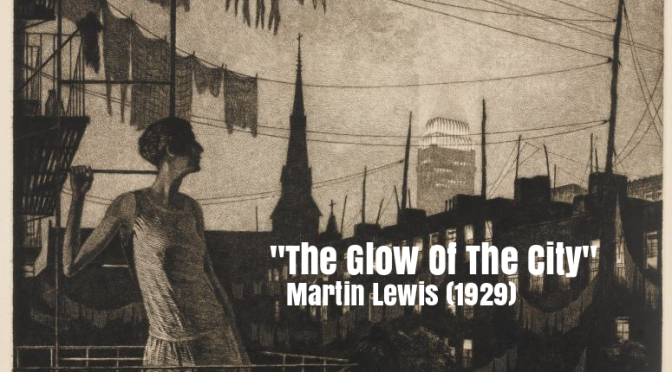
During his thirty-year career, Lewis made about 145 drypoints and etchings. His prints, like Shadow Dance and Stoops in Snow, were much admired during the 1930s for their realistic portrayal of daily life and sensitive rendering of texture. The artist’s skill in composition and his talent in the drypoint and etching media have received renewed attention in recent years. Lewis is one of the few printmakers of this era who specialized in nocturnal scenes. Some scholars consider his print Glow of the City his most significant work because of the subtlety of handling. A minute network of dots, lines, and flecks scratched onto the plate creates the illusion of transparent garments hanging in the foreground, while the Chanin Building, an art deco skyscraper, towers over the nearby tenements.

nga.gov/collection/artist-info.4704.html

en.wikipedia.org/wiki/Martin_Lewis_(artist)

Landmarks: Finland’s History Since 1930’s At Helsinki’s Hotel Torni

Monocle 24 The UrbanistHotel Torni (“Hotel Tower”) is a historical hotel located in Helsinki, Finland, and a part of the Sokos Hotels hotel chain. When opened in 1931, it became the tallest building in Finland, a position it maintained until the completion of the new Neste headquarters in neighboring Espoo in 1976. 

It remained the tallest building in Helsinki until 1987. The interior of the building was completely renovated in 2005. It is located in central Helsinki, the so-called Helsinki Design District.

The hotel was designed by architects Jung & Jung in 1928, and has 14 stories. It is allegedly the place where the murder of the Mata Hari-like Minna Craucher was planned in 1932.

Hotel Website

The hotel served the needs of air defense during the Second World War, when members of the Finnish women’s paramilitary organization Lotta Svärd kept watch for enemy bombers. Immediately after the cessation of the war, Hotelli Torni served as the headquarters of the Allied Control Commission monitoring Finnish compliance with the obligations of the Moscow Armistice. It became known as a center of culinary excellence.

From Wikipedia

American Classics: “1937 Cord 812” – Front Wheel Drive, Hidden Headlights

1937 Cord 812 Interior Classic DriverThe Cord 810, and later Cord 812, was a luxury automobile produced by the Cord Automobile division of the Auburn Automobile Company in 1936 and 1937. It was the first American-designed and built front wheel drive car with independent front suspension. It followed the 1934 Citroën Traction Avant and the Cord L-29, both of which also had front wheel drive. Both models were also the first to offer hidden headlights.

Classic Driver logoThe styling of the Cord 810 was the work of designer Gordon M. Buehrig and his team of stylists, which included young Vince Gardner and Alex Tremulis. While the first American front-wheel-drive car with independent front suspension, it had an archaic tube rear axle with semi-elliptic rear springs. Power came from a 4,739 cc (289 cu in) Lycoming V8 of the same 125 hp (93 kW) as the L-29. The semi-automatic four-speed transmission (three plus overdrive) extended in front of the engine, like on a Traction Avant. This allowed Buehrig to dispense with the driveshaft and transmission tunnel; as a result, the new car was so low it required no running boards. It had a 125 in (3,175 mm) wheelbase (shared with several 812 body styles), and in 1936 came in four models: the entry-level sedan at US$1995, the Beverly sedan ($2095), Sportsman ($2145), and Phaeton ($2195). The 1937 812s had the same models, priced $2445, $2545, $2585, and $2645, plus two more, on a 132 in (3,400 mm) wheelbase, the $2960 Custom Beverly and $3060 Custom Berline.
More pictures

From Wikipedia

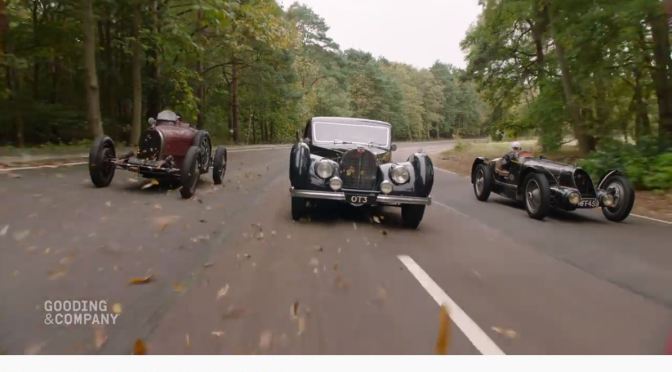
Classic Cars: “A Trio Of Bugattis At Speed” (Gooding & Company)

Gooding & Company is proud to present three stunning Bugattis from the Passion of a Lifetime Auction, a bespoke sale at Somerset House in central London on 1 April 2020.

This collection features 16 of the most coveted and valuable examples of European sports and racing automobiles of the 20th century. Visit the link below for event details and the complete list of vehicles presented at this exclusive auction event!

Website

Performing Arts: “The Letters Of Cole Porter” (New Yorker Review)

From a New Yorker online article review:

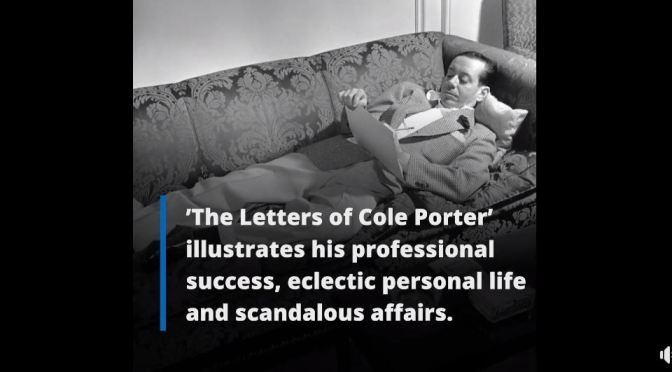
The Letters Of Cole Porter Yale University Press November 2019Beneath his smooth, genial, almost inhumanly productive and evasive surface, there were turbulent waters. His very name, for all its air of Ivy League ease, represents a burdened legacy. The Porters were his difficult, scapegrace father’s family; the Coles were his mother’s rich and ambitious Indiana family. He was a Porter by birth but, if his mother had anything to do with it, would be a Cole for life.

Certainly, Porter’s ghost could not ask for better care than he has been given in “The Letters of Cole Porter” (Yale), edited by Cliff Eisen, a professor of music history at King’s College London, and Dominic McHugh, a musicologist at the University of Sheffield (and the editor of Alan Jay Lerner’s letters). Laid out with a meticulous scholarly apparatus, as though this were the correspondence of Grover Cleveland, every turn in the songwriter’s story is deep-dived for exact chronology, and every name casually dropped by Porter gets a worried, explicatory footnote.

Read New Yorker Article

Classics: Famed Italian Car Designer “Pininfarina” Turns 90 (1930 – 2020)

Pininfarina Logo

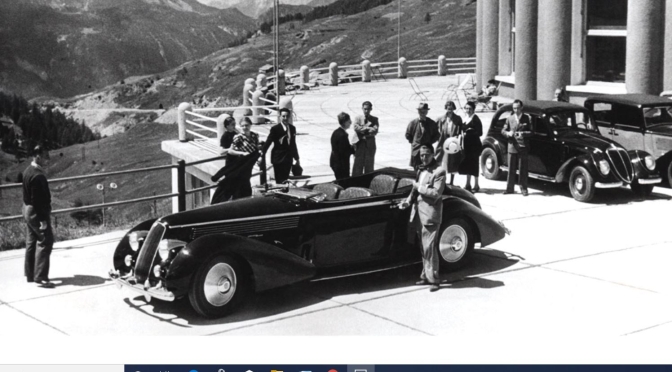
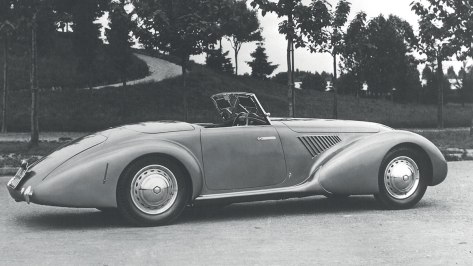
On May 22nd (1930), Battista “Pinin” Farina founded Carrozzeria Pinin Farina in Turin. The company was designed to build special car bodies for individual customers or in small production runs. The Corso Trapani plant had 150 employees on a covered area of 9250 square meters. In June, the following news appeared on an automobile periodical: “And now the popular nickname “Pinin” used by the whole of the Turin motoring world when talking about Battista Farina, was officially about to become used throughout the country, as a result of the recent Company changes which led to the founding of S.A. Carrozzeria Pinin Farina“. At the Paris Motor Show Pinin Farina exhibited Lancia, Alfa Romeo, Isotta-Fraschini and Fiat cars. The Lancia Dilambda, the first official Pinin Farina special, appeared at the 1931 Concours d’Elegance at Villa d’Este. His first accomplishments in the 1930’s included the Hispano Suiza Coupé and the Fiat 518 Ardita.

Heritage-1939-AlfaRomeo-8C-2900-CabAero

In the Thirties the car was a good that was reserved for a minor élite, almost a plaything for a narrow circle of bold, blasé youngsters. Yet Pinin felt sure that these unlikely, noisy jalopies, which also happened to be expensive, would change quickly to become outstanding and entirely respectable tools of individual mobility. One of the early ads says: “Luxury and grand luxury cars”.  Cars were destined to ruling houses, diplomats, maharajahs and even some Middle East sheiks who were beginning to collect some of the first oil royalties, for actors and actresses, more foreigners than Italians. Pinin wrote: “In September I sold a Dilambda spider cabriolet to the Queen of Romania, I began to have some of the nobility amongst my customers”.

pininfarina-design-90-years.jpg


Pinin immediately embraced the cause of modernity and aerodynamics. In his view, it was the most natural way (in so far as it was the most respondent to the “nature” of the object) of solving the problem of the autonomous and original formal identity of cars. Aerodynamics, he was to write in his memoirs, was the “form of speed”. At the 1935 Milan Motor Show Pinin exhibited the Alfa Romeo 6C Pescara Coupé aerodinamico. One year later, the Lancia Astura Cabriolet tipo Bocca: elegance and craftsmanship for a small series of streamlined, richly finished cabriolets which introduced the unprecedented notion of the legitimacy of making a certain number of replicas of a custom-built model. Then the Lancia Aprilia Aerodinamica was built, a revolutionary berlinetta where an astonishing Cx of 0.40 was intuitively and empirically achieved. Aerodynamics was no longer a symbolic element, a metaphor of speed; it had now become a real standard of efficiency.

Pininfarina Design  90 Years.jpg

Pininfarina website

1930’S Racing Cars: Amazing “Bugatti Type 59” Reunion (Classic Driver)

From a Classic Driver Magazine online article:

Bugatti Type 59 Classic Driver photo 2019During this year’s Monterey Car Week, all four of Bugatti’s hallowed Type 59s were reunited for the first time since 1935. We spoke to the man who pulled off arguably the most historically significant automotive rendezvous of the decade…

In the fabled legend of Bugatti’s racing cars, there is one model that is so beautiful and so elusive that is stands at the top of every enthusiast of the great French marque’s wish list: the Type 59. Along with the input of Jean Bugatti, who had been one of the Classic Driver logodriving forces behind the introduction of the twin-cam engine, Ettore Bugatti created the ultimate expression of his jewel-like Grand Prix car.
Read Classic Driver article

Classic Car Nostalgia: “1939 BMW 328” Is One Of The “Cars Of The Century” (Classic Driver)

From a Classic Driver online listing:

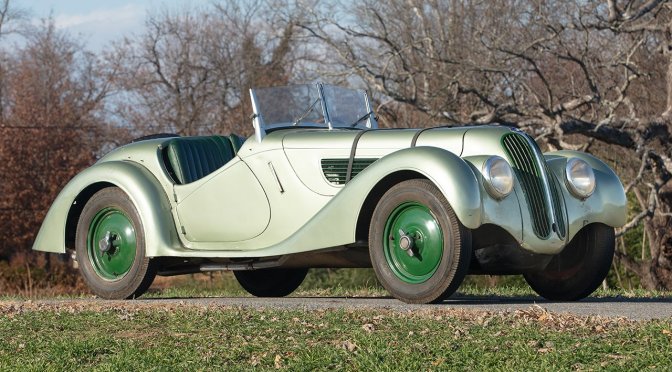
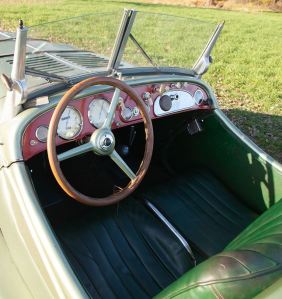
1939 BMW 328BMW’s 328 is recognized as one of history’s most important sports cars, and examples are proudly displayed in leading museums such as the Revs Institute and the Simeone Foundation Automotive Museum. The model emerged victorious in its debut race at the Nürburgring in 1936, won its class at the 1938 Mille Miglia and the 1939 Le Mans, and won the Mille Miglia outright in 1940. With over 200 victories, 328s were competitive until well into the 1950s.

This incredible 328 was purchased in 1945 in Germany by decorated fighter pilot and American Air Corps Commander Edward B. Giller, who was stationed there shortly after the war. Retaining its matching-numbers engine, the 328 here has remained in the Giller family for over 75 years and has never undergone a comprehensive restoration. Offered for sale for the first time since 1945, it is a remarkable piece of history that enthusiasts of preservation-class cars will admire and respect.

Wikipedia article: https://en.wikipedia.org/wiki/BMW_328

To read and see more: https://www.classicdriver.com/en/car/bmw/328/1939/724625