
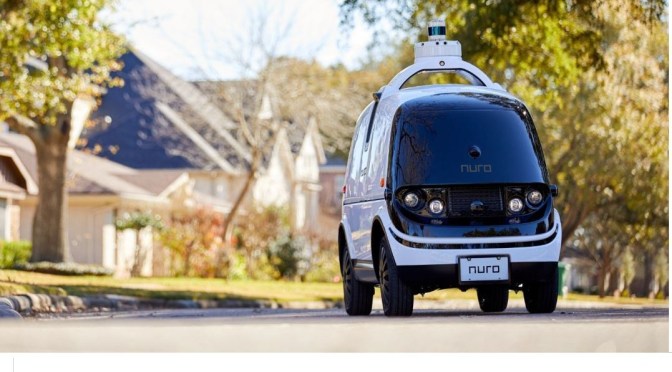
From a Nuro online Blog news release (February 6, 2020):
 Today, the US Department of Transportation (DOT) and the National Highway Traffic Safety Administration (NHTSA) approved a regulatory exemption for R2, Nuro’s second-generation vehicle. As the first company to be granted approval for a self-driving vehicle exemption, it’s an important moment for Nuro and a milestone for the industry. Under Secretary of Transportation Elaine Chao’s leadership, DOT is advancing a future of improved safety, mobility, and commerce.

This decision provides regulatory certainty for Nuro to operate our second-generation self-driving vehicle, built to carry packages instead of people. We custom-designed R2 to enrich local commerce with last-mile delivery of consumer products, groceries, and hot food from local stores and restaurants. With its specially designed size, weight, pedestrian-protecting front end, operating speed, electric propulsion, and cautious driving habits, R2 is ready to begin service as a socially responsible neighborhood vehicle that you can trust. In the coming weeks, R2 will begin public road testing to prepare for its first deliveries to customers’ homes with our partners in Houston, Texas. With this vehicle, we can also bring our service to new cities, so more Americans can benefit from safe, efficient, convenient on-demand deliveries.




 “Iceland’s glacial rivers are nature’s abstract paintings. It seems obvious that rivers this wild and stunning are protected, yet the harsh reality is that many have been dammed, mainly to provide power for aluminum plants.

 Last year the Lancet published a paper on the impact of wearing gowns, surveying 928 adult patients and carrying out structured interviews with 10 patients. Over half (58%) reported wearing the gown despite feeling uncertain that it was a medical necessity. Gown design was considered inadequate, with 61% reporting that they struggled to put it on or required assistance and 67% reporting that it didn’t fit. Most worryingly, 72% felt exposed, 60% felt self-conscious, and 57% felt uncomfortable wearing the gown.
 Packard Super Eight was the name given to the larger of the two eight-cylinder luxury automobiles produced by the Packard Motor Car Company of Detroit, Michigan. It shared frames and some body types with the top model Packard Twelve. Following the discontinuation of the Seventeenth Series Packard Twelve after the 1939 model year, a new Super Eight One-Eighty was derived from the Super Eight as the new top car range. The Super Eight was renamed the Packard Super Eight One-Sixty.
 After 1942, Packard concentrated on the new Clipper styling that was developed for an upper-class sedan the previous year. There were Super Clippers and Custom Super Clipper in the One-Sixty and One-Eighty tradition until 1947. After a heavy facelift, the name Clipper was dropped. The most senior Super Eight One-Eighty became the Custom Eight, while its slightly lower-priced sibling, the Super Eight One-Sixty, once again became simply the Super Eight. Clipper Custom Super Eights and Custom Eights were very close relatives to their respective Super models, distinguished outside by the lack of an eggcrate grille and small rear chrome trim moulding under the trunk lid on Supers. In 1949, a new Super Eight Deluxe was added to the line. This car had also the Custom Eight’s eggcrate grille, but not the rear trim.


 LAKE WYLIE, S.C.—This lakefront suburb of Charlotte, N.C., is among the Sunbelt’s strongest magnets for young families.

 On this week’s show, Staff Writer Jennifer Couzin-Frankel joins host Sarah Crespi to talk about
  Boomers Daily