Category Archives: Reviews

Vintage: “1955 Cadillac Eldorado Convertible” (Classic Driver)

From Wikipedia:

1955 Cadillac Eldorado Interior Classic DriverThe Cadillac Eldorado is a premium luxury car that was manufactured and marketed by Cadillac from 1952 to 2002 over twelve generations. Competitors and similar vehicles included the Continental Mark series, Buick Riviera, Oldsmobile Toronado and Chrysler’s Imperial Coupe.

The Eldorado was at or near the top of the Cadillac line. The original 1953 Eldorado convertible and the Eldorado Brougham models of 1957–1960 had distinct bodyshells and were the most expensive models that Cadillac offered those years. The Eldorado was never less than second in price after the Cadillac Series 75 limousine until 1966. From 1967 on, the Eldorado was built in high volumes on a unique two door personal luxury car platform.

Classic Driver logoFor 1955, the Eldorado’s body gained its own rear end styling with high, slender, pointed tailfins. These contrasted with the rather thick, bulbous fins which were common at the time and were an example of the Eldorado once again pointing the way forward. The Eldorado sport convertible featured extras such as wide chrome body belt moldings and twin round taillights halfway up the fenders. Sales nearly doubled to 3,950.

Website


1950’s English Sports Cars: “1956 Austin-Healey BN2”

From Wikipedia:

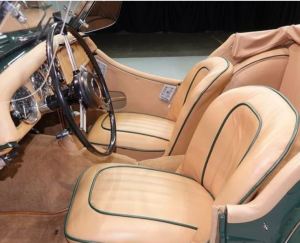
1956 Austin-Healey BN 2 100 BN2 Le Mans ‘ M’ Interior Classic DriverThe Austin-Healey 100 is a sports car that was built by Austin-Healey from 1953 until 1956.

Based on Austin A90 Atlantic mechanicals, it was developed by Donald Healey to be produced in-house by his small Healey car company in Warwick. 

Healey built a single Healey Hundred for the 1952 London Motor Show, and the design impressed Leonard Lord, managing director of Austin, who was looking for a replacement for the unsuccessful A90. Body styling was by Gerry Coker, the chassis was designed by Barry Bilbie with longitudinal members and cross bracing producing a comparatively stiff structure upon which to mount the body, innovatively welding the front bulkhead to the frame for additional strength. In order to keep the overall vehicle height low the rear axle was underslung, the chassis frame passing under the rear axle assembly.

Classic Driver logoLord struck a deal with Healey to build it in quantity; bodies made by Jensen Motors were given Austin mechanical components at Austin’s Longbridge factory. The car was renamed the Austin-Healey 100.

The “100” was named by Healey for the car’s ability to reach 100 mph (160 km/h); its successor, the better known Austin-Healey 3000, was named for the 3000 cc displacement of its engine.

Apart from the first twenty cars, production Austin-Healey 100s were finished at Austin’s Longbridge plant alongside the A90 and based on fully trimmed and painted body/chassis units produced by Jensen in West Bromwich—in an arrangement the two companies previously had explored with the Austin A40 Sports. 14,634 Austin-Healey 100s were produced.

The 100 was the first of three models later called the Big Healeys to distinguish them from the much smaller Austin-Healey Sprite. The Big Healeys are often referred to by their three-character model designators rather than by their models, as the model names do not reflect the mechanical differences and similarities well.

View more photos at Classic Driver

New Books: “A Journey Through Wine And Food”

A Journey Through Wine and Food - A Collection of Wine and Food Pairings Jerilyn Zaveral and Carla Anderson January 2020A Journey Through Wine and Food is a total sensory experience with its lifelike photography, stunning presentation of each dish, glimpses into the wineries and their winemakers, histories of the Central Valley wine region, and most of all amazing recipes that will transform everyday meals into priceless celebrations for any occasion! Inspirational quotes can also be found throughout as a reminder that not only do we need food to nourish our bodies, but we need the company of those on our journey to nourish out souls.

From Shrimp Tacos and Rose, to Beef Bourguignon with Burgundy, to Chocolate Cake paired with Port, A Journey Through Wine and Food gives everyone an opportunity to enhance their experience in the kitchen, regardless of skill level, and takes the guess work out of which wines to pair with dinner. It will also take you on a journey through The Central Valley wine regions of California giving you a sneak peek at some of the best wineries in the world, which until now could be considered “hidden gems.”

Jerilyn Zaveral was born and raised in Central California where she continues to live with her husband Joe and their dog, Hogan. Other than a short stay in New York when she wrote her first cookbook and opened her first cafe, her heart and home have always been in the San Joaquin Valley where she enjoys cooking for family and friends and tasting fine wines. She has won several awards in cooking competitions and cook-offs. Most notably her cafe “Z Spice of Life” was recognized as a destination spot in the Hudson Valley Explorer’s Guide. Jerilyn’s love of creating recipes and meals began when she was a very young child in her grandmother’s kitchen. More specifically, it was one afternoon while baking a chocolate cake when her grandmother asked her to get out the mayonnaise…the realization instantly took hold that cooking isn’t always about the end product, but about the journey of discovering unique tastes, textures and combinations of flavors that others might not expect.

To read more or purchase


Books On Aging: “Old Man Country” – Thomas R. Cole

Old Man Country My Search for Meaning Among The Elders Thomas R. Cole December 2019The book follows the journey of a writer in search of wisdom, as he encounters twelve distinguished American men over 80 — including Paul Volcker, the former head of the Federal Reserve, and Denton Cooley, the world’s most famous heart surgeon. In these and other intimate conversations, the book explores and honors the particular way that each man faces four challenges of living a good old age: Am I still a man? Do I still matter? What is the meaning of my life? Am I loved? 

We aspire to live in a country where old men are celebrated as vital elders but not demeaned if they become ill and dependent. We aspire to maintain health as well as maintain dignity and fulfillment in frailty. Old Man Country helps readers see and imagine these possibilities for themselves.

Review of book in Houston Chronicle

Readers will come to see how each man — even the most famous — faces universal challenges. Personal stories about work, love, sexuality, and hope mingle with stories about illness, loss and death. This book will strengthen each of us as we and our loved ones anticipate and navigate our way through the passages of old age.

Read more or purchase book

Classic Cars: 1954 Ford Crestline “Skyliner” Featured A Glass Roof

From a Classic Driver online listing:

1954 Ford Crestline Skyliner Classic DriverIn 1954, Ford added a new niche model to the top-of-the-line Crestline series : the Skyliner. The car had a glass roof section over the front seats, made of blue-green tinted acrylic and letting a diffused yet filtered light through. Ford claimed that 60% of the sunrays were filtered out.

The Skyliner offered a very light interior, with a soft green glow : the perfect car for the drive-in cinema, and a a great view of the future’s past, developed in an era obsessed with Jet Age design features. The Skyliner was only in production for one year, and in total 13.144 examples were sold.

Read and view more

New Arts & Culture Books: “Federico Fellini – The Book Of Dreams” (Rizzoli)

Federico Fellini The Book of Dreams Rizzoli 2020The volume will be released to coincide with the centenary of Federico Fellini’s birth (January 2020), which will be celebrated in Italy with a traveling exhibition on the director that will start its journey from Milan in December 2019.

A highly colorful journey into the boundless territory of a genius’s imagination, this is a work that added a fundamental element to the study of Federico Fellini and his creative experience. From the late 1960s until 1990, the great director used this diary to represent his nocturnal visions in the form of drawings or, as he himself described them, “scribbles, rushed and ungrammatical notes.”

About The Author

Sergio Toffetti, born in Turin in 1951, is president of the Museo Nazionale del Cinema and has published essays on Italian and international cinema, and on the conservation and restoration of film. Felice Laudadio is president of the Fondazione Centro Sperimentale di Cinematografia in Rome. He has overseen numerous cinema events, such as MystFest, EuropaCinema, and RomaFictionFest. Gian Luca Farinelli has been director of the Cineteca of Bologna since 2000. In 1986 he created, together with Nicola Mazzanti, Il Cinema Ritrovato an event dedicated to the history of cinema and the activity of film libraries. Together with Martin Scorsese, Raffaele Donato, Thierry Frémaux, and Alberto Luna he founded the World Cinema Foundation, which brings together about twenty great international directors for the restoration of third-world films.

To review or purchase

Top Destination Travel: “Blackberry Mountain” Resort, TN – 5200 Acres In Great Smoky Mountains

Spanning 5,200 acres in the Great Smoky Mountains, Blackberry Mountain continues a legacy of world-renowned hospitality and unwavering dedication and appreciation for the land. Rising above Miller’s Cove in Walland, TN, Blackberry Mountain has dedicated 2,800 acres of land to conservation.

Every adventure needs a home base, and the luxury accommodations on the Mountain offer equal parts modern design, natural charm and refined comfort. Choose from a ridgetop cabin, a stone cottage nestled into the hillside near The Lodge, or a multi-bedroom home. You’ll find each to be well-appointed, thoughtfully furnished and, of course, tastefully stocked.

This effort to preserve the natural wonder of the mountains offers breathtaking views and a serene escape from the stresses of modern life in a private national park setting. A commitment to land conservation and a passion for sharing the wonders of life in the Smokies shapes the unprecedented experience that awaits on Blackberry Mountain. Outfitted for adventure and designed for comfort, this estate takes the Blackberry State of Mind to new heights.

Website

Classics: Famed Italian Car Designer “Pininfarina” Turns 90 (1930 – 2020)

Pininfarina Logo

On May 22nd (1930), Battista “Pinin” Farina founded Carrozzeria Pinin Farina in Turin. The company was designed to build special car bodies for individual customers or in small production runs. The Corso Trapani plant had 150 employees on a covered area of 9250 square meters. In June, the following news appeared on an automobile periodical: “And now the popular nickname “Pinin” used by the whole of the Turin motoring world when talking about Battista Farina, was officially about to become used throughout the country, as a result of the recent Company changes which led to the founding of S.A. Carrozzeria Pinin Farina“. At the Paris Motor Show Pinin Farina exhibited Lancia, Alfa Romeo, Isotta-Fraschini and Fiat cars. The Lancia Dilambda, the first official Pinin Farina special, appeared at the 1931 Concours d’Elegance at Villa d’Este. His first accomplishments in the 1930’s included the Hispano Suiza Coupé and the Fiat 518 Ardita.

Heritage-1939-AlfaRomeo-8C-2900-CabAero

In the Thirties the car was a good that was reserved for a minor élite, almost a plaything for a narrow circle of bold, blasé youngsters. Yet Pinin felt sure that these unlikely, noisy jalopies, which also happened to be expensive, would change quickly to become outstanding and entirely respectable tools of individual mobility. One of the early ads says: “Luxury and grand luxury cars”.  Cars were destined to ruling houses, diplomats, maharajahs and even some Middle East sheiks who were beginning to collect some of the first oil royalties, for actors and actresses, more foreigners than Italians. Pinin wrote: “In September I sold a Dilambda spider cabriolet to the Queen of Romania, I began to have some of the nobility amongst my customers”.

pininfarina-design-90-years.jpg


Pinin immediately embraced the cause of modernity and aerodynamics. In his view, it was the most natural way (in so far as it was the most respondent to the “nature” of the object) of solving the problem of the autonomous and original formal identity of cars. Aerodynamics, he was to write in his memoirs, was the “form of speed”. At the 1935 Milan Motor Show Pinin exhibited the Alfa Romeo 6C Pescara Coupé aerodinamico. One year later, the Lancia Astura Cabriolet tipo Bocca: elegance and craftsmanship for a small series of streamlined, richly finished cabriolets which introduced the unprecedented notion of the legitimacy of making a certain number of replicas of a custom-built model. Then the Lancia Aprilia Aerodinamica was built, a revolutionary berlinetta where an astonishing Cx of 0.40 was intuitively and empirically achieved. Aerodynamics was no longer a symbolic element, a metaphor of speed; it had now become a real standard of efficiency.

Pininfarina Design  90 Years.jpg

Pininfarina website

New Architecture Books: “Traces of J. B. Jackson – The Man Who Taught Us to See Everyday America”

Traces of J.B. Jackson The Man Who Taught Us To See Everday America Helen L. HorowitzAfter a varied life of traveling, writing, sketching, ranch labor, and significant service in army intelligence in World War II, Jackson moved to New Mexico and single-handedly created the magazine Landscape. As it grew under his direction throughout the 1950s and 1960s, Landscape attracted a wide range of contributors. Jackson became a man in demand as a lecturer and, beginning in the late 1960s, he established the field of landscape studies at Berkeley, Harvard, and elsewhere, mentoring many who later became important architects, planners, and scholars.

J. B. Jackson transformed forever how Americans understand their landscape, a concept he defined as land shaped by human presence. In the first major biography of the greatest pioneer in landscape studies, Helen Horowitz shares with us a man who focused on what he regarded as the essential American landscape, the everyday places of theHarvard Design Magazine Fall 1998 countryside and city, exploring them as texts that reveal important truths about society and culture, present and past. In Jackson’s words, landscape is “history made visible.”

Read Harvard Design Magazine article

Horowitz brings this singular person to life, revealing how Jackson changed our perception of the landscape and, through friendship as well as his writings, profoundly influenced the lives of many, including her own.

To read more or purchase book

Interviews: Director Martin Scorsese On Filmmaking & Death (NYT)

From a New York Times online article (01/02/20):

Martin Scorsese Photo by Philip Montgomery for The New York Times
Scorsese would like to take a year to read and spend time with loved ones. “Because we’re all going. Friends are dying. Family’s going.”Credit…Philip Montgomery for The New York Times

In ways both subtle and substantial, Scorsese sees the world changing and becoming less familiar to him. He gratefully accepted a deal with Netflix, which covered the reported $160 million budget for “The Irishman.” But the bargain meant that, after the movie received a limited theatrical release, it would be shown on the company’s streaming platform.

Scorsese has other aspirations but they have nothing to do with moviemaking. “I would love to just take a year and read,” he said. “Listen to music when it’s needed. Be with some friends. Because we’re all going. Friends are dying. Family’s going.”

Martin Scorsese is the most alive he’s been in his work in a long time, brimming with renewed passion for filmmaking and invigorated by the reception that has greeted his latest gangland magnum opus, “The Irishman.”

And what he wants to talk about is death.

Just to be clear, he’s not talking about the deaths in his movies or anyone else’s. “You just have to let go, especially at this vantage point of age,” he said one Saturday afternoon last month.

Read entire article