Category Archives: Health

Health: “Patient One – Saving America’s First Known Coronavirus Patient” (Frontline)

The inside story of how the first confirmed COVID-19 patient in the U.S. was identified and treated in Washington State.

Frontline Coronavirus Pandemic PBSWhen a man returning from Wuhan, China in January 2020 exhibited symptoms of the novel coronavirus, public health officials in the Seattle area were already on alert.

“We had a game plan in place already,” says Dr. George Diaz, who treated patient one when he was admitted to Providence Regional Medical Center in Everett. Yet in spite of the state’s preparedness, it would soon become clear that the virus’s spread was already ahead of efforts to contain it.

“Patient One: Saving America’s First Known Coronavirus Patient” was drawn from FRONTLINE’s reporting for “Coronavirus Pandemic” – veteran science reporter Miles O’Brien and his team’s investigation of the U.S. response to COVID-19.

“Coronavirus Pandemic” premieres Tues., April 21. Stream it on the PBS Video App starting at 7/6c, or watch it on PBS or YouTube at 9/8c. Check local PBS listings.

More here: https://to.pbs.org/2ypGUOw
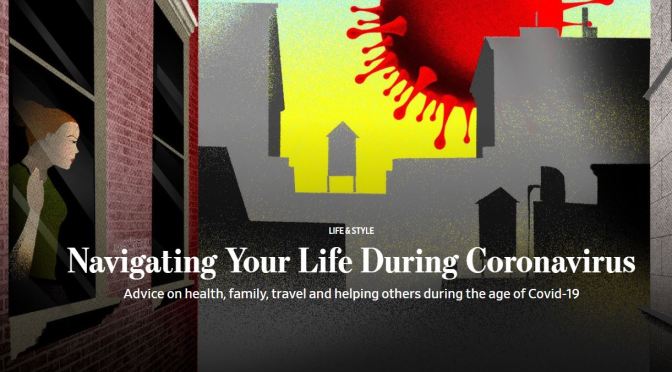
 

Health News: “Navigating The Coronavirus” – Wall Street Journal (April 17)

From the Wall Street Journal (April 17, 2020):

As the coronavirus pandemic upends work, travel and home life, the rules are shifting for what people can and can’t do in their daily lives. The WSJ is continuously updating advice and information on how to stay safe, healthy and connected, and how to help others.

WSJ Special Section 4.17.20 - Navigating the Coronavirus-

Aid to a Friend Caring for a Coronavirus Patient

“Because I am organized in my job and day-to-day life, I took on my husband’s care thinking I would have it all quickly in hand. But things didn’t turn out that way,” writes Leslie Yazel, whose husband came down with coronavirus-related pneumonia. Here, she offers what she learned about the best ways to help those who are caring for someone with coronavirus.

Get a Good Night’s Sleep

Read more

Covid-19 Podcast: Testing Lab Challenges, WHO Funding & Immune System Issues (Nature.com)

nature-podcastsBenjamin Thompson, Noah Baker, and Amy Maxmen discuss Trump withholding funds from the WHO, and how COVID-19 kills. We also hear about controlling misinformation while communicating risk.
In this episode:

01:15 Understanding bottlenecks

After listening to last week’s episode of Coronapod, researchers in the USA were inspired to start collecting data about the challenges facing labs carrying out testing. After more than 4,000 responses to their online survey, we discuss their goals.

03:08 A hole in the WHO’s funding

US President Donald Trump has announced plans to withhold funding for the WHO, pending a review of the organization’s handling of the pandemic. We discuss the decision and ask what it means for the global response to COVID-19.

News: Nature‘s rolling coronavirus news blog

05:55 Responding to the immune system

We investigate the role of the immune system in the death of COVID-19 patients and what this could mean for treatments. Could some therapeutics actually be undermining the body’s ability to fight the virus?

News: How does COVID-19 kill? Uncertainty is hampering doctors’ ability to choose treatments

13:54 One good thing this week

Our hosts pick out things that have made them smile in the last 7 days, including seasonal memories from Sierra Leone, a trip to the supermarket, and the 99-year old war veteran who has raised millions for charity.

BBC News: Coronavirus: Capt Tom Moore’s NHS fundraiser hits £17m

18:33 Communicating complex data

Clearly communicating risks and evidence is key for governments and other organisations if they are to best inform the public during the pandemic. But what is the best way to do it? We hear the methods that communications experts and behavioural scientists recommend to keep the public informed, and keep misinformation at bay.

New Study: Obesity Results In Six Times Higher Rates Of Type 2 Diabetes, 3X More Than Genetic Risks (2020)

From a Diabetologia online study release (April 15, 2020):

Diabetologia Journal“Having normal body weight is crucial in the prevention of type 2 diabetes, regardless of genetic predisposition.”

“The results suggest that type 2 diabetes prevention by weight management and healthy lifestyle is critical across all genetic risk groups.”

“Overall, the results indicate that a favorable lifestyle should be universally recommended in the prevention of type 2 diabetes, regardless of genetic predisposition, thus supporting current public health guidelines,”

Methods

We examined the joint association of genetic predisposition, obesity and unfavourable lifestyle with incident type 2 diabetes using a case-cohort study nested within the Diet, Cancer and Health cohort in Denmark. The study sample included 4729 individuals who developed type 2 diabetes during a median 14.7 years of follow-up, and a randomly selected cohort sample of 5402 individuals.

Results

Obesity (BMI ≥ 30 kg/m2) and unfavourable lifestyle were associated with higher risk for incident type 2 diabetes regardless of genetic predisposition (p > 0.05 for GRS–obesity and GRS–lifestyle interaction). The effect of obesity on type 2 diabetes risk (HR 5.81 [95% CI 5.16, 6.55]) was high, whereas the effects of high genetic risk (HR 2.00 [95% CI 1.76, 2.27]) and unfavourable lifestyle (HR 1.18 [95% CI 1.06, 1.30]) were relatively modest.

Read full study

Health: LVMH And Fashion Industry Now Making Hand Sanitizer, Masks And Protective Gear (Podcast)

Monocle 24 On Design LogoJamie Waters explains how the fashion industry emerged as a vital contributor in the fight against the pandemic. Many brands, big and small, have pivoted to make masks and other protective equipment.
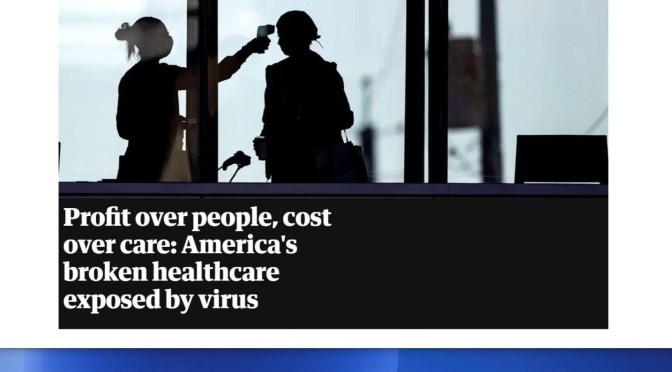

Medical Economics: Virus Exposes America’s “Broken Healthcare System” (2020)

From The Guardian (April 16, 2020):

The Guardian Healthcare“As this epidemic makes clear, at any moment, any of us could become sick, could become hospitalized, could be on a mechanical ventilator,” said Adam Gaffney, an ICU doctor in Boston. “And that, in the United States, could mean potentially ruinous healthcare costs.”
With over 21,000 people dead and more than a 547,000 infected with the coronavirus in the US the last question on a person’s mind should be how they will pay for life-saving treatment.

There were 27.9 million people without health insurance in 2018, and record-high unemployment will increase that figure by millions

But as the death toll mounted, a patient who was about to be put on a ventilator in one of New York City’s stretched to capacity intensive care units had a final question for his nurse: “Who’s going to pay for it?”

Read full article

Health: Testing, Approving And Fairly Distributing A New Coronavirus Vaccine

SCIENTISTS ARE working at an unprecedented pace to find a vaccine for SARS-CoV-2, the virus that causes covid-19. The stakes are high. Natasha Loder, The Economist’s health policy editor, explains how an effective vaccine might be developed.

Dr Trevor Drew of the Australian Centre for Disease Preparedness speaks to host Kenneth Cukier about two trials which have reached the animal-testing stage. Plus, once a vaccine is discovered, what can be done to make sure it is distributed fairly? Dr Seth Berkely, chief executive of GAVI, the vaccine alliance, explains the importance of global cooperation. Runtime: 26 min

Social Distancing: 3-D Simulation Of How Respiratory Droplets Spread Coronavirus

From The New York Times (April 14, 2020):

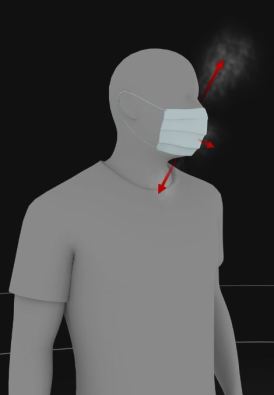
Face Mask Disrupts trajectory of cough New York Times April 14 2020

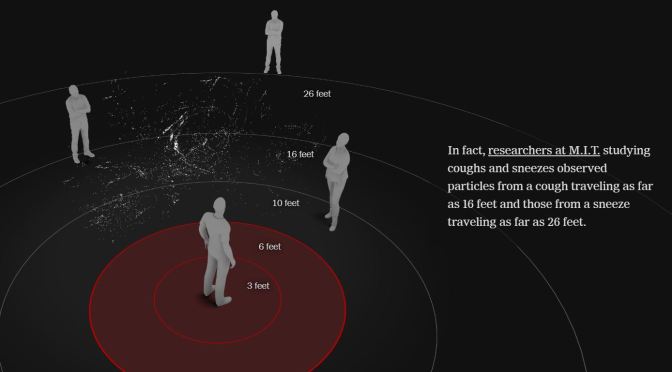
But as this simulation suggests, and scientists have argued, droplets can travel farther than six feet. And small droplets known as aerosols can remain suspended or travel through the air before they eventually settle on surfaces. This is how they could disperse over the next 20 minutes.

The Centers for Disease Control and Prevention encourages people to stay home. If you must venture out, you should stay at least six feet away from others. The World Health Organization recommends a minimum of three feet of separation.

Scientists are learning about the novel coronavirus in real time, and those who study similar respiratory illnesses say that until it is better understood, no guideline is likely to offer perfect safety. Instead, understanding the possible transmission routes for the virus can help us see why keeping our distance is so important.

View 3-D simulation

Health Study: Physical Therapy Superior To Steroid Injection For Knee Osteoarthritis

New England Journal of Medicine Articles

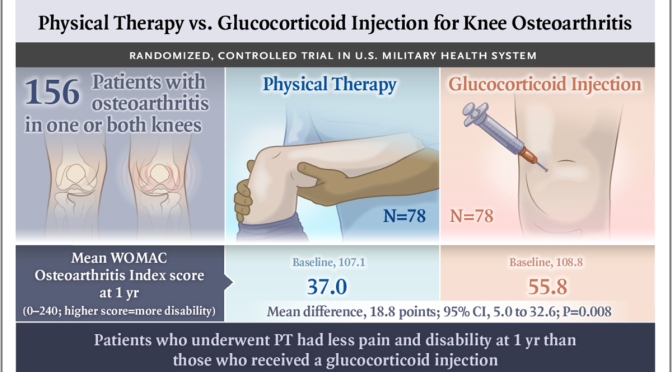
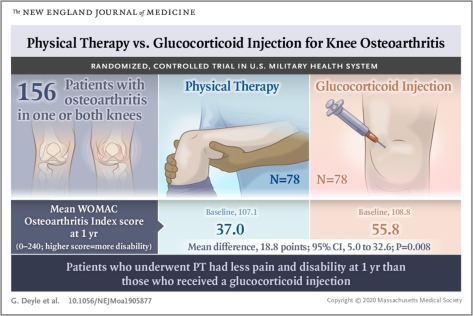
Patients with osteoarthritis of the knee who underwent physical therapy had less pain and functional disability at 1 year than patients who received an intraarticular glucocorticoid injection.

Physical Therapy Superior To Glucocorticoid Injection for Knee Osteoarthritis NEJM April 9 2020

Osteoarthritis of the knee is a leading cause of disability.1 Current management is typically limited to the treatment of symptoms until late stages of arthritis lead to knee replacement.2 Intraarticular glucocorticoid injections are commonly used as a primary treatment for osteoarthritis of the knee,3 but there are conflicting reports regarding the extent and duration of the relief of symptoms with this therapy.4-6 Complications from these injections occur infrequently but include joint infection,7 accelerated degradation of articular cartilage,8 and subchondral insufficiency fractures.9

PHYSICAL THERAPY

The physical therapy intervention, which is described in the protocol,26 included instructions and images for exercises, joint mobilizations, and the clinical reasoning underlying the priorities, dosing, and progression of treatment. During a typical clinical session, the physical therapist would implement hands-on, manual techniques immediately before the patient performed reinforcing exercises to help the patient perform the movements with little or no pain. For example, if a patient could not fully extend or flex the knee, or those movements were painful, the physical therapist would use a hands-on, passive mobilizing technique to repeatedly move the knee to reduce stiffness while altering the mechanics of the technique to avoid pain. The patient would then perform repeated active knee movements in the same direction.

Read full study