
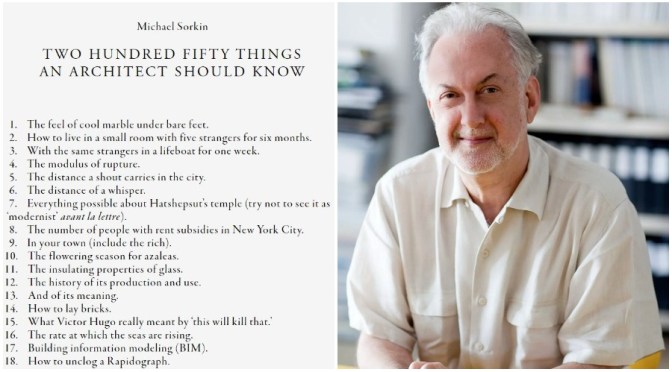
From an Apollo Magazine online article (March 31, 2020):
 Ultimately he was a humane critic of the contemporary city, a serious, funny and poetic voice defending the powerless against big capital and an articulator of how architecture should be used as a tool of resistance. He is indelibly associated with New York, a city he loved with a fervour despite its faults, and of which he defended every inch as a public good. Number 210 in his list was the medieval German phrase ‘Stadtluft macht frei’ – ‘city air makes you free’. He will survive through his magical writing, which makes us all a little freer.
Michael Sorkin, who died last week of complications due to Covid-19, gained his reputation as the architecture critic of The Village Voice in New York, which, in the 1980s, was a publication with a formidable reach and impact on a city just beginning to boom again. He launched fierce attacks against the banality of the contemporary city, the rapacity and greed of developers (notably the current president, including in a 1985 piece entitled ‘Dump the Trump’) and the loss of great landmarks. But he was no nostalgist; he revelled in the potential of architecture to catalyse change and excoriated his contemporaries for caving in to big business, for building prisons and being complicit in a denuded public realm.


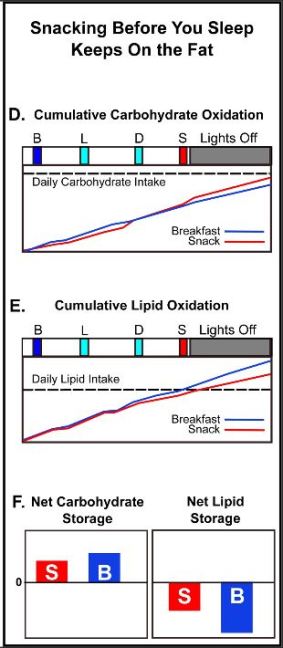
 These daily oscillations are controlled by the circadian clock, which is composed of an autoregulatory biochemical mechanism that is expressed in tissues throughout the body and is coordinated by a master pacemaker located in the suprachiasmatic nuclei of the brain (aka the SCN [

 On this week’s show, Contributing Correspondent Kai Kupferschmidt talks with host Sarah Crespi about modeling coronavirus spread and the role of forecasts in national lockdowns and other pandemic policies. They also talk about the launch of a global trial of promising treatments.


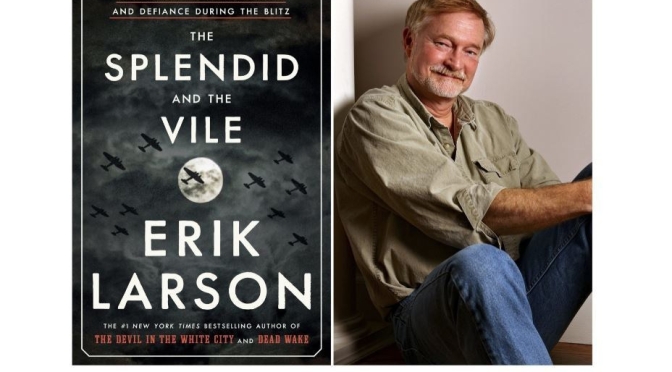

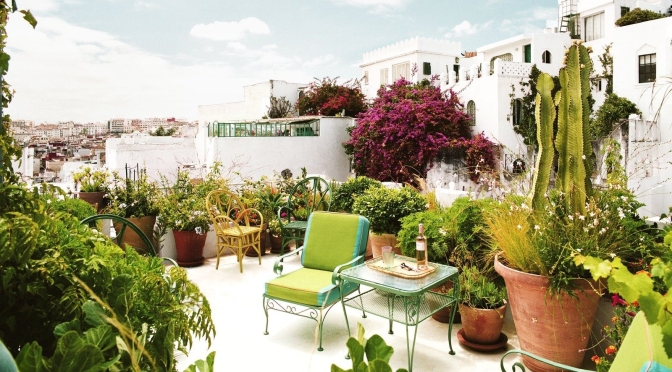
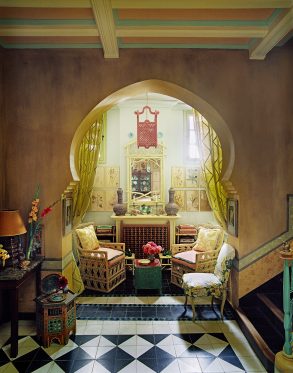 “Tangier is the crossroads of so many civilizations,” says AD100 talent Frank de Biasi of the evocative Moroccan port city that he and his partner, the multifaceted designer Gene Meyer, have made their home. “There’s a central energy here,” he explains, “where the Atlantic meets the Mediterranean, where Europe meets Africa. It’s a psychic point like no other place.”
 Boomers Daily