
Tag Archives: Work

Previews: The Economist Magazine – June 3, 2023

Image

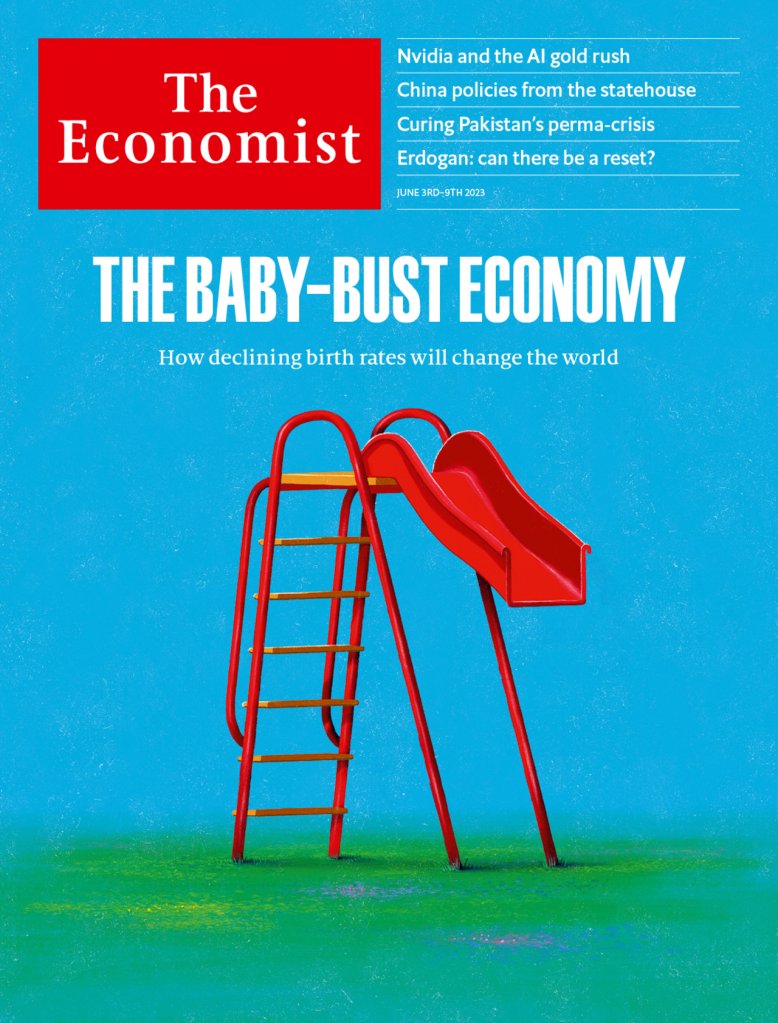
The Economist Magazine– June 3, 2023 issue: The baby-bust economy: How declining birth rates will change the world.

Global fertility has collapsed, with profound economic consequences

What might change the world’s dire demographic trajectory?

In the roughly 250 years since the Industrial Revolution the world’s population, like its wealth, has exploded. Before the end of this century, however, the number of people on the planet could shrink for the first time since the Black Death. The root cause is not a surge in deaths, but a slump in births. Across much of the world the fertility rate, the average number of births per woman, is collapsing. Although the trend may be familiar, its extent and its consequences are not. Even as artificial intelligence (ai) leads to surging optimism in some quarters, the baby bust hangs over the future of the world economy.

How to make the re-election of Recep Tayyip Erdogan less bad news

Turkish President and People's Alliance's presidential candidate Recep Tayyip Erdogan gestures to supporters at the presidential palace, in Ankara, Turkey, Sunday, May 28, 2023. Turkey President Recep Tayyip Erdogan won reelection Sunday, extending his increasingly authoritarian rule into a third decade as the country reels from high inflation and the aftermath of an earthquake that leveled entire cities. (AP Photo/Ali Unal)

There is a chance for a partial reset

It certainly wasn’t fair. Nor was it entirely free. But, like it or not, the victory on May 28th of Recep Tayyip Erdogan in Turkey’s presidential election is a fact. For the next five years Turkey, Europe and the wider world will have to deal with a prickly and authoritarian populist. That is bad news on many fronts: economically, democratically and regionally. And yet pragmatists have a duty to search for chinks of light in the gloom.

It’s not just a fiscal fiasco: greying economies also innovate less

That compounds the problems of shrinking workforces and rising bills for health care and pensions

“Adam is a special child,” says the voice-over, as the camera pans across abandoned classrooms and deserted maternity wards. “He’s the last child born in Italy.” The short film made for Plasmon, an Italian brand of baby food owned by Kraft-Heinz, a giant American firm, is set in 2050. It imagines an Italy where babies are a thing of the past. It is exaggerating for effect, of course, but not by as much as you might imagine. The number of births in Italy peaked at 1m in 1964; by 2050, the un projects, it will have shrunk by almost two-thirds, to 346,000.
Culture/Politics: Harper’s Magazine — May 2023 Issue

Image

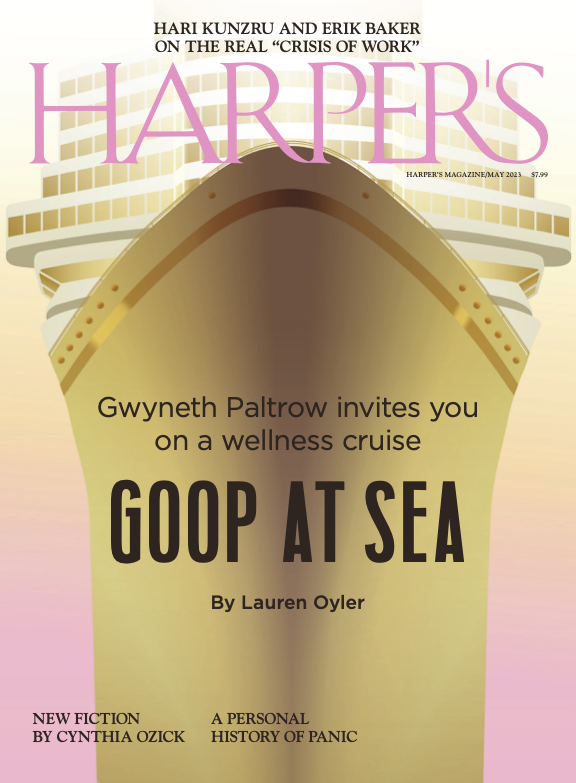
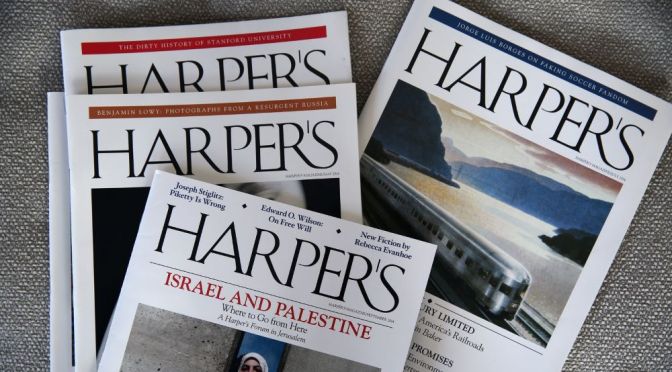
Harper’s Magazine – May 2023 issue: @laurenoyler goes on the @goop cruise; @harikunzru and @erikmbaker on the real “crisis of work; A person history of panic; Losing a father and finding Stoicism; New fiction by Cynthia Ozick and more..

The Age of the Crisis of Work

The Age of the Crisis of Work thumbnail

What is the sound of quiet quitting?

Something has gone wrong with work. On this, everyone seems to agree. Less clear is the precise nature of the problem, let alone who or what is to blame. For some time we’ve been told that we’re in the midst of a Great Resignation. Workers are quitting their jobs en masse, repudiating not just their bosses but ambition itself—even the very idea of work.

The Anatomy of Panic

The Anatomy of Panic thumbnail

A personal history of anxiety

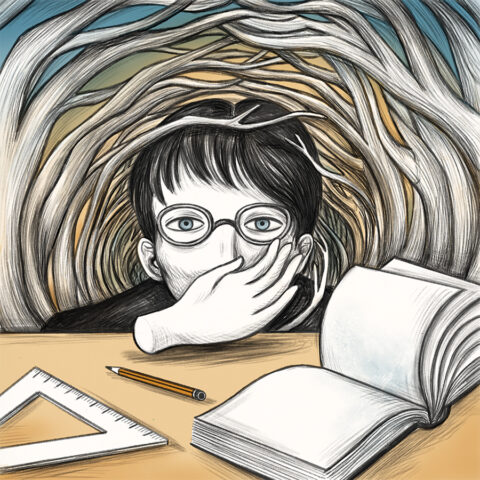
I had my first panic attack when I was fifteen, in the middle of January, while I was sitting in geometry class. Winter in Illinois, flesh comes off the bones—what did we need geometry for? We could look at the naked angles of the trees, the circles in the sky at night. 

Culture/Society: Monocle Magazine – February 2023

Issue 160 - Monocle - Print - Shop | Monocle

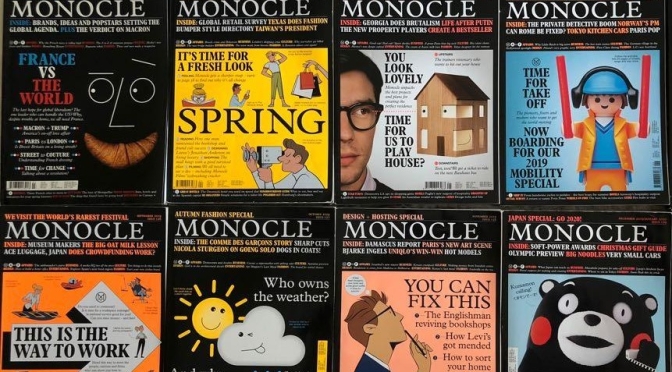
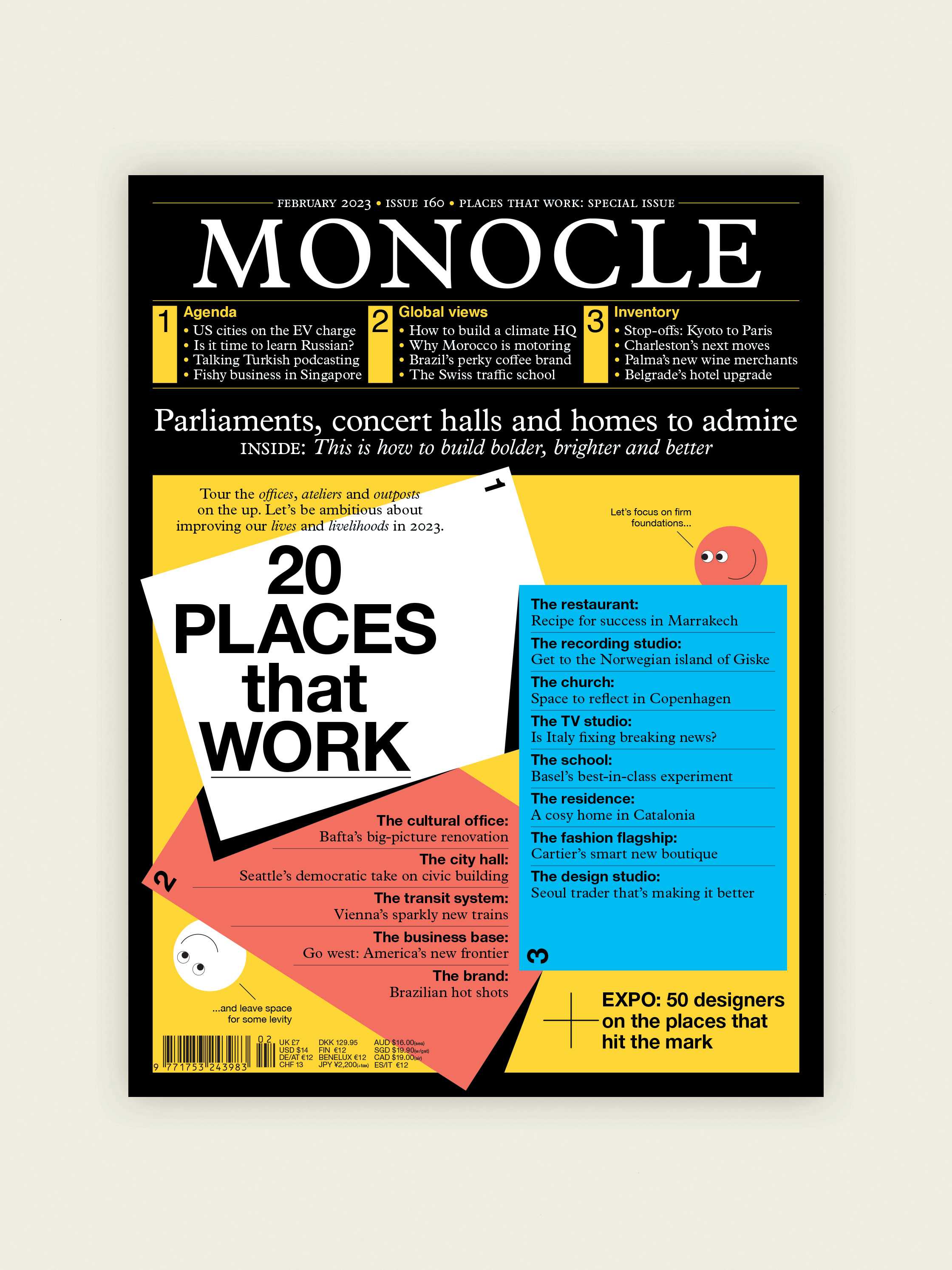
Monocle FilmsMonocle’s February 2023 issue is all about celebrating places that work, whether that’s a parliament, home or metro carriage. From a floating office to a school teaching children the rules of the road, we profile the locations that look good and work well for those who use them. Plus: Charleston’s hospitality boom and why you should learn Russian.

Opinion: The Despot In The Desert, Big-Tech Decline, Imperfect Is OK At Work

A selection of three essential articles read aloud from the latest issue of The Economist. This week, MBS: despot in the desert, the era of big-tech exceptionalism may be over (49:05), and why it’s OK not to be perfect at work (55:30). 

Global News: A Worker’s World, Amazon Effect On Sports, Japanese Poetry

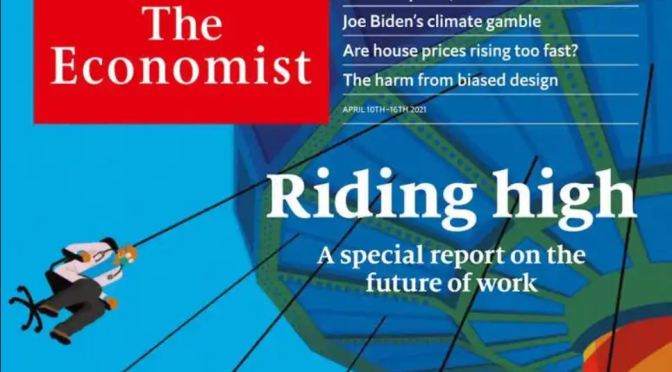
A selection of three essential articles read aloud from the latest issue of The Economist. This week, riding high in a workers’ worldthe Amazon effect on live sport (9:45) and even transience is mutating (17:35).

The Future Of Work: ‘Is Working From Home A Long-Term Trend?’ (Video)

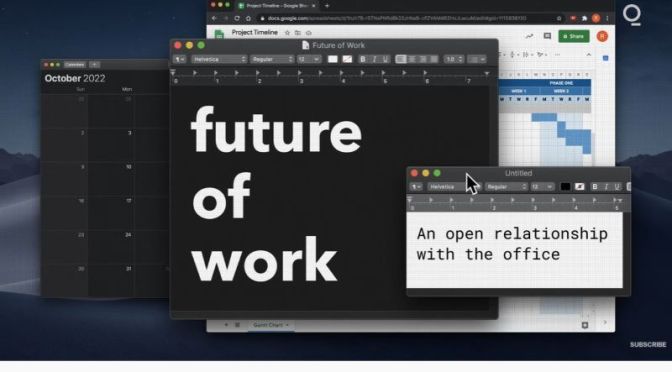
The white-collar world has been forced by Covid-19 into a “work from home” experiment, and the results are in. It turns out we can be just as productive at home, if not more so, and many don’t want to go back to the office — at least not full time. So what will happen to the office? Will we see workers coming in only when they have to? And if so, what does that mean to the multibillion- dollar commercial real estate industry?

Urban Design: “The Future Of Cities” (WSJ Video)

The coronavirus pandemic could have a lasting impact on city life. WSJ’s Jaden Urbi explores how the ways we work, shop and play are changing as urban designers refocus on health, tech and open spaces.

Illustration: Zoë Soriano

Health & Business: “The Office Redesign Is Just Beginning” (WSJ Video)

Plexiglass dividers and floor decals might not be permanent, but the pandemic will bring lasting change to offices. Experts from the architecture and real-estate industries share how they are getting back to work and what offices will look like in the future.

Photo: Cesare Salerno for The Wall Street Journal

Wednesday Podcast: Virus Misinformation, 2020 Election & Surveillance

Axios TodayThe spread of misinformation is crippling our fight against the coronavirus. Social media and a deeply partisan divide are fueling what the World Health Organization calls an “infodemic,” which is just as urgent as the virus itself.

  • Plus, the 2020 election could determine the future of the Keystone XL and Dakota Access pipelines.
  • And, going back to work might require getting used to surveillance and data collection in the workplace.
  • Guests: Axios’ Bryan Walsh, Ben Geman, and Erica Pandey