

Tag Archives: Technology

Studies: “Home Hospital” Model Of Care Reduces Costs By 38%, Improves Recovery (Harvard)
From a Harvard Gazette online article:
“This work cements the idea that, for the right patients, we can deliver hospital-level care outside of the four walls of the traditional hospital, and provides more of the data we need to make home hospital care the standard of care in our country,” said corresponding author David Levine, a physician and researcher in the Division of General Internal Medicine and Primary Care.
“It opens up so many exciting possibilities — it’s exciting for patients because it gives them the opportunity to be in a familiar setting, and it’s exciting for clinicians because we get to be with a patient in that person’s own surroundings. As a community-minded hospital, this is a way for us to bring excellent care to our community.”
The home hospital model of care — in which select patients receive hospital-level care for an acute illness from the comfort of their own home instead of in a traditional hospital — has become increasingly popular across the U.S.
To read more: https://news.harvard.edu/gazette/story/2019/12/home-hospital-model-reduces-costs-by-38-improves-care/
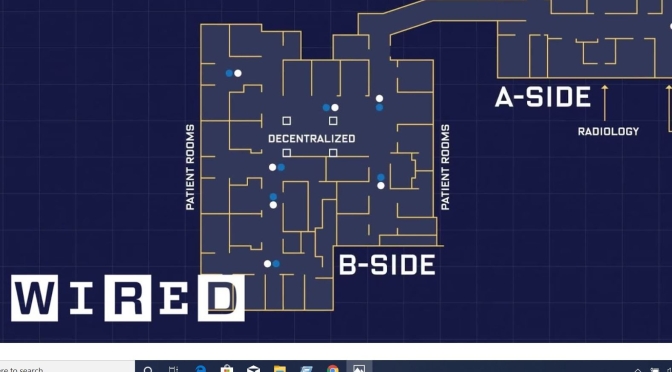
Hospital Care: How Improved Design Of Emergency Rooms Can Save Lives (Video)
 Produced by WIRED Brand Lab with American Institute of Architects | How can design transform emergency rooms from one of the most stressful and chaotic places into a place of healing? Dr. Bon Ku and architect Billie Faircloth, AIA, break down the science behind designing a better work environment for hospitals.

Travel: Harbour Air Seaplanes Announces World’s First Commercial Electric Plane Flight
From a Harbour Air Seaplanes online release:
 “Today, we made history,” said Greg McDougall, CEO and founder of Harbour Air Seaplanes. “I am incredibly proud of Harbour Air’s leadership role in re-defining safety and innovation in the aviation and seaplane industry. Canada has long held an iconic role in the history of aviation, and to be part of this incredible world-first milestone is something we can all be really proud of.”
December 10, 2019 – Harbour Air, North America’s largest seaplane airline and magniX, the company powering the electric aviation revolution, today announced the successful flight of the world’s first all-electric commercial aircraft. The successful flight of the ePlane, a six-passenger DHC-2 de Havilland Beaver magnified by a 750-horsepower (560 kW) magni500 propulsion system, took place on the Fraser River at Harbour Air Seaplanes terminal in Richmond (YVR South) this morning. The plane was piloted by Harbour Air CEO and founder Greg McDougall. This historic flight signifies the start of the third era in aviation – the electric age.
To read more: https://www.harbourair.com/harbour-air-and-magnix-announce-successful-flight-of-worlds-first-commercial-electric-airplane/
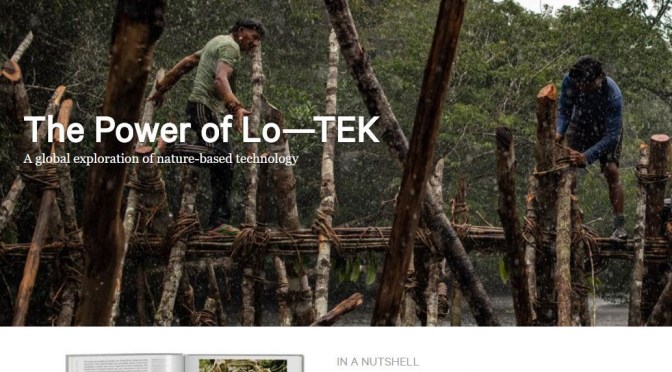
Architecture & Design Books: “Lo-TEK Design By Radical Indigenism” By Julia Watson (Taschen)
 Lo—TEK, derived from Traditional Ecological Knowledge, is a cumulative body of multigenerational knowledge, practices, and beliefs, countering the idea that indigenous innovation is primitive and exists isolated from technology. It is sophisticated and designed to sustainably work with complex ecosystems.
Three hundred years ago, intellectuals of the European Enlightenment constructed a mythology of technology. Influenced by a confluence of humanism, colonialism, and racism, this mythology ignored local wisdom and indigenous innovation, deeming it primitive. Today, we have slowly come to realize that the legacy of this mythology is haunting us.
With a foreword by anthropologist Wade Davis and four chapters spanning Mountains, Forests, Deserts, and Wetlands, this book explores thousands of years of human wisdom and ingenuity from 20 countries including Peru, the Philippines, Tanzania, Kenya, Iran, Iraq, India, and Indonesia. We rediscover an ancient mythology in a contemporary context, radicalizing the spirit of human nature.
To read more or purchase: https://www.taschen.com/pages/en/catalogue/architecture/all/04698/facts.julia_watson_lotek_design_by_radical_indigenism.htm
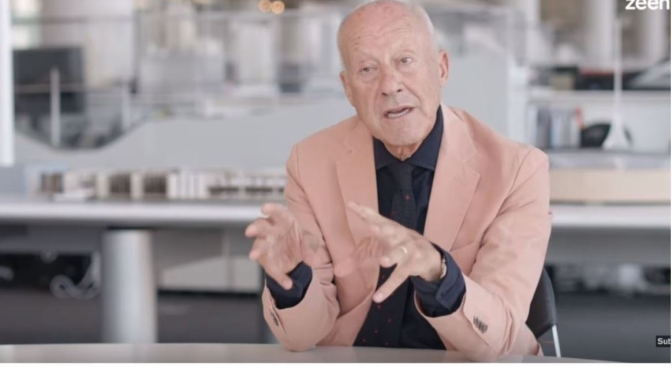
Interviews: 84-Year Old British Architect Norman Foster On His First High-Tech Building (Video)
“High-tech is something to do with the expression of the technology – the means by which the building stands,” the award-winning architect told Dezeen in an exclusive interview at his London practice.
 British architect Norman Foster reflects on his first high-tech building and how it shaped offices to come, in this exclusive video produced by Dezeen. Named after the electronics manufacturer that commissioned the building,
Reliance Controls was an industrial facility located in Swindon in Southwest England. Completed in 1967, the building was the last to be designed by Team 4, an architecture practice comprising Foster, Richard Rogers, Su Brumwell and Wendy Cheesman, before the group disbanded. The single-storey rectangular shed, which was designed to house the company’s factory and offices, was one of the first buildings labelled as high-tech – a style of architecture that Foster defines as a celebration of a building’s functional components.
Reliance Controls was the first building to dissolve the traditional boundaries between factory workers and office workers. “There was only a glass screen that would separate the assembly line for electronics from those who are managing the sales force,” said Foster. “They would all share the same kitchen and dining facilities, the same bathrooms. That we take for granted now but at that time it was it was really revolutionary – unheard of.”
Website: https://www.dezeen.com/2019/12/13/norman-foster-reliance-controls-video-interview/

New Research Videos: “In Search Of The Amazon’s Tallest Tree” (Cambridge)
Research has discovered the tallest known tree in the Amazon, towering above the previous record holder at a whopping 88.5 metres. This giant could store as much carbon as an entire hectare of rainforest elsewhere in the Amazon. Toby Jackson, a plant scientist in the University of Cambridge, took part in an expedition to find the tree in a remote region of northern Brazil, and validate its height the old-fashioned way – by climbing it.
To read more: https://www.cam.ac.uk/research/news/expedition-finds-tallest-tree-in-the-amazon

New Tech Books: “The Future Is Faster Than You Think”, Peter H. Diamandis & Steven Kotler (Jan 2020)
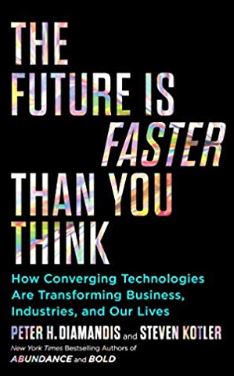 Technology is accelerating far more quickly than anyone could have imagined. During the next decade, we will experience more upheaval and create more wealth than we have in the past hundred years. In this gripping and insightful roadmap to our near future, Diamandis and Kotler investigate how wave after wave of exponentially accelerating technologies will impact both our daily lives and society as a whole. What happens as AI, robotics, virtual reality, digital biology, and sensors crash into 3D printing, blockchain, and global gigabit networks? How will these convergences transform today’s legacy industries? What will happen to the way we raise our kids, govern our nations, and care for our planet?
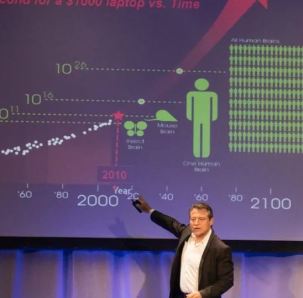 Recently named by Fortune as one of the “World’s 50 Greatest Leaders,” Peter H. Diamandis is the founder and executive chairman of the XPRIZE Foundation, which leads the world in designing and operating large-scale incentive competitions. He is also the executive founder of Singularity University, a graduate-level Silicon Valley institution that counsels the world’s leaders on exponentially growing technologies.
As an entrepreneur, Diamandis has started over 20 companies in the areas of longevity, space, venture capital and education. He is co-founder of BOLD Capital Partners, a venture fund with $250M investing in exponential technologies, and co-founder and Vice
Chairman of Celularity, Inc., a cellular therapeutics company.
Website: https://www.diamandis.com/
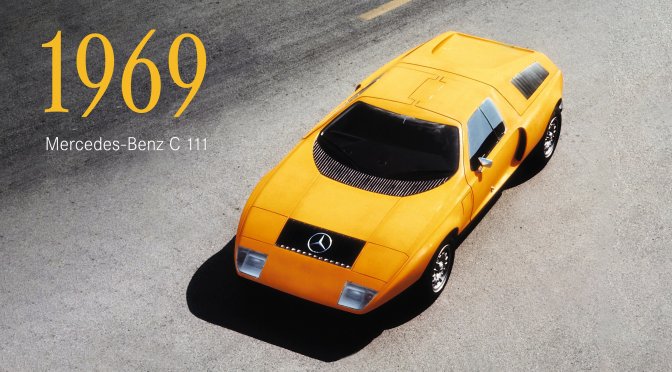
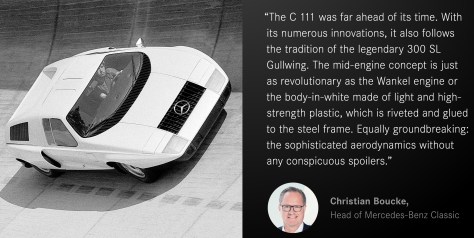
Innovation In The 60’s: The “1969 Mercedes-Benz C 111” Was Mid-Engine, Gullwing & Glass Fiber Light

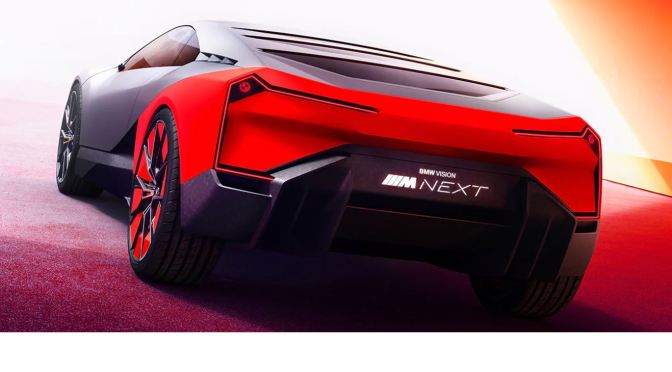
Future Of Mobility: BMW Design Chief Talks About Brand’s “Vision M NEXT” Car Technology (Video)
 ‘we believe in the power of choice,’ begins domagoj dukec. as cars embrace new technologies such as autonomous systems, BMW and their designers are ensuring customers are still offered their own ultimate driving experience. in fact, they are actually integrating technology into the background of their designs, from the powertrains to the adaptable furniture and interior fabrics, creating mobility spaces that adapt to your needs. the innovations are there to help and enhance the experience but are free to the user to choose when, where and how it affects their journey. this power of choice is exemplified by BMW‘s two driving modes and vision cars: EASE and BOOST, and the Vision iNEXT and Vision M NEXT.

 Boomers Daily