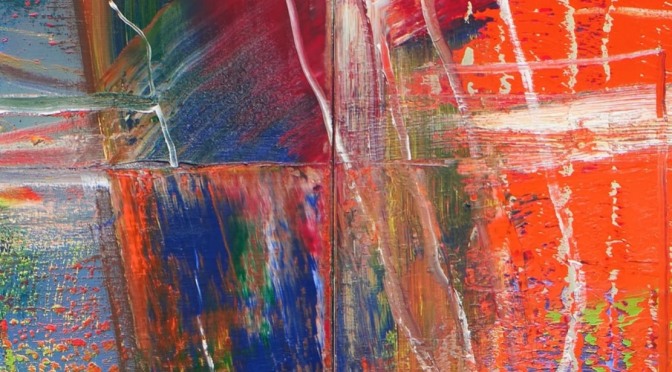
Sotheby’s (February 3, 2023) – Reminiscent of a landscape, or the strata of a Monet waterlily painting, the horizontal swathes of paint migrate across Abstraktes Bild in wave like-motion across the breadth of the canvas. Texture, colour and structure are here deployed with spectacular force, with the gliding scrape of the squeegee revealing the kaleidoscopic architectural structure of the artist’s underpainting.
It is a masterpiece created during the critical year of 1986, which saw the artist’s first large-scale touring retrospective and was also the year in which Richter first took up the squeegee as his principal compositional tool. He has only ever produced 24 Abstraktes Bild of this magnitude (with a width greater than 380 cm), of which half of these reside in museum collections across the globe.
Gerhard Richter was born in 1932 in Dresden, Germany. Throughout his career, Richter has negotiated the frontier between photography and painting, captivated by the way in which these two seemingly opposing practices speak to and challenge one another. From exuberant canvases rendered with a squeegee and acerbic color charts to paintings of photographic detail and close-ups of a single brushstroke, Richter moves effortlessly between the two mediums, reveling in the complexity of their relationship, while never asserting one above the other.
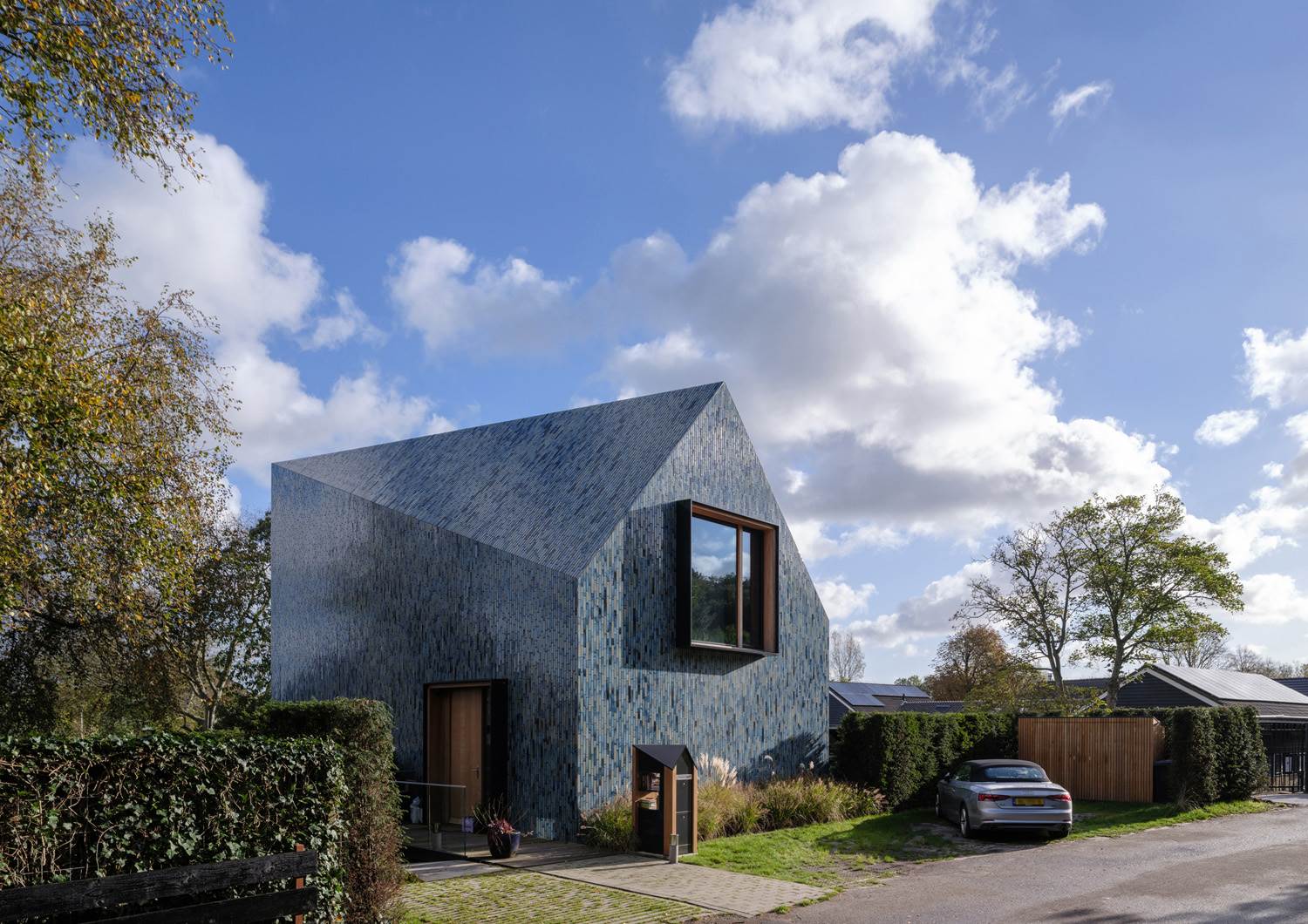
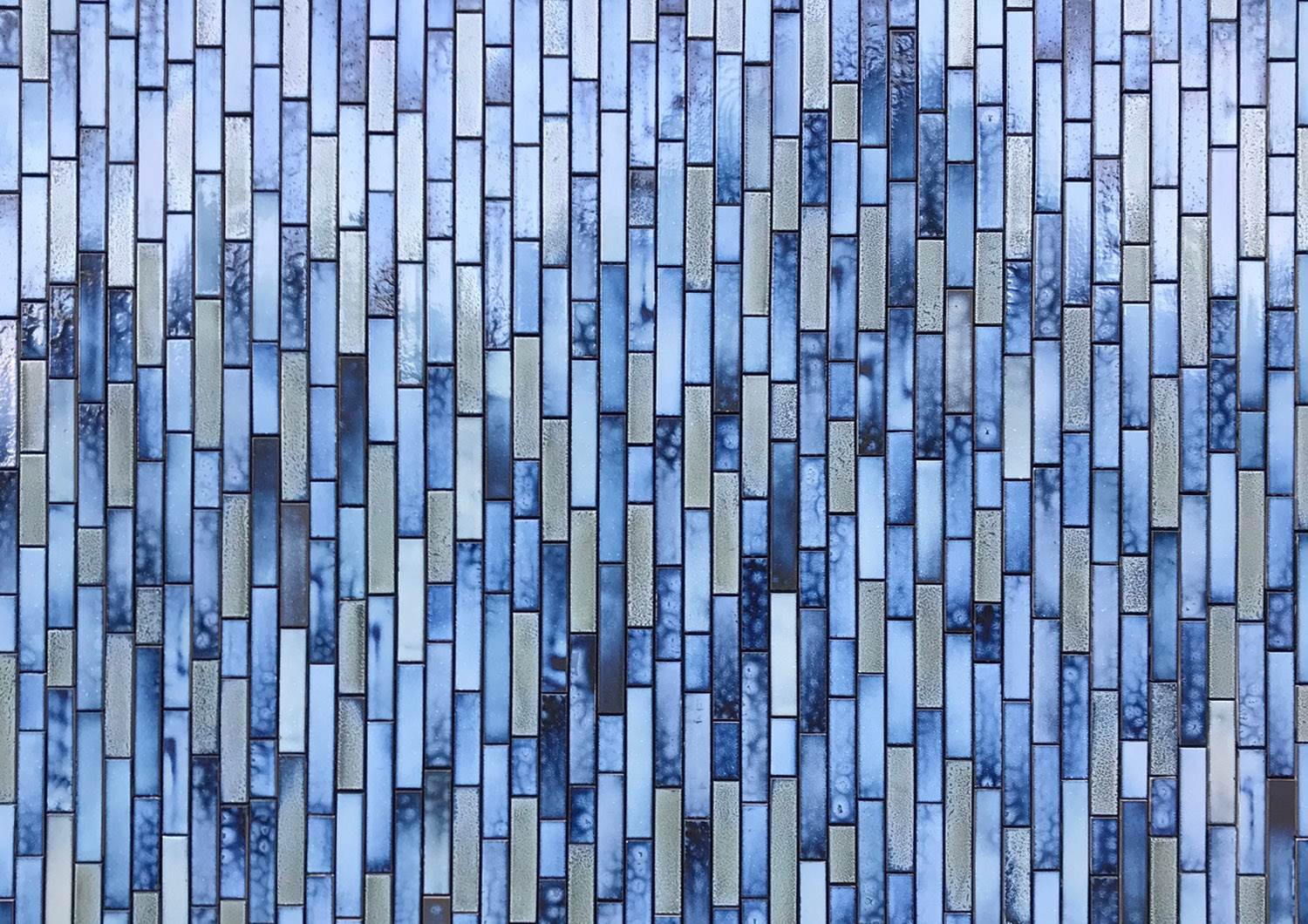
The monolithic presence of the building volume is accentuated through the sloping roof surfaces and exterior walls. These are covered with tiles of the same continuous material – multicoloured glazed ceramic tiles. The hue of these tiles forms a coherent whole, making a connection and blending the building into the transformative landscape.
The naturally sloping landscape embraces Villa BW, with a building volume characterised by a double-curved roof coupled with an unmistakable expression of the facade. The twisting roof is created as a result of two overlapping shapes. A gable roof is designed on the dune-side, also characteristic of the street scene on the Oorsprongweg. In contrast, a horizontal roofline is designed for the polder-side.
The villa is constructed over three floors, with an additional level within the hood of the roof. Due to the natural course of the terrain and the replenishment of an embankment as a continuation of the dune landscape, the ground floor and basement level at -1 have a direct relationship with the surroundings. Facing southeast the connection with the landscape alongside the sloped garden is enhanced by enclosing two voids with a curtain wall system.
The strong connection between the landscape and the house translates into the expression of the facade and roof cladding with the application of a single natural material, expressed through a custom ceramic tile covering that wraps the entire building. This customised multicoloured glazed tile cladding represents the transitions in the landscape, from dune landscape to polder, and the soil layers, from light to dark.
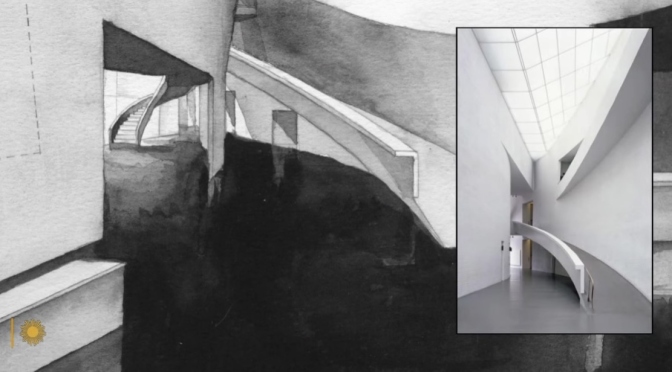
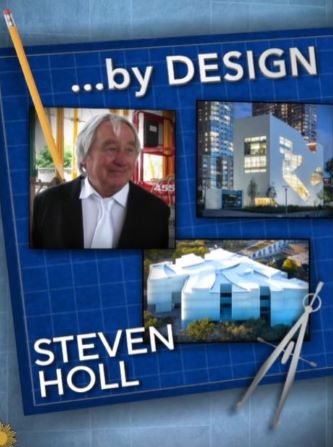
CBS Sunday Morning (January 29, 2023) – The works of architect Steven Holl have helped define the look of cities around the world, making remarkable use of light and space.
Correspondent Rita Braver talks with Holl, whose recent works include the REACH at the John F. Kennedy Center for the Performing Arts, in Washington, D.C., and the Kinder Building at The Museum of Fine Arts, Houston – buildings in which Holl hopes to express “the joy from the creative act.”
Steven Holl is a tenured Professor of Architecture who has taught at Columbia GSAPP since 1981. After completing architecture studies in Rome in 1970, the University of Washington in 1971, and graduate studies at London’s Architectural Association in 1976, Holl founded Steven Holl Architects in 1977. Based in New York City, the forty person firm also has an office in Beijing.
Steven Holl has realized cultural, civic, academic and residential projects both in the United States and internationally including the Kiasma Museum of Contemporary Art in Helsinki, Finland (1998); the Chapel of St. Ignatius, Seattle, Washington (1997); Simmons Hall at the Massachusetts Institute of Technology in Cambridge, Massachusetts (2002); the Nelson-Atkins Museum of Art in Kansas City, Missouri (2007); the Horizontal Skyscraper in Shenzhen, China (2009); the Linked Hybrid mixed-use complex in Beijing, China (2009); Cité de l’Océan et du Surf in Biarritz, France (2011); the Reid Building at the Glasgow School of Art, Glasgow, Scotland (2014); the Arts Building West and the Visual Arts Building at the University of Iowa in Iowa City, Iowa (2006, 2016); the Ex of IN House (2016); the Lewis Arts Complex at Princeton University in Princeton, New Jersey (2017); Maggie’s Centre Barts in London (2017); the Institute for Contemporary Art at Virginia Commonwealth University (2018); and the Glassell School of Art at the Museum of Fine Arts, Houston (2018). Upcoming work includes the REACH expansion of the John F. Kennedy Center for Performing Arts in Washington, D.C. (2019); the Winter Visual Arts Center at Franklin & Marshall College (2019); Rubenstein Commons at the Institute for Advanced Study in Princeton, New Jersey (2019); and the expansion of the Museum of Fine Arts, Houston (2020).
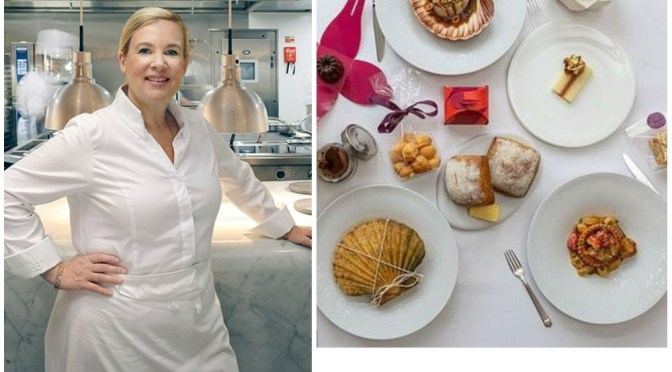
Eater – Three-Michelin-starred restaurant Hélène Darroze in London offers its tasting menu at lunch and dinner, meaning nearly all the day’s preparation must be done before noon. The staff at the restaurant prepare dishes like langoustine, grouse wellington, chef’s table octopus, and more.
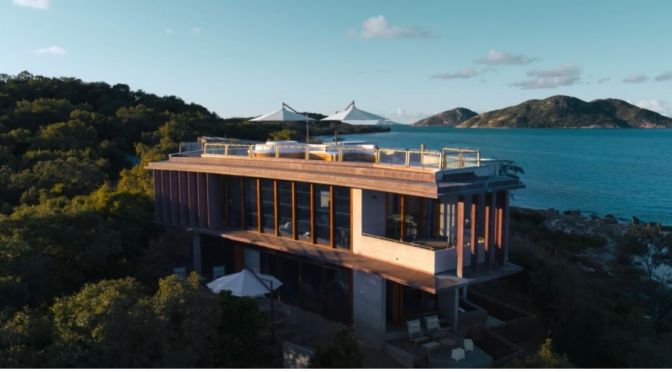
Luxury Lodges of Australia (December 20, 2022) – The House At Lizard Island, a world-class reef house situated on the doorstep of the Great Barrier Reef opened its doors on 1 July, 2022 for guests seeking unparalleled levels of privacy and personalised service alongside barefoot adventure and a genuine connection to nature. Newly built on a pristine headland of the exclusive Lizard Island,
Lizard Island is an island on the Great Barrier Reef in Queensland, 1,624-kilometre northwest of Brisbane and part of the Lizard Island Group that also includes Palfrey Island. It is part of the Lizard Island National Park. Lizard Island is within the locality of Lizard in the Cook Shire.
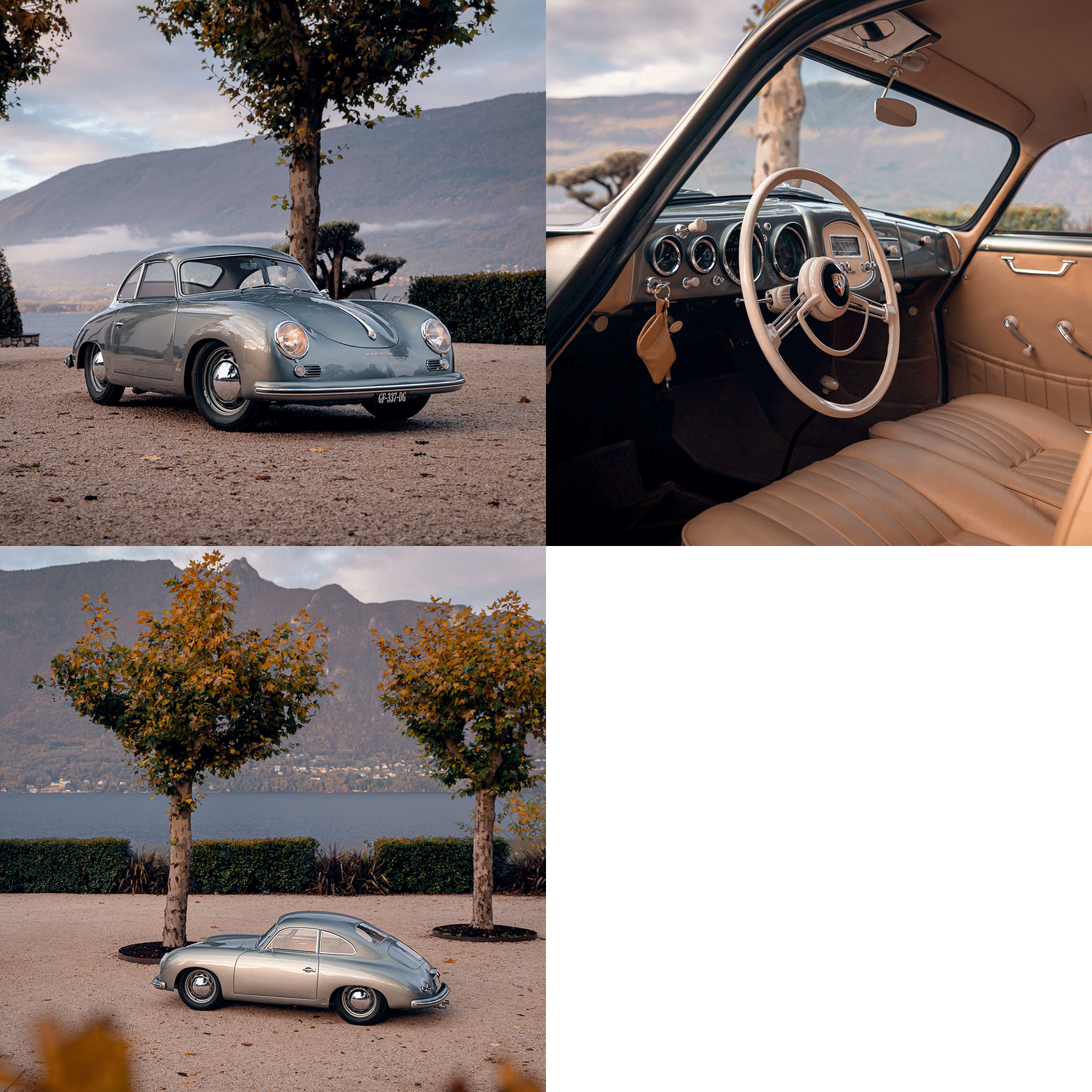
ClassicDriver (December 6, 2022) – This stunning piece of automotive sculpture is a 1955 Porsche 356, and as the eagle-eyed among you will notice, this particular car is a very rare Pre-A model. As some of the earliest cars Porsche ever built, these Pre-A 356s were once disregarded by enthusiasts in favour of the faster and more modern 356 B and C models. However, what the Pre-A 356s lacked in outright pace, they made up for with their undeniable purity of design. We think you’ll agree, this particular example is quite the looker.
Financial Times – The FT’s Daniel Garrahan and food critic Tim Hayward visit Silo, a ‘zero waste’ restaurant in Hackney, which rejects the bin, makes ice cream from waste bread, turns seaweed into pendant lighting and ‘upcycles’ used wine bottles
SILO BEGAN IN AUSTRALIA IN 2011 WITH ARTIST JOOST BAKKER WHO PROPOSED THE IDEA OF ‘NOT HAVING A BIN’… FROM THAT POINT SILO’S CHEF AND OWNER HAS BUILT THE BUSINESS UP TO BEING THE WORLD’S FIRST ZERO WASTE RESTAURANT.
SILO IS A RESTAURANT CONCEIVED FROM A DESIRE TO INNOVATE THE FOOD INDUSTRY WHILST DEMONSTRATING RESPECT: RESPECT FOR THE ENVIRONMENT, RESPECT FOR THE WAY OUR FOOD IS GENERATED AND RESPECT FOR THE NOURISHMENT GIVEN TO OUR BODIES. THIS MEANS WE CREATE EVERYTHING FROM ITS WHOLE FORM, CUTTING OUT FOOD MILES AND OVER-PROCESSING, WHILST PRESERVING NUTRIENTS AND THE INTEGRITY OF THE INGREDIENTS IN THE PROCESS.
Dezeen – In the first instalment of Dezeen’s new Concrete Icons series produced in collaboration with Holcim, MAD Architects founder Ma Yansong explains how his firm’s sinuous concrete library in Haikou, China encourages visitors to use their imagination.
Yansong is the first participant in Concrete Icons, a new video series profiling the most iconic contemporary concrete buildings by the world’s leading architects. The video focusses on MAD’s Cloudscape of Haikou, a library with a flowing form cast in white concrete located in a waterside park in Haikou on the island of Hainan.
Completed in 2021, the 1,000-square-metre structure houses a library, cafe, restrooms, showers, a nursery room, and bike storage, and acts as a waystation for visitors to the park. Speaking to Dezeen in an exclusive video interview filmed at MAD’s offices in Beining, Yansong explained how the building is designed to put visitors in a contemplative or imaginative state of mind.
MAD Architects, led by Ma Yansong, has announced the opening of the Cloudscape of Haikou is located on the southern tip of China. A unique urban public and cultural space for citizens and visitors to Haikou, this flowing, sculptural concrete form was named as one of the “most anticipated architecture projects of 2021” by The Times of London.
A prominent port city on the southern tip of China, Haikou was once an important stop on the Maritime Silk Road. With the establishment of the Hainan International Tourism Island and Hainan Free Trade Zone, Haikou’s influence has seen a gradual resurgence in modern times. Meanwhile, Haikou’s government is also enriching the city’s cultural importance, through enhancing the social attributes of the city’s public spaces, and strengthening the connection between the city, humanities, and architecture. The Cloudscape of Haikou is one such culmination of this effort.
The Cloudscape of Haikou is the first of sixteen coastal pavilions commissioned by the Haikou Tourism and Culture Investment Holding Group to rejuvenate the historic port city, with the aim of improving public space along the coastline. Known as “Haikou, Pavilions by the Seaside,” the initiative invited teams of internationally recognized architects, artists, and interdisciplinary professionals to create sixteen landmark public stations.
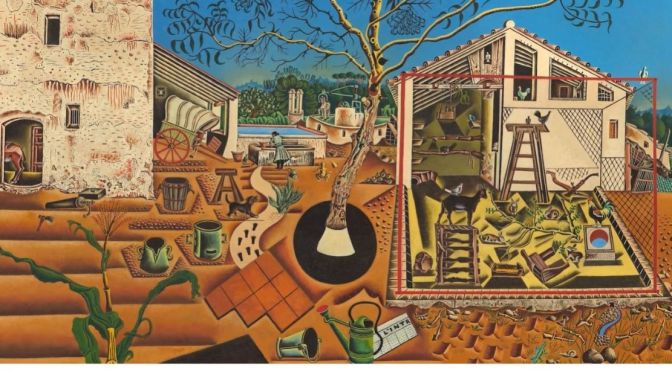
National Gallery of Art – Joan Miró finished “The Farm,” his first masterpiece, 100 years ago. To celebrate, curator Harry Cooper and Joan Punyet Miró, Miró’s grandson, get together to tell the tale of this seminal painting from their perches at the National Gallery of Art in Washington, D.C. and Miró’s farm in Mont-roig del Camp, Spain. From Pablo Picasso in Paris to Earnest Hemingway in Cuba, you won’t want to miss the epic journey of Miró and his beloved “The Farm.”
Joan Miró i Ferrà was a Spanish painter, sculptor and ceramicist born in Barcelona. A museum dedicated to his work, the Fundació Joan Miró, was established in his native city of Barcelona in 1975, and another, the Fundació Pilar i Joan Miró, was established in his adoptive city of Palma in 1981.
News, Views and Reviews For The Intellectually Curious
















 Boomers Daily