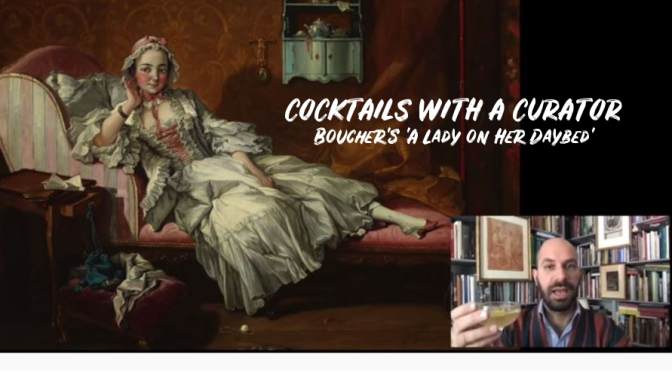
In this episode of “Cocktails with a Curator,” Xavier F. Salomon, Peter Jay Sharp Chief Curator, examines the life and work of French painter François Boucher, with a focus on “A Lady on Her Daybed.” Discover why Boucher was said to epitomize the taste of the eighteenth century.
This week’s complementary cocktail has a kick: the potent French 75, named after the powerful French 75mm field gun.
Michelangelo Merisi da Caravaggio is one of the most admired painters of the late 16th and early 17th centuries. Known for his powerful, dramatically lit compositions, Caravaggio depicted violence and the human form with a degree of realism unprecedented at the time. He was among the most famous painters in Rome—but not only because of his skill as an artist.
Caravaggio was also notorious for his wild life and shocking temper. After being sentenced to death for murder, he fled Rome and died in exile at age 38 . Three biographies written in the decades after his death constitute nearly all that is known about the enigmatic artist.
In this episode, Getty curator and expert on Italian painting Davide Gasparatto discusses Caravaggio and the role these early biographies, by Giulio Mancini, Giovanni Baglione, and Giovanni Pietro Bellori, played in defining Caravaggio’s legacy.
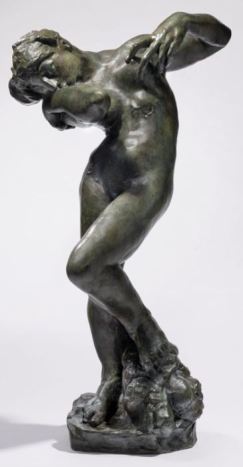
Auguste Rodin (1840-1917) Meditation, small model, type I version
Rodin travelled to Italy in 1875, a trip described by the late art historian Kirk Varnedoe as, ‘one of the seminal events in modern art’.
Here, in his mid-thirties, he fell under the spell of the Renaissance master, Michelangelo. His monumental, exaggerated nude figures would have a deep and lasting influence on the artist. ‘My liberation from academicism was via Michelangelo,’ Rodin later recalled. ‘He is the bridge by which I passed from one circle to another.’
Auguste Rodin (1840-1917) is renowned for breathing life into clay, creating naturalistic, often vigorously modelled sculptures which convey intense human emotions: love, ecstasy, agony or grief. Breaking the rules of academic convention and classical idealism, Rodin ushered in a new form of highly expressive sculpture that went on to influence generations of artists that followed.
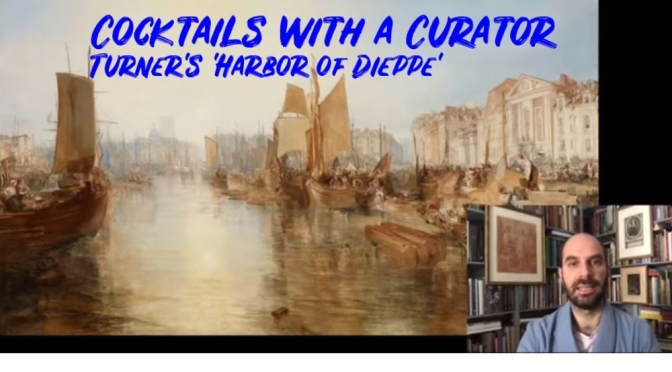
In this episode of “Cocktails with a Curator,” Xavier F. Salomon, Peter Jay Sharp Chief Curator, discusses the French port city depicted in J. M. W. Turner’s painting “Harbor of Dieppe: Changement de Domicile,” and how the artist’s extensive travel throughout Europe helped to develop his affinity for harbors. The complementary cocktail is the Widow’s Kiss, a French drink traditionally given to women who had lost their husbands at sea.
Alex Hillkurtz was born in England and grew up in California where he is a renowned storyboard artist for feature films, television, and commercials. His film credits include “Argo”, “Almost Famous”, “It’s Complicated”, and many others.
Alex currently lives in Paris with his film editor wife, Tiffany, and enjoys discovering the hidden corners of the city that sketching and plein air painting allow. He uses the language of cinema to inform his images, moving beyond what one sees, and depicting what he wants others to see. He believes that in our too-crowded lives, sketching and plein air painting invite us to move at a more deliberate pace… a true sense of place, and sometimes unexpected stories are revealed.
A look ‘beneath’ Titian’s canvases reveals the tweaks and changes he made as he worked over four hundred years ago. Find out more with Restorer Jill Dunkerton.
The Ashmolean’s 2020 Young Rembrandt exhibition is currently closed, but you can still visit virtually. Watch this introduction from exhibition curator An Van Camp, and explore the exhibition section by section at ashmolean.org
The Young Rembrandt exhibition charts the astonishing transformation of the Dutch master Rembrandt. Spanning the years 1624 to 1634, it traces how a young and unremarkable artist from Leiden became the superstar of 17th-century Amsterdam and one of the greatest artists of all time.
Manet called him “the greatest painter of all.” Picasso was so inspired by his masterpiece Las Meninas that he painted 44 variations of it. Francis Bacon painted a study of his portrait of Pope Innocent X. Monet and Renoir, Corot and Courbet, Degas and Dalí…for so many champions of art history, the ultimate soundboard was—and remains—Diego Rodríguez de Silva y Velázquez (1599-1660).
Las Meninas – Diego Velázquez (1656)
This updated catalog raisonné brings together Velázquez’s complete works, jaw-droppingly reproduced in extra-large format, with a selection of enlarged detailsand brand new photography of recently restored paintings, achieved through the joint initiative of TASCHEN and Wildenstein. The book’s dazzling images are accompanied by insightful commentary from José López-Rey on Velázquez’s interest in human life and his equal attention to all subjects, from an old woman frying eggs to a pope or king, as well as his commitment to color and light, which would influence the Impressionists over two centuries later.
The authors
José López-Rey (1905–1991) taught Italian Renaissance at the University of Madrid and worked as an art advisor for the Spanish Ministry of Education. Before the end of the Spanish Civil War, he emigrated to the USA, where he resumed his teaching career at the Institute of Fine Arts, New York. In 1973 he was awarded emeritus status. López-Rey was a corresponding member of the Hispanic Society of America and a consultant and contributor to several international art journals, including the Gazette des Beaux Arts and Art News.
Odile Delenda, graduate of the École du Louvre, served as professor there, and then as deputy head of the department of paintings at the Musée du Louvre until 2007. She has collaborated on several exhibitions of old master paintings. A research fellow at the Wildenstein Institute in Paris since 1990, she has continued her study of Spanish art from the Siglo de Oro. She is, among other works, the author of Vélasquez, peintre religieux (1993) and, under the auspices of the Wildenstein Institute, the first critical catalogue raisonné of the painted oeuvre of Francisco de Zurbarán and his studio (2009/10).

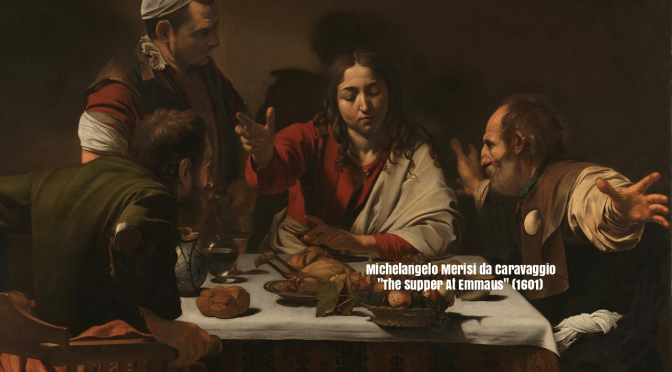
 Michelangelo Merisi da Caravaggio is one of the most admired painters of the late 16th and early 17th centuries. Known for his powerful, dramatically lit compositions, Caravaggio depicted violence and the human form with a degree of realism unprecedented at the time. He was among the most famous painters in Rome—but not only because of his skill as an artist.
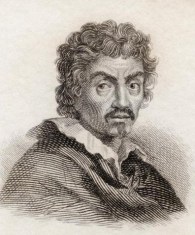 Caravaggio was also notorious for his wild life and shocking temper. After being sentenced to death for murder, he fled Rome and died in exile at age 38 . Three biographies written in the decades after his death constitute nearly all that is known about the enigmatic artist.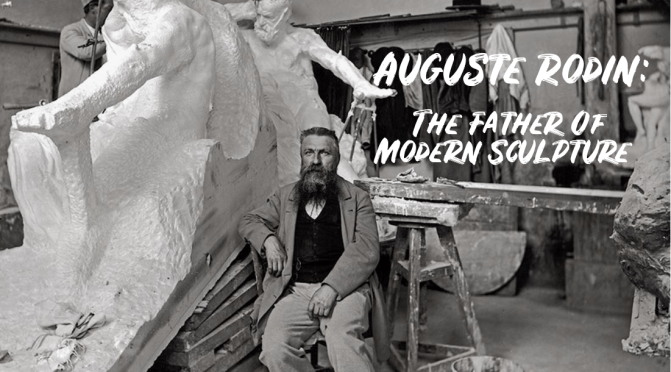

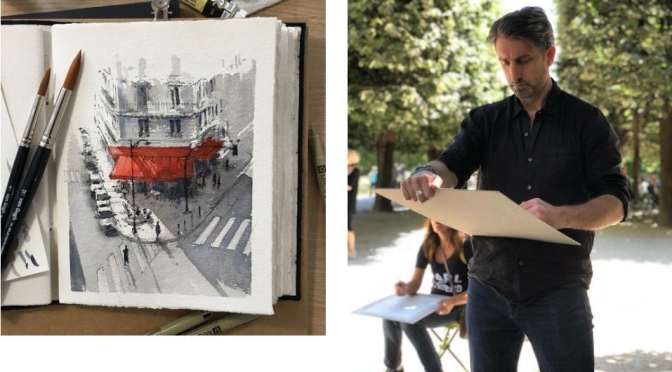
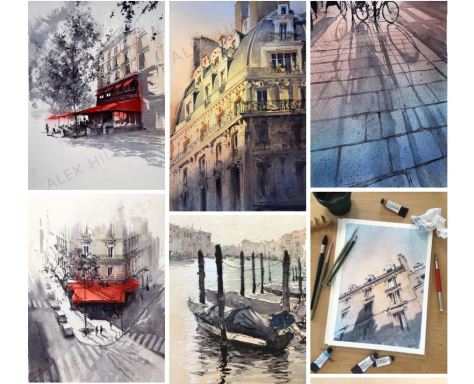 Alex currently lives in Paris with his film editor wife, Tiffany, and enjoys discovering the hidden corners of the city that sketching and plein air painting allow. He uses the language of cinema to inform his images, moving beyond what one sees, and depicting what he wants others to see. He believes that in our too-crowded lives, sketching and plein air painting invite us to move at a more deliberate pace… a true sense of place, and sometimes unexpected stories are revealed.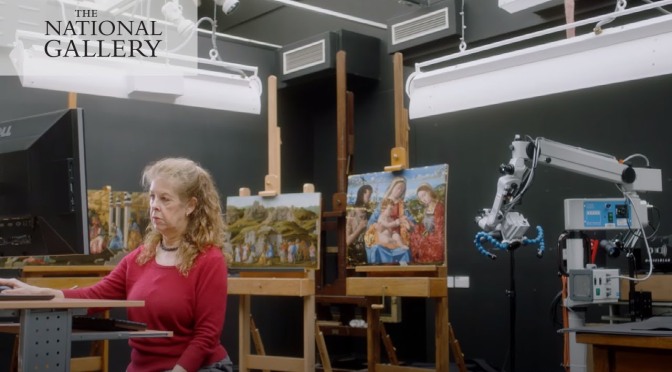


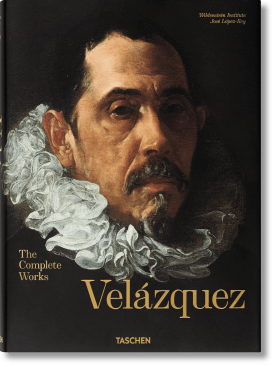 Manet called him “the greatest painter of all.” Picasso was so inspired by his masterpiece Las Meninas that he painted 44 variations of it. Francis Bacon painted a study of his portrait of Pope Innocent X. Monet and Renoir, Corot and Courbet, Degas and Dalí…for so many champions of art history, the ultimate soundboard was—and remains—Diego Rodríguez de Silva y Velázquez (1599-1660).


 Boomers Daily