

Category Archives: Technology
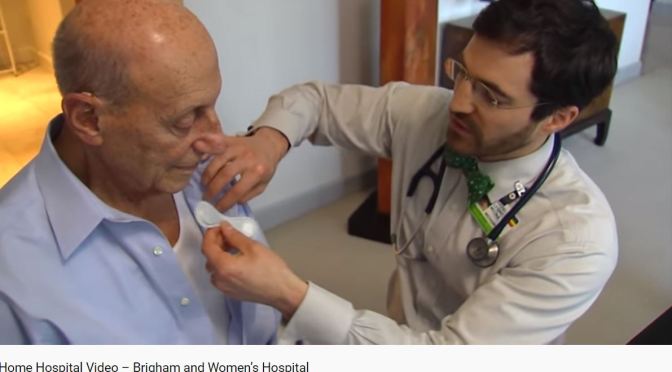
Studies: “Home Hospital” Model Of Care Reduces Costs By 38%, Improves Recovery (Harvard)
From a Harvard Gazette online article:
“This work cements the idea that, for the right patients, we can deliver hospital-level care outside of the four walls of the traditional hospital, and provides more of the data we need to make home hospital care the standard of care in our country,” said corresponding author David Levine, a physician and researcher in the Division of General Internal Medicine and Primary Care.
“It opens up so many exciting possibilities — it’s exciting for patients because it gives them the opportunity to be in a familiar setting, and it’s exciting for clinicians because we get to be with a patient in that person’s own surroundings. As a community-minded hospital, this is a way for us to bring excellent care to our community.”
The home hospital model of care — in which select patients receive hospital-level care for an acute illness from the comfort of their own home instead of in a traditional hospital — has become increasingly popular across the U.S.
To read more: https://news.harvard.edu/gazette/story/2019/12/home-hospital-model-reduces-costs-by-38-improves-care/

Travel: Harbour Air Seaplanes Announces World’s First Commercial Electric Plane Flight
From a Harbour Air Seaplanes online release:
 “Today, we made history,” said Greg McDougall, CEO and founder of Harbour Air Seaplanes. “I am incredibly proud of Harbour Air’s leadership role in re-defining safety and innovation in the aviation and seaplane industry. Canada has long held an iconic role in the history of aviation, and to be part of this incredible world-first milestone is something we can all be really proud of.”
December 10, 2019 – Harbour Air, North America’s largest seaplane airline and magniX, the company powering the electric aviation revolution, today announced the successful flight of the world’s first all-electric commercial aircraft. The successful flight of the ePlane, a six-passenger DHC-2 de Havilland Beaver magnified by a 750-horsepower (560 kW) magni500 propulsion system, took place on the Fraser River at Harbour Air Seaplanes terminal in Richmond (YVR South) this morning. The plane was piloted by Harbour Air CEO and founder Greg McDougall. This historic flight signifies the start of the third era in aviation – the electric age.
To read more: https://www.harbourair.com/harbour-air-and-magnix-announce-successful-flight-of-worlds-first-commercial-electric-airplane/
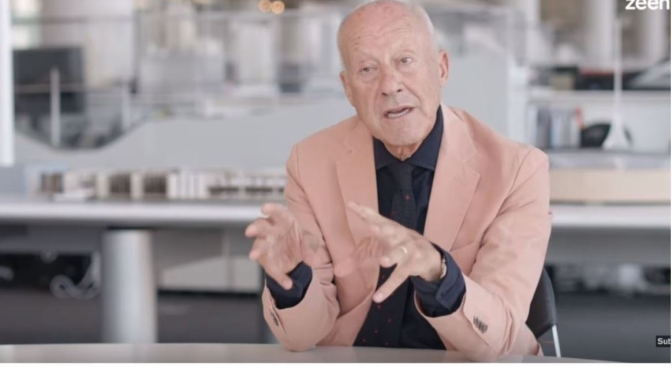
Interviews: 84-Year Old British Architect Norman Foster On His First High-Tech Building (Video)
“High-tech is something to do with the expression of the technology – the means by which the building stands,” the award-winning architect told Dezeen in an exclusive interview at his London practice.
 British architect Norman Foster reflects on his first high-tech building and how it shaped offices to come, in this exclusive video produced by Dezeen. Named after the electronics manufacturer that commissioned the building,
Reliance Controls was an industrial facility located in Swindon in Southwest England. Completed in 1967, the building was the last to be designed by Team 4, an architecture practice comprising Foster, Richard Rogers, Su Brumwell and Wendy Cheesman, before the group disbanded. The single-storey rectangular shed, which was designed to house the company’s factory and offices, was one of the first buildings labelled as high-tech – a style of architecture that Foster defines as a celebration of a building’s functional components.
Reliance Controls was the first building to dissolve the traditional boundaries between factory workers and office workers. “There was only a glass screen that would separate the assembly line for electronics from those who are managing the sales force,” said Foster. “They would all share the same kitchen and dining facilities, the same bathrooms. That we take for granted now but at that time it was it was really revolutionary – unheard of.”
Website: https://www.dezeen.com/2019/12/13/norman-foster-reliance-controls-video-interview/
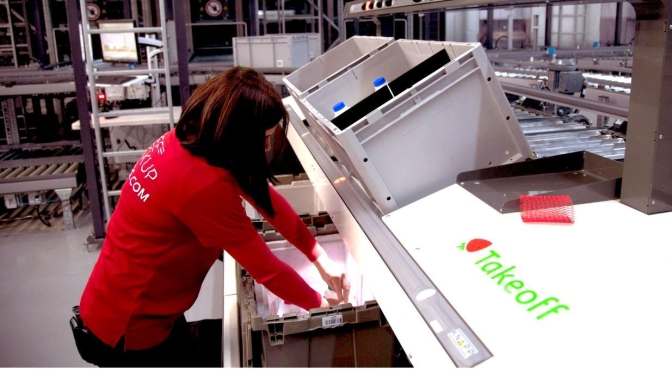
Shopping: Albertsons And Takeoff Technologies Launch EGrocery “Micro-Fulfillment” Centers
From and Albertson Companies online news release:
 “The micro-fulfillment center model is a key element in the store of the future,” said Vivek Sankaran, Albertsons Companies President and Chief Executive Officer. “It combines the efficiency of automation with the ease of meeting customers when and how they want to shop. In working with Takeoff, we can evolve how the MFC ties into our store and e-commerce ecosystems and accelerate our path to best serve our customers.”
December 12, 2019 – Albertsons Companies and Takeoff Technologies are teaming up to collaborate on the future of grocery micro-fulfillment centers (MFC). The two companies have decided to form a strategic partnership with dedicated teams to collaborate on the evolution of the microfulfillment capabilities to drive the future of e-commerce order fulfillment.
 Albertsons Cos., which operates stores in 8 out of 10 of the largest MSA’s in the United States, has also agreed to purchase additional MFCs from Takeoff and is evaluating market expansion opportunities. Albertsons Cos. and Takeoff worked closely together on the successful implementation of the company’s first MFC in South San Francisco in October 2019.
To read more: https://www.albertsonscompanies.com/newsroom/12-12-19-albertsons-companies-takeoff-develop-strategic-partnership.html
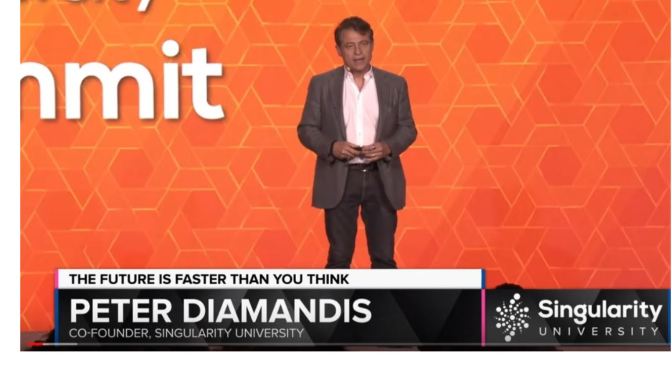
New Tech Books: “The Future Is Faster Than You Think”, Peter H. Diamandis & Steven Kotler (Jan 2020)
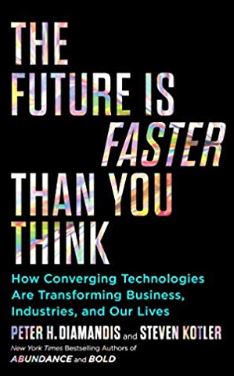 Technology is accelerating far more quickly than anyone could have imagined. During the next decade, we will experience more upheaval and create more wealth than we have in the past hundred years. In this gripping and insightful roadmap to our near future, Diamandis and Kotler investigate how wave after wave of exponentially accelerating technologies will impact both our daily lives and society as a whole. What happens as AI, robotics, virtual reality, digital biology, and sensors crash into 3D printing, blockchain, and global gigabit networks? How will these convergences transform today’s legacy industries? What will happen to the way we raise our kids, govern our nations, and care for our planet?
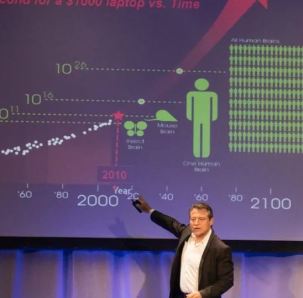 Recently named by Fortune as one of the “World’s 50 Greatest Leaders,” Peter H. Diamandis is the founder and executive chairman of the XPRIZE Foundation, which leads the world in designing and operating large-scale incentive competitions. He is also the executive founder of Singularity University, a graduate-level Silicon Valley institution that counsels the world’s leaders on exponentially growing technologies.
As an entrepreneur, Diamandis has started over 20 companies in the areas of longevity, space, venture capital and education. He is co-founder of BOLD Capital Partners, a venture fund with $250M investing in exponential technologies, and co-founder and Vice
Chairman of Celularity, Inc., a cellular therapeutics company.
Website: https://www.diamandis.com/

Innovations: “ExoLung” Tankless Underwater Diving System (Video)
 Exolung is a new and unique approach to shallow water diving for recreational and utility purposes. It is also enjoyable to use in the pool for training, or as a form of underwater gymnastics and yoga. The idea was to create a simple extension to the usual ABC kit (fins, mask, snorkel), being simple, robust and affordable whilst not requiring a lot of maintenance or care, and absolutely no recharge or refill required.
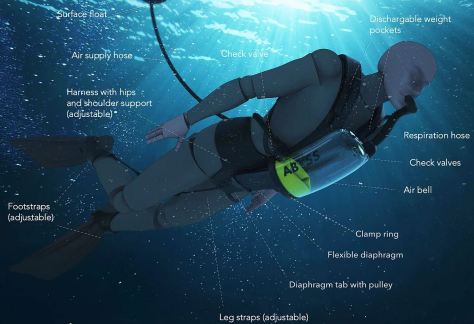
It is lightweight (3,5kg) and compact (40x30x20cm pack size) making it super portable, flexible and functional. There is a high degree of safety, due to the inflatable dive buoy, which the diver is attached to at all times. There is no need for diving certification, though a basic knowledge of compressed air diving is required before use. This can be learned by attending a beginner diving course at your local centre.
Website: https://www.exolung.com/
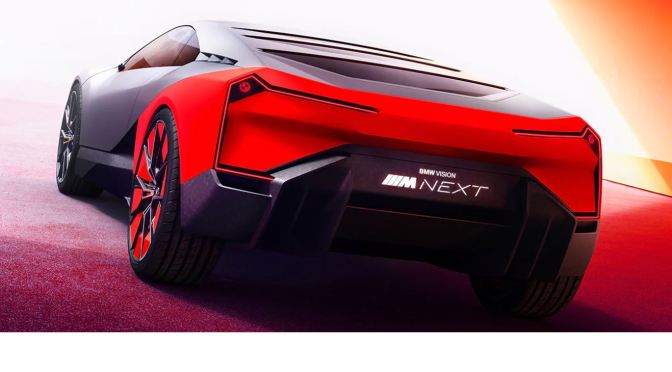
Future Of Mobility: BMW Design Chief Talks About Brand’s “Vision M NEXT” Car Technology (Video)
 ‘we believe in the power of choice,’ begins domagoj dukec. as cars embrace new technologies such as autonomous systems, BMW and their designers are ensuring customers are still offered their own ultimate driving experience. in fact, they are actually integrating technology into the background of their designs, from the powertrains to the adaptable furniture and interior fabrics, creating mobility spaces that adapt to your needs. the innovations are there to help and enhance the experience but are free to the user to choose when, where and how it affects their journey. this power of choice is exemplified by BMW‘s two driving modes and vision cars: EASE and BOOST, and the Vision iNEXT and Vision M NEXT.

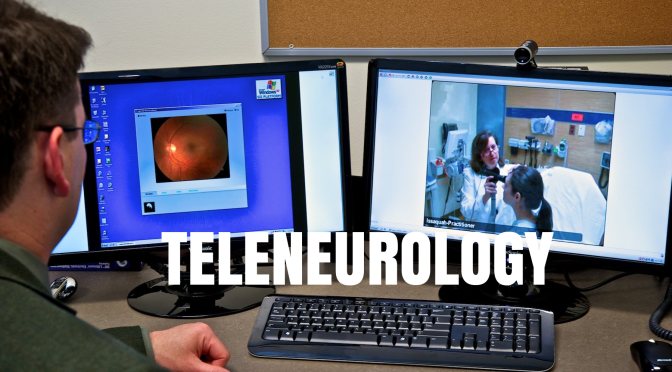
Medical Technology: “TeleNeurology” Remote Consultations Are As Effective As Office Visits
From a Becker’s Hospital Review online release:
 Telemedicine extends care accessibility to people with epilepsy, who may be unable to drive to appointments, as well as people with mobility issues stemming from neurologic disorders such as multiple sclerosis. Virtual care also helps address geographic barriers by allowing patients in rural areas to see a neurologist through telemedicine technology instead of having to travel hours for in-person care, said lead author Jaime Hatcher-Martin, MD, PhD, a member of AAN, according to the news release.

The studies’ analysis found that patients and their caregivers were equally satisfied with virtual physician visits and in-person appointments. Some studies showed that the use of telemedicine is as effective as in-person care to make accurate diagnoses. However, the researchers noted that there have been few randomized, controlled studies on telemedicine for neurology apart from stroke care.

Genetic Engineering: Harvard Scientist George Church Seeks To “Reverse Aging” (60 Minutes Video)
Our lives have been transformed by the information age. But what’s coming next is likely to be more profound, call it the genetic information age. We have mapped the human genome and in just the last few years we have learned to read and write DNA like software. And you’re about to see a few breakthroughs-in-waiting that would transform human health. For a preview of this revolution in evolution we met George Church, a world leading geneticist, whose own DNA harbors many eccentricities and a few genes for genius.
 Boomers Daily