Discover Aix, the ‘Little Paris’ of Provence, the historic region of Beaune, a land of wine and castles. Beautiful Bordeaux and Normandy. The stork villages of Alsace and the pickled-in-the-past, post-card pretty perched town of Saint-Guilhem-le-Desert. Breath-taking Lavender fields in Provence, castles in the air in Dordogne. Exquisite Villefranche-sur-Mer and Nice. Discover what’s new, the best tours, recipes, a language lesson, practical guides and much, much more…
Haunted by the approach of another world war, the beloved fantasy author created a new story of Middle-earth that few people even knew about—until now. BY JOHN GARTH, PHOTOGRAPHS BY KIERAN DODDS
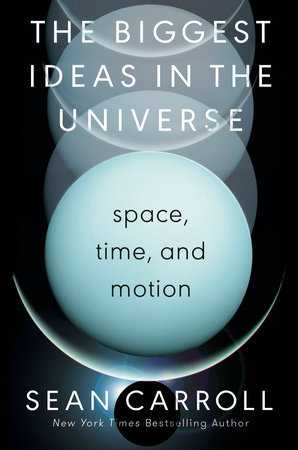
The goal of The Biggest Ideas in the Universe is to bridge the gap between popular-science treatments of modern physics and true expert knowledge. This is the real stuff — equations and all — presented in a way that presumes no prior knowledge other than high-school algebra. Readers will come up to speed about exactly what professional physicists are talking about, with an emphasis on established knowledge rather than speculation.
Volume One, Space, Time, and Motion, covers the domain of classical physics, from Newton to Einstein. We get introduced to Spherical Cow Philosophy, in which complications are stripped away to reveal the essence of a system, and the Laplacian Paradigm, in which the laws of physics take us from initial conditions into the future by marching through time. We learn the basic ideas of calculus, where we can calculate rates of change and how much of a quantity has accumulated. We think about the nature of space and time, separately and together. Finally we are introduced to the mysteries of non-Riemannian geometry and Einstein’s theory of curved spacetime, culminating into a dive into black holes.
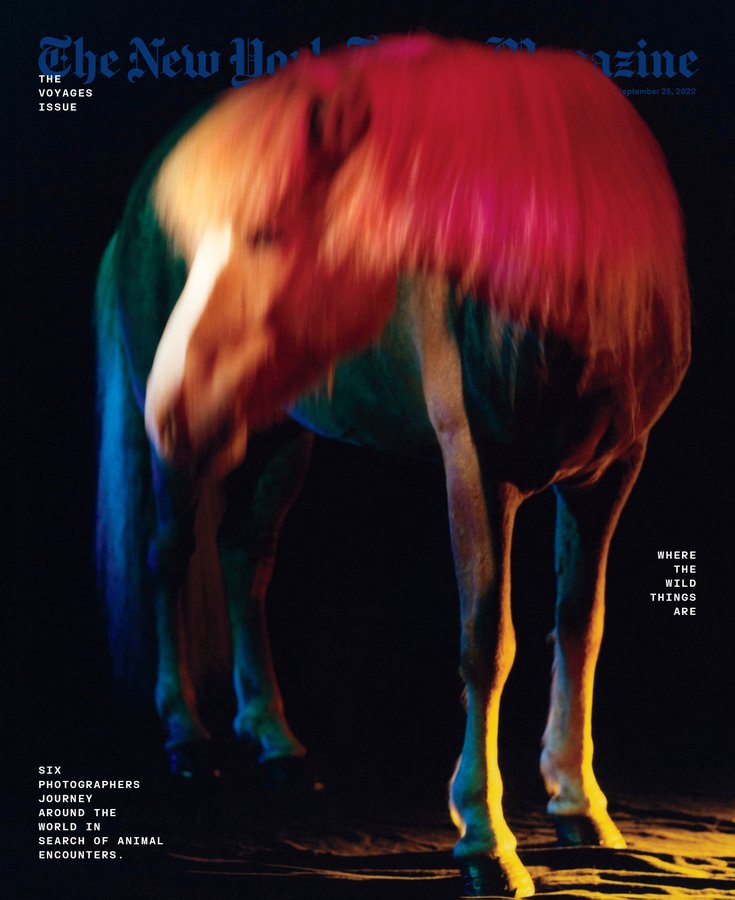
Horses that resemble My Little Ponies (but on Mars). Caimans that eat pythons. Monkeys that live alongside these caimans. High-fiving raccoons. Searching for a snow leopard. Six photographers. Six stories of animal encounters.
The World Archaeology October 2022 issue explores the secrets of Japan’s stone circles, the lost prehistoric cities of Bolivia, women’s everyday lives in the Ice Age, an idyllic alpine region that saw fierce fighting during the First World War, and much more.
The stone circles of Japan are enigmatic monuments. These structures were created by Jomon hunter-gatherers, mostly from roughly 2500-300 BC, and can be associated with burials, seasonal ceremonies, and solar alignments. Such preoccupations are far from being restricted to Jomon Japan, with study of these circles proving influential when it came to early 20th-century attempts to understand Stonehenge. In our cover feature, we take a detailed look at some of the Jomon stone circles, examining both the monuments themselves, and wider activity in the period.
A family tree of sea cows suggests that the dugong traversed an ocean to reach its present habitat.
Builder drones
Ground-based robots have potential for helping in the construction industry, but they are limited by their height. In this week’s issue, Mirko Kovac, Robert Stuart-Smith and their colleagues introduce highly manoeuvrable aerial robots that can perform additive 3D construction tasks. Inspired by natural builders such as wasps and bees, the researchers created BuilDrones (as shown on the cover) that can work in an autonomous team to perform 3D printing tasks using foam- or cement-based materials. They also created ScanDrones to assess the quality of the structures
being built. The team hopes that this approach of ‘aerial additive manufacturing’ could help to build structures in difficult to access areas.
News, Views and Reviews For The Intellectually Curious






/https://tf-cmsv2-smithsonianmag-media.s3.amazonaws.com/filer_public/77/b2/77b26047-7784-4bc6-bf89-29de6b3bc7e7/oct22_web_cover.jpg)












 Boomers Daily