
Category Archives: History

Heritage: WWII Concrete Bunkers, Western France

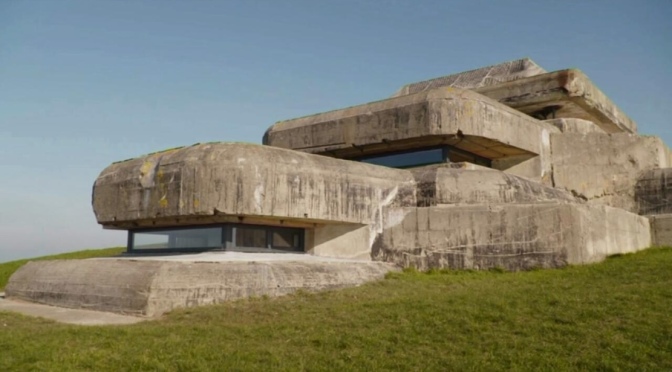
FRANCE 24 English (April 3, 2023) – Eight decades after World War II, the Atlantic Wall is still breaking up. Along the coast of Brittany, in western France, lie more than 1,000 bunkers. Most of these vestiges of German occupation are abandoned, but some have been given a new lease of life.

The submarine base of Lorient has become an ideal location for manufacturing carbon masts for yachts. Further west, on the tip of Finistère, a bunker has been transformed into a museum on the war.

Finally, on the Crozon peninsula, a young entrepreneur has decided to transform a network of tunnels built by the Allies into a brewery.

Preview: Archaeology Magazine – May/June 2023

Image

Archaeology Magazine (May/June 2023):

Roman Ruins Uncovered at England’s Exeter Cathedral

(BBC News reports that traces of a Roman street and timber buildings were uncovered in southwest England at the site of the cloister garden at Exeter Cathedral during an investigation ahead of the construction of a new cloister gallery.

England Exeter Cathedral

The Shaman’s Secrets

Germany Mesolithic Shaman Bone Headdress

An impressive selection of grave goods including roe deer antlers (top) that could have been worn as a headdress and boars’ teeth (middle) and tusks (above) with holes drilled in them enabling them to be suspended from an animal skin were found in a 9,000-year-old shaman’s burial.

Bad Dürrenberg is a modest spa town in eastern Germany, perched on a bluff overlooking the Saale River. On a Friday afternoon in 1934, workers were laying pipe to supply the spa’s fountain with water when they came across red-tinted earth. 

(Photographs Juraj Lipták)

Fine Art: The Burlington Magazine – April 2023

April 2023, #1441 – Vol 165 | Current issue | Current issue − The  Burlington Magazine

The Burlington Magazine – April 2023: Few paintings capture the exhilaration of the arrival of spring as powerfully as Vincent van Gogh’s ‘Orchard in blossom, bordered by cypresses’, a detail of which is on the cover of our newly published April issue.

Process: Design Drawings from the Rijksmuseum 1500–1900

The manifold collections of the Rijksmuseum, Amsterdam, include rich holdings of the decorative arts, international in scope, with a natural bias towards the Netherlands. But unlike the Victoria and Albert Museum, London, the Museum für angewandte Kunst, Vienna, and the Musée des Arts Décoratifs, Paris, products of the nineteenth-century campaign to improve design, the Rijksmuseum, a national museum of art and history, had no strong motive to collect design drawings (although the Rijksprentenkabinet, housed in the museum, contains one of the world’s great assemblages of engraved ornament).

Politics versus archaeology in Paris

An air of anticipation has greeted the fourth anniversary of the fire that broke out on 15th April 2019 and destroyed the medieval roof of Notre-Dame, Paris, together with its flèche, designed by Eugène Viollet-le-Duc in 1859. The main controversies surrounding the restoration having been settled – as reported in this Magazine, in July 2020 the French government announced that the roof and flèche will be rebuilt as they were, using the same materials as the original – attention has turned to the discoveries being made and to the restoration process.

‘Abyss Of Time’: How James Hutton Founded Geology & ‘Earth’s Age’ In Scotland

BBC News (March 26, 2023) – In the 1700s, geologist James Hutton discovered a rock formation in Scotland that transformed how we think about time. Through studying the rocky headland of Siccar Point, Hutton identified the existence of ‘deep time’ – proving that Earth is millions, not thousands, of years old.

James Hutton (1726–1797), a Scottish farmer and naturalist, is known as the founder of modern geology. He was a great observer of the world around him. More importantly, he made carefully reasoned geological arguments. Hutton came to believe that the Earth was perpetually being formed; for example, molten material is forced up into mountains, eroded, and then eroded sediments are washed away.

He recognized that the history of the Earth could be determined by understanding how processes such as erosion and sedimentation work in the present day. His ideas and approach to studying the Earth established geology as a proper science.

Spring 2023: Jacarandas Blooming In Mexico City

March 26, 2023: For nearly 100 years, Mexico City residents have enjoyed jacaranda season: a “fascinating sorcery” that brings a little bit of the Amazon rainforest to urbanites’ doorstep, as Alberto Ruy Sánchez wrote in his 2019 book “Dicen las Jacarandas.” And when the flowers fall, “the sky blooms on the ground,” an unexpected burst of color at one’s feet.

Skyscraper Architecture: New York City’s Top Styles

Architectural Digest (March 24, 2023) – Michael Wyetzner of Michielli + Wyetzner Architects returns to AD, this time breaking down five of the most common skyscraper styles dotting the New York City skyline. From set back ‘wedding cakes’ to the supertall buildings of the future, Michael gives expert insight on the different skyscraper styles that coalesce into one unforgettable view.

Preview: History Today Magazine – April 2023

Image

HISTORY TODAY MAGAZINE – APRIL 2023 ISSUE

The First Folio

Shakespeare’s First Folio in the library of Durham University, 1950s.

The stage has a short memory, print a long one: 400 years since its first publication, Shakespeare’s First Folio is the reason we remember him.

American Moppets

 Teleradiola "Belarus-5" in an ordinary Soviet house.
 ‘The ‘Belarus-5’ in an ordinary Soviet house,’ photographed in the 1960s. 

Americanised globalisation and the new world of Russian business in the 1990s.

In the 1990s, a version of the satirical puppet show Spitting Image arrived on Russian television. A Muscovite once told the story of his father, who took great care to record every episode on VHS.

Culture/History: The Many Lives Of Abbeys In France

FRANCE 24 (March 21, 2023) – Once important seats of Christian worship, and now treasures of the country’s heritage, French abbeys often have surprising histories. That’s the case of Fontevraud abbey, in the former duchy of Anjou. Run by a woman during its heyday, the abbey was turned into a prison after the French Revolution.

In Alsace, the abbey of Mont Sainte-Odile is famous for its supposedly miraculous spring water. Finally, on the outskirts of Montpellier, Valmagne abbey used to be a wine cellar. Visitors can still observe the gigantic barrels that were once used to store thousands of litres of wine.

Previews: BBC History Magazine – April 2023

HIS_293_April Cover rgb

BBC HISTORY MAGAZINE – APRIL 2023:

The kingdom is dead: what causes monarchies to fail?

King Alfonso XIII of Spain, Charles I of England, Puyi of China and Lydia Liliuokalani of Hawaii

From the Romans to the Russians, monarchies that at one time seemed all powerful have come crashing down as a result of violence, political manoeuvring or the will of the people. Danny Bird charts the downfall of 10 kingdoms and empires throughout history

How much do you know about the Crimean War?

Soldiers in the Crimean War

How much do you know about the Crimean War? Test your knowledge with this quiz on the Victorian conflict…

Tours: The Lighthouse Of Chania, Island Of Crete

Smithsonian Channel (March 16, 2023) – No one is allowed up the historic Chania lighthouse anymore which, for hundreds of years, had guided sailors along the coast. But historian Bettany Hughes has special permission–and she’s taking us with her.

The original Venetian lighthouse was built around the late 16th century to protect the harbour. A chain could be connected from the base of the lighthouse to the fortress of Firkas in oder to close the harbour.

During the Turkish occupation the lighthouse fell into disrepair and was eventually rebuilt between 1824 and 1832 in the form of a minaret. The modern lighthouse is often referred to as ‘ Egyptian’ because it was built during a time where Crete was occupied by Egyptian troops who were supporting the weakening Ottoman Empire against the rebelious Cretans.