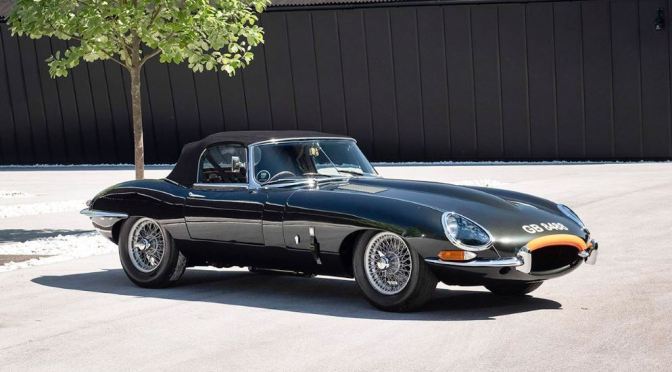
‘Project ZP’ proved the Jaguar E-type was as fast as it looked.
Although the response to the E-type was frenzied, Jaguar knew that more than a pretty face was required to secure the model’s future. Under the veil of ‘Project ZP’, seven of the earliest E-types were transformed into racers. And this particular car stands today as the best of the bunch…
The Rolling Stones perform “You Can’t Always Get What You Want” during One World: Together At Home on April 18.
Global Citizen is a social action platform for a global generation that aims to solve the world’s biggest challenges. On our platform, you can learn about issues, take action on what matters most, and join a community committed to social change. We believe we can end extreme poverty because of the collective actions of Global Citizens across the world.
“Astonishing” is the word we are looking to describe this BMW 507. A word we use a lot if it comes to selling classic cars, but only a little few deserve this ‘title’ like this 507 does. When an exceptional model, with an unique story, from what the historical documents are well archieved, it just makes us going crazy. Add matching numbers and -colors tot his list and we are losing it totally. That’s no different with this 507.
Max Hoffman convinced BMW that if they built a competitor to the Mercedes-Benz 300SL, he would sell it profitable in the United States. The BMW was intended to fill the gap between the affordable sports cars like the triumph and MG and the exclusive cars like the Mercedes-Benz 300SL and Ferrari 250 GT California. Though, BMW couldn’t achieve their target price, for what the BMW 507 was even more expensive than the 300SL. BMW found itself in a financial difficult situation and almost went bankrupt. At the end of the day, BMW recovered from this “failure” and the 507 even became a true flagship in the whole history of automotive.
In the ‘50s BMW disposed over all fundamental ingredients which would make the 507 complete. An all-aluminium 3.2-litre V8 engine was placed in a shortened chassis of the 502. This ingenious masterpiece produced no less than 150hp and sounds like a guitar solo in your ears. To save weigt, the body was made of aluminium, which results in a 1280kg’s for a fully finished 507. Besides the phenomenal results, BMW wanted to offer luxury as well. Both aspects are just spot on.
The Amphicar Model 770 is an amphibious automobile, launched at the 1961 New York Auto Show, manufactured in West Germany and marketed from 1961 to 1968. Production stopped in 1965.
Designed by Hans Trippel, the amphibious vehicle was manufactured by the Quandt Group at Lübeck and at Berlin-Borsigwalde, with a total of 3,878 manufactured in a single generation.
A descendant of the Volkswagen Schwimmwagen,[4] the Amphicar offered only modest performance compared to most contemporary boats or cars, featured navigation lights and flag as mandated by the US Coast Guard — and after operation in water, required greasing at 13 points, one of which required removal of the rear seat.
MAD Magazine and DC Comics mourn the loss of Mort Drucker, whose artwork proved that parody is the sincerest form of flattery. “Mort was one of the best—maybe the best—caricature artists in the world,” said DC Chief Creative Officer and Publisher Jim Lee. “His work will continue to entertain for generations.”
Mort entered the comics field when he was 18, working as a production artist for DC. His first original piece of art was a one-pager titled “Tinker Tom Shows You How to Make Fancy Western Duds,” published in All-American Western #117 in December 1950. In 1956, Mort met with MAD publisher Bill Gaines during a Dodgers vs. Yankees World Series game. “If the Dodgers win, you’re hired,” said Gaines. They did win, and Mort began a career at MAD that would span the next five decades, and most notably brought to life the magazine’s infamous parodies of TV shows and films.
Mort won numerous awards and honors for his work, including the Reuben Award for Outstanding Cartoonist of the Year in 1987. He was inducted into the Will Eisner Hall of Fame in 2011, and in 2015 became the inaugural recipient of the National Cartoonists Society’s Medal of Honor. He received an honorary Doctorate in Fine Arts from the Art Institute of Boston, and his TIME Magazine covers hang in the National Portrait Gallery.
The first three chapters of Ernest Hemingway’s classic novel.
For Whom the Bell Tolls is a novel by Ernest Hemingway published in 1940. It tells the story of Robert Jordan, a young American volunteer attached to a Republican guerrilla unit during the Spanish Civil War. As a dynamiter, he is assigned to blow up a bridge during an attack on the city of Segovia.
It was published just after the end of the Spanish Civil War (1936–1939), whose general lines were well known at the time. It assumes the reader knows that the war was between a democratically elected, pro-working-class and anti-Catholic government, supported by the Soviet Union, which many foreigners like Robert went to Spain to help, and a successful, dictatorial, Catholic, pro-landowner revolt, supported by Nazi Germany and Fascist Italy. It was commonly viewed as the dress rehearsal for the Second World War. In 1940, the year the book was published, the United States had not yet entered the war, which had begun on Sept. 1, 1939, with Nazi Germany’s invasion of Poland.
The novel is regarded as one of Hemingway’s best works, along with The Sun Also Rises, A Farewell to Arms, and The Old Man and the Sea.
Ernest Miller Hemingway (July 21, 1899 – July 2, 1961) was an American journalist, novelist, short-story writer, and sportsman. His economical and understated style—which he termed the iceberg theory—had a strong influence on 20th-century fiction, while his adventurous lifestyle and his public image brought him admiration from later generations. Hemingway produced most of his work between the mid-1920s and the mid-1950s, and he won the Nobel Prize in Literature in 1954. He published seven novels, six short-story collections, and two nonfiction works. Three of his novels, four short-story collections, and three nonfiction works were published posthumously. Many of his works are considered classics of American literature.
In this report first broadcast on August 19, 2007, thirty years after the death of comedian Groucho Marx, “Sunday Morning” host Charles Osgood looks back at the life of the ringleader of the Marx Brothers, who starred in such classics as “Animal Crackers,” “Duck Soup” and “A Night at the Opera.”
Osgood speaks with Marx Brothers fans Elliott Gould, David Steinberg, Frank Ferrante (who played Groucho on stage), Washington Post columnist Harold Meyerson, and Charlotte Chandler, author of the book “Hello, I Must Be Going: Groucho and His Friends.”
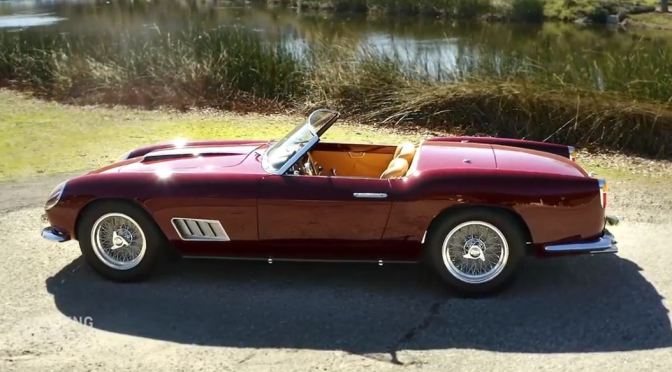
Join President David Gooding as he takes one of the all-time great Ferraris out on the open road. After successfully completing multiple editions of the California Mile and Colorado Grand and taking home top prizes from Cavallino Classic and Pebble Beach Concours d’Elegance®, the quality and beauty of 0937 GT is undeniable.
This outstanding covered headlight example will be offered at The Amelia Island 2020 auction with the ultra-rare factory hardtop.
The Oldsmobile 88 (marketed from 1989 on as the Eighty Eight) is a full-size car that was sold and produced by Oldsmobile from 1949 until 1999. From 1950 to 1974 the 88 was the division’s top-selling line, particularly the entry-level models such as the 88 and Dynamic 88. The 88 series was also an image leader for Oldsmobile, particularly in the early years (1949–51) when it was one of the best performing automobiles thanks to its relatively small size, light weight and advanced overhead-valve high-compression V8 engine. This engine, originally designed for the larger C-bodied and more luxurious 98 series, also replaced the straight-8 on the smaller B-bodied 78. With the large, high performance V8, the Oldsmobile 88 is widely considered to be the first muscle car, although this title is disputed.
In 1950, Oldsmobile offered a modified Cadillac manual gearbox for V8 models. The 88 now outsold the six-cylinder 76 lineup, which was dropped entirely after the 1950 model year. It had a 40 ft. turning circle. The 1950 model won the 1950 Carrera
A large number of variations in nomenclature were seen over this long model run — Futuramic, Super, Golden Rocket, Dynamic, Jetstar, Delta, Delmont, Starfire, Holiday, L/S, LSS, Celebrity, and Royale were used at various times with the 88 badge, and Fiesta appeared on some station wagons in the 1950s and 1960s. The name was more commonly shown as numbers in the earlier years (“Delta 88”, for example) and was changed to spell out “Eighty Eight” starting in 1989.
The Alfa Romeo GTA is a coupé automobile manufactured by the Italian manufacturer Alfa Romeo from 1965 to 1971. It was made for racing (Corsa) and road use (Stradale).
In 1962, the successor for the very popular Giulietta series was introduced. This car was the Alfa Romeo Giulia, internally called the “Series 105”. The coupé of the 105 series, used the shortened floorpan from the Giulia Berlina and was designed by Bertone. The name of the car evolved from Giulia Sprint GT to Giulia Sprint and to GTJ (Junior) and GTV (Veloce) in the late 1960s.


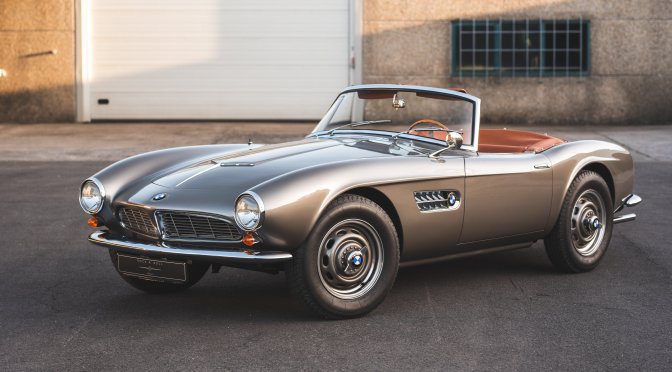
 “Astonishing” is the word we are looking to describe this BMW 507. A word we use a lot if it comes to selling classic cars, but only a little few deserve this ‘title’ like this 507 does. When an exceptional model, with an unique story, from what the historical documents are well archieved, it just makes us going crazy. Add matching numbers and -colors tot his list and we are losing it totally. That’s no different with this 507.
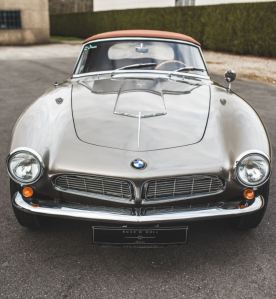 Max Hoffman convinced BMW that if they built a competitor to the Mercedes-Benz 300SL, he would sell it profitable in the United States. The BMW was intended to fill the gap between the affordable sports cars like the triumph and MG and the exclusive cars like the Mercedes-Benz 300SL and Ferrari 250 GT California. Though, BMW couldn’t achieve their target price, for what the BMW 507 was even more expensive than the 300SL. BMW found itself in a financial difficult situation and almost went bankrupt. At the end of the day, BMW recovered from this “failure” and the 507 even became a true flagship in the whole history of automotive.
 In the ‘50s BMW disposed over all fundamental ingredients which would make the 507 complete. An all-aluminium 3.2-litre V8 engine was placed in a shortened chassis of the 502. This ingenious masterpiece produced no less than 150hp and sounds like a guitar solo in your ears. To save weigt, the body was made of aluminium, which results in a 1280kg’s for a fully finished 507. Besides the phenomenal results, BMW wanted to offer luxury as well. Both aspects are just spot on.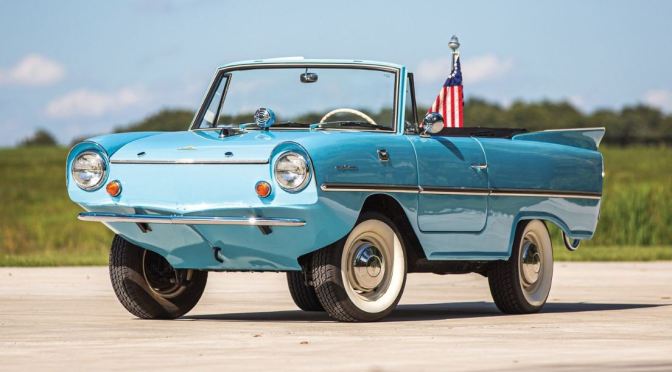
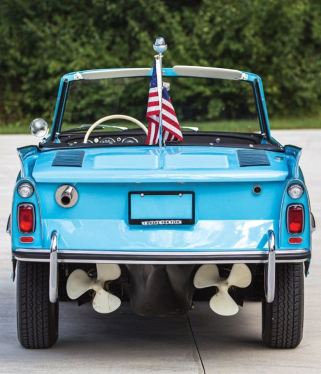 The Amphicar Model 770 is an amphibious automobile, launched at the 1961 New York Auto Show, manufactured in West Germany and marketed from 1961 to 1968. Production stopped in 1965.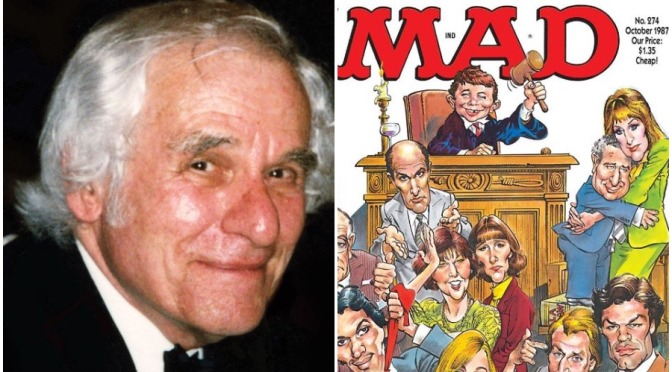
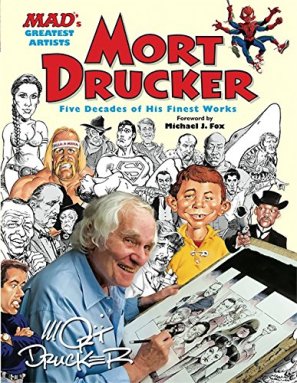 MAD Magazine and DC Comics mourn the loss of Mort Drucker, whose artwork proved that parody is the sincerest form of flattery. “Mort was one of the best—maybe the best—caricature artists in the world,” said DC Chief Creative Officer and Publisher Jim Lee. “His work will continue to entertain for generations.”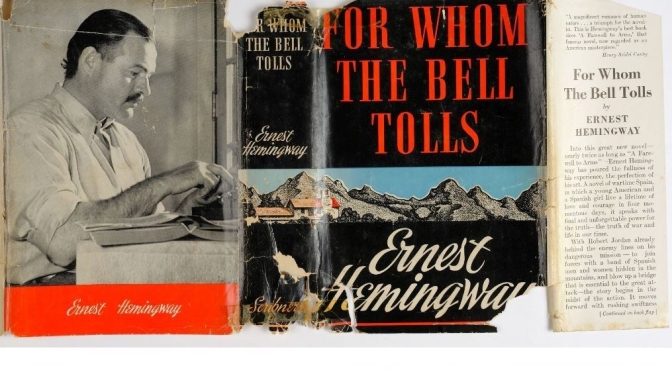


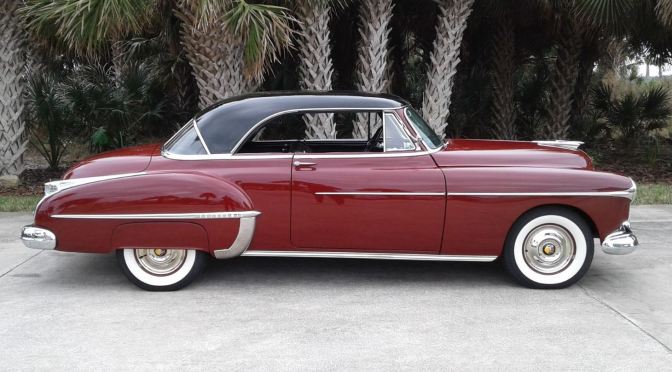
 The Oldsmobile 88 (marketed from 1989 on as the Eighty Eight) is a full-size car that was sold and produced by Oldsmobile from 1949 until 1999. From 1950 to 1974 the 88 was the division’s top-selling line, particularly the entry-level models such as the 88 and Dynamic 88. The 88 series was also an image leader for Oldsmobile, particularly in the early years (1949–51) when it was one of the best performing automobiles thanks to its relatively small size, light weight and advanced overhead-valve high-compression V8 engine. This engine, originally designed for the larger C-bodied and more luxurious 98 series, also replaced the straight-8 on the smaller B-bodied
  A large number of variations in nomenclature were seen over this long model run — Futuramic, Super, Golden Rocket, Dynamic, Jetstar, Delta, Delmont, Starfire, Holiday, L/S, LSS, Celebrity, and Royale were used at various times with the 88 badge, and Fiesta appeared on some station wagons in the 1950s and 1960s. The name was more commonly shown as numbers in the earlier years (“Delta 88”, for example) and was changed to spell out “Eighty Eight” starting in 1989.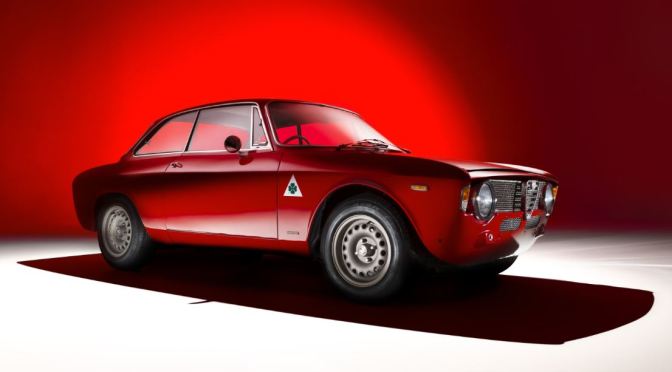
 The Alfa Romeo GTA is a coupé automobile manufactured by the Italian manufacturer Alfa Romeo from 1965 to 1971. It was made for racing (Corsa) and road use (Stradale).
 Boomers Daily