

All posts by She Seeks Serene

Health Studies: “Head and Neck Injuries Associated With Cell Phone Use”
From a
 Cell phone–related injuries to the head and neck have increased steeply over the recent 20-year period, with many cases resulting from distraction. Although the disposition of most cases is simple, some injuries bear a risk of long-term complications. Many of these injuries occurred among those aged 13 to 29 years and were associated with common activities, such as texting while walking. These findings suggest a need for patient education about injury prevention and the dangers of activity while using these devices.
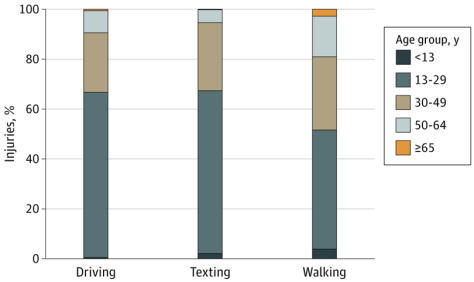
Since their invention, cell phones have played a major role in the daily lives of American adults. Approximately 96% of Americans own a cell phone, provoking interest in their role in causing injury. Given that head and neck traumas make up approximately 5% of emergency department (ED) visits in the United States, cell phone use in relation to such injuries could be of public health concern, in particular because of the psychological and financial burdens such injuries may entail. In addition, knowledge of the mechanism of injury is vital for patient risk stratification and trauma management,and understanding the mechanisms of common cell phone–related injuries can aid health care professionals in assessing patient needs. Health care professionals and public safety officials also must be aware of the epidemiologic nature of such injuries in order to provide adequate counseling and give input for legislation to protect the population.

Classic American Cars: “1957 Ford Thunderbird”
 Ford Thunderbird (colloquially called the T-Bird) is a nameplate that was used by Ford from model years 1955 to 1997 and 2002 to 2005 over eleven model generations. Introduced as a two-seat convertible, the Thunderbird was produced in a number of body configurations through its production life, including four-seat hardtop coupe, four-seat convertible, five-seat convertible and hardtop, four-door pillared hardtop sedan, six-passenger hardtop coupe, and five passenger pillared coupe, with the final generation produced as a two-seat convertible.
The Ford Thunderbird began life in February 1953 in direct response to Chevrolet’s new sports car, the Corvette, which was publicly unveiled in prototype form just a month before. Under rapid development, the Thunderbird went from idea to prototype in about a year, being unveiled to the public at the Detroit Auto Show on February 20, 1954. It was a two-seat design available with a detachable glass-fibre hard top and a folding fabric top.
 The Thunderbird was revised for 1957 with a reshaped front bumper, a larger grille and tailfins, and larger tail lamps. The instrument panel was heavily re-styled with round gauges in a single pod, and the rear of the car was lengthened, allowing the spare tire to be positioned back in the trunk. The 312 cu in (5.1 L) V8 became the Thunderbird’s standard engine, and now produced 245 horsepower (183 kW). Other, even more powerful versions of the 312 cu in (5.1 L) V8 were available including one with two four-barrel Holley carburetors and another with a Paxton supercharger delivering 300 horsepower (220 kW). Though Ford was pleased to see sales of the Thunderbird rise to a record-breaking 21,380 units for 1957, company executives felt the car could do even better, leading to a substantial redesign of the car for 1958.
From Wikipedia

Top New Travel Videos: “Oregon’s Secret Coast”
Filmed and Edited by: Shawn Reeder
Oregon’s Coast is known throughout the world for its majestic rocky coastline, secluded beaches, forested sea stacks and magical vibe. Yet tucked away in the far southern reaches lies a particularly beautiful almost hidden gem, Oregon’s Secret Coast. A little over 2 years ago I made my first trip and instantly fell in love. It kind of reminds me of a mix between Big Sur and New Zealand, two of my favorite meetings of land and ocean.

That trip started a love affair that has had me return 5 times in the last two years, each time getting to know the magic of this land better while also getting to know myself better. There’s something about time by the ocean that is very introspective for me, and always has gems of insight that I discover like hidden treasures.
Fine Arts: “Metropolitan Museum Of Art” 150th Anniversary (1870 – 2020)
 Watch Episode 1, “Looking back to look forward,” in which Met image archivist Stephanie Post, educator and former-Project Runway host Tim Gunn, and New York City Ballet dancer Silas Farley share how their encounters with history and the Museum inform their sense of self and their creative practices.
As part of The Met’s 150th anniversary, Met Stories is a new video series and year-long social media initiative that shares unexpected and compelling stories gathered from the many people who visit The Met, whether artists, teachers, curators, actors, museum staff, designers, thought-leaders, or public figures.

Politics: Mark Shields And David Brooks Discuss Latest In Washington (PBS)
Syndicated columnist Mark Shields and New York Times columnist David Brooks join Amna Nawaz to discuss the week in politics, including how the Trump administration and Congress have handled conflict with Iran, indications House Speaker Nancy Pelosi is preparing to send articles of impeachment to the Senate for a trial of the president and what all the tumult means for 2020 Democrats.

Camper Trailers: Easy Caravaning’s “TakeOff” Opens In 30 Seconds
From a New Atlas online article:
The TakeOff interior houses two rows of furniture running down the sides of a center aisle. The front dinette includes benches on either side of an adjustable table, converting to an 63 x 81-in (160 x 205-cm) oversized queen bed at night. The versatile, multi-position lounge can be set up in several configurations, including an optional eight-seat dinette and a shortened bed with rear dining nook.

Pop-up tent campers are an age-old way of enjoying a light, aerodynamic tow and roomy base camp. They’re not always as quick or easy to set up as the term “pop-up” suggests, however. The new TakeOff from Dutch startup Easy Caravanning follows through on the pop-up trailer’s implied promise of quickness. A sort of pop-up camper van roof on wheels, the TakeOff rides low and light and sets up in about half a minute, making it perfect for a quick lunch break on the way to camp, as well as a cozy extended camping holiday.

Wine: Remembering Georges Duboeuf, “King Of Beaujolais” (1933-2020)
From a Food and Wine online article:
 But it’s Beaujolais Nouveau that he is most famous for, the annual celebration, on the third Thursday of November, of the first red wine to be released from the region. It’s a tradition that dates back to the 19th century, but his efforts played a definitive role in making it the international celebration it is today, so much so that he was known as the “king of Beaujolais.” Over the years, Les Vins Georges Duboeuf has expanded their Beaujolais Nouveau offerings to include a rosé and a Beaujolais-Villages Nouveau (which was particularly lovely this past year, and is still drinking beautifully).
 There are a handful of names in the world of wine that have broken through the barriers of the business and come to signify an entire region, or style or more elementally, the deeply felt joy that drinking it evokes. Georges Duboeuf, who passed away on January 4, at home in Romanèche-Thorins, managed to achieve all three—and then some.
Design: The History Behind “Two-Up, Two-Down” London Row Houses
From a CityLab online article:
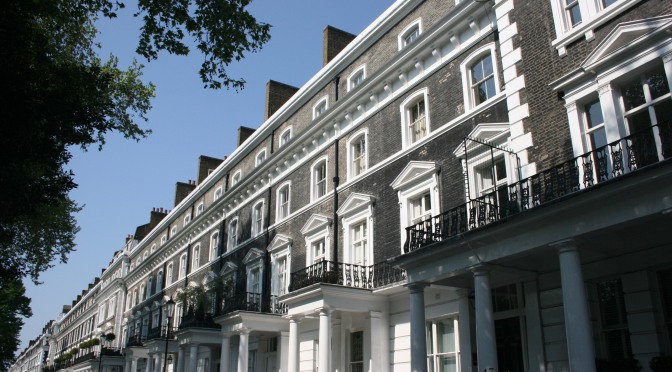
From the outside, London’s row houses have an eclectic variety of ornament, and they range in scale from palatial to boxy. But inside, they are pretty much all configured the same way. That’s because from the late 17th century up until the First World War, most residential buildings here cleaved very close to a model found across English cities: the terraced house, known in its most condensed, emblematic form as the “two-up, two-down.”
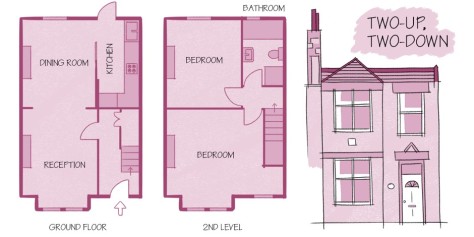
For a city that’s long been the repository of vast commercial, imperial, and industrial wealth, this might seem a very modest template. However, it is one that can be easily scaled up, points out Edward Denison, associate professor at the Bartlett School of Architecture and author of The Life of the British Home: An Architectural History.
“What’s extraordinary, in London in particular, is that you can find very grand houses in places such as Carlton House Terrace, with vast rooms and very high ceilings, that are still essentially two-up, two-downs with extra floors added,” says Denison. “Then you go to working-class terraced housing in places like Greenwich, and find a very different scale and quality of fittings, but essentially the same configuration.

Health: “Digestion And The Brain” (Harvard Podcast)
Most of the time your digestive tract toils silently in the background, routinely taking in nourishment and expelling waste. But here’s a key takeaway: Your brain is a critical part of maintaining this smoothly running system.
Here to explain is Harvard professor Dr. Lawrence S. Friedman, faculty editor the special health report Sensitive Gut.
 Boomers Daily