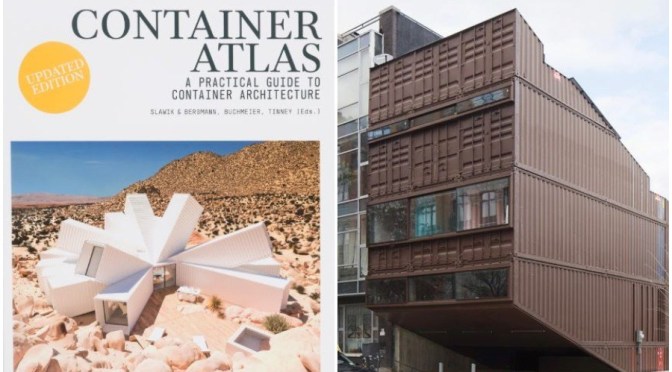
Container Atlas seeks out luxurious remote hideaways, urban dwellings, community centers, and more, all showing how the humble container can put the fab into pre-fab.
Container architecture has become an essential part of our twenty-first century surroundings, with it being used to create modular structures for pavilions, brand showrooms, retail premises, and even residential homes. Ten years after the first publication of Container Atlas, this eagerly anticipated follow-up charts how this movement has evolved into an essential part of today’s architectural vocabulary. Container Atlas serves as a practical and inspirational reference not only for architects and engineers, but also for all creatives eager to learn about the rich and diverse language of container architecture and modular building.
Architect and Professor Han Slawik and his team have established themselves as international experts in the field of container architecture. He is the author of the first edition of Container Atlas and has returned to the subject with refreshed insights into this burgeoning movement.
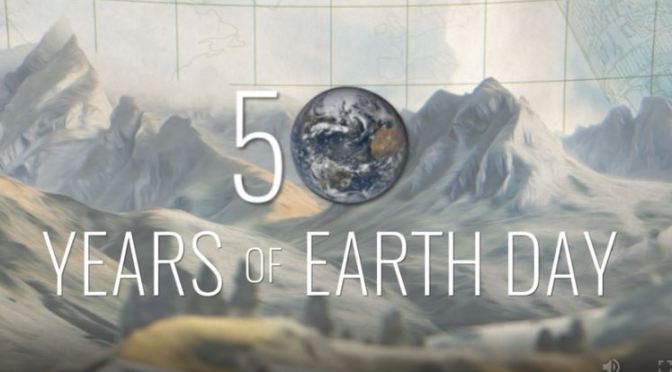
It’s been five decades since Apollo 8 astronaut William Anders photographed Earth peaking over the Moon’s horizon. The iconic image, dubbed Earthrise, inspired a new appreciation of the fragility of our place in the universe. Two years later, Earth Day was born to honor our home planet. As the world prepares to commemorate the 50th anniversary of Earth Day, NASA reflects on how the continued growth of its fleet of Earth-observing satellites has sharpened our view of the planet’s climate, atmosphere, land, polar regions and oceans.
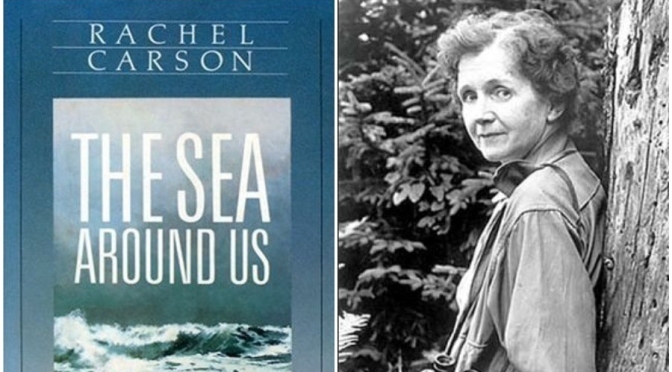
Before she published “Silent Spring,” one of the most influential books of the last century, Rachel Carson was a young aspiring poet and then a graduate student in marine biology. Although she couldn’t swim and disliked boats, Carson fell in love with the ocean. Her early books—including “The Sea Around Us,” “The Edge of the Sea” and “Under the Sea Wind”—were like no other nature writing of their time,
Jill Lepore says: Carson made you feel you were right there with her, gazing into the depths of a tide pool or lying in a cave lined with sea sponges. Lepore notes that Carson was wondering about a warming trend in the ocean as early as the 1940s, and was planning to explore it after the publication of “Silent Spring.” If she had not died early, of cancer, could Carson have brought climate change to national attention well before it was too late?
Excerpts from Carson’s work were read by Charlayne Woodard, and used with permission of Carson’s estate.
Rachel Louise Carson (May 27, 1907 – April 14, 1964) was an American marine biologist, author, and conservationist whose book Silent Spring and other writings are credited with advancing the global environmental movement.
Carson began her career as an aquatic biologist in the U.S. Bureau of Fisheries, and became a full-time nature writer in the 1950s. Her widely praised 1951 bestseller The Sea Around Us won her a U.S. National Book Award, recognition as a gifted writer, and financial security. Her next book, The Edge of the Sea, and the reissued version of her first book, Under the Sea Wind, were also bestsellers. This sea trilogy explores the whole of ocean life from the shores to the depths.
Late in the 1950s, Carson turned her attention to conservation, especially some problems that she believed were caused by synthetic pesticides. The result was the book Silent Spring (1962), which brought environmental concerns to an unprecedented share of the American people. Although Silent Spring was met with fierce opposition by chemical companies, it spurred a reversal in national pesticide policy, which led to a nationwide ban on DDT and other pesticides. It also inspired a grassroots environmental movement that led to the creation of the U.S. Environmental Protection Agency. Carson was posthumously awarded the Presidential Medal of Freedom by President Jimmy Carter.
Waterfalls, wild valleys, and gigantic panoramas – SalzburgerLand presents itself from its most beautiful side. Countless secret spots always repeatedly delight residents of Salzburg as well as holidaymakers, whether it is the Salzach River through the city, deep gorges, mountain lakes, beautiful forests or the many unique mountain experiences.
NPR’s Tamara Keith and Amy Walter of the Cook Political Report join Amna Nawaz to discuss the latest political news, including protests against government COVID-19 restrictions, polling on how Americans more broadly feel about reopening the economy amid a public health threat and China’s role in the 2020 campaign strategies of President Trump and former Vice President Joe Biden.
Tension-type headaches can be either episodic or chronic. They are rarely disabling or associated with any significant autonomic phenomena, thus patients do not usually seek medical care and usually successfully self-treat. Unlike migraine, there is no significant nausea, no vomiting, and a lack of aggravation by routine physical activity.
In this podcast Mark Green, Professor of Neurology, Anesthesiology and Rehabilitation Medicine, Director of Headache and Pain Medicine, Icahn School of Medicine at Mount Sinai, New York, gives a clinical overview of the condition.
In the summer of 1891, Claude Monet began to paint a row of poplar trees that lined the river Epte near his house at Giverny. The trees were auctioned off for timber shortly thereafter, but Monet made a deal with the purchaser to delay cutting them so he could continue to paint the trees through the autumn. Using a shallow rowboat that had slots in the bottom capable of holding several canvases at once, Monet painted twenty-four pictures of the poplars from his floating studio.
The resulting pictures reflect the view at different seasons and times of day and were known as the “Poplar Series” when they were exhibited in February 1892.
Donald G. McNeil Jr., a science and health reporter for The New York Times, discusses how the Coronavirus lockdown might end what it would look like.
While the economy is likely to reopen slowly, there is hope that society will adapt to manage the uncertainty of our new circumstances. Here’s what experts say the next year (or more) will look like.
Cardiovascular consults are way down. Is the threat of COVID-19 infection scaring people away from ED’s?
We caught up with Dr. Comilla Sasson, the American Heart Association’s VP for science and innovation. She’s an emergency physician who teaches at the University of Colorado. She’d traveled to New York City to “help with the response,” and she talked with us from a field hospital that had been set up on a tennis court in Central Park.
She had lots to say about what’s driving patients away from emergency departments these days and what’s likely to happen in medicine (hello, telemedicine!) once the pandemic abates.
A selection of three essential articles read aloud from the latest issue of The Economist. This week, is China the pandemic’s big geopolitical winner? (8:30) Saudi Arabia has declared a ceasefire in Yemen, but the Houthis are fighting on. (14:13) And, how Britain’s glossy magazines are adjusting to a gloomy world.
News, Views and Reviews For The Intellectually Curious


 Before she published “Silent Spring,” one of the most influential books of the last century, Rachel Carson was a young aspiring poet and then a graduate student in marine biology. Although she couldn’t swim and disliked boats, Carson fell in love with the ocean. Her early books—including “
 Jill Lepore

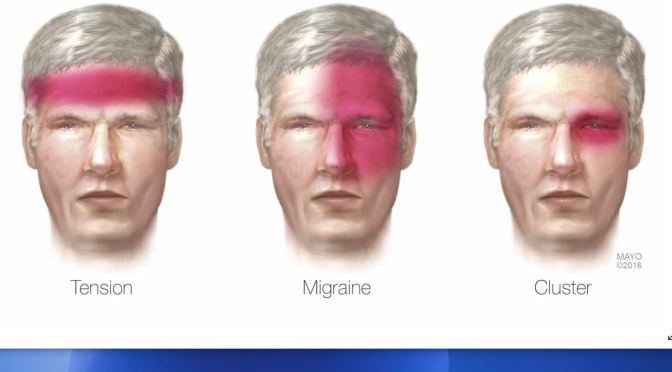
 Tension-type headaches can be either episodic or chronic. They are rarely disabling or associated with any significant autonomic phenomena, thus patients do not usually seek medical care and usually successfully self-treat. Unlike migraine, there is no significant nausea, no vomiting, and a lack of aggravation by routine physical activity.
 In the summer of 1891, Claude Monet began to paint a row of poplar trees that lined the river Epte near his house at Giverny. The trees were auctioned off for timber shortly thereafter, but Monet made a deal with the purchaser to delay cutting them so he could continue to paint the trees through the autumn. Using a shallow rowboat that had slots in the bottom capable of holding several canvases at once, Monet painted twenty-four pictures of the poplars from his floating studio.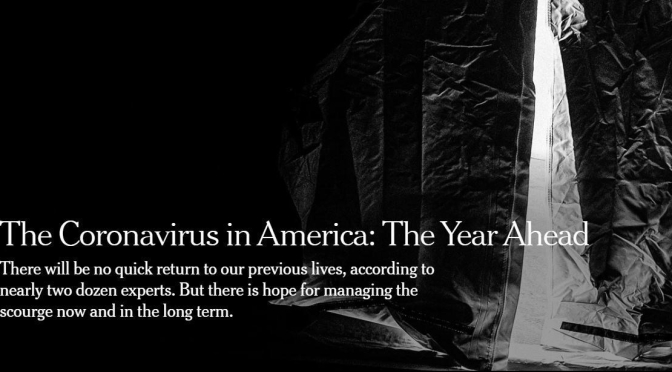
 Donald G. McNeil Jr.
 Cardiovascular consults are way down. Is the threat of COVID-19 infection scaring people away from ED’s?
 A selection of three essential articles read aloud from the latest issue of The Economist. This week, is
  Boomers Daily